OXFORD, Rebecca. Learning Styles
and Strategies. 1st ed. Cambridge
University Press, 2003.
 According to Oxford (1991) learning
strategies are specific behaviors or processes
that students use to enhance their FL learning
 Strategy relates well to the FL task at hand,
 Strategy fits the particular student’s learning
style preferences to one degree or another,
 Students that employs the strategy effectively
and links it with other relevant strategies.
“Strategy make learning easier, faster, more
enjoyable, more self-directed and more
transferrable to new situations”.
 Ehrman & Oxford say that students normally
use strategies related to their own
preferences of learning. Furthermore, they
point out that it is up to the teacher to direct
and instruct students to benefit from using
strategies as well as choosing them.
 Learning Strategies are conscious and
controlled by the learners.
 Strategies aim language learning pre set
goals.
 A well-orchestrated set of strategies might
lead to a fulfilling learning.
 Achievement of proficiency,
 High level of self-efficacy,
 Learners are able to choose better and more
effective strategies with time,
 Learn to reflect their own language learning
process,
 Become good language learners.
 Researchers and Teachers have improved
ways to instruct students and/or learners on
how to use strategies in a more relevant and
powerful manner,
 Increase motivation,
 Positive results can be achieved,
 Demonstrate when a given strategy might be
used and how to transfer it to other
situations.
COGNITIVE STRATEGIES: Enable leaners to
manipulate materials in indirect ways.
 Reasoning
 Analysis
 Note-taking
 Summarizing
 Synthesizing
 Outlining
 Schemes
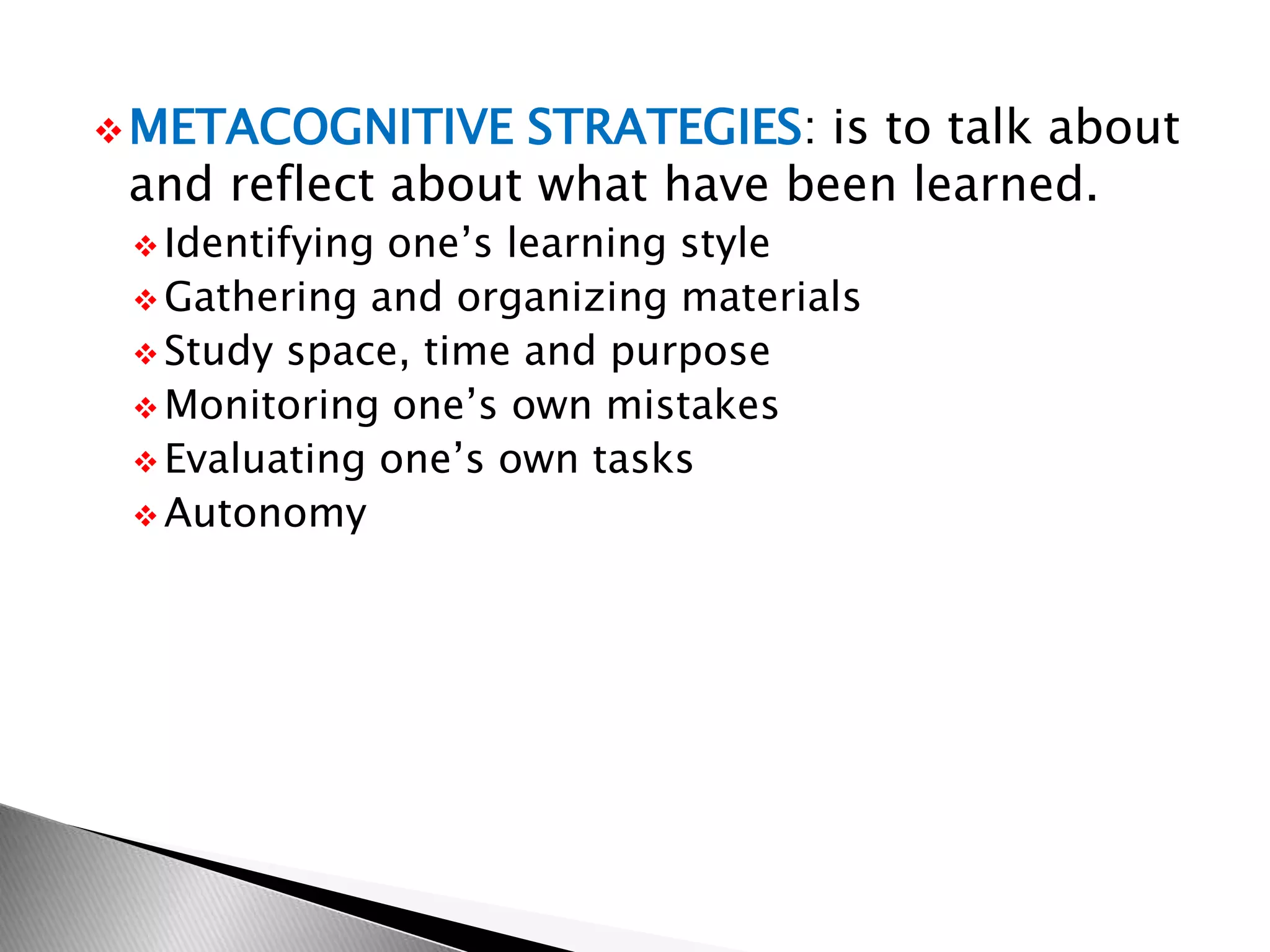
METACOGNITIVE STRATEGIES: is to talk about
and reflect about what have been learned.
 Identifying one’s learning style
 Gathering and organizing materials
 Study space, time and purpose
 Monitoring one’s own mistakes
 Evaluating one’s own tasks
 Autonomy
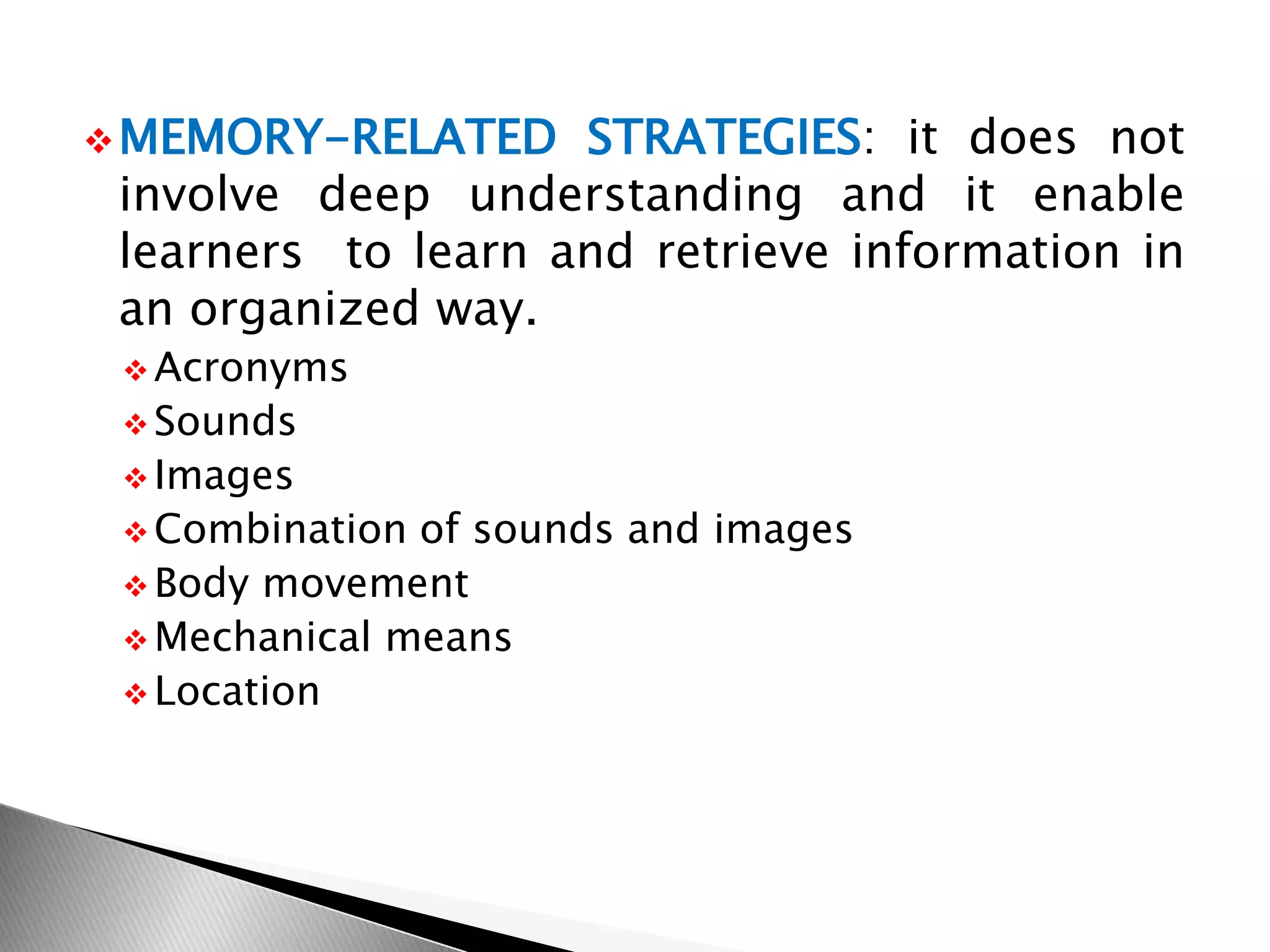
MEMORY-RELATED STRATEGIES: it does not
involve deep understanding and it enable
learners to learn and retrieve information in
an organized way.
 Acronyms
 Sounds
 Images
 Combination of sounds and images
 Body movement
 Mechanical means
 Location
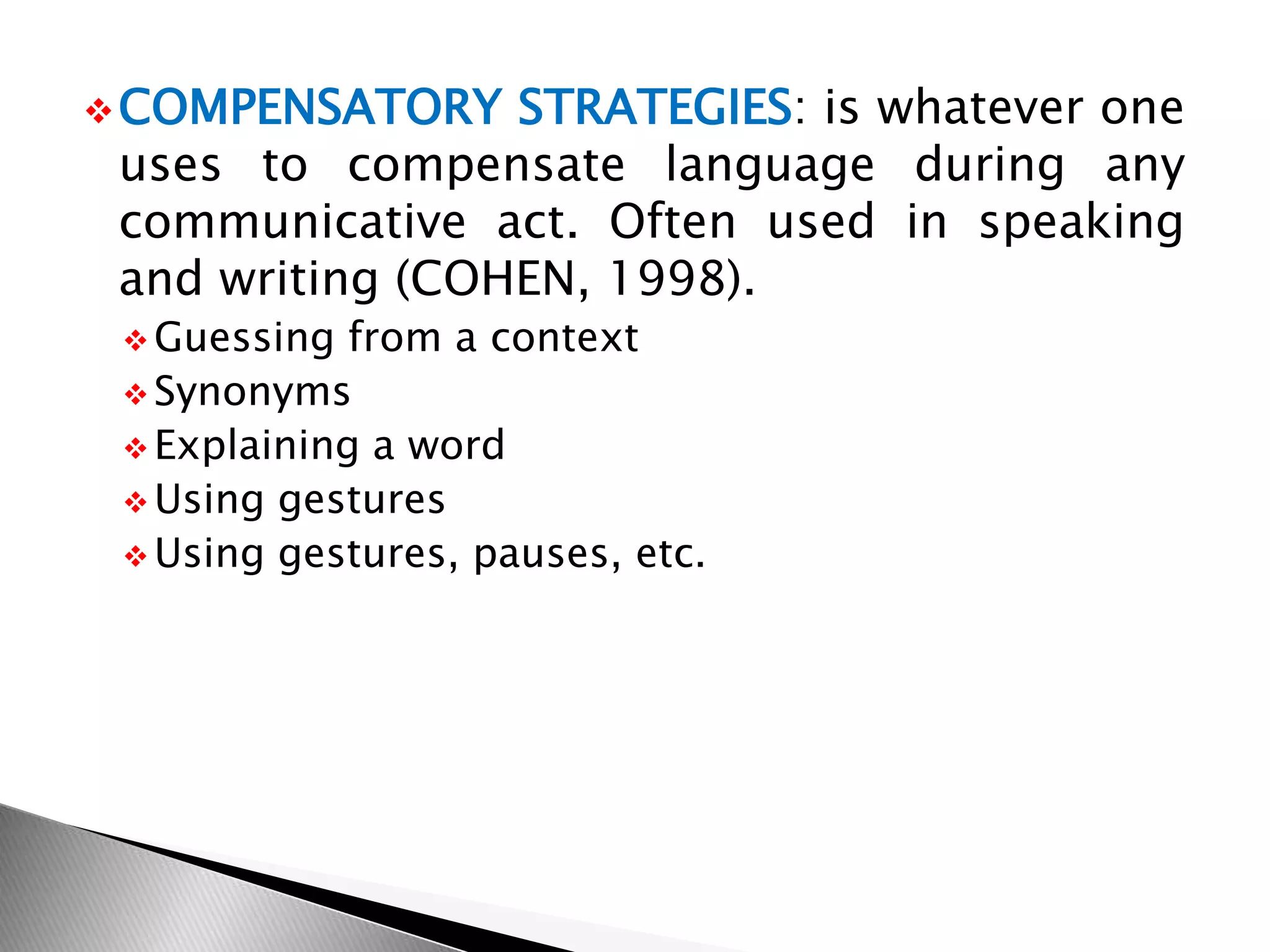
COMPENSATORY STRATEGIES: is whatever one
uses to compensate language during any
communicative act. Often used in speaking
and writing (COHEN, 1998).
 Guessing from a context
 Synonyms
 Explaining a word
 Using gestures
 Using gestures, pauses, etc.
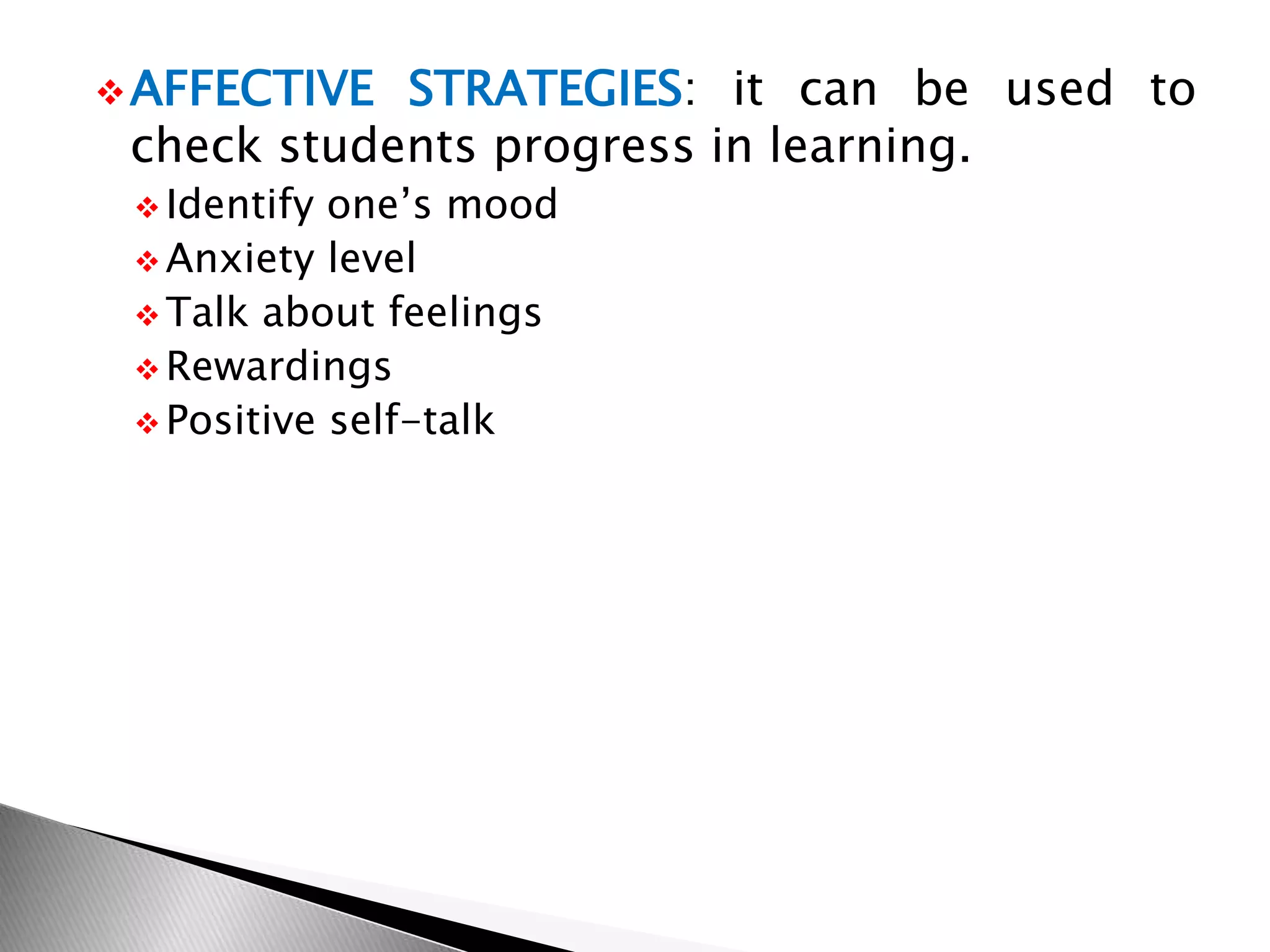
AFFECTIVE STRATEGIES: it can be used to
check students progress in learning.
 Identify one’s mood
 Anxiety level
 Talk about feelings
 Rewardings
 Positive self-talk
SOCIAL STRATEGIES: help learners to work
with others, interacting and to understand
the FL culture and language.
 Asking questions
 Asking for help
 Talk with natives
 Conversation in pairs
 Exploring cultural and social norms
 How do you know if you have learning
strategies?
 How do you know if you use them?
 How do you know if it is working for you?
 How do you transfer them from one place to
another?
◦ Self-reports
◦ Observations
◦ Interviews
◦ Journals
◦ Think-aloud
 Preparing classes focusing in developing
Learning strategies,
 Change teaching methodologies to teach
Learning Strategies,
 Teachers must assess, check if it is
happening,
 Taking into account Students Leaning Styles
and preferences,
 The more students learn how to use FL
learning strategies the less work teacher’s
will have,

LEARNING STRATEGIES.ppsx

  • 1.
    OXFORD, Rebecca. LearningStyles and Strategies. 1st ed. Cambridge University Press, 2003.
  • 2.
     According toOxford (1991) learning strategies are specific behaviors or processes that students use to enhance their FL learning
  • 3.
     Strategy relateswell to the FL task at hand,  Strategy fits the particular student’s learning style preferences to one degree or another,  Students that employs the strategy effectively and links it with other relevant strategies. “Strategy make learning easier, faster, more enjoyable, more self-directed and more transferrable to new situations”.
  • 4.
     Ehrman &Oxford say that students normally use strategies related to their own preferences of learning. Furthermore, they point out that it is up to the teacher to direct and instruct students to benefit from using strategies as well as choosing them.
  • 5.
     Learning Strategiesare conscious and controlled by the learners.  Strategies aim language learning pre set goals.  A well-orchestrated set of strategies might lead to a fulfilling learning.
  • 6.
     Achievement ofproficiency,  High level of self-efficacy,  Learners are able to choose better and more effective strategies with time,  Learn to reflect their own language learning process,  Become good language learners.
  • 7.
     Researchers andTeachers have improved ways to instruct students and/or learners on how to use strategies in a more relevant and powerful manner,  Increase motivation,  Positive results can be achieved,  Demonstrate when a given strategy might be used and how to transfer it to other situations.
  • 8.
    COGNITIVE STRATEGIES: Enableleaners to manipulate materials in indirect ways.  Reasoning  Analysis  Note-taking  Summarizing  Synthesizing  Outlining  Schemes
  • 9.
    METACOGNITIVE STRATEGIES: isto talk about and reflect about what have been learned.  Identifying one’s learning style  Gathering and organizing materials  Study space, time and purpose  Monitoring one’s own mistakes  Evaluating one’s own tasks  Autonomy
  • 10.
    MEMORY-RELATED STRATEGIES: itdoes not involve deep understanding and it enable learners to learn and retrieve information in an organized way.  Acronyms  Sounds  Images  Combination of sounds and images  Body movement  Mechanical means  Location
  • 11.
    COMPENSATORY STRATEGIES: iswhatever one uses to compensate language during any communicative act. Often used in speaking and writing (COHEN, 1998).  Guessing from a context  Synonyms  Explaining a word  Using gestures  Using gestures, pauses, etc.
  • 12.
    AFFECTIVE STRATEGIES: itcan be used to check students progress in learning.  Identify one’s mood  Anxiety level  Talk about feelings  Rewardings  Positive self-talk
  • 13.
    SOCIAL STRATEGIES: helplearners to work with others, interacting and to understand the FL culture and language.  Asking questions  Asking for help  Talk with natives  Conversation in pairs  Exploring cultural and social norms
  • 14.
     How doyou know if you have learning strategies?  How do you know if you use them?  How do you know if it is working for you?  How do you transfer them from one place to another? ◦ Self-reports ◦ Observations ◦ Interviews ◦ Journals ◦ Think-aloud
  • 15.
     Preparing classesfocusing in developing Learning strategies,  Change teaching methodologies to teach Learning Strategies,  Teachers must assess, check if it is happening,  Taking into account Students Leaning Styles and preferences,  The more students learn how to use FL learning strategies the less work teacher’s will have,