


Make the most of your energySM
Optimizing Pipeline
Energy Consumption
2010 / White paper
Summary
Executive summary ..................................................................................... p	 1
Introduction ................................................................................................. p 	2
Part 1: While energy management is challenging,
it grows more vital for pipeline businesses ................................................... p 	4
Part 2: Knowing current and future costing
scenarios helps identify savings opportunities .............................................. p 	8
Part 3: System-wide solution returns efficiency savings
and supports enterprise safety, security, and
environmental responsiblity .......................................................................... p 	13
The Schneider Electric solution .................................................................... p 	16
Conclusion .................................................................................................. p 	18
Executive summary
White paper on Pipeline Management | 01
Optimizing Pipeline Energy Consumption
Effective energy management can benefit the hydrocarbon pipeline operator.
Energy consumption costs – the leading expense for most operators – are rising
continuously; however, the commitments needed on the part of the operator often
impede implementation of energy-saving practices.
Key to effective energy management is the ability to quantify energy consumption
accurately at any specific time and its cost and that of drag reducing agent (DR)
use. Operators committed to energy management can implement a real-time,
system-wide power optimization solution that evaluates the resource efficiency of
a steady-state model of the pipeline. This solution will also perform costing runs of
alternative configurations, formulated for the next energy cost rate or other ‘what
if’ scenarios, in order to find the most energy-efficient alternative that maintains
operational safety and integrity. Implementing these alternatives, the operator can
save one percent to five percent of energy costs and reduce carbon emissions.
This advanced information management technology makes these costing
considerations so practical they can become a routine, real-time operations
process. Putting available information to work with this solution can make power
optimization extremely realistic and highly rewarding for the company while
supporting overall operational security, safety and environmental stewardship.
Cost savings and environmental stewardship through
effective energy management
Introduction
White paper on Pipeline Management | 02
Optimizing Pipeline Energy Consumption
Electric energy transmission and distribution networks are becoming ‘smarter’
through the use of highly available data about the status of the grid – data that
helps support more efficient operations and business processes. More and more,
the concept of a ‘smart grid’ appeals to pipeline operators as well: they face
significant internal and external drivers to use pump and compressor energy more
efficiently and reduce their ever-increasing energy consumption costs.
Real-time operations data, already available in a pipeline SCADA system, can help
examine current energy consumption and test alternative operating scenarios
for improved cost efficiency. This information is highly revealing and can help
overcome the challenges of energy management for today’s pipeline operator –
and support benefits across the enterprise.
Reducing operating costs
up to five percent or more
White paper on Pipeline Management | 04
Optimizing Pipeline Energy Consumption
With hydrocarbon pipeline networks becoming more complex and operations
more complicated, operators must address long-standing operating challenges:
	 • Safety of people and property
	 • Delivery commitments
	 • Regulatory requirements
	 • Reducing emissions for ‘greener’ operation and carbon credits
	 • Social responsibility and good stewardship
Operators typically have placed priorities on meeting commitments, complying
with regulations, and satisfying safety and security concerns; their control room
personnel have focused on the real-time dynamics of batch scheduling, pipeline
hydraulics, contracts, and current and forecasted operating conditions. In many
cases, energy consumption has not been a leading issue for the company.
However, the cost of the energy required to operate the pipelines – already the
leading expense for most operators – is rising continuously and now ranges from
40 to 65 percent, or more, of total operational costs. Added to the rising energy
consumption is an increase in carbon emissions of each pipeline.
Energy management has become more significant for the pipeline operator, not
only as a standalone cost issue but also as a process that can help accomplish
other operational and business goals.
Part 1: Optimizing Pipeline Energy
Consumption
It’s all about cost reduction
Power optimization doesn’t necessarily target
reduced energy consumption; instead, it
targets the cost of the energy consumed
during pumping operations. Simply, it
determines the energy (KW) and cost ($) of
a pipeline’s operation at a specific moment
in time and then uses this information to
determine the optimum pipeline pump
configuration and drag reducing agent (DRA)
injection rates that would minimize cost.
Energy consumption costs commanding
attention
While energy management is challenging, it grows
more vital for pipeline business
Optimizing Pipeline Energy Consumption
White paper on Pipeline Management | 05
What pipelines would benefit from energy
management?
Each pipeline operates in a different manner and will realize cost benefits at
varying levels. Some of the operating factors that are considered in power
optimization include:
	 • Duty cycle of the pipeline
	 • Length of pipeline; does it transverse different states or multiple energy
rate contracts?
	 • Number and types of products in the pipeline
	 • Number of stations on the pipeline and alternative operating modes
	 • Use of drag reducing agent (DRA)
	 • Current maintenance status of the pumping units
	 • Overall energy management program of the pipeline
Pipelines that run at 100 percent capacity or with less complex contracts have
fewer options for energy consumption improvement, since at least one pipeline
segment generally has pumps running at their highest capacity and/or DRA
is injected at its highest rate. Yet, even this pipeline can benefit from power
optimization, as other sections of the pipeline likely still have options for pump
status selection and/or DRA injection rate.
Benefits are both tangible
and creditable
By committing to a power optimization
program that allows documentation of
energy usage and savings, a pipeline
operator reduces electricity consumption
and associated costs and emissions. This
approach not only reduces bottom-line
expenses, it also generates carbon credits
that can be sold or traded on the open market
per industry and/or government regulations
or applied to help meet overall carbon
footprint limits – and reap the marketing
benefits of being a ‘green’ organization and an
environmental steward.
Optimizing Pipeline Energy Consumption
White paper on Pipeline Management | 06
The challenges of effective
energy management
Energy management requires a comprehensive commitment on the part of
the company to:
	 • Dedicated resources—the operator must be willing to invest in the
appropriate personnel, skills, and technology tools.
	 • Planning and scheduling—the operator must look at energy
management as a comprehensive component to management
and not let obligations to satisfy shippers and customers
overshadow the effort required to plan and schedule the energy
required.
	 • Real-time monitoring and optimization—to effectively manage
energy use, the operators must have timely pipeline information,
a responsive calculation solution, and the means of implementing
the recommended functions.
Optimizing Pipeline Energy Consumption
White paper on Pipeline Management | 07
Schneider Electric leads the way
Schneider Electric has developed suites of
management software for pipeline and power
industries around the world, providing them
innovative solutions for real-time monitoring
and control that support operational
efficiency, safety, and security. The company’s
Energy Management Application Suite (EMAS)
includes the proven Power Optimization
solution that gives pipeline operators and
energy managers access to precise energy
cost data to help them make confident
decisions that optimize energy efficiency and
batch scheduling, improve the bottom line,
and reduce carbon emissions. Contact us for
more information.
While challenges exist, the benefits possible with an effective energy
management solution can extend across the company’s operational and
business positions.
Internal drivers:
	 • Implementing best operating strategies through controllers and
energy managers
	 • Being able to quantify energy costs in real time and optimize
operation in real time
	 • Instill innovation and improvement in operating processes involving
equipment, procedures, and business decisions
External drivers:
	 • Regulations likely to target energy efficiency in the near- or mid-term
	 • The company’s image as environmentally friendly
	 • Incentives offered by power providers to large consumers for rate
structures that will help the provider meet demand without additional
generation
	 • Carbon credits earned through reduced carbon outputs
	 • Improved profitability for shareholders
Opportunities
Optimizing Pipeline Energy Consumption
White paper on Pipeline Management | 08
It is vital that the operator know its operating costs at any particular time. With
this knowledge, the operator can quickly and confidently make operating
decisions that support both energy efficiency and operational integrity.
In addition to current conditions, other cost and operating scenarios can be
considered:
Cost of proposed, or ‘what if’ configurations for the real-time state identifies
the cost of a modified configuration, at the current time or at some future time.
This costing category gives the operator a chance to evaluate a different pump
configuration before actually implementing it, to determine if it would reduce
energy cost –
	 • Investigate pumping schedules using normal pump rates when the
utility charges low time-of-day rates, or
	 • Choose to use more power to drive faster pumps for priority orders,
while still spending less on the energy required.
Part 2: Optimizing Pipeline Energy
Consumption
Optimize configuration for current
conditions
Knowing current and future costing scenarios helps
identify savings opportunities
Optimizing Pipeline Energy Consumption
White paper on Pipeline Management | 09
Cost of an optimized configuration identifies the cost of an optimized
configuration with the current conditions and time –
	 • Learn to sequence jobs in order of individual demands. With fewer
pump starts and stops and a more consistent usage pattern, the
operator minimizes usage spikes and their associated penalties.
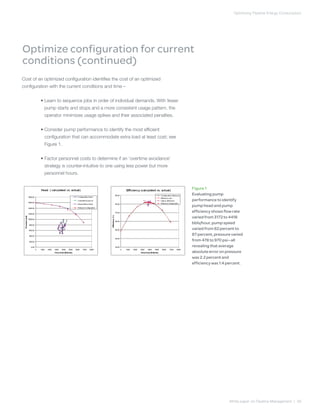
	 • Consider pump performance to identify the most efficient
configuration that can accommodate extra load at least cost; see
Figure 1.
	 • Factor personnel costs to determine if an ‘overtime avoidance’
strategy is counter-intuitive to one using less power but more
personnel hours.
Optimize configuration for current
conditions (continued)
Figure 1
Evaluating pump
performance to identify
pump head and pump
efficiency shows flow rate
varied from 3172 to 4418
bbls/hour, pump speed
varied from 62 percent to
87 percent, pressure varied
from 478 to 970 psi—all
revealing that average
absolute error on pressure
was 2.2 percent and
efficiency was 1.4 percent.
Optimizing Pipeline Energy Consumption
White paper on Pipeline Management | 10
Top three ways to optimize
pipeline energy costs
	 • Know your present operating costs and
how costs change with demand charges
	 • Identify optimal pumps, and minimize
pump throttling
	 • Identify optimal DRA injection locations
and rates. Most companies follow
generic guidelines and don’t even
consider pipeline status when making
DRA injection decisions. Taking into
account the effectiveness of the DRA,
the cost of the DRA, the increased
throughput, and the resulting power
savings helps determine the best DRA
flow rate based on current conditions.
Demand charges can significantly increase energy rates for prolonged periods
of time, and the operator should avoid them as a matter of practice. Knowing
when a costly energy rate transition is approaching would give the operator the
ability to minimize the impact of the higher energy and/or demand level:
	 • Early Warning for the real-time state – knowing the cost of the
current configuration at the next energy rate boundary; it tells the
operator what the cost will be if no configuration change is made.
	 • Early Warning optimized – knowing the cost of an optimized
configuration at the next energy rate boundary
	 • Early Warning optimized at current time – knowing the cost of a
future optimized configuration at the current time
Solution options
So what can the pipeline operator do to make energy use more efficient?
Efficient equipment.
Certainly, pumps, compressors, and other vital transportation pipeline assets
are becoming more efficient and will continue to evolve in their capabilities.
High efficiency equipment can cut costs on a site-by-site basis, but it does not
provide a solution for system-wide optimization. By having to continuous invest
in new equipment, the operator is minimizing returns.
Information management technology.
In commodity delivery networks everywhere, including water systems
and electric and gas power distribution systems, operations are not only
becoming more complex but they also are losing experienced personnel to
retirement. Veteran employees take with them innate knowledge of manual
network management. Enter their replacements: a generation groomed in the
technology era and ready to embrace information management tools that give
them similar decision-making knowledge.
Cost control scenarios also look ahead
Optimizing Pipeline Energy ConsumptionOptimizing Pipeline Energy Consumption
White paper on Pipeline Management | 11
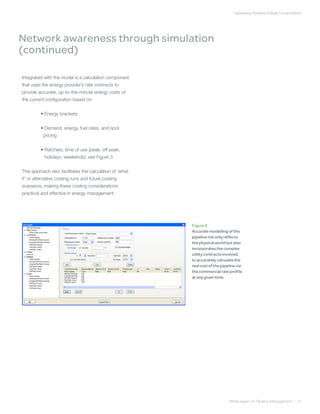
Figure 2
Advanced technology
can create a steady-state
model of the pipeline
that gives the operator
accurate simulation of the
real-time operating state.
Network awareness through simulation
Many pipeline operators are now using or
investigating state-of-the-art business technology
for responsive, even proactive, pump operations
management. This solution involves an integrated
suite of tools that creates a steady-state hydraulic
model, integrated with and leveraging real-time
information from the pipeline SCADA system. This
technology provides operators highly accurate
pipeline state calculations, including KW consumption
of the pumps that mimics the utility’s own demand
recorder; see Figure 2.
model, integrated with and leveraging real-time information from the pipeline
SCADA system. This technology provides operators highly accurate pipeline state
calculations, including KW consumption of the pumps that mimics the utility’s own
demand recorder; see Figure 2.
[caption] Figure 2. Advanced technology can create a steady-state model of the
pipeline that gives the operator accurate simulation of the real-time operating state.
Integrated with the model is a calculation component that uses the energy
provider’s rate contracts to provide accurate, up-to-the-minute energy costs of the
current configuration based on:
• Energy brackets
• Demand, energy, fuel rates, and spot pricing
• Ratchets, time of use (peak, off peak, holidays, weekends); see Figure 3.
This approach also facilitates the calculation of ‘what if’ or alternative costing runs
and future costing scenarios, making these costing considerations practical and
effective in energy management.
Optimizing Pipeline Energy ConsumptionOptimizing Pipeline Energy Consumption
White paper on Pipeline Management | 12
Integrated with the model is a calculation component
that uses the energy provider’s rate contracts to
provide accurate, up-to-the-minute energy costs of
the current configuration based on:
	 • Energy brackets
	 •Demand, energy, fuel rates, and spot
pricing
	 • Ratchets, time of use (peak, off peak,
holidays, weekends); see Figure 3.
This approach also facilitates the calculation of ‘what
if’ or alternative costing runs and future costing
scenarios, making these costing considerations
practical and effective in energy management.
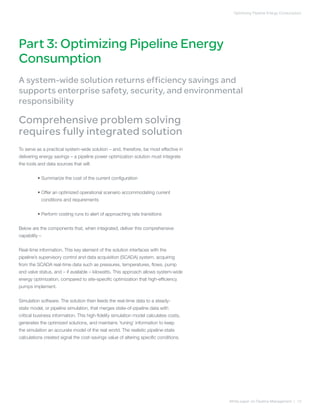
Figure 3
Accurate modelling of the
pipeline not only reflects
the physical world but also
incorporates the complex
utility contracts involved,
to accurately calculate the
real cost of the pipeline via
the commercial rate profile
at any given time.
Network awareness through simulation
(continued)
Optimizing Pipeline Energy Consumption
White paper on Pipeline Management | 13
To serve as a practical system-wide solution – and, therefore, be most effective in
delivering energy savings – a pipeline power optimization solution must integrate
the tools and data sources that will:
	 • Summarize the cost of the current configuration
	 • Offer an optimized operational scenario accommodating current
conditions and requirements
	 • Perform costing runs to alert of approaching rate transitions
Below are the components that, when integrated, deliver this comprehensive
capability –
Real-time information. This key element of the solution interfaces with the
pipeline’s supervisory control and data acquisition (SCADA) system, acquiring
from the SCADA real-time data such as pressures, temperatures, flows, pump
and valve status, and – if available – kilowatts. This approach allows system-wide
energy optimization, compared to site-specific optimization that high-efficiency
pumps implement.
Simulation software. The solution then feeds the real-time data to a steady-
state model, or pipeline simulation, that merges state-of-pipeline data with
critical business information. This high-fidelity simulation model calculates costs,
generates the optimized solutions, and maintains ‘tuning’ information to keep
the simulation an accurate model of the real world. The realistic pipeline-state
calculations created signal the cost-savings value of altering specific conditions.
A system-wide solution returns efficiency savings and
supports enterprise safety, security, and environmental
responsibility
Part 3: Optimizing Pipeline Energy
Consumption
Comprehensive problem solving
requires fully integrated solution
Optimizing Pipeline Energy Consumption
White paper on Pipeline Management | 14
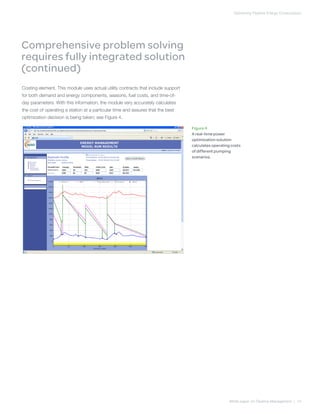
Costing element. This module uses actual utility contracts that include support
for both demand and energy components, seasons, fuel costs, and time-of-
day parameters. With this information, the module very accurately calculates
the cost of operating a station at a particular time and assures that the best
optimization decision is being taken; see Figure 4.
Figure 4
A real-time power
optimization solution
calculates operating costs
of different pumping
scenarios.
Comprehensive problem solving
requires fully integrated solution
(continued)
Optimizing Pipeline Energy Consumption
White paper on Pipeline Management | 15
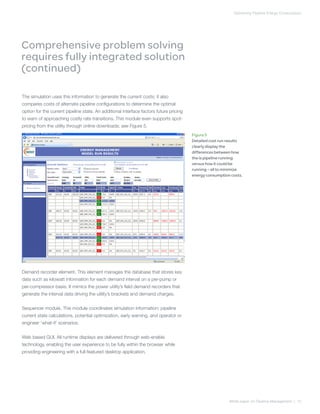
The simulation uses this information to generate the current costs; it also
compares costs of alternate pipeline configurations to determine the optimal
option for the current pipeline state. An additional interface factors future pricing
to warn of approaching costly rate transitions. This module even supports spot-
pricing from the utility through online downloads; see Figure 5.
Demand recorder element. This element manages the database that stores key
data such as kilowatt information for each demand interval on a per-pump or
per-compressor basis. It mimics the power utility’s field demand recorders that
generate the interval data driving the utility’s brackets and demand charges.
Sequencer module. This module coordinates simulation information: pipeline
current state calculations, potential optimization, early warning, and operator or
engineer ‘what-if’ scenarios.
Web based GUI. All runtime displays are delivered through web-enable
technology, enabling the user experience to be fully within the browser while
providing engineering with a full-featured desktop application.
Figure 5
Detailed cost run results
clearly display the
differences between how
the is pipeline running
versus how it could be
running – all to minimize
energy consumption costs.
Comprehensive problem solving
requires fully integrated solution
(continued)
Optimizing Pipeline Energy Consumption
White paper on Pipeline Management | 16
Schneider Electric’s Energy Management Application Suite (EMAS) – Power
Optimization solution was developed in close cooperation with major industry
operators to ensure it addresses all the operational needs and enterprise goals
discussed above. It seamlessly integrates real-time operational parameters
from the system SCADA with simulation software, a costing element, demand
recorder, sequencer module, and web-based GUI to accurately identify current
and optimized configuration scenarios. This approach has shown to help
energy managers fine-tune power consumption and reduce operating costs
by 1 percent to 5 percent or more, depending on pipeline characteristics and
complexity of the operator’s contracts.
The Schneider Electric Solution
Power optimization in the
control room
A power optimization application using
real-time information can provide
recommendations on:
	 • Present situation – a cost summary of
the current configuration at the current
time
	 • Early warning – alerts that summarize
the current configuration at the next
rate boundary and help avoid costly rate
transitions
	 • ‘What if’ scenarios – cost summary of
a modified configuration at the current
time or at some future time
With this meaningful, real-time information,
controllers use their expertise to implement
the safest, most cost-effective processes.
Energy managers will want to work with
controllers to help them migrate from routine
operational decisions to those that also can
make significant energy-saving impacts.
Optimizing Pipeline Energy Consumption
White paper on Pipeline Management | 17
Power optimization for the
Energy Manager
While the fully effective Power Optimization
solution provides real-time feedback to
operations personnel, the engineering
platform can leverage the same technology.
In this mode, the Energy Manager, along with
Engineering, can
	 • Review various potential physical
pipeline changes
	 • Consider different pipeline operating
procedures
	 • Evaluate different rate schedule
structures to help negotiate favorable
new power contracts
In short, the same tool that helps control
current energy consumption can help plan
improvements in future energy usages.
Because it reflects Schneider Electric’s industry-leading expertise in information
management and its decades of solutions partnership with pipeline operators,
the EMAS Power Optimization solution is complete, reliable, and designed to
serve future energy management needs of the hydrocarbon pipeline industry.
Contact Schneider Electric for more information about the EMAS Power
Optimization solution.
The Schneider Electric Solution
(continued)
Conclusion
Optimizing Pipeline Energy Consumption
White paper on Pipeline Management | 18
Power optimization solutions in a
nutshell:
• A system-wide power optimization solution gives the pipeline operator
valuable insights into energy spending. The operator schedules jobs based on
predictable rate schedules, sequences jobs in order of demand while avoiding
rate spikes, and favors more economical assets when accommodating extra
load.
• While improving business efficiency, it can reduce system-wide power
consumption by as much as 20 percent and save significant operating costs.
The operator can use the historical calculated energy costs stored in the
application’s demand recorder to calculate accurate energy brackets and
demand charges. With this information, the operator then forecasts future
energy consumption based on varying operational modes and can more
effectively negotiate energy rate contracts with its provider.
• Reduced power consumption can generate carbon credits for the operator
as defined by the government. As trading or selling of carbon credits grows
throughout North America, operators using a power optimization application will
be in a good position to document energy saved and the carbon credits earned
that can be sold, traded, or applied to reduce the operator’s carbon footprint.
• The real-time information continuously available through an energy management
application identifies significant operating constraints such as pump capacities,
maximum operating pressures, slack line conditions, and DRA effects. This level
of real-time information helps the operator stay on top of operational safety and
the security of network assets.
Long-term savings with controlled energy
consumption
©2012SchneiderElectric.Allrightsreserved.
August 2012
Schneider Electric USA
10333 Southport Rd SW, Ste 200
Calgary, AB T2W3X6
Phone: 1-403-212-2407
Fax: 1-403-259-2926
http://www.schneider-electric.com

[Oil & Gas White Paper] Optimizing Pipeline Energy Consumption

  • 1.
    Make the mostof your energySM Optimizing Pipeline Energy Consumption 2010 / White paper
  • 2.
    Summary Executive summary .....................................................................................p 1 Introduction ................................................................................................. p 2 Part 1: While energy management is challenging, it grows more vital for pipeline businesses ................................................... p 4 Part 2: Knowing current and future costing scenarios helps identify savings opportunities .............................................. p 8 Part 3: System-wide solution returns efficiency savings and supports enterprise safety, security, and environmental responsiblity .......................................................................... p 13 The Schneider Electric solution .................................................................... p 16 Conclusion .................................................................................................. p 18
  • 3.
    Executive summary White paperon Pipeline Management | 01 Optimizing Pipeline Energy Consumption Effective energy management can benefit the hydrocarbon pipeline operator. Energy consumption costs – the leading expense for most operators – are rising continuously; however, the commitments needed on the part of the operator often impede implementation of energy-saving practices. Key to effective energy management is the ability to quantify energy consumption accurately at any specific time and its cost and that of drag reducing agent (DR) use. Operators committed to energy management can implement a real-time, system-wide power optimization solution that evaluates the resource efficiency of a steady-state model of the pipeline. This solution will also perform costing runs of alternative configurations, formulated for the next energy cost rate or other ‘what if’ scenarios, in order to find the most energy-efficient alternative that maintains operational safety and integrity. Implementing these alternatives, the operator can save one percent to five percent of energy costs and reduce carbon emissions. This advanced information management technology makes these costing considerations so practical they can become a routine, real-time operations process. Putting available information to work with this solution can make power optimization extremely realistic and highly rewarding for the company while supporting overall operational security, safety and environmental stewardship. Cost savings and environmental stewardship through effective energy management
  • 4.
    Introduction White paper onPipeline Management | 02 Optimizing Pipeline Energy Consumption Electric energy transmission and distribution networks are becoming ‘smarter’ through the use of highly available data about the status of the grid – data that helps support more efficient operations and business processes. More and more, the concept of a ‘smart grid’ appeals to pipeline operators as well: they face significant internal and external drivers to use pump and compressor energy more efficiently and reduce their ever-increasing energy consumption costs. Real-time operations data, already available in a pipeline SCADA system, can help examine current energy consumption and test alternative operating scenarios for improved cost efficiency. This information is highly revealing and can help overcome the challenges of energy management for today’s pipeline operator – and support benefits across the enterprise.
  • 5.
    Reducing operating costs upto five percent or more
  • 6.
    White paper onPipeline Management | 04 Optimizing Pipeline Energy Consumption With hydrocarbon pipeline networks becoming more complex and operations more complicated, operators must address long-standing operating challenges: • Safety of people and property • Delivery commitments • Regulatory requirements • Reducing emissions for ‘greener’ operation and carbon credits • Social responsibility and good stewardship Operators typically have placed priorities on meeting commitments, complying with regulations, and satisfying safety and security concerns; their control room personnel have focused on the real-time dynamics of batch scheduling, pipeline hydraulics, contracts, and current and forecasted operating conditions. In many cases, energy consumption has not been a leading issue for the company. However, the cost of the energy required to operate the pipelines – already the leading expense for most operators – is rising continuously and now ranges from 40 to 65 percent, or more, of total operational costs. Added to the rising energy consumption is an increase in carbon emissions of each pipeline. Energy management has become more significant for the pipeline operator, not only as a standalone cost issue but also as a process that can help accomplish other operational and business goals. Part 1: Optimizing Pipeline Energy Consumption It’s all about cost reduction Power optimization doesn’t necessarily target reduced energy consumption; instead, it targets the cost of the energy consumed during pumping operations. Simply, it determines the energy (KW) and cost ($) of a pipeline’s operation at a specific moment in time and then uses this information to determine the optimum pipeline pump configuration and drag reducing agent (DRA) injection rates that would minimize cost. Energy consumption costs commanding attention While energy management is challenging, it grows more vital for pipeline business
  • 7.
    Optimizing Pipeline EnergyConsumption White paper on Pipeline Management | 05 What pipelines would benefit from energy management? Each pipeline operates in a different manner and will realize cost benefits at varying levels. Some of the operating factors that are considered in power optimization include: • Duty cycle of the pipeline • Length of pipeline; does it transverse different states or multiple energy rate contracts? • Number and types of products in the pipeline • Number of stations on the pipeline and alternative operating modes • Use of drag reducing agent (DRA) • Current maintenance status of the pumping units • Overall energy management program of the pipeline Pipelines that run at 100 percent capacity or with less complex contracts have fewer options for energy consumption improvement, since at least one pipeline segment generally has pumps running at their highest capacity and/or DRA is injected at its highest rate. Yet, even this pipeline can benefit from power optimization, as other sections of the pipeline likely still have options for pump status selection and/or DRA injection rate. Benefits are both tangible and creditable By committing to a power optimization program that allows documentation of energy usage and savings, a pipeline operator reduces electricity consumption and associated costs and emissions. This approach not only reduces bottom-line expenses, it also generates carbon credits that can be sold or traded on the open market per industry and/or government regulations or applied to help meet overall carbon footprint limits – and reap the marketing benefits of being a ‘green’ organization and an environmental steward.
  • 8.
    Optimizing Pipeline EnergyConsumption White paper on Pipeline Management | 06 The challenges of effective energy management Energy management requires a comprehensive commitment on the part of the company to: • Dedicated resources—the operator must be willing to invest in the appropriate personnel, skills, and technology tools. • Planning and scheduling—the operator must look at energy management as a comprehensive component to management and not let obligations to satisfy shippers and customers overshadow the effort required to plan and schedule the energy required. • Real-time monitoring and optimization—to effectively manage energy use, the operators must have timely pipeline information, a responsive calculation solution, and the means of implementing the recommended functions.
  • 9.
    Optimizing Pipeline EnergyConsumption White paper on Pipeline Management | 07 Schneider Electric leads the way Schneider Electric has developed suites of management software for pipeline and power industries around the world, providing them innovative solutions for real-time monitoring and control that support operational efficiency, safety, and security. The company’s Energy Management Application Suite (EMAS) includes the proven Power Optimization solution that gives pipeline operators and energy managers access to precise energy cost data to help them make confident decisions that optimize energy efficiency and batch scheduling, improve the bottom line, and reduce carbon emissions. Contact us for more information. While challenges exist, the benefits possible with an effective energy management solution can extend across the company’s operational and business positions. Internal drivers: • Implementing best operating strategies through controllers and energy managers • Being able to quantify energy costs in real time and optimize operation in real time • Instill innovation and improvement in operating processes involving equipment, procedures, and business decisions External drivers: • Regulations likely to target energy efficiency in the near- or mid-term • The company’s image as environmentally friendly • Incentives offered by power providers to large consumers for rate structures that will help the provider meet demand without additional generation • Carbon credits earned through reduced carbon outputs • Improved profitability for shareholders Opportunities
  • 10.
    Optimizing Pipeline EnergyConsumption White paper on Pipeline Management | 08 It is vital that the operator know its operating costs at any particular time. With this knowledge, the operator can quickly and confidently make operating decisions that support both energy efficiency and operational integrity. In addition to current conditions, other cost and operating scenarios can be considered: Cost of proposed, or ‘what if’ configurations for the real-time state identifies the cost of a modified configuration, at the current time or at some future time. This costing category gives the operator a chance to evaluate a different pump configuration before actually implementing it, to determine if it would reduce energy cost – • Investigate pumping schedules using normal pump rates when the utility charges low time-of-day rates, or • Choose to use more power to drive faster pumps for priority orders, while still spending less on the energy required. Part 2: Optimizing Pipeline Energy Consumption Optimize configuration for current conditions Knowing current and future costing scenarios helps identify savings opportunities
  • 11.
    Optimizing Pipeline EnergyConsumption White paper on Pipeline Management | 09 Cost of an optimized configuration identifies the cost of an optimized configuration with the current conditions and time – • Learn to sequence jobs in order of individual demands. With fewer pump starts and stops and a more consistent usage pattern, the operator minimizes usage spikes and their associated penalties. • Consider pump performance to identify the most efficient configuration that can accommodate extra load at least cost; see Figure 1. • Factor personnel costs to determine if an ‘overtime avoidance’ strategy is counter-intuitive to one using less power but more personnel hours. Optimize configuration for current conditions (continued) Figure 1 Evaluating pump performance to identify pump head and pump efficiency shows flow rate varied from 3172 to 4418 bbls/hour, pump speed varied from 62 percent to 87 percent, pressure varied from 478 to 970 psi—all revealing that average absolute error on pressure was 2.2 percent and efficiency was 1.4 percent.
  • 12.
    Optimizing Pipeline EnergyConsumption White paper on Pipeline Management | 10 Top three ways to optimize pipeline energy costs • Know your present operating costs and how costs change with demand charges • Identify optimal pumps, and minimize pump throttling • Identify optimal DRA injection locations and rates. Most companies follow generic guidelines and don’t even consider pipeline status when making DRA injection decisions. Taking into account the effectiveness of the DRA, the cost of the DRA, the increased throughput, and the resulting power savings helps determine the best DRA flow rate based on current conditions. Demand charges can significantly increase energy rates for prolonged periods of time, and the operator should avoid them as a matter of practice. Knowing when a costly energy rate transition is approaching would give the operator the ability to minimize the impact of the higher energy and/or demand level: • Early Warning for the real-time state – knowing the cost of the current configuration at the next energy rate boundary; it tells the operator what the cost will be if no configuration change is made. • Early Warning optimized – knowing the cost of an optimized configuration at the next energy rate boundary • Early Warning optimized at current time – knowing the cost of a future optimized configuration at the current time Solution options So what can the pipeline operator do to make energy use more efficient? Efficient equipment. Certainly, pumps, compressors, and other vital transportation pipeline assets are becoming more efficient and will continue to evolve in their capabilities. High efficiency equipment can cut costs on a site-by-site basis, but it does not provide a solution for system-wide optimization. By having to continuous invest in new equipment, the operator is minimizing returns. Information management technology. In commodity delivery networks everywhere, including water systems and electric and gas power distribution systems, operations are not only becoming more complex but they also are losing experienced personnel to retirement. Veteran employees take with them innate knowledge of manual network management. Enter their replacements: a generation groomed in the technology era and ready to embrace information management tools that give them similar decision-making knowledge. Cost control scenarios also look ahead
  • 13.
    Optimizing Pipeline EnergyConsumptionOptimizing Pipeline Energy Consumption White paper on Pipeline Management | 11 Figure 2 Advanced technology can create a steady-state model of the pipeline that gives the operator accurate simulation of the real-time operating state. Network awareness through simulation Many pipeline operators are now using or investigating state-of-the-art business technology for responsive, even proactive, pump operations management. This solution involves an integrated suite of tools that creates a steady-state hydraulic model, integrated with and leveraging real-time information from the pipeline SCADA system. This technology provides operators highly accurate pipeline state calculations, including KW consumption of the pumps that mimics the utility’s own demand recorder; see Figure 2. model, integrated with and leveraging real-time information from the pipeline SCADA system. This technology provides operators highly accurate pipeline state calculations, including KW consumption of the pumps that mimics the utility’s own demand recorder; see Figure 2. [caption] Figure 2. Advanced technology can create a steady-state model of the pipeline that gives the operator accurate simulation of the real-time operating state. Integrated with the model is a calculation component that uses the energy provider’s rate contracts to provide accurate, up-to-the-minute energy costs of the current configuration based on: • Energy brackets • Demand, energy, fuel rates, and spot pricing • Ratchets, time of use (peak, off peak, holidays, weekends); see Figure 3. This approach also facilitates the calculation of ‘what if’ or alternative costing runs and future costing scenarios, making these costing considerations practical and effective in energy management.
  • 14.
    Optimizing Pipeline EnergyConsumptionOptimizing Pipeline Energy Consumption White paper on Pipeline Management | 12 Integrated with the model is a calculation component that uses the energy provider’s rate contracts to provide accurate, up-to-the-minute energy costs of the current configuration based on: • Energy brackets •Demand, energy, fuel rates, and spot pricing • Ratchets, time of use (peak, off peak, holidays, weekends); see Figure 3. This approach also facilitates the calculation of ‘what if’ or alternative costing runs and future costing scenarios, making these costing considerations practical and effective in energy management. Figure 3 Accurate modelling of the pipeline not only reflects the physical world but also incorporates the complex utility contracts involved, to accurately calculate the real cost of the pipeline via the commercial rate profile at any given time. Network awareness through simulation (continued)
  • 15.
    Optimizing Pipeline EnergyConsumption White paper on Pipeline Management | 13 To serve as a practical system-wide solution – and, therefore, be most effective in delivering energy savings – a pipeline power optimization solution must integrate the tools and data sources that will: • Summarize the cost of the current configuration • Offer an optimized operational scenario accommodating current conditions and requirements • Perform costing runs to alert of approaching rate transitions Below are the components that, when integrated, deliver this comprehensive capability – Real-time information. This key element of the solution interfaces with the pipeline’s supervisory control and data acquisition (SCADA) system, acquiring from the SCADA real-time data such as pressures, temperatures, flows, pump and valve status, and – if available – kilowatts. This approach allows system-wide energy optimization, compared to site-specific optimization that high-efficiency pumps implement. Simulation software. The solution then feeds the real-time data to a steady- state model, or pipeline simulation, that merges state-of-pipeline data with critical business information. This high-fidelity simulation model calculates costs, generates the optimized solutions, and maintains ‘tuning’ information to keep the simulation an accurate model of the real world. The realistic pipeline-state calculations created signal the cost-savings value of altering specific conditions. A system-wide solution returns efficiency savings and supports enterprise safety, security, and environmental responsibility Part 3: Optimizing Pipeline Energy Consumption Comprehensive problem solving requires fully integrated solution
  • 16.
    Optimizing Pipeline EnergyConsumption White paper on Pipeline Management | 14 Costing element. This module uses actual utility contracts that include support for both demand and energy components, seasons, fuel costs, and time-of- day parameters. With this information, the module very accurately calculates the cost of operating a station at a particular time and assures that the best optimization decision is being taken; see Figure 4. Figure 4 A real-time power optimization solution calculates operating costs of different pumping scenarios. Comprehensive problem solving requires fully integrated solution (continued)
  • 17.
    Optimizing Pipeline EnergyConsumption White paper on Pipeline Management | 15 The simulation uses this information to generate the current costs; it also compares costs of alternate pipeline configurations to determine the optimal option for the current pipeline state. An additional interface factors future pricing to warn of approaching costly rate transitions. This module even supports spot- pricing from the utility through online downloads; see Figure 5. Demand recorder element. This element manages the database that stores key data such as kilowatt information for each demand interval on a per-pump or per-compressor basis. It mimics the power utility’s field demand recorders that generate the interval data driving the utility’s brackets and demand charges. Sequencer module. This module coordinates simulation information: pipeline current state calculations, potential optimization, early warning, and operator or engineer ‘what-if’ scenarios. Web based GUI. All runtime displays are delivered through web-enable technology, enabling the user experience to be fully within the browser while providing engineering with a full-featured desktop application. Figure 5 Detailed cost run results clearly display the differences between how the is pipeline running versus how it could be running – all to minimize energy consumption costs. Comprehensive problem solving requires fully integrated solution (continued)
  • 18.
    Optimizing Pipeline EnergyConsumption White paper on Pipeline Management | 16 Schneider Electric’s Energy Management Application Suite (EMAS) – Power Optimization solution was developed in close cooperation with major industry operators to ensure it addresses all the operational needs and enterprise goals discussed above. It seamlessly integrates real-time operational parameters from the system SCADA with simulation software, a costing element, demand recorder, sequencer module, and web-based GUI to accurately identify current and optimized configuration scenarios. This approach has shown to help energy managers fine-tune power consumption and reduce operating costs by 1 percent to 5 percent or more, depending on pipeline characteristics and complexity of the operator’s contracts. The Schneider Electric Solution Power optimization in the control room A power optimization application using real-time information can provide recommendations on: • Present situation – a cost summary of the current configuration at the current time • Early warning – alerts that summarize the current configuration at the next rate boundary and help avoid costly rate transitions • ‘What if’ scenarios – cost summary of a modified configuration at the current time or at some future time With this meaningful, real-time information, controllers use their expertise to implement the safest, most cost-effective processes. Energy managers will want to work with controllers to help them migrate from routine operational decisions to those that also can make significant energy-saving impacts.
  • 19.
    Optimizing Pipeline EnergyConsumption White paper on Pipeline Management | 17 Power optimization for the Energy Manager While the fully effective Power Optimization solution provides real-time feedback to operations personnel, the engineering platform can leverage the same technology. In this mode, the Energy Manager, along with Engineering, can • Review various potential physical pipeline changes • Consider different pipeline operating procedures • Evaluate different rate schedule structures to help negotiate favorable new power contracts In short, the same tool that helps control current energy consumption can help plan improvements in future energy usages. Because it reflects Schneider Electric’s industry-leading expertise in information management and its decades of solutions partnership with pipeline operators, the EMAS Power Optimization solution is complete, reliable, and designed to serve future energy management needs of the hydrocarbon pipeline industry. Contact Schneider Electric for more information about the EMAS Power Optimization solution. The Schneider Electric Solution (continued)
  • 20.
    Conclusion Optimizing Pipeline EnergyConsumption White paper on Pipeline Management | 18 Power optimization solutions in a nutshell: • A system-wide power optimization solution gives the pipeline operator valuable insights into energy spending. The operator schedules jobs based on predictable rate schedules, sequences jobs in order of demand while avoiding rate spikes, and favors more economical assets when accommodating extra load. • While improving business efficiency, it can reduce system-wide power consumption by as much as 20 percent and save significant operating costs. The operator can use the historical calculated energy costs stored in the application’s demand recorder to calculate accurate energy brackets and demand charges. With this information, the operator then forecasts future energy consumption based on varying operational modes and can more effectively negotiate energy rate contracts with its provider. • Reduced power consumption can generate carbon credits for the operator as defined by the government. As trading or selling of carbon credits grows throughout North America, operators using a power optimization application will be in a good position to document energy saved and the carbon credits earned that can be sold, traded, or applied to reduce the operator’s carbon footprint. • The real-time information continuously available through an energy management application identifies significant operating constraints such as pump capacities, maximum operating pressures, slack line conditions, and DRA effects. This level of real-time information helps the operator stay on top of operational safety and the security of network assets. Long-term savings with controlled energy consumption
  • 21.
    ©2012SchneiderElectric.Allrightsreserved. August 2012 Schneider ElectricUSA 10333 Southport Rd SW, Ste 200 Calgary, AB T2W3X6 Phone: 1-403-212-2407 Fax: 1-403-259-2926 http://www.schneider-electric.com