
NERC Critical Infrastructure
Protection (CIP) and Security for
Field Devices
Compliance principles and requirements


Make the most of your energy        SM
Summary

Executive Summary . ................................................................................... p	 1

Introduction ................................................................................................. p 	2

Understanding CIP objectives ...................................................................... p 	4

Core Security Principles . ............................................................................. p 	5

NERC CIP technical control guidelines . ....................................................... p 	6

Finding your compliance solution.................................................................. p 	10

Conclusion................................................................................................... p 11
NERC Critical Infrastructure Protection (CIP) and Security for Field Devices


Executive summary

The North American Electric Reliability Corporation (NERC) maintains a set of
Critical Infrastructure Protection (CIP) guidelines that address a broad range of
critical cyber asset and cyber security issues. These guidelines describe the
security-focused procedures that, in combination with compliant technology,
enable secure electric grid operations. The CIP guidelines do not specify the
technologies that must be deployed. Instead, they describe the technology design
necessary to build an information management architecture that complies with
security goals.


These goals include the minimizing of administrative authorization needed for
operational functions. Rights and privileges are to be assigned to a functional role,
not a named individual. Audit trails of field data device and substation activity,
similar to control room auditability, must be maintained to assure comprehensive
confidence in data and controls.


The six CIP guidelines summarized in the paper speak to the procedures and
policies that are vital to critical cyber asset security – personnel authorizations;
personnel training; security of the information management system’s electronic
perimeter; security of the information management system’s physical assets;
operational security; and incident reporting and response planning.


The utility builds its CIP-compliant program with defined procedures addressing
these guidelines, coupled with the hardware and software that enable full
implementation of these procedures. Training of all personnel is necessary for
effective and efficient compliance.


                                                                                                                                                 White paper | 01
NERC Critical Infrastructure Protection (CIP) and Security for Field Devices


Introduction

In this paper, we target ‘the myth of compliance.’


While the term ‘compliant’ most often refers to products – the software and
devices deployed in daily field operations of the electric grid – we at Telvent see
security compliance as a ‘process.’ Through our extensive experience working
with critical infrastructure asset owners, vendors and regulatory agencies, we
know full compliance is achieved only when compliant hardware and software is
complemented by information management procedures reflecting strong security
principles.


Here, we discuss in general how consistent NERC Critical Infrastructure Protection
(CIP) compliance reflects best security practices combining:


• Core security principles


• Technical controls defined by CIP guidelines


•  strong level of discipline within the user organization and its vendor
  A
 organizations


                                                                                                                                           White paper | 02
NERC Critical Infrastructure
Protection (CIP) and Security
for Field Devices
NERC Critical Infrastructure Protection (CIP) and Security for Field Devices


Understanding CIP objectives

What CIP does. CIP provides general security                  CIP covers both technical and operational
guidance toward achieving the minimal level of                compliance. It is the combination of compliant
security required for safe and secure operations.             technology and security-focused procedures that
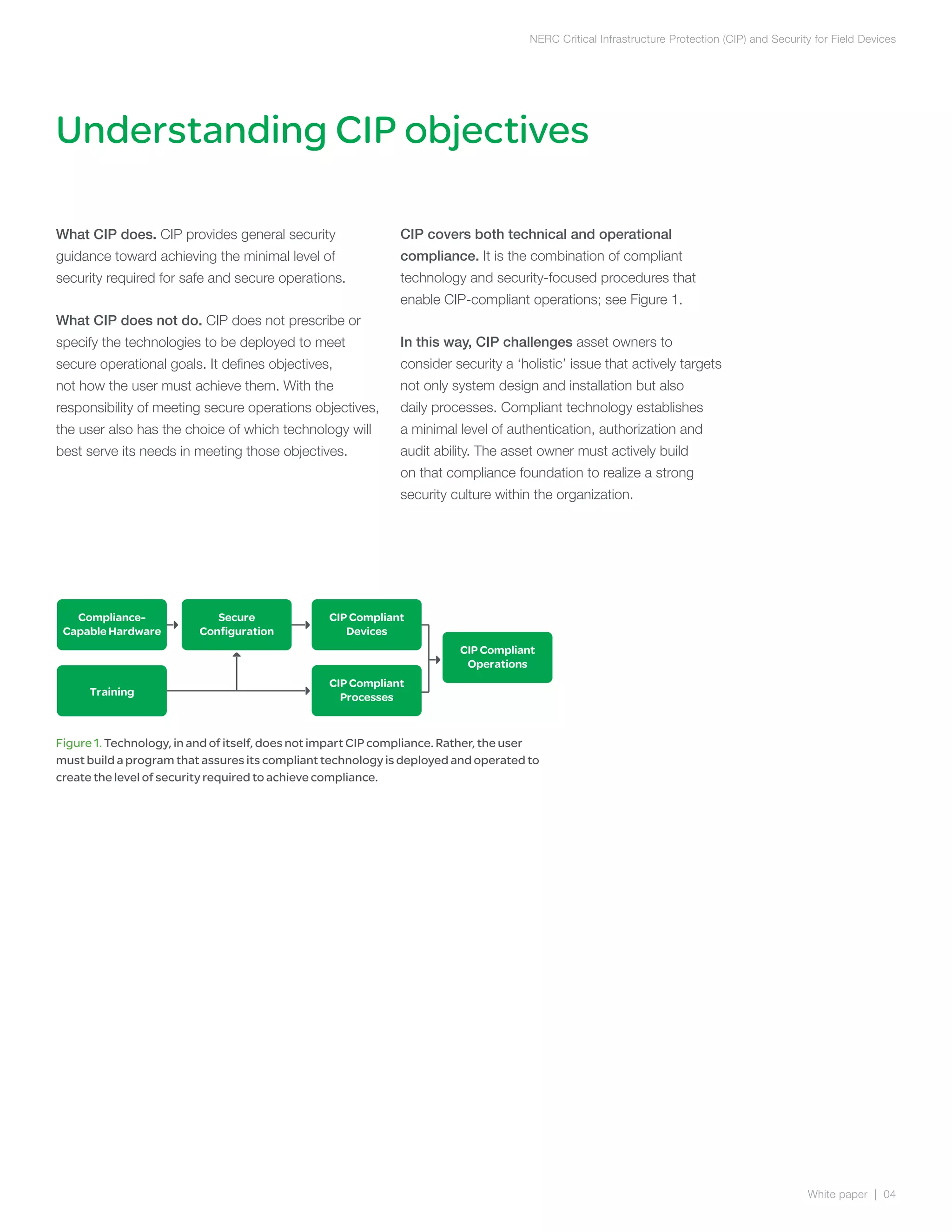
                                                              enable CIP-compliant operations; see Figure 1.
What CIP does not do. CIP does not prescribe or
specify the technologies to be deployed to meet               In this way, CIP challenges asset owners to
secure operational goals. It defines objectives,              consider security a ‘holistic’ issue that actively targets
not how the user must achieve them. With the                  not only system design and installation but also
responsibility of meeting secure operations objectives,       daily processes. Compliant technology establishes
the user also has the choice of which technology will         a minimal level of authentication, authorization and
best serve its needs in meeting those objectives.             audit ability. The asset owner must actively build
                                                              on that compliance foundation to realize a strong
                                                              security culture within the organization.


   Compliance-               Secure              CIP Compliant
 Capable Hardware         Configuration             Devices
                                                                         CIP Compliant
                                                                          Operations
                                                 CIP Compliant
      Training                                     Processes


Figure 1. Technology, in and of itself, does not impart CIP compliance. Rather, the user
must build a program that assures its compliant technology is deployed and operated to
create the level of security required to achieve compliance.


                                                                                                                                               White paper | 04
NERC Critical Infrastructure Protection (CIP) and Security for Field Devices


Core Security Principles

Let’s review the security principles that are
fundamental in molding a CIP-compliant information
                                                             Information management key for
management architecture:                                     security – and more

Principle of Least Privilege (PoLP). This principle          Reliable information management serves
describes the technology design – the design                 critical infrastructure security by –
of applications and field devices – that allows
                                                             •  aintaining infrastructure availability –
                                                               M
operation with the minimum amount of administrative
                                                               preventing acts, intentional or accidental,
authorization. A granular-access approach to                   from interrupting operations
operational control limits authority to each employee’s
functions; any control authorized beyond defined             •  reserving data integrity – to support the
                                                               P
operational functions invites errors that could have           quality of operational decision-making as well
inadvertent, far-reaching impact – and even invite             as meet regulatory/auditing scrutiny
malicious abuse.
                                                             The robust information management system
                                                             also can enforce data confidentiality, allowing it
While many legacy systems might not accommodate
                                                             to be used for:
highly granular access, newer technology is being
designed to meet this criterion.                             • Accounting purposes

Role-based Access Controls (RbAC). Rights and                • Business-critical processes
privileges associated with any network device are
assigned to an administrative role or job duty, rather       • Customer consumption
than to a named individual. This approach allows
individuals to move in and out of roles within the        With compliant information management architecture,
organization without complicated re-definition of         the asset owner will:
that person’s authorization, supporting continuous
compliance and limiting authorization errors. It also     • Know and control who is allowed to access the
supports the centralized management essential in an       system
efficient, integrated network.
                                                          • Know and control what each individual is allowed to
Audit trails. While maintaining audit trail capability    do on the system
is familiar in the control room, CIP compliance
extends this concept to operation of field devices.       • Know and control what can be done by an
By maintaining an awareness of field data activity        individual based on where the individual is accessing
and changes at the device and substation level, the       the system
user can integrate that data into centralized control
with confidence. The intent is to not only provide the    • Know what each individual has done on the system
means for documenting system management in the
recent past but to also enable real-time assessment       • Prevent access to critical assets from any location
of whether the CIP controls in place are appropriate –    where any of the above situations is not true
doing their job and meeting compliance goals.


                                                                                                                                           White paper | 05
NERC Critical Infrastructure Protection (CIP) and Security for Field Devices


NERC CIP technical control
guidelines
The NERC CIP document addresses a broad range
of Critical Cyber Asset (CCA) and Cyber Security
                                                             About NERC
issues; here, we very briefly review six of the CIP
guidelines that apply to operation of electric network       The North American Electric Reliability
                                                             Corporation (NERC) is an international
field devices; also see Table 1. The full text of the
                                                             regulatory authority established to evaluate
NERC CIP standard can be found at http://www.
                                                             reliability of the bulk power system in North
nerc.com.                                                    America. NERC develops and enforces
                                                             Reliability Standards; assesses adequacy
CIP-003 Security Management Controls describes               annually via ten-year forecasts and winter and
the development of a cyber security policy and               summer forecasts; monitors the bulk power
documentation of that policy in a way that it can            system; and educates, trains, and certifies
                                                             industry personnel. NERC is the electric
be updated and that all staff is aware of the policy.
                                                             reliability organization for North America,
It discusses management of personnel who have                subject to oversight by the U.S. Federal
access to the CCAs and identification of users with          Energy Regulatory Commission (FERC) and
different privileges, roles and responsibilities.            governmental authorities in Canada. For more
                                                             information, visit http://www.nerc.com
•  he user will want to look for hardware that can be
  T
  configured to allow a specific ID for each user and     CIP guideline uses vaguely worded phrases such
  for addition and deletion of privileged users and for   as “where technically feasible”; this wording makes
  users with different levels of access. Hardware that    it difficult for the organization to fully understand
  documents not only access but also documents            requirements.
  details of functions performed during the access is
  a big advantage; this downloadable User Log will        While encryption is not identified specifically as a
  provide an audit trail for CIP compliance.              guideline for ESP access, CIP-005 does speak to:

CIP-004 Personnel and Training identifies the             •  ecurity of dial-up access – unclear if having a
                                                            S
personnel training and awareness recommended                password and User Name to access constitutes
for supporting security-related operations and              ‘secure.’ Use of a ‘call back’ modem or a SCADA-
procedures. It cites CCA user identification lists that     controlled relay that is closed for access and
are reviewed periodically and can be modified to            opened when not needed provides adequate
change both users and user privileges.                      security.

•  evices that accept addition or deletion of users
  D                                                         -  n alternative to dial-up connection is the
                                                              A
  and/or privileges remotely allow updates quickly            Ethernet strategy, providing the IT tunnel that
  and keep functionalities accurately maintained.             eliminates a dial-up channel. Another plus: with
                                                              employees equipped with cell phones, replacing
CIP-005 Electronic Security Perimeter(s) deals                dial-up access also eliminates any need for a
with identification and protection of ESP access              phone line into the substation.
points and communications. In some places, this


                                                                                                                                          White paper | 06
NERC Critical Infrastructure Protection (CIP) and Security for Field Devices


•  ccess denied by default – access requires
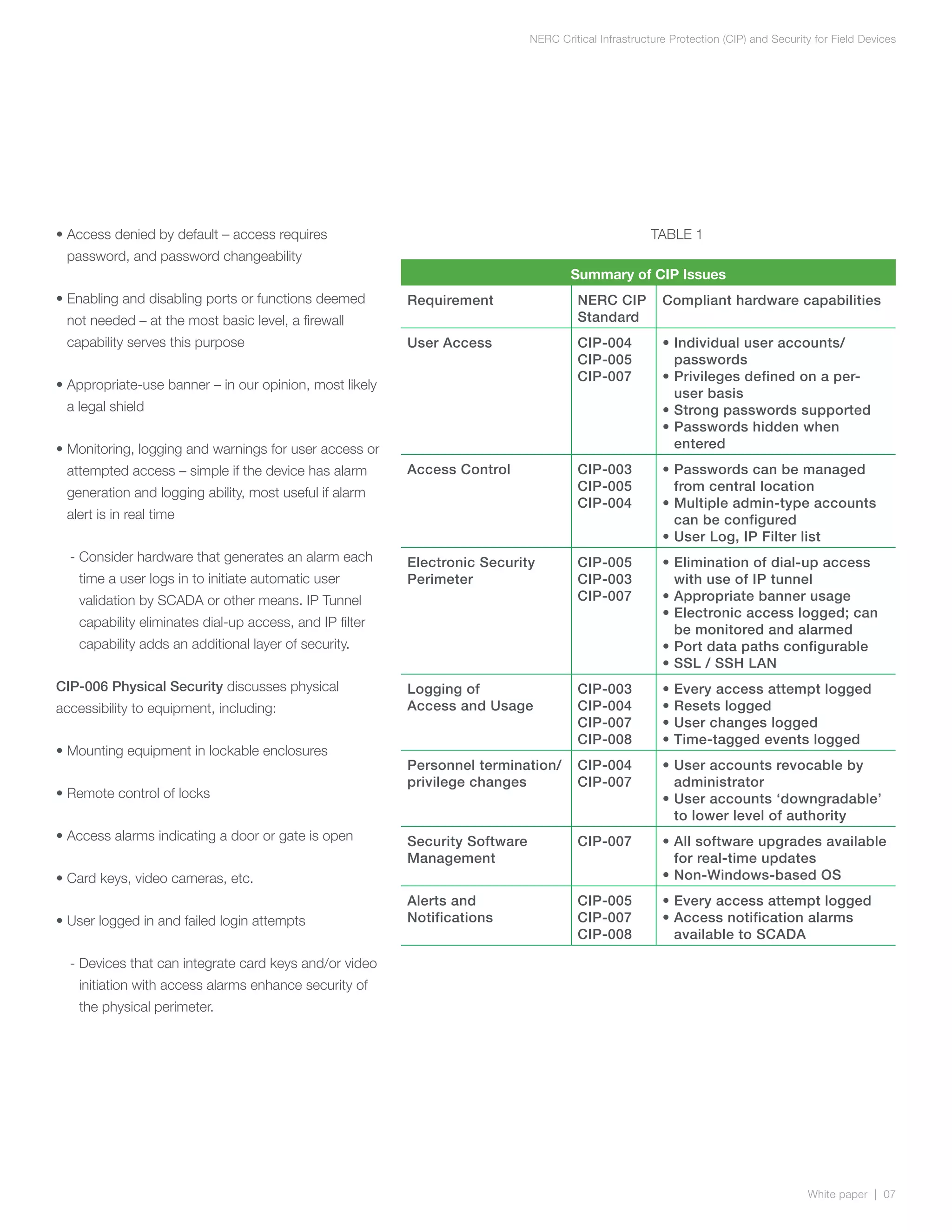
  A                                                                                                    TABLE 1
 password, and password changeability
                                                                                      Summary of CIP Issues
•  nabling and disabling ports or functions deemed
  E                                                       Requirement                  NERC CIP          Compliant hardware capabilities
 not needed – at the most basic level, a firewall                                      Standard
 capability serves this purpose                           User Access                  CIP-004           • ndividual user accounts/
                                                                                                           I
                                                                                       CIP-005             passwords
                                                                                       CIP-007           •  rivileges defined on a per-
                                                                                                           P
•  ppropriate-use banner – in our opinion, most likely
  A
                                                                                                           user basis
 a legal shield                                                                                          • Strong passwords supported
                                                                                                         •  asswords hidden when
                                                                                                           P
•  onitoring, logging and warnings for user access or
  M                                                                                                        entered
 attempted access – simple if the device has alarm        Access Control               CIP-003           • 
                                                                                                           Passwords can be managed
 generation and logging ability, most useful if alarm                                  CIP-005             from central location
                                                                                       CIP-004           •  ultiple admin-type accounts
                                                                                                           M
 alert is in real time                                                                                     can be configured
                                                                                                         • User Log, IP Filter list
  -  onsider hardware that generates an alarm each
    C                                                     Electronic Security          CIP-005           •  limination of dial-up access
                                                                                                           E
   time a user logs in to initiate automatic user         Perimeter                    CIP-003             with use of IP tunnel
   validation by SCADA or other means. IP Tunnel                                       CIP-007           • Appropriate banner usage
                                                                                                         •  lectronic access logged; can
                                                                                                           E
   capability eliminates dial-up access, and IP filter
                                                                                                           be monitored and alarmed
   capability adds an additional layer of security.                                                      • Port data paths configurable
                                                                                                         • SSL / SSH LAN
CIP-006 Physical Security discusses physical              Logging of                   CIP-003           •   Every access attempt logged
accessibility to equipment, including:                    Access and Usage             CIP-004           •   Resets logged
                                                                                       CIP-007           •   User changes logged
                                                                                       CIP-008           •   Time-tagged events logged
• Mounting equipment in lockable enclosures
                                                          Personnel termination/       CIP-004           •  ser accounts revocable by
                                                                                                           U
                                                          privilege changes            CIP-007             administrator
• Remote control of locks                                                                                •  ser accounts ‘downgradable’
                                                                                                           U
                                                                                                           to lower level of authority
• Access alarms indicating a door or gate is open         Security Software            CIP-007           •  ll software upgrades available
                                                                                                           A
                                                          Management                                       for real-time updates
• Card keys, video cameras, etc.                                                                         • Non-Windows-based OS
                                                          Alerts and                   CIP-005           • Every access attempt logged
• User logged in and failed login attempts                Notifications                CIP-007           •  ccess notification alarms
                                                                                                           A
                                                                                       CIP-008             available to SCADA

  -  evices that can integrate card keys and/or video
    D
   initiation with access alarms enhance security of
   the physical perimeter.


                                                                                                                                       White paper | 07
NERC Critical Infrastructure Protection (CIP) and Security for Field Devices


CIP-007 Systems Security Management deals
with operating issues such as security patches,
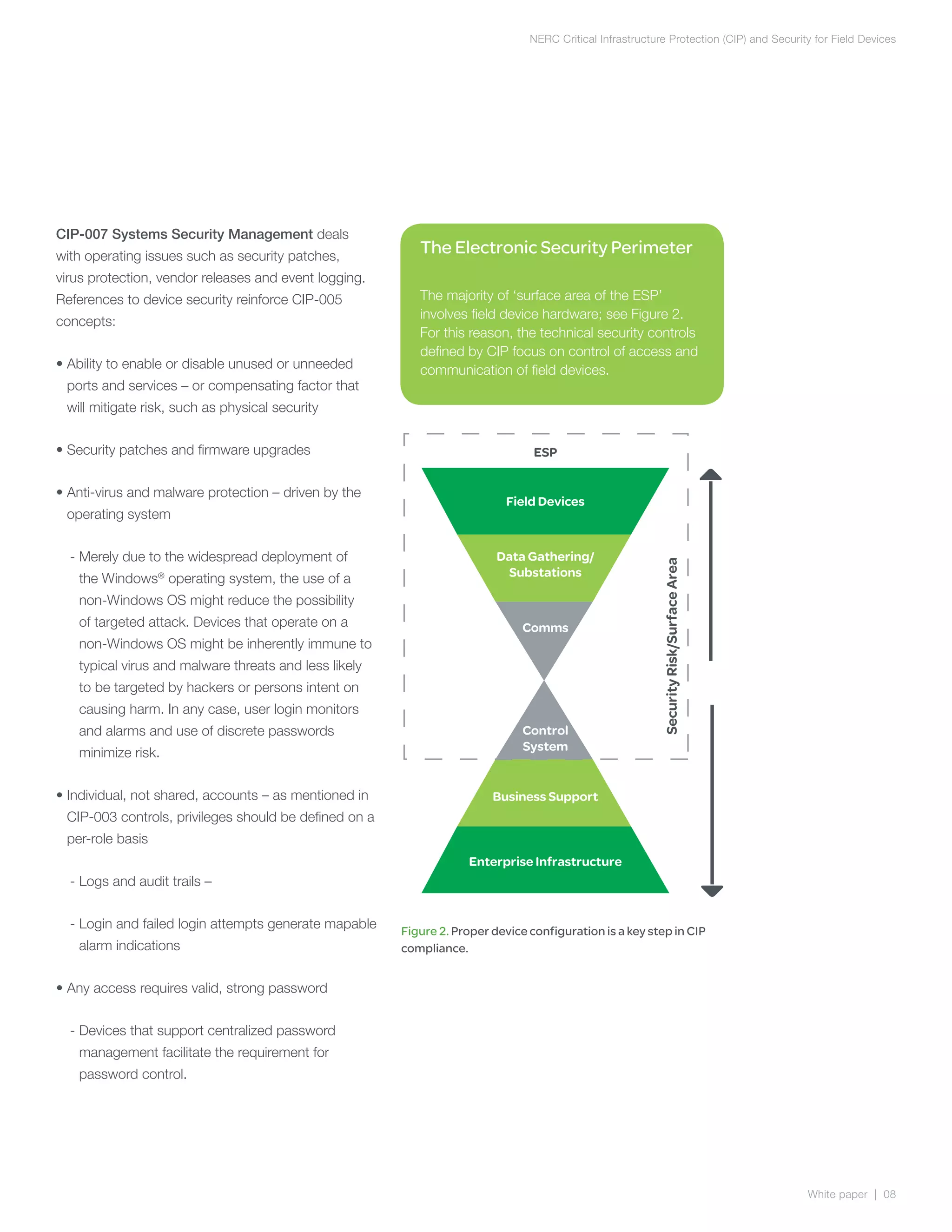
                                                           The Electronic Security Perimeter
virus protection, vendor releases and event logging.
References to device security reinforce CIP-005            The majority of ‘surface area of the ESP’
                                                           involves field device hardware; see Figure 2.
concepts:
                                                           For this reason, the technical security controls
                                                           defined by CIP focus on control of access and
•  bility to enable or disable unused or unneeded
  A                                                        communication of field devices.
 ports and services – or compensating factor that
 will mitigate risk, such as physical security


• Security patches and firmware upgrades                                         ESP


•  nti-virus and malware protection – driven by the
  A
                                                                            Field Devices
 operating system


  -  erely due to the widespread deployment of
    M                                                                     Data Gathering/


                                                                                                           Security Risk/Surface Area
   the Windows® operating system, the use of a                             Substations

   non-Windows OS might reduce the possibility
   of targeted attack. Devices that operate on a                               Comms
   non-Windows OS might be inherently immune to
   typical virus and malware threats and less likely
   to be targeted by hackers or persons intent on
   causing harm. In any case, user login monitors
   and alarms and use of discrete passwords                                    Control
                                                                               System
   minimize risk.


• ndividual, not shared, accounts – as mentioned in
  I                                                                      Business Support
 CIP-003 controls, privileges should be defined on a
 per-role basis
                                                                    Enterprise Infrastructure
  - Logs and audit trails –


  -  ogin and failed login attempts generate mapable
    L                                                   Figure 2. Proper device configuration is a key step in CIP
   alarm indications                                    compliance.


• Any access requires valid, strong password


  -  evices that support centralized password
    D
   management facilitate the requirement for
   password control.


                                                                                                                                         White paper | 08
NERC Critical Infrastructure Protection (CIP) and Security for Field Devices


•  sers can be assigned different levels of access
  U
 based on need


  - View Only


  - Other levels/privileges


  -  dministrator who can control access by other
    A
    users


• All passwords are stored, hidden or encrypted


•  quipment should be wiped on disposal, either
  E
 by memory erase or physically destroying the
 microchip if necessary


  - f a device fails, it might be difficult to effectively
    I
    erase memory. Look for devices that have
    removable media.


CIP-008 Incident Reporting and Response
Planning relates to the managing and handling of
reports and logs. While collecting and storing logs for
historical reference is necessary, how that retention
is done is determined by the hardware and the
organization’s capabilities.


•  emote electronic download of user logs, SOE
  R
 log, system log and control log facilitates data
 documentation for reports and compliance audit
 trail, compared to collection via a physical tap.


                                                                                                                       White paper | 09
NERC Critical Infrastructure Protection (CIP) and Security for Field Devices


Finding your compliance solution

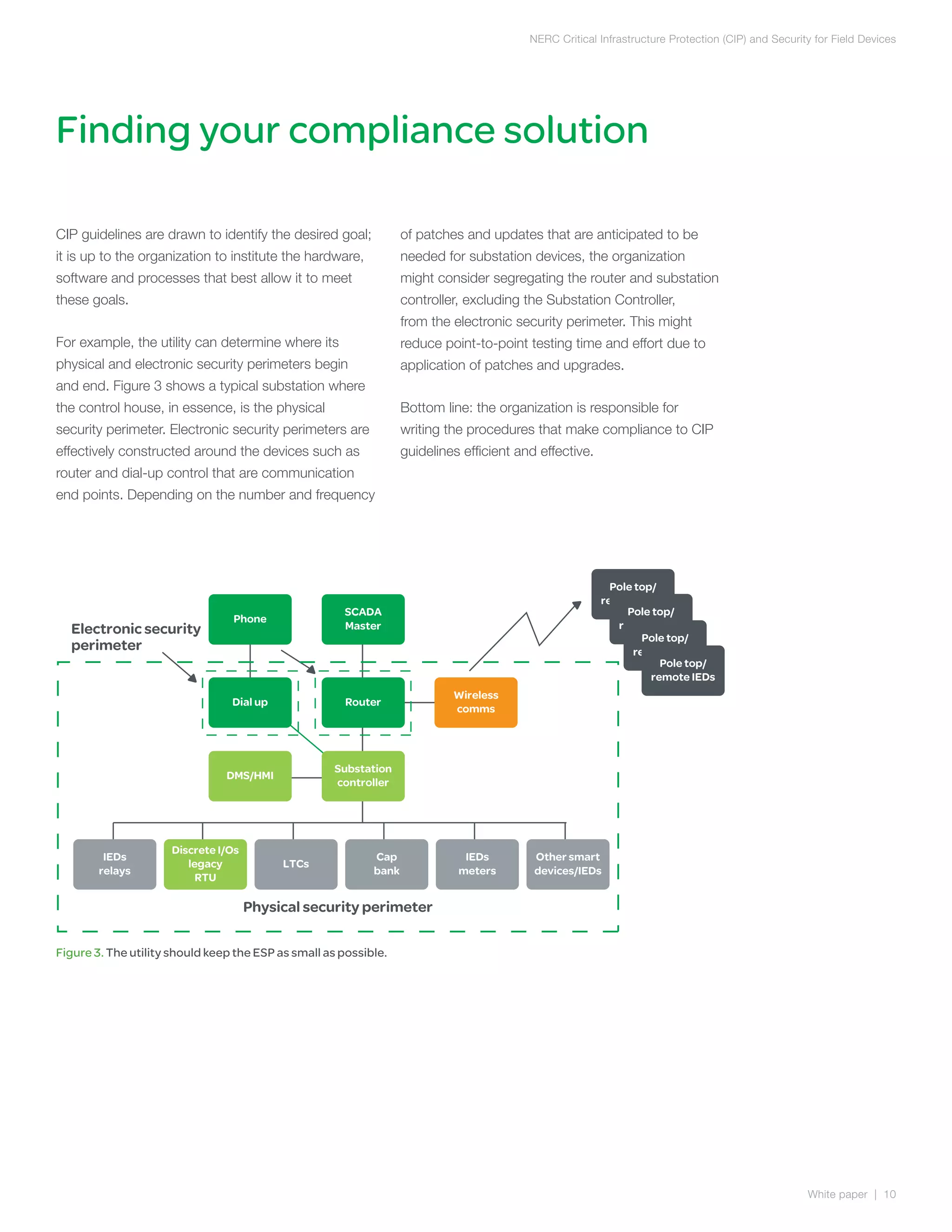
CIP guidelines are drawn to identify the desired goal;             of patches and updates that are anticipated to be
it is up to the organization to institute the hardware,            needed for substation devices, the organization
software and processes that best allow it to meet                  might consider segregating the router and substation
these goals.                                                       controller, excluding the Substation Controller,
                                                                   from the electronic security perimeter. This might
For example, the utility can determine where its                   reduce point-to-point testing time and effort due to
physical and electronic security perimeters begin                  application of patches and upgrades.
and end. Figure 3 shows a typical substation where
the control house, in essence, is the physical                     Bottom line: the organization is responsible for
security perimeter. Electronic security perimeters are             writing the procedures that make compliance to CIP
effectively constructed around the devices such as                 guidelines efficient and effective.
router and dial-up control that are communication
end points. Depending on the number and frequency


                                                                                                           Pole top/
                                                                                                         remote IEDs
                                                      SCADA                                                   Pole top/
                                 Phone
  Electronic security                                 Master                                                remote IEDs
                                                                                                                 Pole top/
  perimeter                                                                                                    remote IEDs
                                                                                                                     Pole top/
                                                                                                                   remote IEDs
                                                                            Wireless
                                 Dial up               Router
                                                                            comms


                                                     Substation
                                DMS/HMI
                                                     controller


                      Discrete I/Os
         IEDs                                               Cap               IEDs         Other smart
                         legacy            LTCs
        relays                                              bank             meters        devices/IEDs
                           RTU

                                      Physical security perimeter

Figure 3. The utility should keep the ESP as small as possible.


                                                                                                                                                   White paper | 10
NERC Critical Infrastructure Protection (CIP) and Security for Field Devices


Conclusion

One requirement CIP guidelines don’t spell out is the need for adaptability and intra-
organization cooperation. Security is an arms race, and the electric utility requires
considerable cooperation and integration within the organization to stay agile enough
to adapt to changing challenges and still meet compliance.


Careful consideration of hardware and software choices will help the utility institute
the continual modifications that are needed to meet the moving target of critical
infrastructure protection. Flexible asset access controls are a must to mitigate
changing risks. Above all, dedicated intra-organization communications and training
that emphasize security make every employee part of the solution – and assure that
security is a successful process.


                                                                                                                                            White paper | 11
©2012 Schneider Electric. All rights reserved.


Schneider Electric USA, Inc.
   4701 Royal Vista Circle
   Fort Collins, CO 80528
   Phone:  -866-537-1091
           1
   	      + (34) 9-17-14-70-02
   Fax: 1-970-223-5577
   www.schneider-electric.com/us
                                   June 2012

NERC Critical Infrastructure Protection (CIP) and Security for Field Devices

  • 1.
    NERC Critical Infrastructure Protection(CIP) and Security for Field Devices Compliance principles and requirements Make the most of your energy SM
  • 2.
    Summary Executive Summary .................................................................................... p 1 Introduction ................................................................................................. p 2 Understanding CIP objectives ...................................................................... p 4 Core Security Principles . ............................................................................. p 5 NERC CIP technical control guidelines . ....................................................... p 6 Finding your compliance solution.................................................................. p 10 Conclusion................................................................................................... p 11
  • 3.
    NERC Critical InfrastructureProtection (CIP) and Security for Field Devices Executive summary The North American Electric Reliability Corporation (NERC) maintains a set of Critical Infrastructure Protection (CIP) guidelines that address a broad range of critical cyber asset and cyber security issues. These guidelines describe the security-focused procedures that, in combination with compliant technology, enable secure electric grid operations. The CIP guidelines do not specify the technologies that must be deployed. Instead, they describe the technology design necessary to build an information management architecture that complies with security goals. These goals include the minimizing of administrative authorization needed for operational functions. Rights and privileges are to be assigned to a functional role, not a named individual. Audit trails of field data device and substation activity, similar to control room auditability, must be maintained to assure comprehensive confidence in data and controls. The six CIP guidelines summarized in the paper speak to the procedures and policies that are vital to critical cyber asset security – personnel authorizations; personnel training; security of the information management system’s electronic perimeter; security of the information management system’s physical assets; operational security; and incident reporting and response planning. The utility builds its CIP-compliant program with defined procedures addressing these guidelines, coupled with the hardware and software that enable full implementation of these procedures. Training of all personnel is necessary for effective and efficient compliance. White paper | 01
  • 4.
    NERC Critical InfrastructureProtection (CIP) and Security for Field Devices Introduction In this paper, we target ‘the myth of compliance.’ While the term ‘compliant’ most often refers to products – the software and devices deployed in daily field operations of the electric grid – we at Telvent see security compliance as a ‘process.’ Through our extensive experience working with critical infrastructure asset owners, vendors and regulatory agencies, we know full compliance is achieved only when compliant hardware and software is complemented by information management procedures reflecting strong security principles. Here, we discuss in general how consistent NERC Critical Infrastructure Protection (CIP) compliance reflects best security practices combining: • Core security principles • Technical controls defined by CIP guidelines • strong level of discipline within the user organization and its vendor A organizations White paper | 02
  • 5.
    NERC Critical Infrastructure Protection(CIP) and Security for Field Devices
  • 6.
    NERC Critical InfrastructureProtection (CIP) and Security for Field Devices Understanding CIP objectives What CIP does. CIP provides general security CIP covers both technical and operational guidance toward achieving the minimal level of compliance. It is the combination of compliant security required for safe and secure operations. technology and security-focused procedures that enable CIP-compliant operations; see Figure 1. What CIP does not do. CIP does not prescribe or specify the technologies to be deployed to meet In this way, CIP challenges asset owners to secure operational goals. It defines objectives, consider security a ‘holistic’ issue that actively targets not how the user must achieve them. With the not only system design and installation but also responsibility of meeting secure operations objectives, daily processes. Compliant technology establishes the user also has the choice of which technology will a minimal level of authentication, authorization and best serve its needs in meeting those objectives. audit ability. The asset owner must actively build on that compliance foundation to realize a strong security culture within the organization. Compliance- Secure CIP Compliant Capable Hardware Configuration Devices CIP Compliant Operations CIP Compliant Training Processes Figure 1. Technology, in and of itself, does not impart CIP compliance. Rather, the user must build a program that assures its compliant technology is deployed and operated to create the level of security required to achieve compliance. White paper | 04
  • 7.
    NERC Critical InfrastructureProtection (CIP) and Security for Field Devices Core Security Principles Let’s review the security principles that are fundamental in molding a CIP-compliant information Information management key for management architecture: security – and more Principle of Least Privilege (PoLP). This principle Reliable information management serves describes the technology design – the design critical infrastructure security by – of applications and field devices – that allows • aintaining infrastructure availability – M operation with the minimum amount of administrative preventing acts, intentional or accidental, authorization. A granular-access approach to from interrupting operations operational control limits authority to each employee’s functions; any control authorized beyond defined • reserving data integrity – to support the P operational functions invites errors that could have quality of operational decision-making as well inadvertent, far-reaching impact – and even invite as meet regulatory/auditing scrutiny malicious abuse. The robust information management system also can enforce data confidentiality, allowing it While many legacy systems might not accommodate to be used for: highly granular access, newer technology is being designed to meet this criterion. • Accounting purposes Role-based Access Controls (RbAC). Rights and • Business-critical processes privileges associated with any network device are assigned to an administrative role or job duty, rather • Customer consumption than to a named individual. This approach allows individuals to move in and out of roles within the With compliant information management architecture, organization without complicated re-definition of the asset owner will: that person’s authorization, supporting continuous compliance and limiting authorization errors. It also • Know and control who is allowed to access the supports the centralized management essential in an system efficient, integrated network. • Know and control what each individual is allowed to Audit trails. While maintaining audit trail capability do on the system is familiar in the control room, CIP compliance extends this concept to operation of field devices. • Know and control what can be done by an By maintaining an awareness of field data activity individual based on where the individual is accessing and changes at the device and substation level, the the system user can integrate that data into centralized control with confidence. The intent is to not only provide the • Know what each individual has done on the system means for documenting system management in the recent past but to also enable real-time assessment • Prevent access to critical assets from any location of whether the CIP controls in place are appropriate – where any of the above situations is not true doing their job and meeting compliance goals. White paper | 05
  • 8.
    NERC Critical InfrastructureProtection (CIP) and Security for Field Devices NERC CIP technical control guidelines The NERC CIP document addresses a broad range of Critical Cyber Asset (CCA) and Cyber Security About NERC issues; here, we very briefly review six of the CIP guidelines that apply to operation of electric network The North American Electric Reliability Corporation (NERC) is an international field devices; also see Table 1. The full text of the regulatory authority established to evaluate NERC CIP standard can be found at http://www. reliability of the bulk power system in North nerc.com. America. NERC develops and enforces Reliability Standards; assesses adequacy CIP-003 Security Management Controls describes annually via ten-year forecasts and winter and the development of a cyber security policy and summer forecasts; monitors the bulk power documentation of that policy in a way that it can system; and educates, trains, and certifies industry personnel. NERC is the electric be updated and that all staff is aware of the policy. reliability organization for North America, It discusses management of personnel who have subject to oversight by the U.S. Federal access to the CCAs and identification of users with Energy Regulatory Commission (FERC) and different privileges, roles and responsibilities. governmental authorities in Canada. For more information, visit http://www.nerc.com • he user will want to look for hardware that can be T configured to allow a specific ID for each user and CIP guideline uses vaguely worded phrases such for addition and deletion of privileged users and for as “where technically feasible”; this wording makes users with different levels of access. Hardware that it difficult for the organization to fully understand documents not only access but also documents requirements. details of functions performed during the access is a big advantage; this downloadable User Log will While encryption is not identified specifically as a provide an audit trail for CIP compliance. guideline for ESP access, CIP-005 does speak to: CIP-004 Personnel and Training identifies the • ecurity of dial-up access – unclear if having a S personnel training and awareness recommended password and User Name to access constitutes for supporting security-related operations and ‘secure.’ Use of a ‘call back’ modem or a SCADA- procedures. It cites CCA user identification lists that controlled relay that is closed for access and are reviewed periodically and can be modified to opened when not needed provides adequate change both users and user privileges. security. • evices that accept addition or deletion of users D - n alternative to dial-up connection is the A and/or privileges remotely allow updates quickly Ethernet strategy, providing the IT tunnel that and keep functionalities accurately maintained. eliminates a dial-up channel. Another plus: with employees equipped with cell phones, replacing CIP-005 Electronic Security Perimeter(s) deals dial-up access also eliminates any need for a with identification and protection of ESP access phone line into the substation. points and communications. In some places, this White paper | 06
  • 9.
    NERC Critical InfrastructureProtection (CIP) and Security for Field Devices • ccess denied by default – access requires A TABLE 1 password, and password changeability Summary of CIP Issues • nabling and disabling ports or functions deemed E Requirement NERC CIP Compliant hardware capabilities not needed – at the most basic level, a firewall Standard capability serves this purpose User Access CIP-004 • ndividual user accounts/ I CIP-005 passwords CIP-007 • rivileges defined on a per- P • ppropriate-use banner – in our opinion, most likely A user basis a legal shield • Strong passwords supported • asswords hidden when P • onitoring, logging and warnings for user access or M entered attempted access – simple if the device has alarm Access Control CIP-003 • Passwords can be managed generation and logging ability, most useful if alarm CIP-005 from central location CIP-004 • ultiple admin-type accounts M alert is in real time can be configured • User Log, IP Filter list - onsider hardware that generates an alarm each C Electronic Security CIP-005 • limination of dial-up access E time a user logs in to initiate automatic user Perimeter CIP-003 with use of IP tunnel validation by SCADA or other means. IP Tunnel CIP-007 • Appropriate banner usage • lectronic access logged; can E capability eliminates dial-up access, and IP filter be monitored and alarmed capability adds an additional layer of security. • Port data paths configurable • SSL / SSH LAN CIP-006 Physical Security discusses physical Logging of CIP-003 • Every access attempt logged accessibility to equipment, including: Access and Usage CIP-004 • Resets logged CIP-007 • User changes logged CIP-008 • Time-tagged events logged • Mounting equipment in lockable enclosures Personnel termination/ CIP-004 • ser accounts revocable by U privilege changes CIP-007 administrator • Remote control of locks • ser accounts ‘downgradable’ U to lower level of authority • Access alarms indicating a door or gate is open Security Software CIP-007 • ll software upgrades available A Management for real-time updates • Card keys, video cameras, etc. • Non-Windows-based OS Alerts and CIP-005 • Every access attempt logged • User logged in and failed login attempts Notifications CIP-007 • ccess notification alarms A CIP-008 available to SCADA - evices that can integrate card keys and/or video D initiation with access alarms enhance security of the physical perimeter. White paper | 07
  • 10.
    NERC Critical InfrastructureProtection (CIP) and Security for Field Devices CIP-007 Systems Security Management deals with operating issues such as security patches, The Electronic Security Perimeter virus protection, vendor releases and event logging. References to device security reinforce CIP-005 The majority of ‘surface area of the ESP’ involves field device hardware; see Figure 2. concepts: For this reason, the technical security controls defined by CIP focus on control of access and • bility to enable or disable unused or unneeded A communication of field devices. ports and services – or compensating factor that will mitigate risk, such as physical security • Security patches and firmware upgrades ESP • nti-virus and malware protection – driven by the A Field Devices operating system - erely due to the widespread deployment of M Data Gathering/ Security Risk/Surface Area the Windows® operating system, the use of a Substations non-Windows OS might reduce the possibility of targeted attack. Devices that operate on a Comms non-Windows OS might be inherently immune to typical virus and malware threats and less likely to be targeted by hackers or persons intent on causing harm. In any case, user login monitors and alarms and use of discrete passwords Control System minimize risk. • ndividual, not shared, accounts – as mentioned in I Business Support CIP-003 controls, privileges should be defined on a per-role basis Enterprise Infrastructure - Logs and audit trails – - ogin and failed login attempts generate mapable L Figure 2. Proper device configuration is a key step in CIP alarm indications compliance. • Any access requires valid, strong password - evices that support centralized password D management facilitate the requirement for password control. White paper | 08
  • 11.
    NERC Critical InfrastructureProtection (CIP) and Security for Field Devices • sers can be assigned different levels of access U based on need - View Only - Other levels/privileges - dministrator who can control access by other A users • All passwords are stored, hidden or encrypted • quipment should be wiped on disposal, either E by memory erase or physically destroying the microchip if necessary - f a device fails, it might be difficult to effectively I erase memory. Look for devices that have removable media. CIP-008 Incident Reporting and Response Planning relates to the managing and handling of reports and logs. While collecting and storing logs for historical reference is necessary, how that retention is done is determined by the hardware and the organization’s capabilities. • emote electronic download of user logs, SOE R log, system log and control log facilitates data documentation for reports and compliance audit trail, compared to collection via a physical tap. White paper | 09
  • 12.
    NERC Critical InfrastructureProtection (CIP) and Security for Field Devices Finding your compliance solution CIP guidelines are drawn to identify the desired goal; of patches and updates that are anticipated to be it is up to the organization to institute the hardware, needed for substation devices, the organization software and processes that best allow it to meet might consider segregating the router and substation these goals. controller, excluding the Substation Controller, from the electronic security perimeter. This might For example, the utility can determine where its reduce point-to-point testing time and effort due to physical and electronic security perimeters begin application of patches and upgrades. and end. Figure 3 shows a typical substation where the control house, in essence, is the physical Bottom line: the organization is responsible for security perimeter. Electronic security perimeters are writing the procedures that make compliance to CIP effectively constructed around the devices such as guidelines efficient and effective. router and dial-up control that are communication end points. Depending on the number and frequency Pole top/ remote IEDs SCADA Pole top/ Phone Electronic security Master remote IEDs Pole top/ perimeter remote IEDs Pole top/ remote IEDs Wireless Dial up Router comms Substation DMS/HMI controller Discrete I/Os IEDs Cap IEDs Other smart legacy LTCs relays bank meters devices/IEDs RTU Physical security perimeter Figure 3. The utility should keep the ESP as small as possible. White paper | 10
  • 13.
    NERC Critical InfrastructureProtection (CIP) and Security for Field Devices Conclusion One requirement CIP guidelines don’t spell out is the need for adaptability and intra- organization cooperation. Security is an arms race, and the electric utility requires considerable cooperation and integration within the organization to stay agile enough to adapt to changing challenges and still meet compliance. Careful consideration of hardware and software choices will help the utility institute the continual modifications that are needed to meet the moving target of critical infrastructure protection. Flexible asset access controls are a must to mitigate changing risks. Above all, dedicated intra-organization communications and training that emphasize security make every employee part of the solution – and assure that security is a successful process. White paper | 11
  • 14.
    ©2012 Schneider Electric.All rights reserved. Schneider Electric USA, Inc. 4701 Royal Vista Circle Fort Collins, CO 80528 Phone: -866-537-1091 1 + (34) 9-17-14-70-02 Fax: 1-970-223-5577 www.schneider-electric.com/us June 2012