Today, many children are
diagnosed with learning
disabilities at school when it is
discovered that they are having
difficulty in some part of their
education.
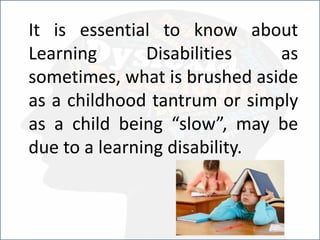
It is essential to know about
Learning Disabilities as
sometimes, what is brushed aside
as a childhood tantrum or simply
as a child being “slow”, may be
due to a learning disability.
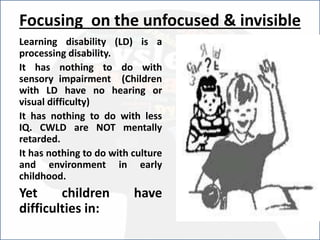
Focusing on the unfocused & invisible
Learning disability (LD) is a
processing disability.
It has nothing to do with
sensory impairment (Children
with LD have no hearing or
visual difficulty)
It has nothing to do with less
IQ. CWLD are NOT mentally
retarded.
It has nothing to do with culture
and environment in early
childhood.
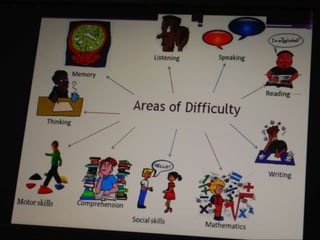
Yet children have
difficulties in:
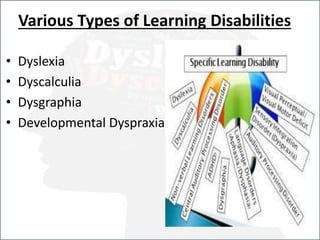
Various Types of Learning Disabilities
• Dyslexia
• Dyscalculia
• Dysgraphia
• Developmental Dyspraxia
Dyslexia
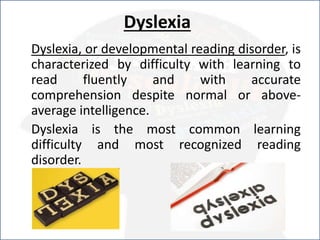
Dyslexia, or developmental reading disorder, is
characterized by difficulty with learning to
read fluently and with accurate
comprehension despite normal or above-
average intelligence.
Dyslexia is the most common learning
difficulty and most recognized reading
disorder.
Types of Dyslexia
1. Visual Dyslexia: It is marked by:
• Reversal of whole word / syllable / letters (e.g.
now / won, was / saw, b / d).
• Substitution (e.g. house / home)
• Addition of sounds (e.g. ischool / school)
• Omission of letters, syllables, words or word
endings (e.g. sed / said). It arises due to a child’s
short memory span and difficulty in interpreting
and recalling visual images.
Types of Dyslexia
2. Auditory Dyslexia: It is characterized by the
child
• having difficulty in processing and understanding
what has been said to him.
• not being able to distinguish subtle differences in
sound (e.g. bit/bet, pig/peg).
• having difficulty in filtering out the extraneous
sound. It is quite likely that a child with auditory
dyslexia becomes very tense or hyper-active in a
noisy room.
Dyscalculia
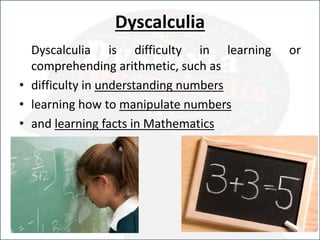
Dyscalculia is difficulty in learning or
comprehending arithmetic, such as
• difficulty in understanding numbers
• learning how to manipulate numbers
• and learning facts in Mathematics
Dysgraphia
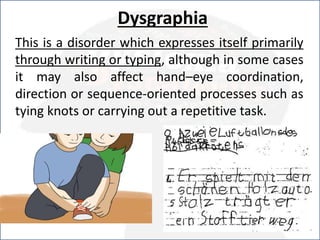
This is a disorder which expresses itself primarily
through writing or typing, although in some cases
it may also affect hand–eye coordination,
direction or sequence-oriented processes such as
tying knots or carrying out a repetitive task.
Developmental Dyspraxia
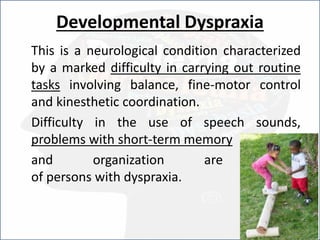
This is a neurological condition characterized
by a marked difficulty in carrying out routine
tasks involving balance, fine-motor control
and kinesthetic coordination.
Difficulty in the use of speech sounds,
problems with short-term memory
and organization are typical
of persons with dyspraxia.
Stereotypes
Since Learning Disabilities have only
recently been classified as a type of
disability, there are several
misconceptions about them which
several of us believe.
In the following slides, we shall try and
break some of these myths.
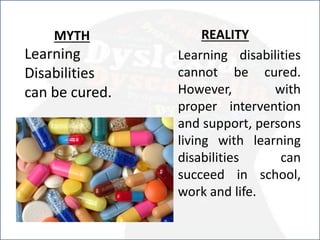
MYTH
Learning
Disabilities
can be cured.
REALITY
Learning disabilities
cannot be cured.
However, with
proper intervention
and support, persons
living with learning
disabilities can
succeed in school,
work and life.
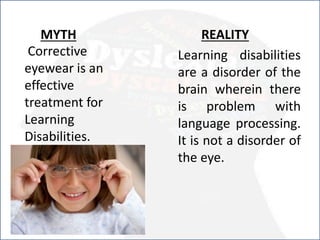
Corrective
eyewear is an
effective
treatment for
Learning
Disabilities.
REALITY
Learning disabilities
are a disorder of the
brain wherein there
is problem with
language processing.
It is not a disorder of
the eye.
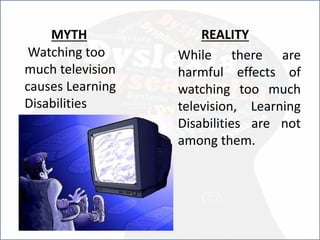
MYTH
Watching too
much television
causes Learning
Disabilities
REALITY
While there are
harmful effects of
watching too much
television, Learning
Disabilities are not
among them.
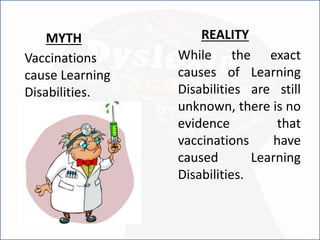
MYTH
Vaccinations
cause Learning
Disabilities.
REALITY
While the exact
causes of Learning
Disabilities are still
unknown, there is no
evidence that
vaccinations have
caused Learning
Disabilities.
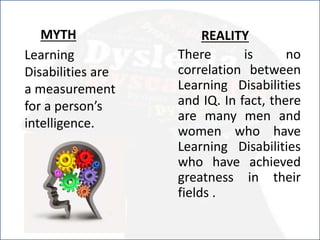
MYTH
Learning
Disabilities are
a measurement
for a person’s
intelligence.
REALITY
There is no
correlation between
Learning Disabilities
and IQ. In fact, there
are many men and
women who have
Learning Disabilities
who have achieved
greatness in their
fields .
MYTH
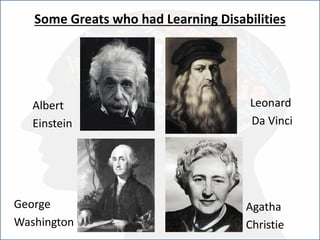
Some Greats who had Learning Disabilities
Albert
Einstein
George
Washington
Agatha
Christie
Leonard
Da Vinci
Services needed / available for children with
Learning Disabilities and their families are:
• assessment,
• certification,
• family counseling,
• teacher training,
• short term courses,
• remedial coaching,
• exemption/ concessions,
• teaching learning material etc.
.All Remedial Services today are however available
only for English medium / speaking population.
So, there is a gap in services deserved by rural,
lower socio economic and non English speaking
population.
The hopeful fact is that The Right to Education Act
seeks to enroll and sustain all children between
6 to 14 in nearby mainstream (regular)schools.
What we need is...
• Inclusive Education: This means School
Education which is in tune with diverse needs
of ALL children including Children with
Disabilities, ALL under one roof for diverse
needs.
• Greater awareness about LDs: If more people,
especially teachers, are made aware of
Learning Disabilities, proper steps can be
taken to make education more inclusive.
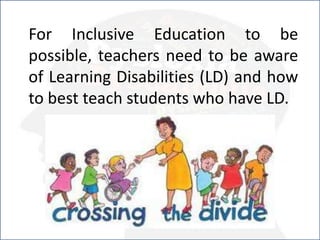
For Inclusive Education to be
possible, teachers need to be aware
of Learning Disabilities (LD) and how
to best teach students who have LD.
When teaching students who have
Dyslexia:
• Adding new words, word definitions and
practicing to use those words appropriately
should be built into reading programs.
• Encourage your child to write stories about
events using new words he/she has learnt.
• Regular testing, monthly or quarterly, using
informal measures will determine progress in
reading and spelling.
Use “The Cloze Technique”
when teaching students who have
Dyslexia:
The child uses the context of the sentence to
understand the unknown words. This strategy
can also be used as a test of comprehension of
the text being read.
It is basically a fill in the blank activity. This
technique should be encouraged by teachers.
When teaching students who have
Dyscalculia
• It is important to introduce concepts
systematically and logically.
• The topics and presentation should begin
from simple concepts and progress to difficult
things.
• The lessons must be such that they draw upon
the student’s concepts and experiences and
then gradually help him towards abstract
mathematical thinking.
Some more tips for students with
Dyscalculia
• Each topic should be taught with the help of
familiar objects and situations. The pictures
and stories you use must kindle the young
student’s imagination, interest and reading
level.
• Provide him with opportunities to practice so
that he not only gains important skills but also
masters an understanding of concepts and
becomes confident.
For students with Dysgraphia.
Encourage the child to practice:
• forming both capital and small cursive letters,
• then, forming both the capital and small
cursive letters in words,
• using the capital and small cursive letters in a
phrase,
• then, using cursive writing in a variety of
creative writing situations.
When teaching students who have
Dyspraxia:
• Seat the child away from the doors and windows
and let him have a clear view of the blackboard.
• Do not ask him to copy from the blackboard.
Provide him with printed matter instead.
• Write the day’s timetable on a strip of chart
paper using different columns and place/stick it
on his desk. (For young children, you can make a
visual agenda)
To teach students with Dyspraxia:
• Each topic should be taught with the help of
familiar objects and situations. The pictures
and stories you use must kindle the young
student’s imagination, interest and reading
level.
• Provide him with opportunities to practice so
that he not only gains important skills but also
masters an understanding of concepts and
becomes confident.
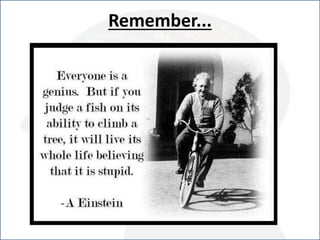
Remember...
We would like to thank
• Dr. Asmita Huddar, Principal of Hashu Advani
College of Special Education for providing us
with the necessary information and expertise
to complete this presentation.
• Our other sources were:
1. National Centre for Learning Disabilities (http://ncld.org/types-learning-
disabilities/what-is-ld/top-10-ld-myths-misconceptions )
2. Wikipedia (https://www.wikipedia.org/)
Knowing More about Learning Disability

Knowing More about Learning Disability

  • 3.
    Today, many childrenare diagnosed with learning disabilities at school when it is discovered that they are having difficulty in some part of their education.
  • 4.
    It is essentialto know about Learning Disabilities as sometimes, what is brushed aside as a childhood tantrum or simply as a child being “slow”, may be due to a learning disability.
  • 5.
    Focusing on theunfocused & invisible Learning disability (LD) is a processing disability. It has nothing to do with sensory impairment (Children with LD have no hearing or visual difficulty) It has nothing to do with less IQ. CWLD are NOT mentally retarded. It has nothing to do with culture and environment in early childhood. Yet children have difficulties in:
  • 7.
    Various Types ofLearning Disabilities • Dyslexia • Dyscalculia • Dysgraphia • Developmental Dyspraxia
  • 8.
    Dyslexia Dyslexia, or developmentalreading disorder, is characterized by difficulty with learning to read fluently and with accurate comprehension despite normal or above- average intelligence. Dyslexia is the most common learning difficulty and most recognized reading disorder.
  • 9.
    Types of Dyslexia 1.Visual Dyslexia: It is marked by: • Reversal of whole word / syllable / letters (e.g. now / won, was / saw, b / d). • Substitution (e.g. house / home) • Addition of sounds (e.g. ischool / school) • Omission of letters, syllables, words or word endings (e.g. sed / said). It arises due to a child’s short memory span and difficulty in interpreting and recalling visual images.
  • 10.
    Types of Dyslexia 2.Auditory Dyslexia: It is characterized by the child • having difficulty in processing and understanding what has been said to him. • not being able to distinguish subtle differences in sound (e.g. bit/bet, pig/peg). • having difficulty in filtering out the extraneous sound. It is quite likely that a child with auditory dyslexia becomes very tense or hyper-active in a noisy room.
  • 11.
    Dyscalculia Dyscalculia is difficultyin learning or comprehending arithmetic, such as • difficulty in understanding numbers • learning how to manipulate numbers • and learning facts in Mathematics
  • 12.
    Dysgraphia This is adisorder which expresses itself primarily through writing or typing, although in some cases it may also affect hand–eye coordination, direction or sequence-oriented processes such as tying knots or carrying out a repetitive task.
  • 13.
    Developmental Dyspraxia This isa neurological condition characterized by a marked difficulty in carrying out routine tasks involving balance, fine-motor control and kinesthetic coordination. Difficulty in the use of speech sounds, problems with short-term memory and organization are typical of persons with dyspraxia.
  • 14.
    Stereotypes Since Learning Disabilitieshave only recently been classified as a type of disability, there are several misconceptions about them which several of us believe. In the following slides, we shall try and break some of these myths.
  • 15.
    MYTH Learning Disabilities can be cured. REALITY Learningdisabilities cannot be cured. However, with proper intervention and support, persons living with learning disabilities can succeed in school, work and life.
  • 16.
    Corrective eyewear is an effective treatmentfor Learning Disabilities. REALITY Learning disabilities are a disorder of the brain wherein there is problem with language processing. It is not a disorder of the eye. MYTH
  • 17.
    Watching too much television causesLearning Disabilities REALITY While there are harmful effects of watching too much television, Learning Disabilities are not among them. MYTH
  • 18.
    Vaccinations cause Learning Disabilities. REALITY While theexact causes of Learning Disabilities are still unknown, there is no evidence that vaccinations have caused Learning Disabilities. MYTH
  • 19.
    Learning Disabilities are a measurement fora person’s intelligence. REALITY There is no correlation between Learning Disabilities and IQ. In fact, there are many men and women who have Learning Disabilities who have achieved greatness in their fields . MYTH
  • 20.
    Some Greats whohad Learning Disabilities Albert Einstein George Washington Agatha Christie Leonard Da Vinci
  • 21.
    Services needed /available for children with Learning Disabilities and their families are: • assessment, • certification, • family counseling, • teacher training, • short term courses, • remedial coaching, • exemption/ concessions, • teaching learning material etc.
  • 22.
    .All Remedial Servicestoday are however available only for English medium / speaking population. So, there is a gap in services deserved by rural, lower socio economic and non English speaking population. The hopeful fact is that The Right to Education Act seeks to enroll and sustain all children between 6 to 14 in nearby mainstream (regular)schools.
  • 23.
    What we needis... • Inclusive Education: This means School Education which is in tune with diverse needs of ALL children including Children with Disabilities, ALL under one roof for diverse needs. • Greater awareness about LDs: If more people, especially teachers, are made aware of Learning Disabilities, proper steps can be taken to make education more inclusive.
  • 24.
    For Inclusive Educationto be possible, teachers need to be aware of Learning Disabilities (LD) and how to best teach students who have LD.
  • 26.
    When teaching studentswho have Dyslexia: • Adding new words, word definitions and practicing to use those words appropriately should be built into reading programs. • Encourage your child to write stories about events using new words he/she has learnt. • Regular testing, monthly or quarterly, using informal measures will determine progress in reading and spelling.
  • 27.
    Use “The ClozeTechnique” when teaching students who have Dyslexia: The child uses the context of the sentence to understand the unknown words. This strategy can also be used as a test of comprehension of the text being read. It is basically a fill in the blank activity. This technique should be encouraged by teachers.
  • 28.
    When teaching studentswho have Dyscalculia • It is important to introduce concepts systematically and logically. • The topics and presentation should begin from simple concepts and progress to difficult things. • The lessons must be such that they draw upon the student’s concepts and experiences and then gradually help him towards abstract mathematical thinking.
  • 29.
    Some more tipsfor students with Dyscalculia • Each topic should be taught with the help of familiar objects and situations. The pictures and stories you use must kindle the young student’s imagination, interest and reading level. • Provide him with opportunities to practice so that he not only gains important skills but also masters an understanding of concepts and becomes confident.
  • 30.
    For students withDysgraphia. Encourage the child to practice: • forming both capital and small cursive letters, • then, forming both the capital and small cursive letters in words, • using the capital and small cursive letters in a phrase, • then, using cursive writing in a variety of creative writing situations.
  • 31.
    When teaching studentswho have Dyspraxia: • Seat the child away from the doors and windows and let him have a clear view of the blackboard. • Do not ask him to copy from the blackboard. Provide him with printed matter instead. • Write the day’s timetable on a strip of chart paper using different columns and place/stick it on his desk. (For young children, you can make a visual agenda)
  • 32.
    To teach studentswith Dyspraxia: • Each topic should be taught with the help of familiar objects and situations. The pictures and stories you use must kindle the young student’s imagination, interest and reading level. • Provide him with opportunities to practice so that he not only gains important skills but also masters an understanding of concepts and becomes confident.
  • 33.
  • 34.
    We would liketo thank • Dr. Asmita Huddar, Principal of Hashu Advani College of Special Education for providing us with the necessary information and expertise to complete this presentation. • Our other sources were: 1. National Centre for Learning Disabilities (http://ncld.org/types-learning- disabilities/what-is-ld/top-10-ld-myths-misconceptions ) 2. Wikipedia (https://www.wikipedia.org/)