
HUMAN RESOURCE
 MANAGEMENT


        PRESENTATION ON
       LEARNING & DEVELOPMENT
                AND
  THE PERFORMANCE MANAGEMENT OF
 BADISCHE ANILIN & SODA FABRIK (BASF)


                      Group Menmbers
 Ahmed, Ashek          11-18513-1 (Leader)
 Khan ,Golam Eistiaque         11-18406-1
 Ripon, Syed Md.               11-18432-1
 Sumon, Md. Shamim Ahmed       11-18509-1
 Anjum, Md. Zuhayer            11-18475-1
LEARNING AND DEVELOPMENT
   The Learning and development section of HR
    describes the various options that are available
    to people designing learning solutions.

   It then looks at learning styles and other factors
    which need to be taken into account when
    designing and implementing a learning
    intervention.

   Case studies provide real-life examples of the
    point covered.
LEARNING AND DEVELOPMENT
(CONTD…)
   Learning is there to help the organization
    achieve its objectives.

   Motivation and learning styles are the most
    important issues that need to be taken into
    account in the design of effective learning.

   Learning needs must be accurately identified.

   The learning outcomes should be clearly
    identified before any learning design takes
    place.
TYPES OF LEARNING STRATEGIES
   There are three main types of learning
    strategies:
      One-to-many
      One-to-one
      Remote


   Blended learning is a blend of different learning
    strategies.
BADISCHE ANILIN & SODA FABRIK
(BASF)
   BASF is the leading chemical company of the
    world. Founded on 1865 in Ludwigshafen,
    Germany.

   Among all the other chemical company of the
    world only BASF has access in every area of
    chemical operation.

   BASF leads the chemical industry with its strong
    values and principle in the countries it operates.

   It has HR division all over the world and they follow
    the guidelines of BASF, AG.
LEARNING & DEVELOPMENT IN
BASF
   There are 2 types of learning courses:
   Regional learning by BASF comprises the
    Leadership Academy Asia Pacific and
    Programs on Specific Topics. These programs
    are offered to Managers and team leaders.
    Eligibility is subject to criteria for each module.

   Local courses are learning programs
    conducted by external training organizations.
    These may be organized in-house or
    conducted in public runs. Such programs must
    be relevant to the employee’s current job
    function.
LEADERSHIP EXCELLENCE
PROGRAM
 Goal of the Program:
 BASF goal is to systematically identify and
  develop regional managers with high potential
  for business and functional management
  positions in BASF.

   It fully supports the BASF 2020 Vision- Form the
    “Best Team in Industry” strategic guideline as
    well as the “Executive Diversity Initiative”.

   This program is aligned with the BASF Executive
    Management Development program for
    Executives and Executives Candidates.
DEVELOPMENT OF CANDIDATES
   RBU (Regional Business Unit) Head or Function
    Head is responsible for the development of
    candidates.

   Each Candidate should have a concrete
    Development Plan indicating development
    measures.

   A Candidate’s development should be based
    on real jobs and assignments.

   Fortified by structured learning programs.
E- LEARNING SYSTEM
   BASF has an intranet especially for HR
    department.

   All the employees of BASF all over the world
    can enter here and participate to online
    learning section.

   Technical sections is arranged according to
    the different BU (Business Unit) and giving
    better answer to the questionnaire puts extra
    weight to the employees during the time of
    performance evaluation.
FORMANCE MANAGEMENT
           A management process for ensuring
  employees are focusing their work efforts in
  ways that contribute to achieving the agency’s
  mission.

 It consists of three phases:
   (a) setting expectations for employee performance,
     (b) maintaining a dialogue between supervisor and
  employee
   (c) measuring actual performance relative to
  performance expectations.
WHY MEASURE PERFORMANCE ?

Because
 What you cannot measure you cannot improve.

 If you cannot improve you cannot grow.

 Measurement helps in objectively differentiating
  between performers and non performers.
 Pay for performance is possible only through

  metrics.
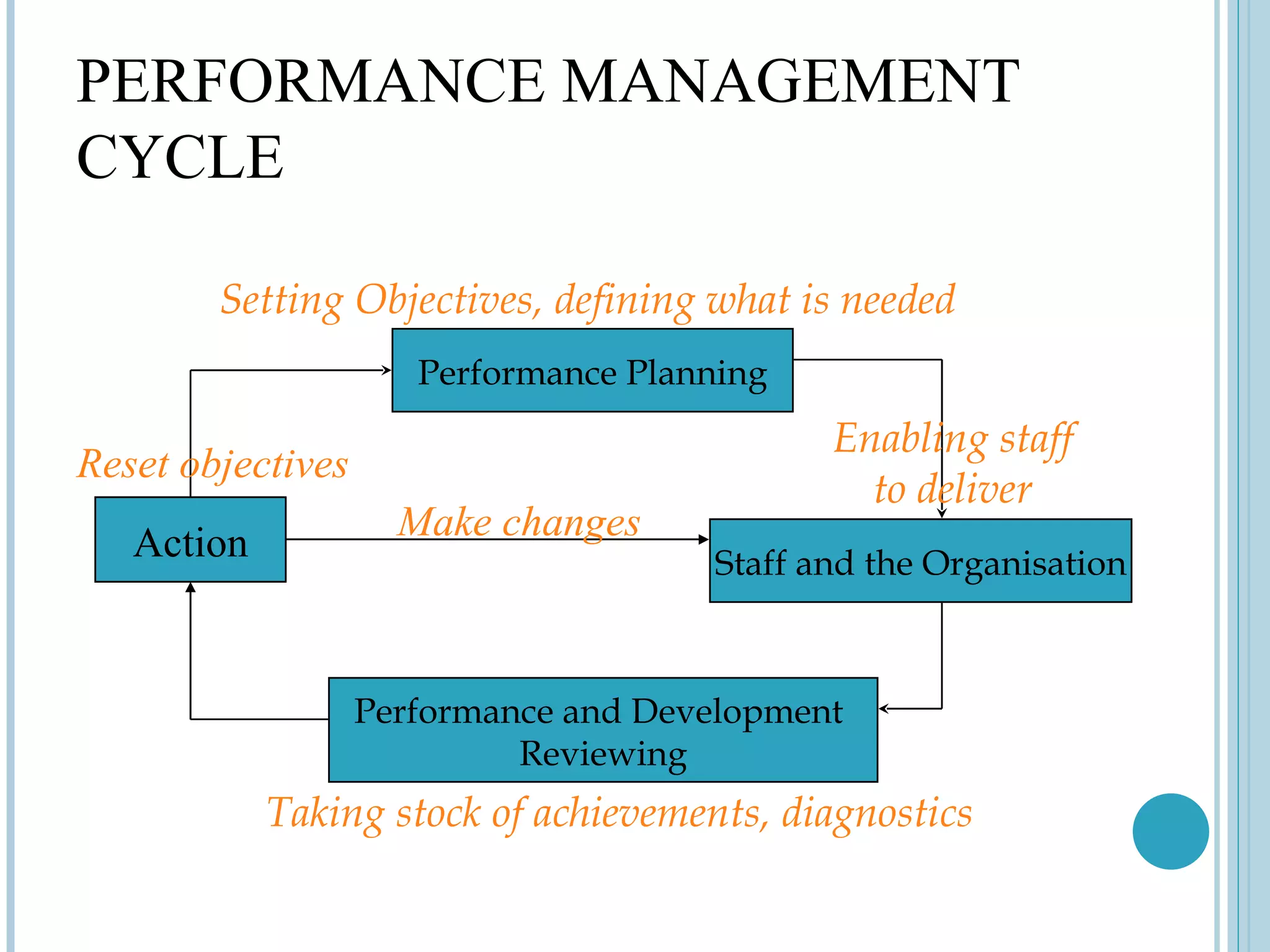
PERFORMANCE MANAGEMENT
CYCLE

        Setting Objectives, defining what is needed
                      Performance Planning
                                              Enabling staff
Reset objectives
                                                to deliver
                     Make changes
   Action                              Staff and the Organisation


                   Performance and Development
                            Reviewing
            Taking stock of achievements, diagnostics
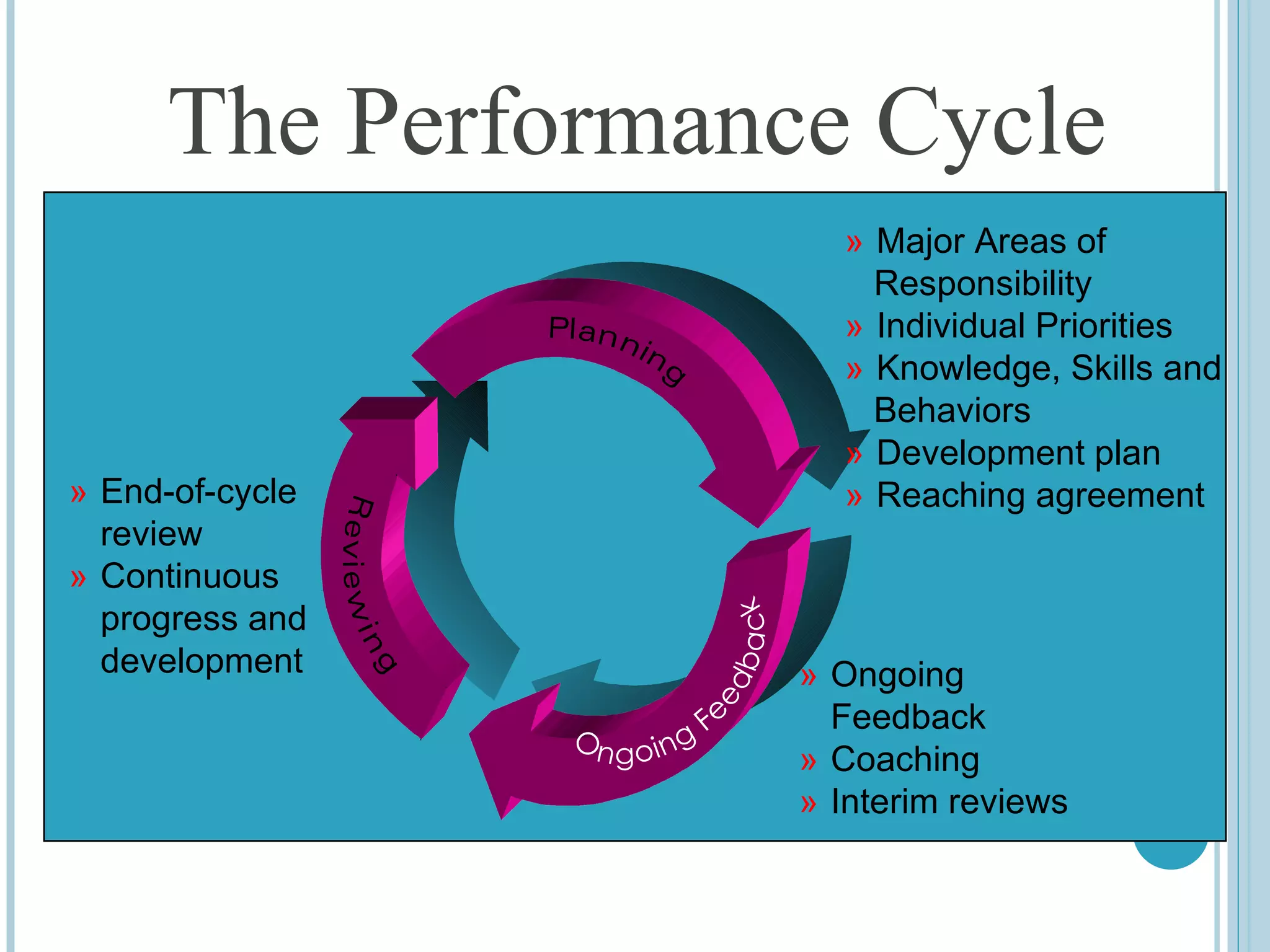
The Performance Cycle
                     » Major Areas of
                       Responsibility
                     » Individual Priorities
                     » Knowledge, Skills and
                       Behaviors
                     » Development plan
» End-of-cycle       » Reaching agreement
  review
» Continuous
  progress and
  development      » Ongoing
                     Feedback
                   » Coaching
                   » Interim reviews
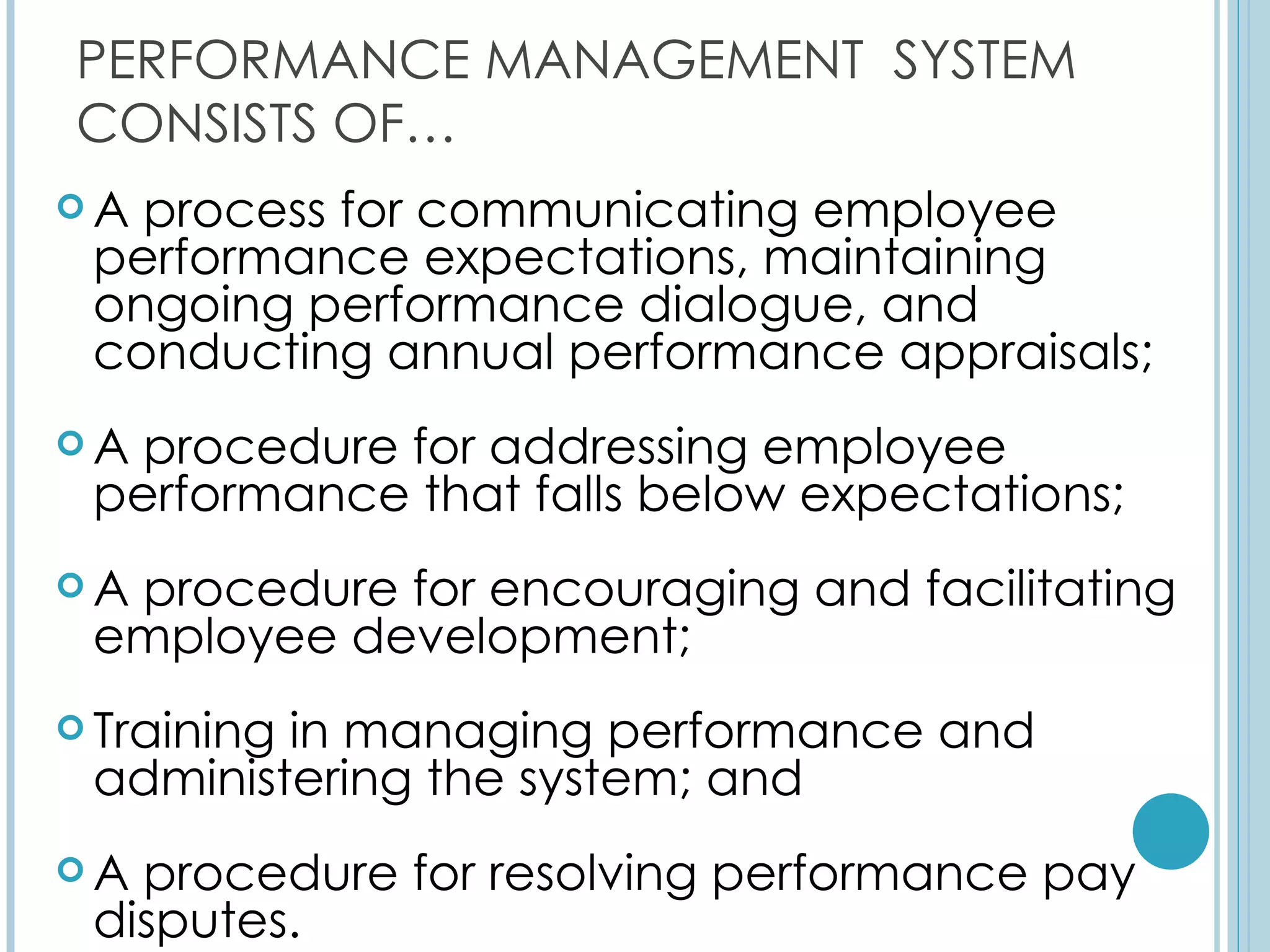
PERFORMANCE MANAGEMENT SYSTEM
CONSISTS OF…
A process for communicating employee
 performance expectations, maintaining
 ongoing performance dialogue, and
 conducting annual performance appraisals;
A procedure for addressing employee
 performance that falls below expectations;
Aprocedure for encouraging and facilitating
 employee development;
 Training
         in managing performance and
 administering the system; and
A procedure for resolving performance pay
 disputes.
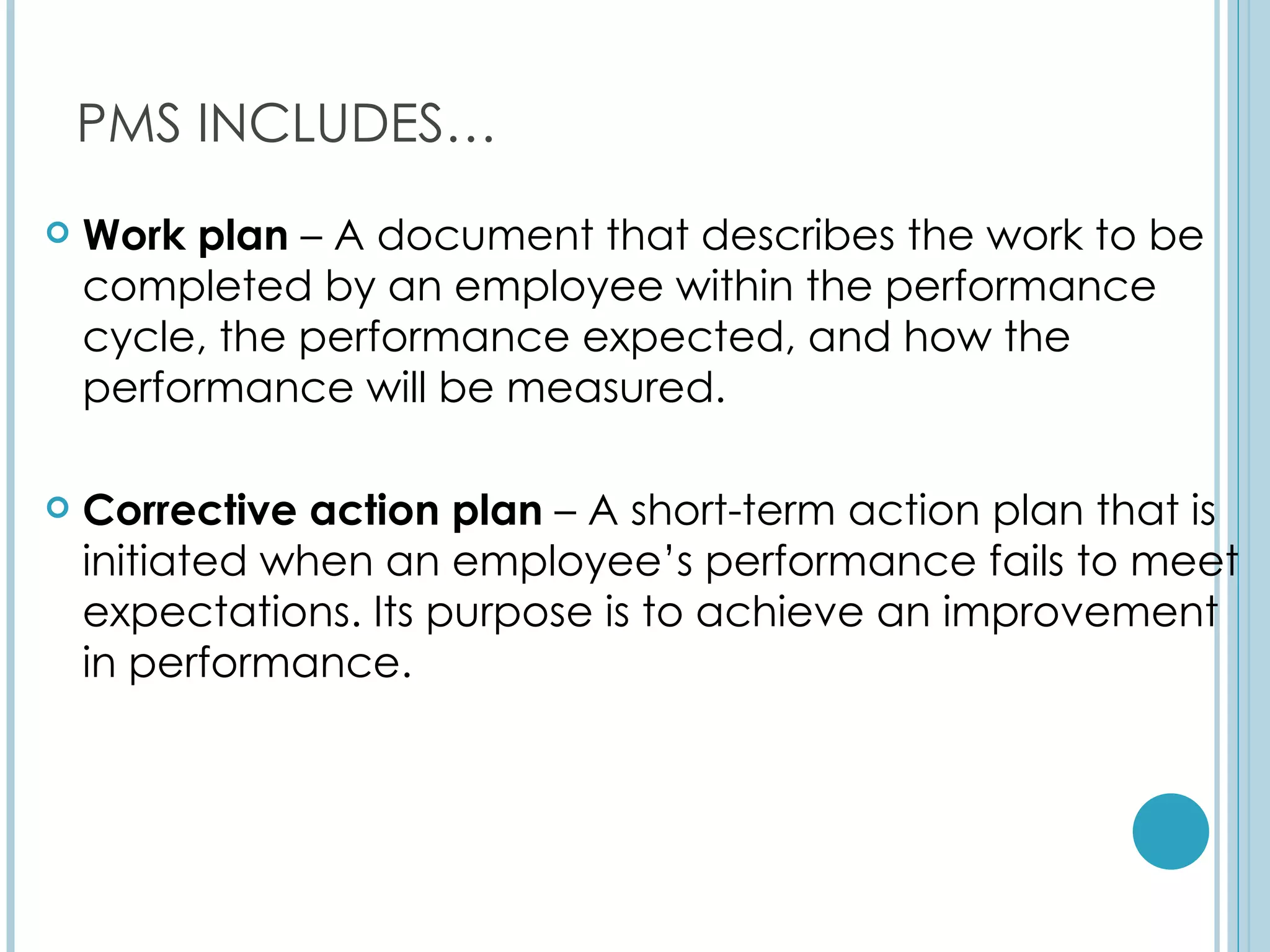
PMS INCLUDES…
   Work plan – A document that describes the work to be
    completed by an employee within the performance
    cycle, the performance expected, and how the
    performance will be measured.

   Corrective action plan – A short-term action plan that is
    initiated when an employee’s performance fails to meet
    expectations. Its purpose is to achieve an improvement
    in performance.
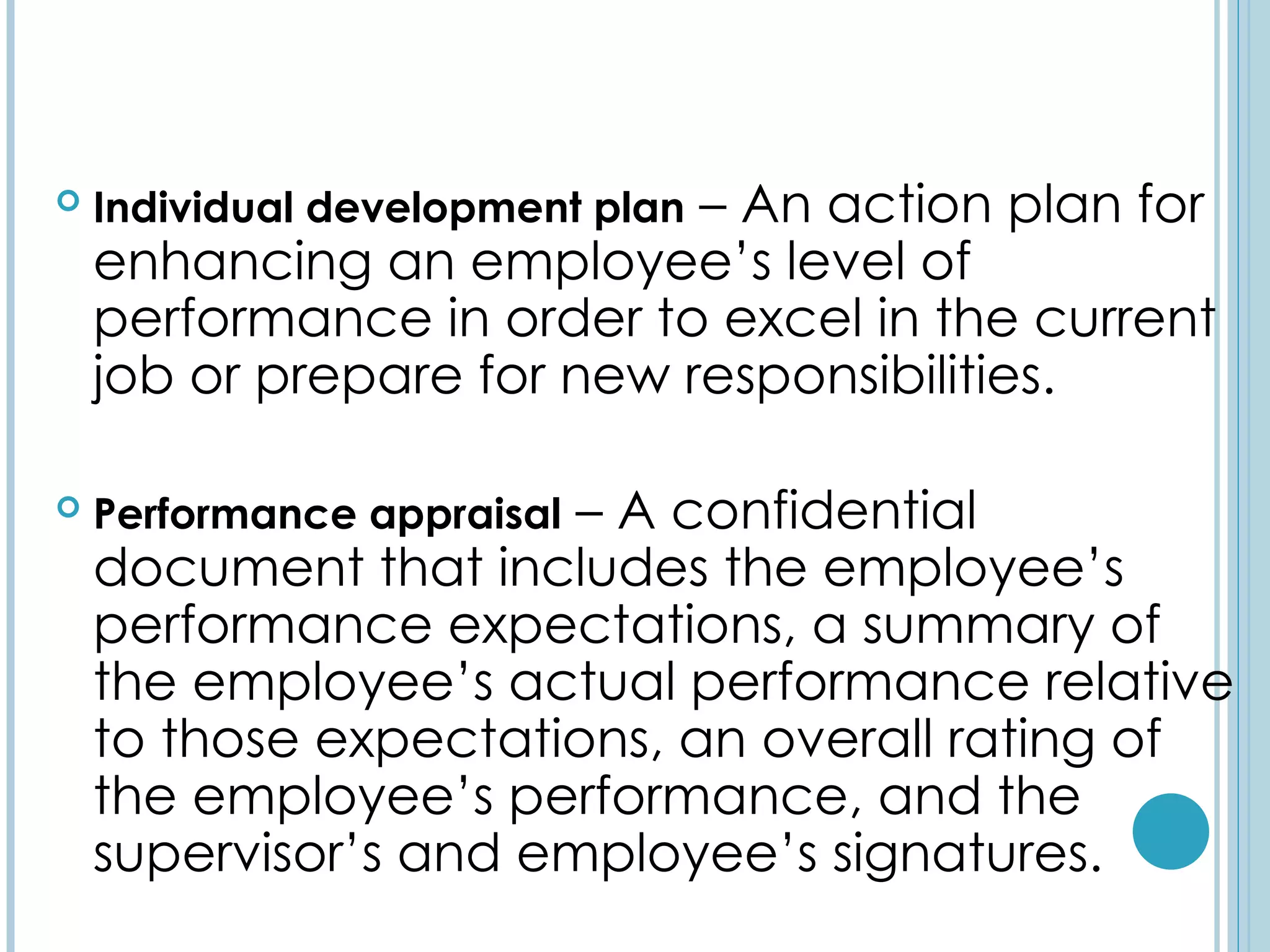
                           – An action plan for
    Individual development plan
    enhancing an employee’s level of
    performance in order to excel in the current
    job or prepare for new responsibilities.

                      – A confidential
    Performance appraisal
    document that includes the employee’s
    performance expectations, a summary of
    the employee’s actual performance relative
    to those expectations, an overall rating of
    the employee’s performance, and the
    supervisor’s and employee’s signatures.
CONTD…


   Performance documentation– A letter, memo,
    completed form, or note on which the
    supervisor indicates the extent to which the
    employee is currently meeting expectations
    and provides evidence to support that
    conclusion.

                – Appraising employees in a
    Fair appraisal
    manner that accurately reflects how they
    performed relative to the expectations
    defined in their work plan and in a manner
    that is not influenced by factors irrelevant to
    performance.
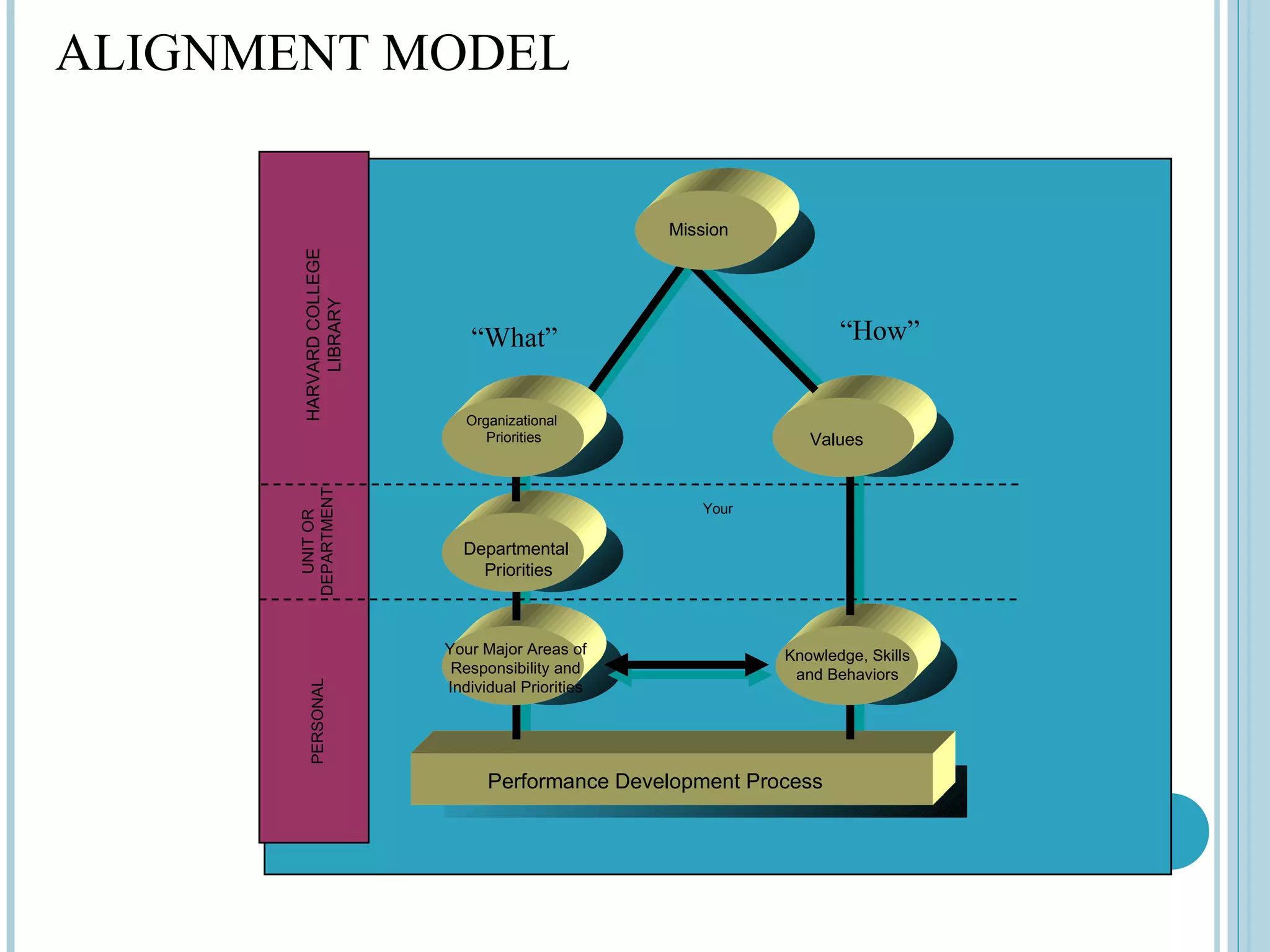
ALIGNMENT MODEL


                                                  Mission


        HARVARD COLLEGE
            LIBRARY          “What”                                 “How”


                             Organizational
                                Priorities                      Values
       DEPARTMENT


                                                      Your
         UNIT OR


                            Departmental
                              Priorities


                          Your Major Areas of                Knowledge, Skills
                           Responsibility and                 and Behaviors
         PERSONAL


                          Individual Priorities


                                Performance Development Process
Thank   You

Learning & Development and the Performance management

  • 1.
    HUMAN RESOURCE MANAGEMENT PRESENTATION ON LEARNING & DEVELOPMENT AND THE PERFORMANCE MANAGEMENT OF BADISCHE ANILIN & SODA FABRIK (BASF) Group Menmbers Ahmed, Ashek 11-18513-1 (Leader) Khan ,Golam Eistiaque 11-18406-1 Ripon, Syed Md. 11-18432-1 Sumon, Md. Shamim Ahmed 11-18509-1 Anjum, Md. Zuhayer 11-18475-1
  • 2.
    LEARNING AND DEVELOPMENT  The Learning and development section of HR describes the various options that are available to people designing learning solutions.  It then looks at learning styles and other factors which need to be taken into account when designing and implementing a learning intervention.  Case studies provide real-life examples of the point covered.
  • 3.
    LEARNING AND DEVELOPMENT (CONTD…)  Learning is there to help the organization achieve its objectives.  Motivation and learning styles are the most important issues that need to be taken into account in the design of effective learning.  Learning needs must be accurately identified.  The learning outcomes should be clearly identified before any learning design takes place.
  • 4.
    TYPES OF LEARNINGSTRATEGIES  There are three main types of learning strategies:  One-to-many  One-to-one  Remote  Blended learning is a blend of different learning strategies.
  • 5.
    BADISCHE ANILIN &SODA FABRIK (BASF)  BASF is the leading chemical company of the world. Founded on 1865 in Ludwigshafen, Germany.  Among all the other chemical company of the world only BASF has access in every area of chemical operation.  BASF leads the chemical industry with its strong values and principle in the countries it operates.  It has HR division all over the world and they follow the guidelines of BASF, AG.
  • 6.
    LEARNING & DEVELOPMENTIN BASF  There are 2 types of learning courses:  Regional learning by BASF comprises the Leadership Academy Asia Pacific and Programs on Specific Topics. These programs are offered to Managers and team leaders. Eligibility is subject to criteria for each module.  Local courses are learning programs conducted by external training organizations. These may be organized in-house or conducted in public runs. Such programs must be relevant to the employee’s current job function.
  • 7.
    LEADERSHIP EXCELLENCE PROGRAM  Goalof the Program:  BASF goal is to systematically identify and develop regional managers with high potential for business and functional management positions in BASF.  It fully supports the BASF 2020 Vision- Form the “Best Team in Industry” strategic guideline as well as the “Executive Diversity Initiative”.  This program is aligned with the BASF Executive Management Development program for Executives and Executives Candidates.
  • 8.
    DEVELOPMENT OF CANDIDATES  RBU (Regional Business Unit) Head or Function Head is responsible for the development of candidates.  Each Candidate should have a concrete Development Plan indicating development measures.  A Candidate’s development should be based on real jobs and assignments.  Fortified by structured learning programs.
  • 9.
    E- LEARNING SYSTEM  BASF has an intranet especially for HR department.  All the employees of BASF all over the world can enter here and participate to online learning section.  Technical sections is arranged according to the different BU (Business Unit) and giving better answer to the questionnaire puts extra weight to the employees during the time of performance evaluation.
  • 10.
    FORMANCE MANAGEMENT A management process for ensuring employees are focusing their work efforts in ways that contribute to achieving the agency’s mission. It consists of three phases: (a) setting expectations for employee performance, (b) maintaining a dialogue between supervisor and employee (c) measuring actual performance relative to performance expectations.
  • 11.
    WHY MEASURE PERFORMANCE? Because  What you cannot measure you cannot improve.  If you cannot improve you cannot grow.  Measurement helps in objectively differentiating between performers and non performers.  Pay for performance is possible only through metrics.
  • 12.
    PERFORMANCE MANAGEMENT CYCLE Setting Objectives, defining what is needed Performance Planning Enabling staff Reset objectives to deliver Make changes Action Staff and the Organisation Performance and Development Reviewing Taking stock of achievements, diagnostics
  • 13.
    The Performance Cycle » Major Areas of Responsibility » Individual Priorities » Knowledge, Skills and Behaviors » Development plan » End-of-cycle » Reaching agreement review » Continuous progress and development » Ongoing Feedback » Coaching » Interim reviews
  • 14.
    PERFORMANCE MANAGEMENT SYSTEM CONSISTSOF… A process for communicating employee performance expectations, maintaining ongoing performance dialogue, and conducting annual performance appraisals; A procedure for addressing employee performance that falls below expectations; Aprocedure for encouraging and facilitating employee development;  Training in managing performance and administering the system; and A procedure for resolving performance pay disputes.
  • 15.
    PMS INCLUDES…  Work plan – A document that describes the work to be completed by an employee within the performance cycle, the performance expected, and how the performance will be measured.  Corrective action plan – A short-term action plan that is initiated when an employee’s performance fails to meet expectations. Its purpose is to achieve an improvement in performance.
  • 16.
    – An action plan for Individual development plan enhancing an employee’s level of performance in order to excel in the current job or prepare for new responsibilities.  – A confidential Performance appraisal document that includes the employee’s performance expectations, a summary of the employee’s actual performance relative to those expectations, an overall rating of the employee’s performance, and the supervisor’s and employee’s signatures.
  • 17.
    CONTD…  Performance documentation– A letter, memo, completed form, or note on which the supervisor indicates the extent to which the employee is currently meeting expectations and provides evidence to support that conclusion.  – Appraising employees in a Fair appraisal manner that accurately reflects how they performed relative to the expectations defined in their work plan and in a manner that is not influenced by factors irrelevant to performance.
  • 18.
    ALIGNMENT MODEL Mission HARVARD COLLEGE LIBRARY “What” “How” Organizational Priorities Values DEPARTMENT Your UNIT OR Departmental Priorities Your Major Areas of Knowledge, Skills Responsibility and and Behaviors PERSONAL Individual Priorities Performance Development Process
  • 19.