1
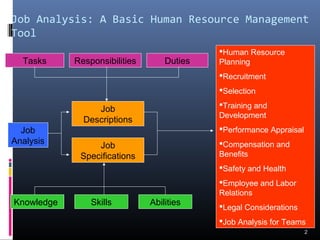
Job Analysis: A Basic Human Resource Management
Tool
2
Tasks Responsibilities Duties
Job
Analysis
Job
Descriptions
Job
Specifications
Knowledge Skills Abilities
Human Resource
Planning
Recruitment
Selection
Training and
Development
Performance Appraisal
Compensation and
Benefits
Safety and Health
Employee and Labor
Relations
Legal Considerations
Job Analysis for Teams
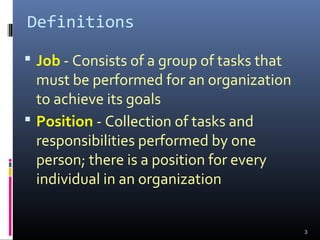
Definitions
 Job - Consists of a group of tasks that
must be performed for an organization
to achieve its goals
 Position - Collection of tasks and
responsibilities performed by one
person; there is a position for every
individual in an organization
3
Definitions (Continued)
 Job analysis - Systematic process of
determining the skills, duties, and knowledge
required for performing jobs in an organization
 Job description – document providing
information regarding tasks, duties, and
responsibilities of job
 Job specification – minimum qualifications to
perform a particular job
4
Types Of Job Analysis
Information
Considerable information is needed,
such as:
 Worker-oriented activities
 Machines, tools, equipment, and work
aids used
 Job-related tangibles and intangibles
 Work performance
 Job content
 Personal requirements for the job
5
Summary of Types of Data Collected Through Job
Analysis
 Work Activities – work activities and processes; activity records (in film
form, for example); procedures used; personal responsibility
 Worker-oriented activities – human behaviors, such as physical actions
and communicating on the job; elemental motions for methods analysis;
personal job demands, such as energy expenditure
 Machines, tools, equipment, and work aids used
 Job-related tangibles and intangibles – knowledge dealt with or
applied (as in accounting); materials processed; products made or
services performed
 Work performance – error analysis; work standards; work
measurements, such as time taken for a task
 Job context – work schedule; financial and nonfinancial incentives;
physical working conditions; organizational and social contexts
 Personal requirements for the job – personal attributes such as
personality and interests; education and training required; work
experience
6
Sources of job analysis
informaiton
 Manager
 Incumbent
 SME
 Job analyst
 DOT
 O*NET
7
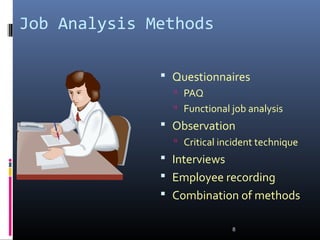
Job Analysis Methods
 Questionnaires
 PAQ
 Functional job analysis
 Observation
 Critical incident technique
 Interviews
 Employee recording
 Combination of methods
8
Timeliness of Job Analysis
Rapid pace of
technological change
makes need for
accurate job analysis
even more important
now and in the
future.
9
Job Analysis and the Law
 Fair Labor Standards Act –
employees categorized as
exempt or nonexempt
 Equal Pay Act – similar pay
must be provided if jobs are
not substantially different as
shown in job descriptions
10
Job Analysis and the Law
(Continued)
 Civil Rights Act – basis for adequate defenses
against unfair discriminations charges in selection,
promotion, and other areas of HR administration
 Occupational Safety and Health Act – specify job
elements that endanger health or are considered
unsatisfactory or distasteful by most people
 Americans with Disabilities Act – make reasonable
accommodations for disabled workers
11
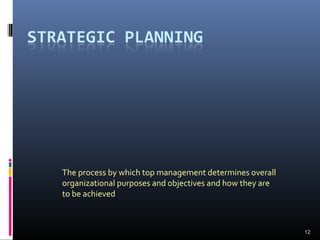
12
The process by which top management determines overall
organizational purposes and objectives and how they are
to be achieved
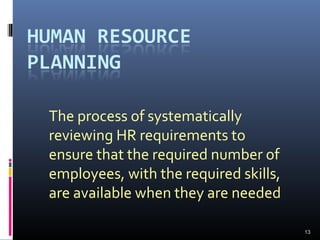
13
The process of systematically
reviewing HR requirements to
ensure that the required number of
employees, with the required skills,
are available when they are needed
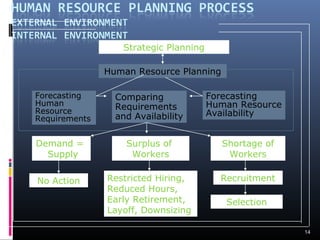
14
Strategic Planning
Human Resource Planning
Forecasting
Human
Resource
Requirements
Comparing
Requirements
and Availability
Forecasting
Human Resource
Availability
Surplus of
Workers
Demand =
Supply
No Action Restricted Hiring,
Reduced Hours,
Early Retirement,
Layoff, Downsizing
Shortage of
Workers
Recruitment
Selection
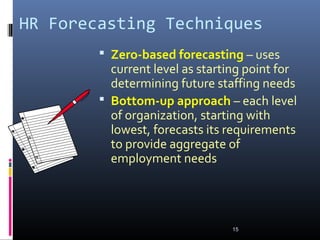
HR Forecasting Techniques
 Zero-based forecasting – uses
current level as starting point for
determining future staffing needs
 Bottom-up approach – each level
of organization, starting with
lowest, forecasts its requirements
to provide aggregate of
employment needs
15
HR Forecasting Techniques
(Continued)
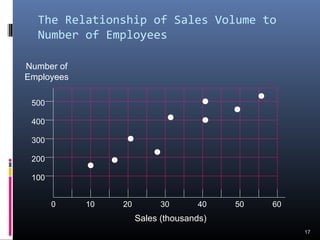
 Mathematical models –Assist in forecasting.
Relationship between sales demand and number
of employees needed is positive one.
 Simulation – technique with experimenting with
real-world situation through a mathematical
model
16
The Relationship of Sales Volume to
Number of Employees
17
Number of
Employees
500
400
300
200
100
0 10 20 30 40 50 60
Sales (thousands)
Forecasting HR Requirements
 Estimate of numbers and kinds of employees
the organization will need at future dates
 Demand for firm’s goods or services must be
forecast
 Forecast is then converted into people
requirements
18
Forecasting HR Availability
 Determining whether the firm will be able to
secure employees with the necessary skills,
and from what sources these individuals may
be obtained
 Show whether the needed employees may
be obtained from within the company, from
outside the organization, or from a
combination of the two sources
19
Surplus of Employees
 Restricted hiring –
employees who leave are
not replaced
 Reduced hours
 Early retirement
 Layoffs
20
Shortage of Workers
Forecasted
 Creative recruiting
 Compensation incentives –
premium pay is one method
 Training programs – prepare
previously unemployable people for
positions
 Different selection standards – alter
current criteria
21
Human Resource Information
Systems (HRIS)
Virtually all HR management functions
can be enhanced through the use of an
HRIS – any organized approach for
obtaining relevant and time information
on which to base HR decisions
22
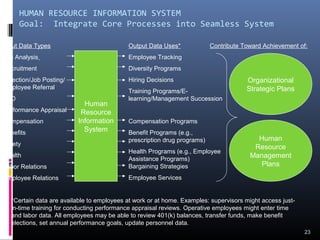
HUMAN RESOURCE INFORMATION SYSTEM
Goal: Integrate Core Processes into Seamless System
23
Input Data Types
Job Analysis
Recruitment
Selection/Job Posting/
Employee Referral
T&D
Performance Appraisal
Compensation
Benefits
Safety
Health
Labor Relations
Employee Relations
Output Data Uses*
Employee Tracking
Diversity Programs
Hiring Decisions
Training Programs/E-
learning/Management Succession
Compensation Programs
Benefit Programs (e.g.,
prescription drug programs)
Health Programs (e.g., Employee
Assistance Programs)
Bargaining Strategies
Employee Services
Organizational
Strategic Plans
Human
Resource
Management
Plans
Contribute Toward Achievement of:
Human
Resource
Information
System
*Certain data are available to employees at work or at home. Examples: supervisors might access just-
in-time training for conducting performance appraisal reviews. Operative employees might enter time
and labor data. All employees may be able to review 401(k) balances, transfer funds, make benefit
elections, set annual performance goals, update personnel data.
Job Design
 Process of determining the specific tasks to be
performed, the methods used in performing
these tasks, and how the job relates to other
work in the organization
 Job enrichment - Basic changes in the content
and level of responsibility of a job, so as to
provide greater challenge to the worker
24
Job Design
 Job enlargement - Changes in the scope of a
job to provide greater variety to the worker
 Reengineering – Fundamental rethinking and
radical redesign of business processes to
achieve dramatic improvements in critical,
contemporary measures of performance, such
as cost, quality, service and speed
25

JOB ANALYSIS AND HUMAN RESOURCE PLANNING

  • 1.
  • 2.
    Job Analysis: ABasic Human Resource Management Tool 2 Tasks Responsibilities Duties Job Analysis Job Descriptions Job Specifications Knowledge Skills Abilities Human Resource Planning Recruitment Selection Training and Development Performance Appraisal Compensation and Benefits Safety and Health Employee and Labor Relations Legal Considerations Job Analysis for Teams
  • 3.
    Definitions  Job -Consists of a group of tasks that must be performed for an organization to achieve its goals  Position - Collection of tasks and responsibilities performed by one person; there is a position for every individual in an organization 3
  • 4.
    Definitions (Continued)  Jobanalysis - Systematic process of determining the skills, duties, and knowledge required for performing jobs in an organization  Job description – document providing information regarding tasks, duties, and responsibilities of job  Job specification – minimum qualifications to perform a particular job 4
  • 5.
    Types Of JobAnalysis Information Considerable information is needed, such as:  Worker-oriented activities  Machines, tools, equipment, and work aids used  Job-related tangibles and intangibles  Work performance  Job content  Personal requirements for the job 5
  • 6.
    Summary of Typesof Data Collected Through Job Analysis  Work Activities – work activities and processes; activity records (in film form, for example); procedures used; personal responsibility  Worker-oriented activities – human behaviors, such as physical actions and communicating on the job; elemental motions for methods analysis; personal job demands, such as energy expenditure  Machines, tools, equipment, and work aids used  Job-related tangibles and intangibles – knowledge dealt with or applied (as in accounting); materials processed; products made or services performed  Work performance – error analysis; work standards; work measurements, such as time taken for a task  Job context – work schedule; financial and nonfinancial incentives; physical working conditions; organizational and social contexts  Personal requirements for the job – personal attributes such as personality and interests; education and training required; work experience 6
  • 7.
    Sources of jobanalysis informaiton  Manager  Incumbent  SME  Job analyst  DOT  O*NET 7
  • 8.
    Job Analysis Methods Questionnaires  PAQ  Functional job analysis  Observation  Critical incident technique  Interviews  Employee recording  Combination of methods 8
  • 9.
    Timeliness of JobAnalysis Rapid pace of technological change makes need for accurate job analysis even more important now and in the future. 9
  • 10.
    Job Analysis andthe Law  Fair Labor Standards Act – employees categorized as exempt or nonexempt  Equal Pay Act – similar pay must be provided if jobs are not substantially different as shown in job descriptions 10
  • 11.
    Job Analysis andthe Law (Continued)  Civil Rights Act – basis for adequate defenses against unfair discriminations charges in selection, promotion, and other areas of HR administration  Occupational Safety and Health Act – specify job elements that endanger health or are considered unsatisfactory or distasteful by most people  Americans with Disabilities Act – make reasonable accommodations for disabled workers 11
  • 12.
    12 The process bywhich top management determines overall organizational purposes and objectives and how they are to be achieved
  • 13.
    13 The process ofsystematically reviewing HR requirements to ensure that the required number of employees, with the required skills, are available when they are needed
  • 14.
    14 Strategic Planning Human ResourcePlanning Forecasting Human Resource Requirements Comparing Requirements and Availability Forecasting Human Resource Availability Surplus of Workers Demand = Supply No Action Restricted Hiring, Reduced Hours, Early Retirement, Layoff, Downsizing Shortage of Workers Recruitment Selection
  • 15.
    HR Forecasting Techniques Zero-based forecasting – uses current level as starting point for determining future staffing needs  Bottom-up approach – each level of organization, starting with lowest, forecasts its requirements to provide aggregate of employment needs 15
  • 16.
    HR Forecasting Techniques (Continued) Mathematical models –Assist in forecasting. Relationship between sales demand and number of employees needed is positive one.  Simulation – technique with experimenting with real-world situation through a mathematical model 16
  • 17.
    The Relationship ofSales Volume to Number of Employees 17 Number of Employees 500 400 300 200 100 0 10 20 30 40 50 60 Sales (thousands)
  • 18.
    Forecasting HR Requirements Estimate of numbers and kinds of employees the organization will need at future dates  Demand for firm’s goods or services must be forecast  Forecast is then converted into people requirements 18
  • 19.
    Forecasting HR Availability Determining whether the firm will be able to secure employees with the necessary skills, and from what sources these individuals may be obtained  Show whether the needed employees may be obtained from within the company, from outside the organization, or from a combination of the two sources 19
  • 20.
    Surplus of Employees Restricted hiring – employees who leave are not replaced  Reduced hours  Early retirement  Layoffs 20
  • 21.
    Shortage of Workers Forecasted Creative recruiting  Compensation incentives – premium pay is one method  Training programs – prepare previously unemployable people for positions  Different selection standards – alter current criteria 21
  • 22.
    Human Resource Information Systems(HRIS) Virtually all HR management functions can be enhanced through the use of an HRIS – any organized approach for obtaining relevant and time information on which to base HR decisions 22
  • 23.
    HUMAN RESOURCE INFORMATIONSYSTEM Goal: Integrate Core Processes into Seamless System 23 Input Data Types Job Analysis Recruitment Selection/Job Posting/ Employee Referral T&D Performance Appraisal Compensation Benefits Safety Health Labor Relations Employee Relations Output Data Uses* Employee Tracking Diversity Programs Hiring Decisions Training Programs/E- learning/Management Succession Compensation Programs Benefit Programs (e.g., prescription drug programs) Health Programs (e.g., Employee Assistance Programs) Bargaining Strategies Employee Services Organizational Strategic Plans Human Resource Management Plans Contribute Toward Achievement of: Human Resource Information System *Certain data are available to employees at work or at home. Examples: supervisors might access just- in-time training for conducting performance appraisal reviews. Operative employees might enter time and labor data. All employees may be able to review 401(k) balances, transfer funds, make benefit elections, set annual performance goals, update personnel data.
  • 24.
    Job Design  Processof determining the specific tasks to be performed, the methods used in performing these tasks, and how the job relates to other work in the organization  Job enrichment - Basic changes in the content and level of responsibility of a job, so as to provide greater challenge to the worker 24
  • 25.
    Job Design  Jobenlargement - Changes in the scope of a job to provide greater variety to the worker  Reengineering – Fundamental rethinking and radical redesign of business processes to achieve dramatic improvements in critical, contemporary measures of performance, such as cost, quality, service and speed 25