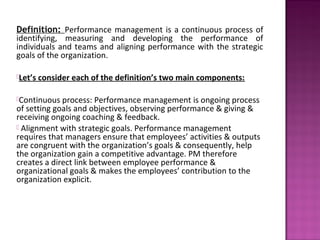
Definition: Performance management is a continuous process of
identifying, measuring and developing the performance of
individuals and teams and aligning performance with the strategic
goals of the organization.

Let’s   consider each of the definition’s two main components:

Continuous  process: Performance management is ongoing process
of setting goals and objectives, observing performance & giving &
receiving ongoing coaching & feedback.
 Alignment with strategic goals. Performance management
requires that managers ensure that employees’ activities & outputs
are congruent with the organization’s goals & consequently, help
the organization gain a competitive advantage. PM therefore
creates a direct link between employee performance &
organizational goals & makes the employees’ contribution to the
organization explicit.
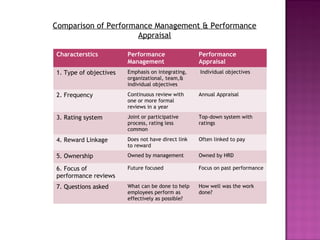
Comparison of Performance Management & Performance
                      Appraisal

Characterstics          Performance                 Performance
                        Management                  Appraisal
1. Type of objectives   Emphasis on integrating,    Individual objectives
                        organizational, team,&
                        individual objectives

2. Frequency            Continuous review with      Annual Appraisal
                        one or more formal
                        reviews in a year

3. Rating system        Joint or participative      Top-down system with
                        process, rating less        ratings
                        common

4. Reward Linkage       Does not have direct link   Often linked to pay
                        to reward

5. Ownership            Owned by management         Owned by HRD

6. Focus of             Future focused              Focus on past performance
performance reviews
7. Questions asked      What can be done to help    How well was the work
                        employees perform as        done?
                        effectively as possible?
   Motivation To perform is increase.
   Self esteem is increased.
   Managers gain insight about subordinates.
   The definitions of job & criteria are clarified.
   Self-insight & development are enhanced.
    Administrative actions are more fair &
    appropriate.
   Organisational goals are made clear.
Employees become more competent.
There is better protection from lawsuits.
Better & more timely differentiation b/w good &
 poor performer.
Supervisors’ view of performance are communicated
 more clearly.
Organisational change is facilitated.
Motivation, commitment, & intentions to stay in the
  organisation are enhanced.
   Increased Turnover
   Use Of Misleading Information
   Lowered Self-Esteem
   Wasted time & Money
   Damaged Relationship
   Decreased Motivation TO Perform
   Employee Burnout & Job dissatisfaction
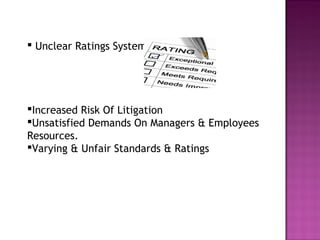
 Unclear Ratings System


Increased Risk Of Litigation
Unsatisfied Demands On Managers & Employees
Resources.
Varying & Unfair Standards & Ratings
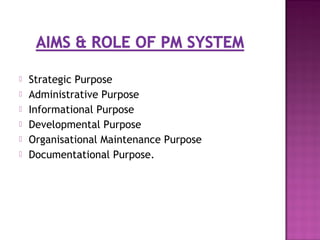
   Strategic Purpose
   Administrative Purpose
   Informational Purpose
   Developmental Purpose
   Organisational Maintenance Purpose
   Documentational Purpose.
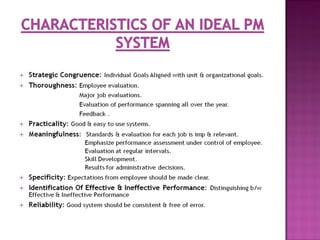
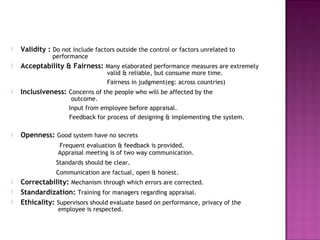
   Validity : Do not include factors outside the control or factors unrelated to
               performance
   Acceptability & Fairness: Many elaborated performance measures are extremely
                                   valid & reliable, but consume more time.
                                   Fairness in judgment(eg: across countries)
   Inclusiveness: Concerns of the people who will be affected by the
                      outcome.
                     Input from employee before appraisal.
                     Feedback for process of designing & implementing the system.

   Openness: Good system have no secrets
                 Frequent evaluation & feedback is provided.
                 Appraisal meeting is of two way communication.
                Standards should be clear.
                Communication are factual, open & honest.
   Correctability: Mechanism through which errors are corrected.
   Standardization: Training for managers regarding appraisal.
   Ethicality: Supervisors should evaluate based on performance, privacy of the
                 employee is respected.
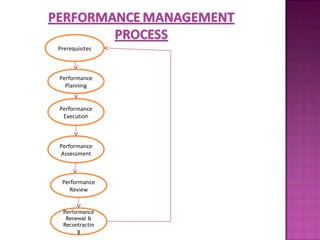
Prerequisites


Performance
  Planning


Performance
 Execution


Performance
Assessment


 Performance
   Review


  Performance
   Renewal &
  Recontractin
        g
STAGES IN PERFORMANCE MANAGEMENT PROCESS

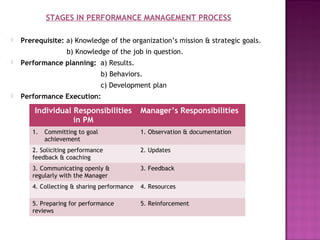
   Prerequisite: a) Knowledge of the organization’s mission & strategic goals.
                   b) Knowledge of the job in question.
   Performance planning: a) Results.
                                 b) Behaviors.
                                 c) Development plan
   Performance Execution:

        Individual Responsibilities          Manager’s Responsibilities
                   in PM
       1.   Committing to goal               1. Observation & documentation
            achievement
       2. Soliciting performance             2. Updates
       feedback & coaching
       3. Communicating openly &             3. Feedback
       regularly with the Manager
       4. Collecting & sharing performance   4. Resources

       5. Preparing for performance          5. Reinforcement
       reviews
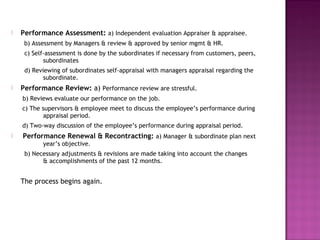
   Performance Assessment: a) Independent evaluation Appraiser & appraisee.
     b) Assessment by Managers & review & approved by senior mgmt & HR.
     c) Self-assessment is done by the subordinates if necessary from customers, peers,
            subordinates
     d) Reviewing of subordinates self-appraisal with managers appraisal regarding the
            subordinate.
   Performance Review: a) Performance review are stressful.
    b) Reviews evaluate our performance on the job.
    c) The supervisors & employee meet to discuss the employee’s performance during
           appraisal period.
    d) Two-way discussion of the employee’s performance during appraisal period.
   Performance Renewal & Recontracting: a) Manager & subordinate plan next
           year’s objective.
     b) Necessary adjustments & revisions are made taking into account the changes
           & accomplishments of the past 12 months.


    The process begins again.
PERFORMANCE MANAGEMENT & STRATEGIC PLANNING

 Definition of Strategic Planning: It is a process that involves
 describing the organization’s destination, assessing barriers that
 stand in the way of that destination, & selecting approaches for
 moving forward. The main goal of strategic planning is to
 allocate resources in a way that provides organization with a
 competitive advantage. Overall, a strategic plan serves as a
 blueprint that defines how the organization will allocate its
 resources in pursuit of its goals.
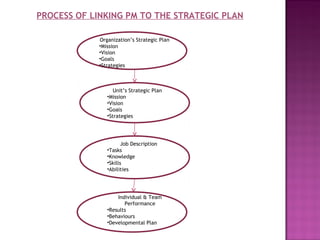
PROCESS OF LINKING PM TO THE STRATEGIC PLAN

             Organization’s Strategic Plan
             •Mission
             •Vision
             •Goals
             •Strategies


                   Unit’s Strategic Plan
                •Mission
                •Vision
                •Goals
                •Strategies


                       Job Description
                •Tasks
                •Knowledge
                •Skills
                •Abilities


                    Individual & Team
                       Performance
                •Results
                •Behaviours
                •Developmental Plan
Developing strategic plans at organizational level

Environmental Analysis: Opportunities & Threats


MISSION: Why an organization exists?

   Characteristics Of a Good Mission Statement:

   It should be feasible
   It should be precise
   It should be clear
   It should be motivating
   It should be distinctive
   It should indicate major components of strategy
   It should indicate how objectives are to be accomplished.
VISION: What organization wants to become?
 Characteristics Of a Good Vision Statement:
   Concise
   Appeals to all stakeholders
   Consistent with Mission & Values
   It should be feasible
   Verifiable
   Inspirational


GOALS: Short-term goals within specified period covered by plan.
How the vision & mission will be implemented & fulfilled
Strategies: Procedures to reach the stated objectives.
   Communicate knowledge of strategic plan
   Outline knowledge, skills,& abilities needed for strategy implementation
   Propose reward systems
   Our Mission: At Microsoft, work to help people & businesses throughout the
    world to realize their full potential. This is our mission. Everyhting we do
    reflects this mission & the values that make it possible.
   Our Values:
   Integrity & honesty
   Passion for customers, for our partners, for technology
   Openness & respectfulness
   Taking on big challenges
   Constructive self-criticism, self-improvement, & personal excellence
   Accountability to customers, shareholders, partners, & employees for
    commitments, results, & quality.


JOB DESCRIPTIONS:
   Should be congruent with the organization & unit mission, vision, goals &
    strategies.
   Objectives listing of job little, tasks, duties, & responsibilities involved in a
    job.
   Differentiate the job from other jobs
   INDIVIDUAL & TEAM PERFORMANCE:

   Motivate employees to display the behavior & produce results.
   HR can function to make informed decision about design choices.
   Criteria measured in the PMS are result that must be relevant to the units &
    organization.

Module 1 pm & cm

  • 3.
    Definition: Performance managementis a continuous process of identifying, measuring and developing the performance of individuals and teams and aligning performance with the strategic goals of the organization. Let’s consider each of the definition’s two main components: Continuous process: Performance management is ongoing process of setting goals and objectives, observing performance & giving & receiving ongoing coaching & feedback.  Alignment with strategic goals. Performance management requires that managers ensure that employees’ activities & outputs are congruent with the organization’s goals & consequently, help the organization gain a competitive advantage. PM therefore creates a direct link between employee performance & organizational goals & makes the employees’ contribution to the organization explicit.
  • 4.
    Comparison of PerformanceManagement & Performance Appraisal Characterstics Performance Performance Management Appraisal 1. Type of objectives Emphasis on integrating, Individual objectives organizational, team,& individual objectives 2. Frequency Continuous review with Annual Appraisal one or more formal reviews in a year 3. Rating system Joint or participative Top-down system with process, rating less ratings common 4. Reward Linkage Does not have direct link Often linked to pay to reward 5. Ownership Owned by management Owned by HRD 6. Focus of Future focused Focus on past performance performance reviews 7. Questions asked What can be done to help How well was the work employees perform as done? effectively as possible?
  • 5.
    Motivation To perform is increase.  Self esteem is increased.  Managers gain insight about subordinates.  The definitions of job & criteria are clarified.  Self-insight & development are enhanced.  Administrative actions are more fair & appropriate.  Organisational goals are made clear.
  • 6.
    Employees become morecompetent. There is better protection from lawsuits. Better & more timely differentiation b/w good & poor performer. Supervisors’ view of performance are communicated more clearly. Organisational change is facilitated. Motivation, commitment, & intentions to stay in the organisation are enhanced.
  • 7.
    Increased Turnover  Use Of Misleading Information  Lowered Self-Esteem  Wasted time & Money  Damaged Relationship  Decreased Motivation TO Perform  Employee Burnout & Job dissatisfaction
  • 8.
     Unclear RatingsSystem Increased Risk Of Litigation Unsatisfied Demands On Managers & Employees Resources. Varying & Unfair Standards & Ratings
  • 9.
    Strategic Purpose  Administrative Purpose  Informational Purpose  Developmental Purpose  Organisational Maintenance Purpose  Documentational Purpose.
  • 11.
    Validity : Do not include factors outside the control or factors unrelated to performance  Acceptability & Fairness: Many elaborated performance measures are extremely valid & reliable, but consume more time. Fairness in judgment(eg: across countries)  Inclusiveness: Concerns of the people who will be affected by the outcome. Input from employee before appraisal. Feedback for process of designing & implementing the system.  Openness: Good system have no secrets Frequent evaluation & feedback is provided. Appraisal meeting is of two way communication. Standards should be clear. Communication are factual, open & honest.  Correctability: Mechanism through which errors are corrected.  Standardization: Training for managers regarding appraisal.  Ethicality: Supervisors should evaluate based on performance, privacy of the employee is respected.
  • 12.
    Prerequisites Performance Planning Performance Execution Performance Assessment Performance Review Performance Renewal & Recontractin g
  • 13.
    STAGES IN PERFORMANCEMANAGEMENT PROCESS  Prerequisite: a) Knowledge of the organization’s mission & strategic goals. b) Knowledge of the job in question.  Performance planning: a) Results. b) Behaviors. c) Development plan  Performance Execution: Individual Responsibilities Manager’s Responsibilities in PM 1. Committing to goal 1. Observation & documentation achievement 2. Soliciting performance 2. Updates feedback & coaching 3. Communicating openly & 3. Feedback regularly with the Manager 4. Collecting & sharing performance 4. Resources 5. Preparing for performance 5. Reinforcement reviews
  • 14.
    Performance Assessment: a) Independent evaluation Appraiser & appraisee. b) Assessment by Managers & review & approved by senior mgmt & HR. c) Self-assessment is done by the subordinates if necessary from customers, peers, subordinates d) Reviewing of subordinates self-appraisal with managers appraisal regarding the subordinate.  Performance Review: a) Performance review are stressful. b) Reviews evaluate our performance on the job. c) The supervisors & employee meet to discuss the employee’s performance during appraisal period. d) Two-way discussion of the employee’s performance during appraisal period.  Performance Renewal & Recontracting: a) Manager & subordinate plan next year’s objective. b) Necessary adjustments & revisions are made taking into account the changes & accomplishments of the past 12 months. The process begins again.
  • 15.
    PERFORMANCE MANAGEMENT &STRATEGIC PLANNING Definition of Strategic Planning: It is a process that involves describing the organization’s destination, assessing barriers that stand in the way of that destination, & selecting approaches for moving forward. The main goal of strategic planning is to allocate resources in a way that provides organization with a competitive advantage. Overall, a strategic plan serves as a blueprint that defines how the organization will allocate its resources in pursuit of its goals.
  • 16.
    PROCESS OF LINKINGPM TO THE STRATEGIC PLAN Organization’s Strategic Plan •Mission •Vision •Goals •Strategies Unit’s Strategic Plan •Mission •Vision •Goals •Strategies Job Description •Tasks •Knowledge •Skills •Abilities Individual & Team Performance •Results •Behaviours •Developmental Plan
  • 17.
    Developing strategic plansat organizational level Environmental Analysis: Opportunities & Threats MISSION: Why an organization exists?  Characteristics Of a Good Mission Statement:  It should be feasible  It should be precise  It should be clear  It should be motivating  It should be distinctive  It should indicate major components of strategy  It should indicate how objectives are to be accomplished.
  • 18.
    VISION: What organizationwants to become?  Characteristics Of a Good Vision Statement:  Concise  Appeals to all stakeholders  Consistent with Mission & Values  It should be feasible  Verifiable  Inspirational GOALS: Short-term goals within specified period covered by plan. How the vision & mission will be implemented & fulfilled Strategies: Procedures to reach the stated objectives.  Communicate knowledge of strategic plan  Outline knowledge, skills,& abilities needed for strategy implementation  Propose reward systems
  • 19.
    Our Mission: At Microsoft, work to help people & businesses throughout the world to realize their full potential. This is our mission. Everyhting we do reflects this mission & the values that make it possible.  Our Values:  Integrity & honesty  Passion for customers, for our partners, for technology  Openness & respectfulness  Taking on big challenges  Constructive self-criticism, self-improvement, & personal excellence  Accountability to customers, shareholders, partners, & employees for commitments, results, & quality. JOB DESCRIPTIONS:  Should be congruent with the organization & unit mission, vision, goals & strategies.  Objectives listing of job little, tasks, duties, & responsibilities involved in a job.  Differentiate the job from other jobs
  • 20.
    INDIVIDUAL & TEAM PERFORMANCE:  Motivate employees to display the behavior & produce results.  HR can function to make informed decision about design choices.  Criteria measured in the PMS are result that must be relevant to the units & organization.