Learning Analytics
seeking new insights from educational data
Andrew Deacon
Centre For Innovation in Learning and Teaching
University of Cape Town
Teaching and Learning with Technology workshop, CPUT, 2014
Outline
• What is changing with ‘big data’
• Three eras of social science research
• Three ways educational data is analyzed
• Changing roles of analytics with more data
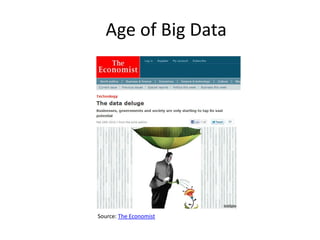
Age of Big Data
Source: The Economist
Learning Analytics
… is the measurement, collection, analysis
and reporting of data about learners and
their contexts, for purposes of
understanding and optimising learning
and the environments in which it occurs.
https://tekri.athabascau.ca/analytics
ASKING NEW QUESTIONS
Three eras of social research
1. Age of Quételet
collect data on simple & important questions
2. Classical period
get the most information from a little data
3. Present day big data
deluge of data and questions
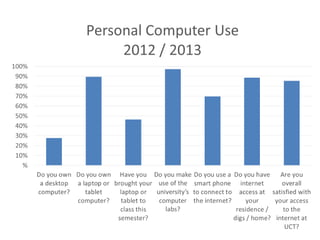
[1] UCT Student Experience Survey
• Understand students’
overall experience
• Data to effect change,
improve decisions and
policies, affirm good
practices & quality
assure
• Good practice
[2] Are streams being disadvantaged?
Within Degree Type:
• Differences in mean
final mark are
significant
• Across years,
differences in
means are similar
• Differences in 2013
are not unusual
Change in mode
of delivery
[3] UCT and social media
Prominent links to:
– Facebook
– Flickr
– LinkedIn
– Twitter
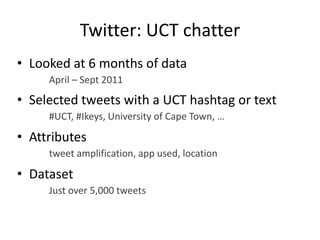
Twitter: UCT chatter
• Looked at 6 months of data
April – Sept 2011
• Selected tweets with a UCT hashtag or text
#UCT, #Ikeys, University of Cape Town, …
• Attributes
tweet amplification, app used, location
• Dataset
Just over 5,000 tweets
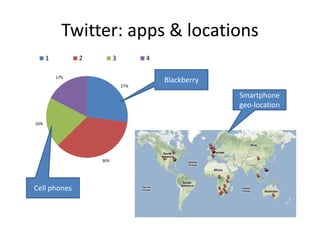
Twitter: apps & locations
27%
36%
20%
17%
1 2 3 4
Smartphone
geo-location
Cell phones
Blackberry
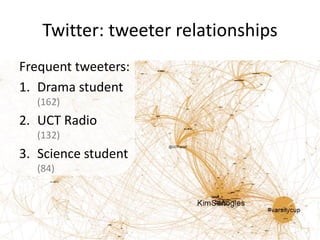
Twitter: tweeter relationships
Frequent tweeters:
1. Drama student
(162)
2. UCT Radio
(132)
3. Science student
(84)
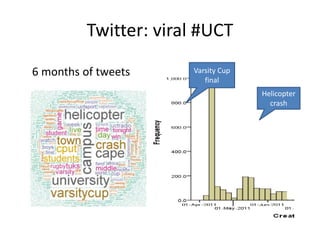
Twitter: viral #UCT
Varsity Cup
final
Helicopter
crash
6 months of tweets
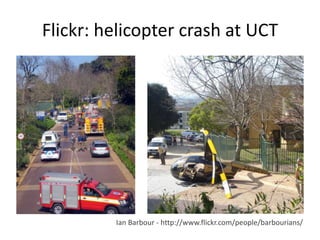
Flickr: helicopter crash at UCT
Ian Barbour - http://www.flickr.com/people/barbourians/
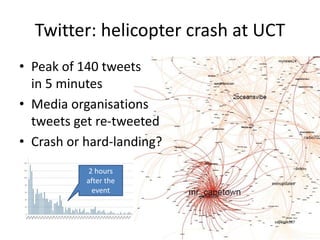
Twitter: helicopter crash at UCT
2 hours
after the
event
• Peak of 140 tweets
in 5 minutes
• Media organisations
tweets get re-tweeted
• Crash or hard-landing?
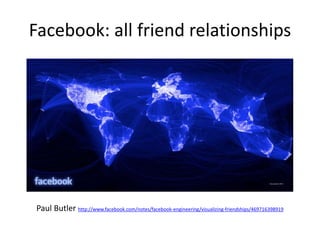
Facebook: all friend relationships
Paul Butler http://www.facebook.com/notes/facebook-engineering/visualizing-friendships/469716398919
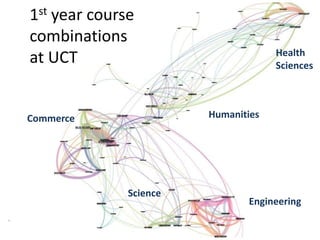
1st year course
combinations
at UCT Health
Sciences
Engineering
Humanities
Science
Commerce
DIFFERENT ANALYTICAL TOOLS
Three approaches to educational data
1. Psychometrics
placing measures on a scale (e.g., in
assessment)
2. Educational Data Mining
focus on learning over time (e.g., in schools)
3. Learning Analytics
typically wider contexts (e.g., in universities)
[3] Developing learning analytics
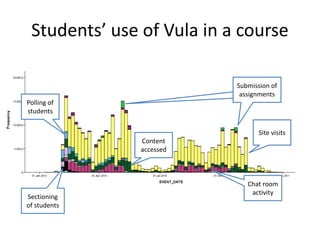
Students’ use of Vula in a course
Site visits
Chat room
activity
Sectioning
of students
Polling of
students
Content
accessed
Submission of
assignments
Submission of
assignments
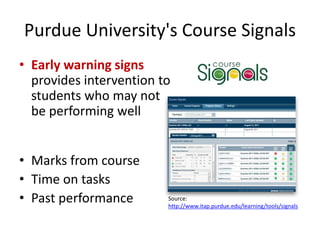
Purdue University's Course Signals
• Early warning signs
provides intervention to
students who may not
be performing well
• Marks from course
• Time on tasks
• Past performance Source:
http://www.itap.purdue.edu/learning/tools/signals
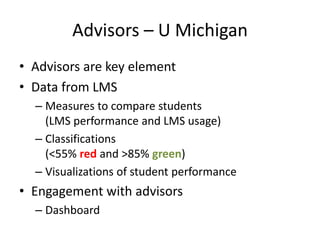
Advisors – U Michigan
• Advisors are key element
• Data from LMS
– Measures to compare students
(LMS performance and LMS usage)
– Classifications
(<55% red and >85% green)
– Visualizations of student performance
• Engagement with advisors
– Dashboard
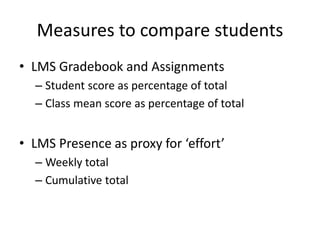
Measures to compare students
• LMS Gradebook and Assignments
– Student score as percentage of total
– Class mean score as percentage of total
• LMS Presence as proxy for ‘effort’
– Weekly total
– Cumulative total
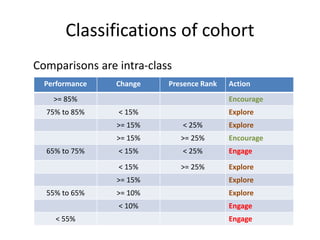
Classifications of cohort
Comparisons are intra-class
Performance Change Presence Rank Action
>= 85% Encourage
75% to 85% < 15% Explore
>= 15% < 25% Explore
>= 15% >= 25% Encourage
65% to 75% < 15% < 25% Engage
< 15% >= 25% Explore
>= 15% Explore
55% to 65% >= 10% Explore
< 10% Engage
< 55% Engage
Advisor support
• Shorten time to intervene
– Weekly update
– Contact ‘red’ students
– Useful to prepare for consultation
• Contextualizing student performance
– Longitude trends (course and degree)
– Identify students who don’t need support
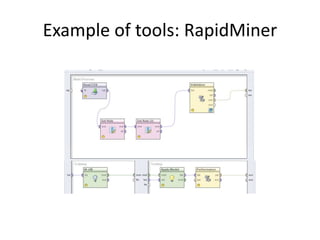
Example of tools: RapidMiner
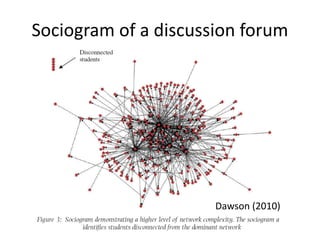
Sociogram of a discussion forum
Dawson (2010)
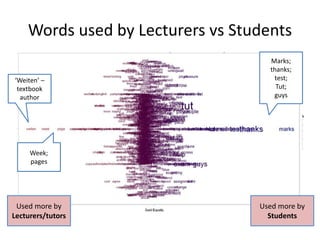
Words used by Lecturers vs Students
Used more by
Students
Used more by
Lecturers/tutors
‘Weiten’ –
textbook
author
Marks;
thanks;
test;
Tut;
guys
Week;
pages
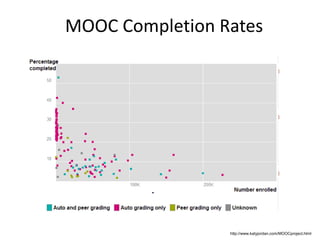
MOOC Completion Rates
http://www.katyjordan.com/MOOCproject.html
CHANGING ROLES OF ANALYTICS
The future with more data
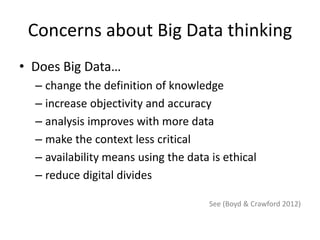
Concerns about Big Data thinking
• Does Big Data…
– change the definition of knowledge
– increase objectivity and accuracy
– analysis improves with more data
– make the context less critical
– availability means using the data is ethical
– reduce digital divides
See (Boyd & Crawford 2012)
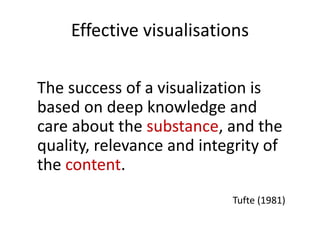
Effective visualisations
The success of a visualization is
based on deep knowledge and
care about the substance, and the
quality, relevance and integrity of
the content.
Tufte (1981)
Correlation and causation
• Correlation does not imply causation
– Covariation is a necessary but not a sufficient
condition for causality
– Correlation is not causation
(but could be a hint)
Future scenarios
• Analytics in educational research:
– More data means asking new questions
– Interpreting data in a student’s context
– Open up discussions and possibilities
– New ethical considerations
• Visualisations and analytics tools:
– Good open source software is available
– Encourage people to engage with learning analytics
Software references
• Gephi – network analysis, data collection
• NodeXL – network analysis, data collection
• TAGS – Twitter data collection (Google Drive)
• Word cloud – R package (wordcloud)
• RapidMiner – Data mining, predictive analytics
• Excel – spreadsheet, charts
• R – statistical analysis, graphs
Literature references
• Boyd, D., Crawford, K. (2012) Critical Questions for Big Data, Information,
Communication & Society, 15:5, 662-679
• Dawson, S. (2010) ‘Seeing’ the learning community: An exploration of the
development of a resource for monitoring online student networking.
British Journal of Educational Technology, 41(5), 736-752.
• Deacon, A., Paskeviciusat, M. (2011) Visualising activity in learning
networks using open data and educational analytics. Southern African
Association for Institutional Research Forum, Cape Town.
• Berland, M., Baker, R.S., Blikstein, P. (in press) Educational data mining and
learning analytics: Applications to constructionist research. To appear in
Technology, Knowledge, and Learning.
• Hansen, D., Shneiderman, B., Smith, M.A. (2011) Analyzing Social Media
Networks with NodeXL: Insights from a Connected World, Morgan
Kaufmann Publishers, San Francisco, CA.
• Tufte, E. (1981) The visual display of quantitative information. Cheshire,
Conn.: Graphics Press.
South African references

Learning Analytics: Seeking new insights from educational data

  • 1.
    Learning Analytics seeking newinsights from educational data Andrew Deacon Centre For Innovation in Learning and Teaching University of Cape Town Teaching and Learning with Technology workshop, CPUT, 2014
  • 2.
    Outline • What ischanging with ‘big data’ • Three eras of social science research • Three ways educational data is analyzed • Changing roles of analytics with more data
  • 3.
    Age of BigData Source: The Economist
  • 4.
    Learning Analytics … isthe measurement, collection, analysis and reporting of data about learners and their contexts, for purposes of understanding and optimising learning and the environments in which it occurs. https://tekri.athabascau.ca/analytics
  • 5.
    ASKING NEW QUESTIONS Threeeras of social research
  • 6.
    Three eras ofsocial research 1. Age of Quételet collect data on simple & important questions 2. Classical period get the most information from a little data 3. Present day big data deluge of data and questions
  • 7.
    [1] UCT StudentExperience Survey • Understand students’ overall experience • Data to effect change, improve decisions and policies, affirm good practices & quality assure • Good practice
  • 9.
    [2] Are streamsbeing disadvantaged? Within Degree Type: • Differences in mean final mark are significant • Across years, differences in means are similar • Differences in 2013 are not unusual Change in mode of delivery
  • 10.
    [3] UCT andsocial media Prominent links to: – Facebook – Flickr – LinkedIn – Twitter
  • 11.
    Twitter: UCT chatter •Looked at 6 months of data April – Sept 2011 • Selected tweets with a UCT hashtag or text #UCT, #Ikeys, University of Cape Town, … • Attributes tweet amplification, app used, location • Dataset Just over 5,000 tweets
  • 12.
    Twitter: apps &locations 27% 36% 20% 17% 1 2 3 4 Smartphone geo-location Cell phones Blackberry
  • 13.
    Twitter: tweeter relationships Frequenttweeters: 1. Drama student (162) 2. UCT Radio (132) 3. Science student (84)
  • 14.
    Twitter: viral #UCT VarsityCup final Helicopter crash 6 months of tweets
  • 15.
    Flickr: helicopter crashat UCT Ian Barbour - http://www.flickr.com/people/barbourians/
  • 16.
    Twitter: helicopter crashat UCT 2 hours after the event • Peak of 140 tweets in 5 minutes • Media organisations tweets get re-tweeted • Crash or hard-landing?
  • 17.
    Facebook: all friendrelationships Paul Butler http://www.facebook.com/notes/facebook-engineering/visualizing-friendships/469716398919
  • 18.
    1st year course combinations atUCT Health Sciences Engineering Humanities Science Commerce
  • 19.
    DIFFERENT ANALYTICAL TOOLS Threeapproaches to educational data
  • 20.
    Three approaches toeducational data 1. Psychometrics placing measures on a scale (e.g., in assessment) 2. Educational Data Mining focus on learning over time (e.g., in schools) 3. Learning Analytics typically wider contexts (e.g., in universities)
  • 21.
  • 22.
    Students’ use ofVula in a course Site visits Chat room activity Sectioning of students Polling of students Content accessed Submission of assignments Submission of assignments
  • 23.
    Purdue University's CourseSignals • Early warning signs provides intervention to students who may not be performing well • Marks from course • Time on tasks • Past performance Source: http://www.itap.purdue.edu/learning/tools/signals
  • 24.
    Advisors – UMichigan • Advisors are key element • Data from LMS – Measures to compare students (LMS performance and LMS usage) – Classifications (<55% red and >85% green) – Visualizations of student performance • Engagement with advisors – Dashboard
  • 25.
    Measures to comparestudents • LMS Gradebook and Assignments – Student score as percentage of total – Class mean score as percentage of total • LMS Presence as proxy for ‘effort’ – Weekly total – Cumulative total
  • 26.
    Classifications of cohort Comparisonsare intra-class Performance Change Presence Rank Action >= 85% Encourage 75% to 85% < 15% Explore >= 15% < 25% Explore >= 15% >= 25% Encourage 65% to 75% < 15% < 25% Engage < 15% >= 25% Explore >= 15% Explore 55% to 65% >= 10% Explore < 10% Engage < 55% Engage
  • 27.
    Advisor support • Shortentime to intervene – Weekly update – Contact ‘red’ students – Useful to prepare for consultation • Contextualizing student performance – Longitude trends (course and degree) – Identify students who don’t need support
  • 28.
  • 29.
    Sociogram of adiscussion forum Dawson (2010)
  • 30.
    Words used byLecturers vs Students Used more by Students Used more by Lecturers/tutors ‘Weiten’ – textbook author Marks; thanks; test; Tut; guys Week; pages
  • 31.
  • 33.
    CHANGING ROLES OFANALYTICS The future with more data
  • 34.
    Concerns about BigData thinking • Does Big Data… – change the definition of knowledge – increase objectivity and accuracy – analysis improves with more data – make the context less critical – availability means using the data is ethical – reduce digital divides See (Boyd & Crawford 2012)
  • 35.
    Effective visualisations The successof a visualization is based on deep knowledge and care about the substance, and the quality, relevance and integrity of the content. Tufte (1981)
  • 36.
    Correlation and causation •Correlation does not imply causation – Covariation is a necessary but not a sufficient condition for causality – Correlation is not causation (but could be a hint)
  • 37.
    Future scenarios • Analyticsin educational research: – More data means asking new questions – Interpreting data in a student’s context – Open up discussions and possibilities – New ethical considerations • Visualisations and analytics tools: – Good open source software is available – Encourage people to engage with learning analytics
  • 38.
    Software references • Gephi– network analysis, data collection • NodeXL – network analysis, data collection • TAGS – Twitter data collection (Google Drive) • Word cloud – R package (wordcloud) • RapidMiner – Data mining, predictive analytics • Excel – spreadsheet, charts • R – statistical analysis, graphs
  • 39.
    Literature references • Boyd,D., Crawford, K. (2012) Critical Questions for Big Data, Information, Communication & Society, 15:5, 662-679 • Dawson, S. (2010) ‘Seeing’ the learning community: An exploration of the development of a resource for monitoring online student networking. British Journal of Educational Technology, 41(5), 736-752. • Deacon, A., Paskeviciusat, M. (2011) Visualising activity in learning networks using open data and educational analytics. Southern African Association for Institutional Research Forum, Cape Town. • Berland, M., Baker, R.S., Blikstein, P. (in press) Educational data mining and learning analytics: Applications to constructionist research. To appear in Technology, Knowledge, and Learning. • Hansen, D., Shneiderman, B., Smith, M.A. (2011) Analyzing Social Media Networks with NodeXL: Insights from a Connected World, Morgan Kaufmann Publishers, San Francisco, CA. • Tufte, E. (1981) The visual display of quantitative information. Cheshire, Conn.: Graphics Press.
  • 40.