CALRG 2011


Social Learning Analytics

Simon Buckingham Shum & Rebecca Ferguson
Knowledge Media Institute & Institute of Educational Technology
The Open University, Milton Keynes, UK

@sbskmi / @R3beccaF


                                                                  1
How we’re going to do this...


10mins   Imagine.../background/critical questions
         – Simon

15mins   A taxonomy of Social Learning Analytics
         – Rebecca

10mins   SLA: more than just a bunch of techniques
         – Simon

15mins   Open discussion...


                                                     2
Coming soon to a future near you?...

  Analytics Report

  Application from Ali Bloggs to study Z0001

  This applicant has a high risk profile:
  1.  No academic study for last 15 years
  2.  Low socio-economic background
  3.  English as a second language
  4.  Weak ICT skills
  5.  His responses to the learning styles survey indicate a loner,
      rather than a collaborative learner, known to be a
      disadvantage on this course
                           [click to view the 3 other risk factors]

  Without a Grade 3 tutor (advanced skills in 1-1 support), based
  on the last 5 years data there is a 37% chance of dropping out
  by Week 6.

                        [ACCEPT]    [REJECT]


                                                                      3
Coming soon to a future near you?...


 “Hi Ann,

 In the last 2 weeks, it looks like you’ve been really stretching
 yourself. You seem to have been working on your critical
 thinking, with that challenge to Mike’s assumption, and the
 evidence-based claim about nuclear waste in your blog.

 Check out Donna Winter, who seems to have very different views
 to yours on global warming. How would you assess her position?

 In your next video conference tutorial, try to improve on the last
 three, in which you seem to have contributed only once each
 time.”


                                                                      4
Coming soon to a future near you?...


   “Did you know that two other people you know have used
   the Smith & Jones 2009 framework graphic?

   Finally, you seem to have really become a pivotal member
   of the Local-Global Climate Network. Good work: only a
   month ago you were on the edge!

   Why not reflect in your blog on how these groups are
   helping you in your long term goal to Work for the UN in
   Africa?”


                                                              5
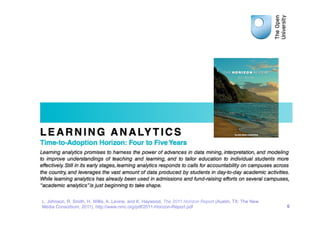
L. Johnson, R. Smith, H. Willis, A. Levine, and K. Haywood, The 2011 Horizon Report (Austin, TX: The New
Media Consortium, 2011), http://www.nmc.org/pdf/2011-Horizon-Report.pdf                                    6
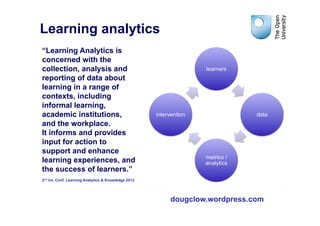
Learning analytics
“Learning Analytics is
concerned with the
collection, analysis and
reporting of data about
learning in a range of
contexts, including
informal learning,
academic institutions,
and the workplace.
It informs and provides
input for action to
support and enhance
learning experiences, and
the success of learners.”
2nd Int. Conf. Learning Analytics & Knowledge 2012


                                                     dougclow.wordpress.com
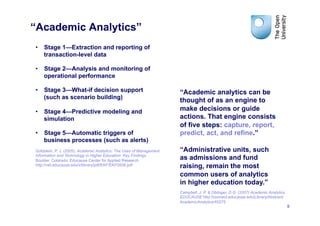
“Academic Analytics”
•  Stage 1—Extraction and reporting of
   transaction-level data

•  Stage 2—Analysis and monitoring of
   operational performance

•  Stage 3—What-if decision support                                   “Academic analytics can be
   (such as scenario building)
                                                                      thought of as an engine to
•  Stage 4—Predictive modeling and                                    make decisions or guide
   simulation                                                         actions. That engine consists
                                                                      of five steps: capture, report,
•  Stage 5—Automatic triggers of                                      predict, act, and refine.”
   business processes (such as alerts)
Goldstein, P. J. (2005). Academic Analytics: The Uses of Management   “Administrative units, such
Information and Technology in Higher Education: Key Findings.
Boulder, Colorado: Educause Center for Applied Research
                                                                      as admissions and fund
http://net.educause.edu/ir/library/pdf/EKF/EKF0508.pdf                raising, remain the most
                                                                      common users of analytics
                                                                      in higher education today.”
                                                                      Campbell, J. P. & Oblinger, D.G. (2007) Academic Analytics.
                                                                      EDUCAUSE http://connect.educause.edu/Library/Abstract/
                                                                      AcademicAnalytics/45275
                                                                                                                                    8
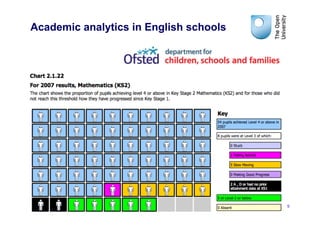
Academic analytics in English schools


                                        9
OU Analytics service: Predictive
modelling
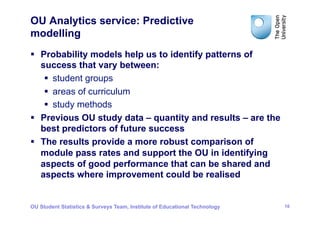
§  Probability models help us to identify patterns of
    success that vary between:
     §  student groups
     §  areas of curriculum
     §  study methods
§  Previous OU study data – quantity and results – are the
    best predictors of future success
§  The results provide a more robust comparison of
    module pass rates and support the OU in identifying
    aspects of good performance that can be shared and
    aspects where improvement could be realised


OU Student Statistics & Surveys Team, Institute of Educational Technology   10
Purdue University Signals


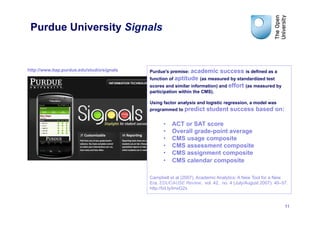
http://www.itap.purdue.edu/studio/signals   Purdue's premise: academic      success is defined as a
                                            function of aptitude (as measured by standardized test
                                            scores and similar information) and effort (as measured by
                                            participation within the CMS).

                                            Using factor analysis and logistic regression, a model was
                                            programmed to predict student success based on:


                                                  •    ACT or SAT score
                                                  •    Overall grade-point average
                                                  •    CMS usage composite
                                                  •    CMS assessment composite
                                                  •    CMS assignment composite
                                                  •    CMS calendar composite

                                            Campbell et al (2007). Academic Analytics: A New Tool for a New
                                            Era, EDUCAUSE Review, vol. 42, no. 4 (July/August 2007): 40–57.
                                            http://bit.ly/lmxG2x


                                                                                                         11
critical questions


                     12
Pause for thought...

§  in the discourse of academic analytics, there is little
    mention of pedagogy, theory, learning or teaching

§  what models of “learning” currently underpin
    analytics? If we can’t log and measure it, it’s invisible...

§  what learning phenomena should analytics track to
    equip learners for the complexities of C21?

§  classification schemes are the mechanisms by which
    we choose not only how to remember, but also
    systematically forget (Bowker and Star, 1999)

§  power: who is defining the measures, to what ends,
    and who gets to see which results?                             13
social learning analytics

        a taxonomy


                            14
Social Learning Analytics


•  Social learning network analysis

•  Social learning discourse analysis

•  Social learning content analysis

•  Social learning dispositions analysis

•  Social learning context analysis
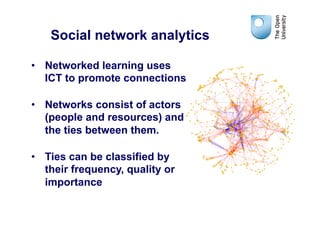
Social network analytics

•  Networked learning uses
   ICT to promote connections

•  Networks consist of actors
   (people and resources) and
   the ties between them.

•  Ties can be classified by
   their frequency, quality or
   importance
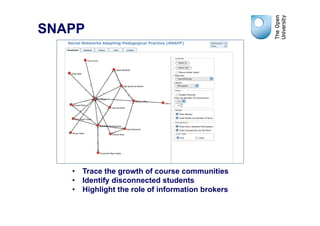
SNAPP


   •  Trace the growth of course communities
   •  Identify disconnected students
   •  Highlight the role of information brokers
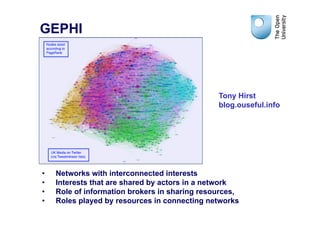
GEPHI


                                                Tony Hirst
                                                blog.ouseful.info


•    Networks with interconnected interests
•    Interests that are shared by actors in a network
•    Role of information brokers in sharing resources,
•    Roles played by resources in connecting networks
Social network analysis
and social learning

•  Identify and support types of interaction
   that promote the learning process

•  Identify interventions that are likely to
   increase the potential of a network to
   support the learning of its actors
Social learning discourse analytics

•  Educational success and failure may be explained
   by the quality of educational dialogue, rather than
   simply in terms of the capability of individual
   students or the skill of their teachers
•  The ways in which learners engage in dialogue
   are indicators of how they engage with other
   learners’ ideas, how they compare those ideas
   with their personal understanding, and how they
   account for their own point of view
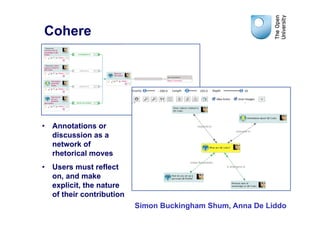
Cohere


•  Annotations or
   discussion as a
   network of
   rhetorical moves
•  Users must reflect
   on, and make
   explicit, the nature
   of their contribution
                           Simon Buckingham Shum, Anna De Liddo
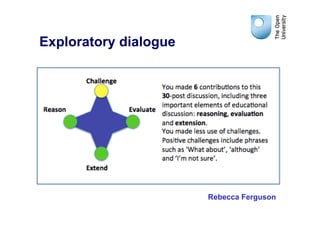
Exploratory dialogue


                       Rebecca Ferguson
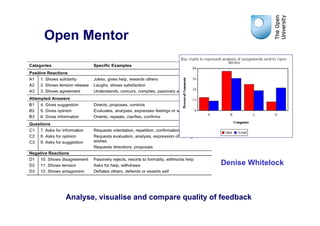
Open Mentor


                                           Denise Whitelock


  Analyse, visualise and compare quality of feedback
Content analytics


Automated methods to examine, index
and filter online media assets, with the
intention of guiding learners through
the ocean of available resources
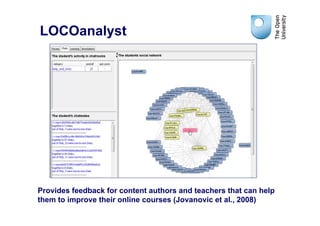
LOCOanalyst


Provides feedback for content authors and teachers that can help
them to improve their online courses (Jovanovic et al., 2008)
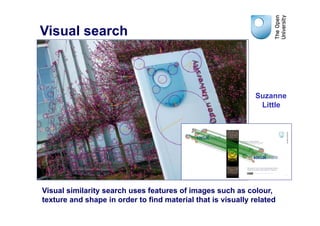
Visual search


                                                              Suzanne
                                                               Little


Visual similarity search uses features of images such as colour,
texture and shape in order to find material that is visually related
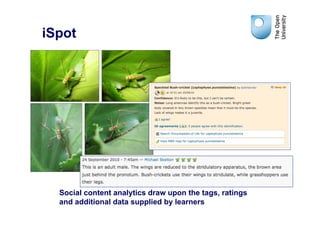
iSpot


  Social content analytics draw upon the tags, ratings
  and additional data supplied by learners
Social learning dispositions analytics
•  Learning dispositions provide a way of identifying and
   naming the qualities of a good learner.


•  They comprise the seven dimensions of ‘learning power’:
   changing & learning, critical curiosity, meaning making,
   dependence & fragility, creativity, relationships/
   interdependence and strategic awareness

•  Dynamic assessment of learning power can be used to
   reflect back to learners what they say about themselves
   in relation to these dimensions


                        Ruth Deakin Crick, University of Bristol
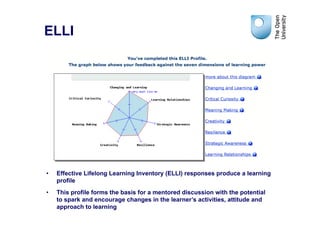
ELLI


•    Effective Lifelong Learning Inventory (ELLI) responses produce a learning
     profile
•    This profile forms the basis for a mentored discussion with the potential
     to spark and encourage changes in the learner’s activities, attitude and
     approach to learning
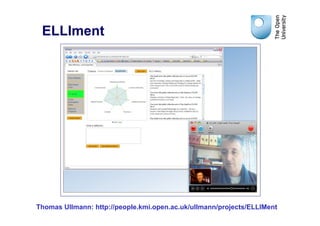
ELLIment


Thomas Ullmann: http://people.kmi.open.ac.uk/ullmann/projects/ELLIMent
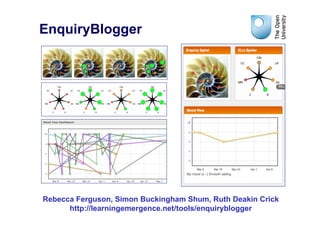
EnquiryBlogger


Rebecca Ferguson, Simon Buckingham Shum, Ruth Deakin Crick
      http://learningemergence.net/tools/enquiryblogger
Social learning context analytics
Taking context into account:
•  Formal settings
•  Informal settings
•  Mobile learning
•  Synchronous environments
•  Asynchronous environments
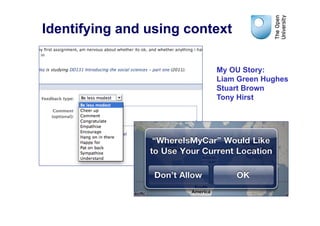
Identifying and using context

                          My OU Story:
                          Liam Green Hughes
                          Stuart Brown
                          Tony Hirst
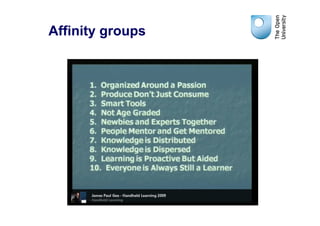
Affinity groups
reflections...


                 36
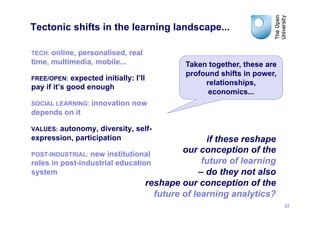
Tectonic shifts in the learning landscape...

TECH: online,
            personalised, real
time, multimedia, mobile...              Taken together, these are
                                         profound shifts in power,
FREE/OPEN:   expected initially: I’ll
                                              relationships,
pay if it’s good enough
                                               economics...
SOCIAL LEARNING: innovation     now
depends on it

VALUES:autonomy, diversity, self-
expression, participation                        if these reshape
POST-INDUSTRIAL: new institutional
                                          our conception of the
roles in post-industrial education              future of learning
system                                         – do they not also
                                 reshape our conception of the
                                   future of learning analytics?
                                                                     37
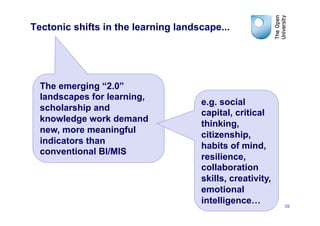
Tectonic shifts in the learning landscape...


  The emerging “2.0”
  landscapes for learning,
                                     e.g. social
  scholarship and
                                     capital, critical
  knowledge work demand
                                     thinking,
  new, more meaningful
                                     citizenship,
  indicators than
                                     habits of mind,
  conventional BI/MIS
                                     resilience,
                                     collaboration
                                     skills, creativity,
                                     emotional
                                     intelligence…         38
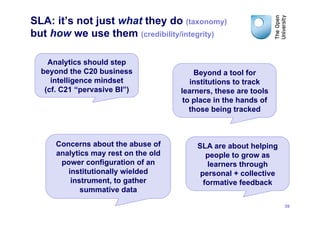
SLA: it’s not just what they do (taxonomy)
but how we use them (credibility/integrity)

    Analytics should step
  beyond the C20 business                 Beyond a tool for
     intelligence mindset                institutions to track
   (cf. C21 “pervasive BI”)           learners, these are tools
                                       to place in the hands of
                                         those being tracked


      Concerns about the abuse of         SLA are about helping
      analytics may rest on the old          people to grow as
       power configuration of an             learners through
         institutionally wielded           personal + collective
          instrument, to gather             formative feedback
             summative data

                                                                   39
Some links...
Learning Analytics blog, resources & open course
http://www.learninganalytics.net


2nd Int. Conf. Learning Analytics, Vancouver, Apr 2012
http://lak12.sites.olt.ubc.ca


KMi Learning Analytics R&D
http://people.kmi.open.ac.uk/sbs/tag/learning-analytics


                                                          40

Social Learning Analytics

  • 1.
    CALRG 2011 Social LearningAnalytics Simon Buckingham Shum & Rebecca Ferguson Knowledge Media Institute & Institute of Educational Technology The Open University, Milton Keynes, UK @sbskmi / @R3beccaF 1
  • 2.
    How we’re goingto do this... 10mins Imagine.../background/critical questions – Simon 15mins A taxonomy of Social Learning Analytics – Rebecca 10mins SLA: more than just a bunch of techniques – Simon 15mins Open discussion... 2
  • 3.
    Coming soon toa future near you?... Analytics Report Application from Ali Bloggs to study Z0001 This applicant has a high risk profile: 1.  No academic study for last 15 years 2.  Low socio-economic background 3.  English as a second language 4.  Weak ICT skills 5.  His responses to the learning styles survey indicate a loner, rather than a collaborative learner, known to be a disadvantage on this course [click to view the 3 other risk factors] Without a Grade 3 tutor (advanced skills in 1-1 support), based on the last 5 years data there is a 37% chance of dropping out by Week 6. [ACCEPT] [REJECT] 3
  • 4.
    Coming soon toa future near you?... “Hi Ann, In the last 2 weeks, it looks like you’ve been really stretching yourself. You seem to have been working on your critical thinking, with that challenge to Mike’s assumption, and the evidence-based claim about nuclear waste in your blog. Check out Donna Winter, who seems to have very different views to yours on global warming. How would you assess her position? In your next video conference tutorial, try to improve on the last three, in which you seem to have contributed only once each time.” 4
  • 5.
    Coming soon toa future near you?... “Did you know that two other people you know have used the Smith & Jones 2009 framework graphic? Finally, you seem to have really become a pivotal member of the Local-Global Climate Network. Good work: only a month ago you were on the edge! Why not reflect in your blog on how these groups are helping you in your long term goal to Work for the UN in Africa?” 5
  • 6.
    L. Johnson, R.Smith, H. Willis, A. Levine, and K. Haywood, The 2011 Horizon Report (Austin, TX: The New Media Consortium, 2011), http://www.nmc.org/pdf/2011-Horizon-Report.pdf 6
  • 7.
    Learning analytics “Learning Analyticsis concerned with the collection, analysis and reporting of data about learning in a range of contexts, including informal learning, academic institutions, and the workplace. It informs and provides input for action to support and enhance learning experiences, and the success of learners.” 2nd Int. Conf. Learning Analytics & Knowledge 2012 dougclow.wordpress.com
  • 8.
    “Academic Analytics” •  Stage1—Extraction and reporting of transaction-level data •  Stage 2—Analysis and monitoring of operational performance •  Stage 3—What-if decision support “Academic analytics can be (such as scenario building) thought of as an engine to •  Stage 4—Predictive modeling and make decisions or guide simulation actions. That engine consists of five steps: capture, report, •  Stage 5—Automatic triggers of predict, act, and refine.” business processes (such as alerts) Goldstein, P. J. (2005). Academic Analytics: The Uses of Management “Administrative units, such Information and Technology in Higher Education: Key Findings. Boulder, Colorado: Educause Center for Applied Research as admissions and fund http://net.educause.edu/ir/library/pdf/EKF/EKF0508.pdf raising, remain the most common users of analytics in higher education today.” Campbell, J. P. & Oblinger, D.G. (2007) Academic Analytics. EDUCAUSE http://connect.educause.edu/Library/Abstract/ AcademicAnalytics/45275 8
  • 9.
    Academic analytics inEnglish schools 9
  • 10.
    OU Analytics service:Predictive modelling §  Probability models help us to identify patterns of success that vary between: §  student groups §  areas of curriculum §  study methods §  Previous OU study data – quantity and results – are the best predictors of future success §  The results provide a more robust comparison of module pass rates and support the OU in identifying aspects of good performance that can be shared and aspects where improvement could be realised OU Student Statistics & Surveys Team, Institute of Educational Technology 10
  • 11.
    Purdue University Signals http://www.itap.purdue.edu/studio/signals Purdue's premise: academic success is defined as a function of aptitude (as measured by standardized test scores and similar information) and effort (as measured by participation within the CMS). Using factor analysis and logistic regression, a model was programmed to predict student success based on: •  ACT or SAT score •  Overall grade-point average •  CMS usage composite •  CMS assessment composite •  CMS assignment composite •  CMS calendar composite Campbell et al (2007). Academic Analytics: A New Tool for a New Era, EDUCAUSE Review, vol. 42, no. 4 (July/August 2007): 40–57. http://bit.ly/lmxG2x 11
  • 12.
  • 13.
    Pause for thought... § in the discourse of academic analytics, there is little mention of pedagogy, theory, learning or teaching §  what models of “learning” currently underpin analytics? If we can’t log and measure it, it’s invisible... §  what learning phenomena should analytics track to equip learners for the complexities of C21? §  classification schemes are the mechanisms by which we choose not only how to remember, but also systematically forget (Bowker and Star, 1999) §  power: who is defining the measures, to what ends, and who gets to see which results? 13
  • 14.
  • 15.
    Social Learning Analytics • Social learning network analysis •  Social learning discourse analysis •  Social learning content analysis •  Social learning dispositions analysis •  Social learning context analysis
  • 16.
    Social network analytics • Networked learning uses ICT to promote connections •  Networks consist of actors (people and resources) and the ties between them. •  Ties can be classified by their frequency, quality or importance
  • 17.
    SNAPP •  Trace the growth of course communities •  Identify disconnected students •  Highlight the role of information brokers
  • 18.
    GEPHI Tony Hirst blog.ouseful.info •  Networks with interconnected interests •  Interests that are shared by actors in a network •  Role of information brokers in sharing resources, •  Roles played by resources in connecting networks
  • 19.
    Social network analysis andsocial learning •  Identify and support types of interaction that promote the learning process •  Identify interventions that are likely to increase the potential of a network to support the learning of its actors
  • 20.
    Social learning discourseanalytics •  Educational success and failure may be explained by the quality of educational dialogue, rather than simply in terms of the capability of individual students or the skill of their teachers •  The ways in which learners engage in dialogue are indicators of how they engage with other learners’ ideas, how they compare those ideas with their personal understanding, and how they account for their own point of view
  • 21.
    Cohere •  Annotations or discussion as a network of rhetorical moves •  Users must reflect on, and make explicit, the nature of their contribution Simon Buckingham Shum, Anna De Liddo
  • 22.
    Exploratory dialogue Rebecca Ferguson
  • 23.
    Open Mentor Denise Whitelock Analyse, visualise and compare quality of feedback
  • 24.
    Content analytics Automated methodsto examine, index and filter online media assets, with the intention of guiding learners through the ocean of available resources
  • 25.
    LOCOanalyst Provides feedback forcontent authors and teachers that can help them to improve their online courses (Jovanovic et al., 2008)
  • 26.
    Visual search Suzanne Little Visual similarity search uses features of images such as colour, texture and shape in order to find material that is visually related
  • 27.
    iSpot Socialcontent analytics draw upon the tags, ratings and additional data supplied by learners
  • 28.
    Social learning dispositionsanalytics •  Learning dispositions provide a way of identifying and naming the qualities of a good learner. •  They comprise the seven dimensions of ‘learning power’: changing & learning, critical curiosity, meaning making, dependence & fragility, creativity, relationships/ interdependence and strategic awareness •  Dynamic assessment of learning power can be used to reflect back to learners what they say about themselves in relation to these dimensions Ruth Deakin Crick, University of Bristol
  • 29.
    ELLI •  Effective Lifelong Learning Inventory (ELLI) responses produce a learning profile •  This profile forms the basis for a mentored discussion with the potential to spark and encourage changes in the learner’s activities, attitude and approach to learning
  • 30.
  • 31.
    EnquiryBlogger Rebecca Ferguson, SimonBuckingham Shum, Ruth Deakin Crick http://learningemergence.net/tools/enquiryblogger
  • 32.
    Social learning contextanalytics Taking context into account: •  Formal settings •  Informal settings •  Mobile learning •  Synchronous environments •  Asynchronous environments
  • 33.
    Identifying and usingcontext My OU Story: Liam Green Hughes Stuart Brown Tony Hirst
  • 34.
  • 36.
  • 37.
    Tectonic shifts inthe learning landscape... TECH: online, personalised, real time, multimedia, mobile... Taken together, these are profound shifts in power, FREE/OPEN: expected initially: I’ll relationships, pay if it’s good enough economics... SOCIAL LEARNING: innovation now depends on it VALUES:autonomy, diversity, self- expression, participation if these reshape POST-INDUSTRIAL: new institutional our conception of the roles in post-industrial education future of learning system – do they not also reshape our conception of the future of learning analytics? 37
  • 38.
    Tectonic shifts inthe learning landscape... The emerging “2.0” landscapes for learning, e.g. social scholarship and capital, critical knowledge work demand thinking, new, more meaningful citizenship, indicators than habits of mind, conventional BI/MIS resilience, collaboration skills, creativity, emotional intelligence… 38
  • 39.
    SLA: it’s notjust what they do (taxonomy) but how we use them (credibility/integrity) Analytics should step beyond the C20 business Beyond a tool for intelligence mindset institutions to track (cf. C21 “pervasive BI”) learners, these are tools to place in the hands of those being tracked Concerns about the abuse of SLA are about helping analytics may rest on the old people to grow as power configuration of an learners through institutionally wielded personal + collective instrument, to gather formative feedback summative data 39
  • 40.
    Some links... Learning Analyticsblog, resources & open course http://www.learninganalytics.net 2nd Int. Conf. Learning Analytics, Vancouver, Apr 2012 http://lak12.sites.olt.ubc.ca KMi Learning Analytics R&D http://people.kmi.open.ac.uk/sbs/tag/learning-analytics 40