
Analytics in Action
http://DSign4Value.com
Higher Education
February 2018
Introduction
©2016 L. SCHLENKER
Agenda
Introduction
Definitions
Infrastructure
Use Scenarios
Limits
Introduction
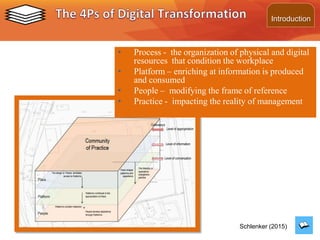
• Process - the organization of physical and digital
resources that condition the workplace
• Platform – enriching at information is produced
and consumed
• People – modifying the frame of reference
• Practice - impacting the reality of management
Schlenker (2015)
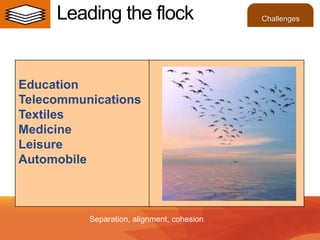
Education
Telecommunications
Textiles
Medicine
Leisure
Automobile
Separation, alignment, cohesion
Leading the flock Challenges
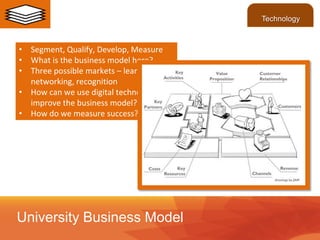
• Segment, Qualify, Develop, Measure
• What is the business model here?
• Three possible markets – learning,
networking, recognition
• How can we use digital technologies to
improve the business model?
• How do we measure success?
University Business Model
Technology
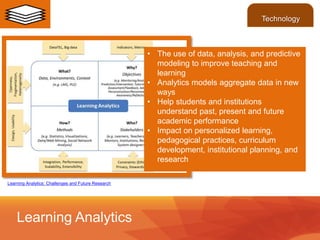
• The use of data, analysis, and predictive
modeling to improve teaching and
learning
• Analytics models aggregate data in new
ways
• Help students and institutions
understand past, present and future
academic performance
• Impact on personalized learning,
pedagogical practices, curriculum
development, institutional planning, and
research
Learning Analytics
Technology
Learning Analytics: Challenges and Future Research
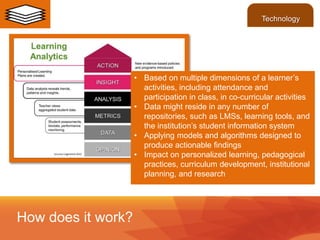
• Based on multiple dimensions of a learner’s
activities, including attendance and
participation in class, in co-curricular activities
• Data might reside in any number of
repositories, such as LMSs, learning tools, and
the institution’s student information system
• Applying models and algorithms designed to
produce actionable findings
• Impact on personalized learning, pedagogical
practices, curriculum development, institutional
planning, and research
How does it work?
Technology
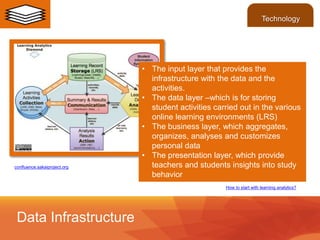
• The input layer that provides the
infrastructure with the data and the
activities.
• The data layer –which is for storing
student activities carried out in the various
online learning environments (LRS)
• The business layer, which aggregates,
organizes, analyses and customizes
personal data
• The presentation layer, which provide
teachers and students insights into study
behavior
Data Infrastructure
Technology
confluence.sakaiproject.org
How to start with learning analytics?
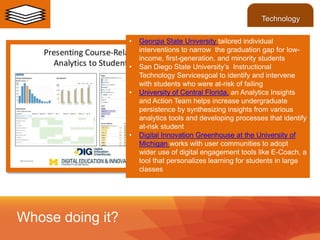
• Georgia State University tailored individual
interventions to narrow the graduation gap for low-
income, first-generation, and minority students
• San Diego State University’s Instructional
Technology Servicesgoal to identify and intervene
with students who were at-risk of failing
• University of Central Florida, an Analytics Insights
and Action Team helps increase undergraduate
persistence by synthesizing insights from various
analytics tools and developing processes that identify
at-risk student
• Digital Innovation Greenhouse at the University of
Michigan works with user communities to adopt
wider use of digital engagement tools like E-Coach, a
tool that personalizes learning for students in large
classes
Whose doing it?
Technology
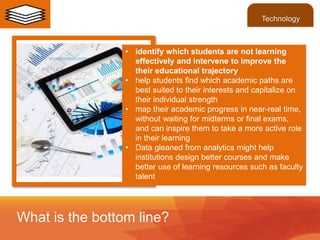
• identify which students are not learning
effectively and intervene to improve the
their educational trajectory
• help students find which academic paths are
best suited to their interests and capitalize on
their individual strength
• map their academic progress in near-real time,
without waiting for midterms or final exams,
and can inspire them to take a more active role
in their learning
• Data gleaned from analytics might help
institutions design better courses and make
better use of learning resources such as faculty
talent
What is the bottom line?
Technology
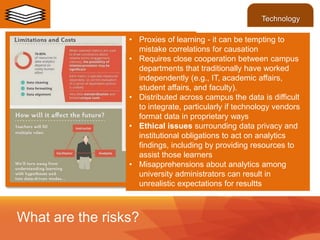
• Proxies of learning - it can be tempting to
mistake correlations for causation
• Requires close cooperation between campus
departments that traditionally have worked
independently (e.g., IT, academic affairs,
student affairs, and faculty).
• Distributed across campus the data is difficult
to integrate, particularly if technology vendors
format data in proprietary ways
• Ethical issues surrounding data privacy and
institutional obligations to act on analytics
findings, including by providing resources to
assist those learners
• Misapprehensions about analytics among
university administrators can result in
unrealistic expectations for resultts
What are the risks?
Technology
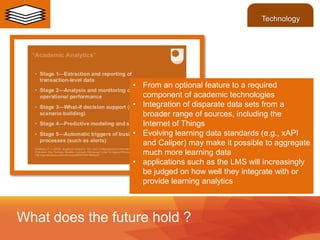
• From an optional feature to a required
component of academic technologies
• Integration of disparate data sets from a
broader range of sources, including the
Internet of Things
• Evolving learning data standards (e.g., xAPI
and Caliper) may make it possible to aggregate
much more learning data
• applications such as the LMS will increasingly
be judged on how well they integrate with or
provide learning analytics
What does the future hold ?
Technology
• Virani K., (2016) Data-driven Education (video)
• Chatti, M., (2016), Learning Analytics: Challenges
and Future Research
• De Wit et al., (2016?) How to start with learning
analytics?
• Smith K.,(2016) Predictive Analytics: Nudging,
Shoving, and Smacking Behaviors in Higher
Education
• Fritz J. and Whitmore J., (2017) Moving the
Heart and Head
Bibliography
Next Steps
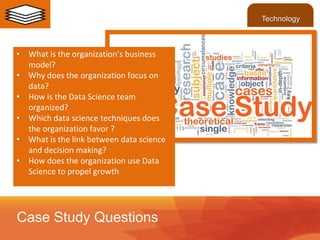
• What is the organization’s business
model?
• Why does the organization focus on
data?
• How is the Data Science team
organized?
• Which data science techniques does
the organization favor ?
• What is the link between data science
and decision making?
• How does the organization use Data
Science to propel growth
Case Study Questions
Technology

Learning Analytics

  • 1.
  • 2.
  • 3.
    Introduction • Process -the organization of physical and digital resources that condition the workplace • Platform – enriching at information is produced and consumed • People – modifying the frame of reference • Practice - impacting the reality of management Schlenker (2015)
  • 4.
  • 5.
    • Segment, Qualify,Develop, Measure • What is the business model here? • Three possible markets – learning, networking, recognition • How can we use digital technologies to improve the business model? • How do we measure success? University Business Model Technology
  • 6.
    • The useof data, analysis, and predictive modeling to improve teaching and learning • Analytics models aggregate data in new ways • Help students and institutions understand past, present and future academic performance • Impact on personalized learning, pedagogical practices, curriculum development, institutional planning, and research Learning Analytics Technology Learning Analytics: Challenges and Future Research
  • 7.
    • Based onmultiple dimensions of a learner’s activities, including attendance and participation in class, in co-curricular activities • Data might reside in any number of repositories, such as LMSs, learning tools, and the institution’s student information system • Applying models and algorithms designed to produce actionable findings • Impact on personalized learning, pedagogical practices, curriculum development, institutional planning, and research How does it work? Technology
  • 8.
    • The inputlayer that provides the infrastructure with the data and the activities. • The data layer –which is for storing student activities carried out in the various online learning environments (LRS) • The business layer, which aggregates, organizes, analyses and customizes personal data • The presentation layer, which provide teachers and students insights into study behavior Data Infrastructure Technology confluence.sakaiproject.org How to start with learning analytics?
  • 9.
    • Georgia StateUniversity tailored individual interventions to narrow the graduation gap for low- income, first-generation, and minority students • San Diego State University’s Instructional Technology Servicesgoal to identify and intervene with students who were at-risk of failing • University of Central Florida, an Analytics Insights and Action Team helps increase undergraduate persistence by synthesizing insights from various analytics tools and developing processes that identify at-risk student • Digital Innovation Greenhouse at the University of Michigan works with user communities to adopt wider use of digital engagement tools like E-Coach, a tool that personalizes learning for students in large classes Whose doing it? Technology
  • 10.
    • identify whichstudents are not learning effectively and intervene to improve the their educational trajectory • help students find which academic paths are best suited to their interests and capitalize on their individual strength • map their academic progress in near-real time, without waiting for midterms or final exams, and can inspire them to take a more active role in their learning • Data gleaned from analytics might help institutions design better courses and make better use of learning resources such as faculty talent What is the bottom line? Technology
  • 11.
    • Proxies oflearning - it can be tempting to mistake correlations for causation • Requires close cooperation between campus departments that traditionally have worked independently (e.g., IT, academic affairs, student affairs, and faculty). • Distributed across campus the data is difficult to integrate, particularly if technology vendors format data in proprietary ways • Ethical issues surrounding data privacy and institutional obligations to act on analytics findings, including by providing resources to assist those learners • Misapprehensions about analytics among university administrators can result in unrealistic expectations for resultts What are the risks? Technology
  • 12.
    • From anoptional feature to a required component of academic technologies • Integration of disparate data sets from a broader range of sources, including the Internet of Things • Evolving learning data standards (e.g., xAPI and Caliper) may make it possible to aggregate much more learning data • applications such as the LMS will increasingly be judged on how well they integrate with or provide learning analytics What does the future hold ? Technology
  • 13.
    • Virani K.,(2016) Data-driven Education (video) • Chatti, M., (2016), Learning Analytics: Challenges and Future Research • De Wit et al., (2016?) How to start with learning analytics? • Smith K.,(2016) Predictive Analytics: Nudging, Shoving, and Smacking Behaviors in Higher Education • Fritz J. and Whitmore J., (2017) Moving the Heart and Head Bibliography Next Steps
  • 14.
    • What isthe organization’s business model? • Why does the organization focus on data? • How is the Data Science team organized? • Which data science techniques does the organization favor ? • What is the link between data science and decision making? • How does the organization use Data Science to propel growth Case Study Questions Technology