INTRODUCTION
Learning is the process of growth and
development where by the learner acquires a body
of knowledge, develops ideas which she makes a
part of herself and develops the ability to use her
knowledge in the pursuit of her ideals. Learning is
part of education, earning brings modification of
behavior.
DEFINITION
“the act or experience of one that learns; knowledge’s or skill
acquired by instruction or study; modification of a behavioral
tendency by experience.”
“Learning is change in behavior which is demonstrated by
people implementing knowledge, skills or practice derived
from education.”
Learning is self active
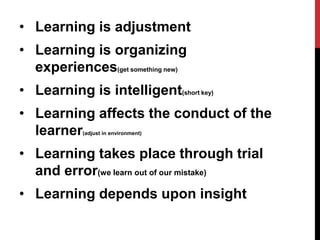
• Learning is adjustment
• Learning is organizing
experiences(get something new)
• Learning is intelligent(short key)
• Learning affects the conduct of the
learner(adjust in environment)
• Learning takes place through trial
and error(we learn out of our mistake)
• Learning depends upon insight
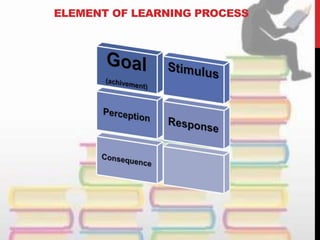
ELEMENT OF LEARNING PROCESS
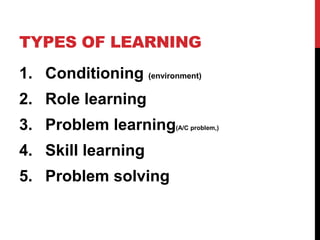
TYPES OF LEARNING
1. Conditioning (environment)
2. Role learning
3. Problem learning(A/C problem,)
4. Skill learning
5. Problem solving
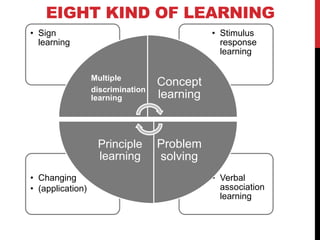
EIGHT KIND OF LEARNING
• Verbal
association
learning
• Changing
• (application)
• Stimulus
response
learning
• Sign
learning
Multiple
discrimination
learning
Concept
learning
Problem
solving
Principle
learning
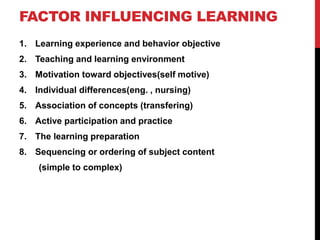
FACTOR INFLUENCING LEARNING
1. Learning experience and behavior objective
2. Teaching and learning environment
3. Motivation toward objectives(self motive)
4. Individual differences(eng. , nursing)
5. Association of concepts (transfering)
6. Active participation and practice
7. The learning preparation
8. Sequencing or ordering of subject content
(simple to complex)
Learning
Learning
Learning
Learning
Learning
Learning

Learning

  • 2.
    INTRODUCTION Learning is theprocess of growth and development where by the learner acquires a body of knowledge, develops ideas which she makes a part of herself and develops the ability to use her knowledge in the pursuit of her ideals. Learning is part of education, earning brings modification of behavior.
  • 3.
    DEFINITION “the act orexperience of one that learns; knowledge’s or skill acquired by instruction or study; modification of a behavioral tendency by experience.” “Learning is change in behavior which is demonstrated by people implementing knowledge, skills or practice derived from education.”
  • 6.
  • 8.
    • Learning isadjustment • Learning is organizing experiences(get something new) • Learning is intelligent(short key) • Learning affects the conduct of the learner(adjust in environment) • Learning takes place through trial and error(we learn out of our mistake) • Learning depends upon insight
  • 11.
  • 12.
    TYPES OF LEARNING 1.Conditioning (environment) 2. Role learning 3. Problem learning(A/C problem,) 4. Skill learning 5. Problem solving
  • 13.
    EIGHT KIND OFLEARNING • Verbal association learning • Changing • (application) • Stimulus response learning • Sign learning Multiple discrimination learning Concept learning Problem solving Principle learning
  • 16.
    FACTOR INFLUENCING LEARNING 1.Learning experience and behavior objective 2. Teaching and learning environment 3. Motivation toward objectives(self motive) 4. Individual differences(eng. , nursing) 5. Association of concepts (transfering) 6. Active participation and practice 7. The learning preparation 8. Sequencing or ordering of subject content (simple to complex)

Editor's Notes

  • #3 Innovations for Learning is a nonprofit focused on improving reading instruction in the primary grades. Since 1993 we have pioneered using digital technology to connect teachers and students to a galaxy of resources to help students learn to read.
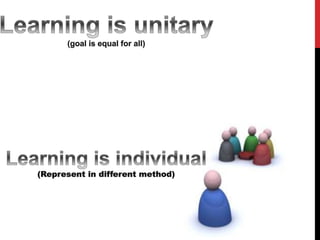
  • #6 Unitary method:- whatever goal is equal for all Individual :- in respresent in different method
  • #7 Social:- environment seen and after given response eg. grooming is selected A/C to function wise Self active:- in that what a problem occur by me and afterward from that problem to learn have benn my improve the knowledge
  • #8 Transeferable :_ if any one have problem and I know the solution of this problem so I have given the knowledge related problem . A/C to his problem Growth: means in B.Sc(N) and M.Sc(N) difference
  • #9 Adjustment:- A/c to time wise all person should be adjust Creative:- eg, exam we understand concepts which are given by teacher but in exam we write in exam by own veiw Organizing experiences:-
  • #13 Conditioning:-And can be the leaders that we all aspire to be, even though our conditioning  over the years may have prevented us from being it. the learning process by which the behavior of an organism becomes dependent on an event occurring in its environment. Rote learning:- Rote learning is a memorization technique based on repetition. The idea is that one will be able to quickly recall the meaning of the material the more one repeats it. Some of the alternatives to rote learning include meaningful learning, associative learning, and active learning. Problem learning:- Learning disabilities can be characterized by a discrepancy between a student’s ability and his or her achievement in areas such as reading, writing, mathematics, or speaking. This option is up to the individual school, or agency doing the assessment.
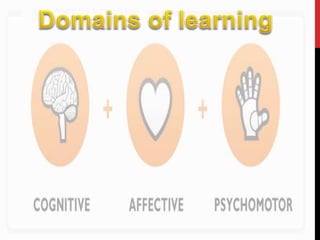
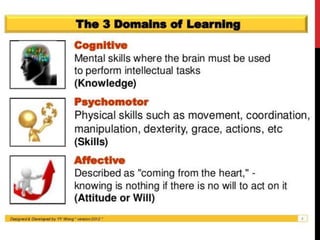
  • #16 Cognitive : Psychomotor:- Affective:-