Learning
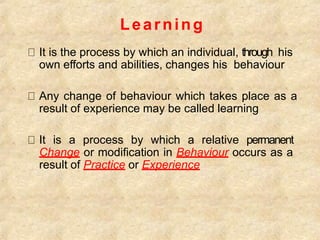
It is the process by which an individual, through his
own efforts and abilities, changes his behaviour
Any change of behaviour which takes place as a
result of experience may be called learning
It is a process by which a relative permanent
Change or modification in Behaviour occurs as a
result of Practice or Experience
• Learning is active process as the part of the
learner
• Extension workers prime role is to create the
“Learning Situations”
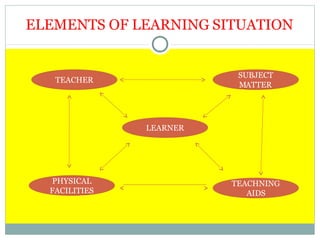
ELEMENTS OF LEARNING SITUATION
TEACHER
PHYSICAL
FACILITIES
TEACHNING
AIDS
LEARNER
SUBJECT
MATTER
Teacher/Instructor
Teaching objectives are clearly significant to the learner and a
r
e
attainable through the educational process with in the mental
physical limitations of the learners
Thorough knowledge of the subject matter
Enthusiastic and interested in subject matter
Democratic instructional procedures
Well prepared, prompt in teaching-learning session
Minimize the distraction within & out side learning session
Skillful in using the teaching materials & equipment
Prepare & use teaching plan
Learner
• Need for information
• Interested
• Capable of learning
• Must use information gained
Subject Matter
• Pertinent to learner’s need
• Applicable to real life situations
• Well organized and logically presented
• Presented clearly
• Challenging, satisfying and significant to the
learners
• Fit into overall objectives
Teaching aid
• Meet the needs effectively
• Readily available
• Each item must be used skillfully
Physical Facilities
• Free from outside distraction
• Well lighted & ventilated
• Adequate space for group
• Well arranged comfortable furniture
Principle o f Adult Learning
• Learning is personal (active process)
• Involvement (themselves)
• Readiness
• Association
• Conditioned principle (physical & psychological climate)
• Comfort assist learning
• Adopt teaching (as per the needs)
• Distribution (short lesson)
• Capacity (rate of learning)
• Arousing interest
• Enough practice & Encouragement
E f f e c t o f senses on Learning
• Taste 1%
• T
ouch 1.5%
• Smell 3.5%
• Hearing 11%
• Sight 83%
Learners abiLity t o r e t a i n
• Read 10%
• Hear 20%
• See 30%
• See & Hear 50%
• What they say as they talk 70%
• Practically doing 90%
Types o f Learning
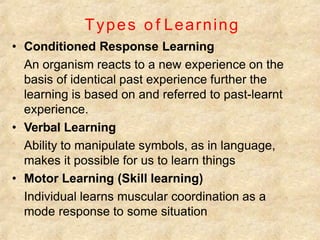
• Conditioned Response Learning
An organism reacts to a new experience on the
basis of identical past experience further the
learning is based on and referred to past-learnt
experience.
• Verbal Learning
Ability to manipulate symbols, as in language,
makes it possible for us to learn things
• Motor Learning (Skill learning)
Individual learns muscular coordination as a
mode response to some situation
• Perceptual Learning
As a result of past experience people perceive
the situation differently. One-way changing a
persons habit of responding is to change the
way in which the individual perceives the
environment
• Attitude Learning
An attitude is an emotionalized system of
ideas, which predisposes an individual to act in
certain way under certain conditions. Our past
experiences will results in giving favorable or
unfavorable response to objects, persons,
situations or ideas
Laws o f Learning: Thorndike’s
Laws
• The law of readiness
• The law of exercise
• The law of effect
• The law of belongingness
Theories o f Learning
• Behavioural Theory
– Classical conditioning theory
– Trial and error theory
– Operant or Instrumental conditioning theory
• Cognitive Theory
• Humanistic Theory
Learning.pptx

Learning.pptx

  • 1.
    Learning It is theprocess by which an individual, through his own efforts and abilities, changes his behaviour Any change of behaviour which takes place as a result of experience may be called learning It is a process by which a relative permanent Change or modification in Behaviour occurs as a result of Practice or Experience
  • 2.
    • Learning isactive process as the part of the learner • Extension workers prime role is to create the “Learning Situations”
  • 3.
    ELEMENTS OF LEARNINGSITUATION TEACHER PHYSICAL FACILITIES TEACHNING AIDS LEARNER SUBJECT MATTER
  • 4.
    Teacher/Instructor Teaching objectives areclearly significant to the learner and a r e attainable through the educational process with in the mental physical limitations of the learners Thorough knowledge of the subject matter Enthusiastic and interested in subject matter Democratic instructional procedures Well prepared, prompt in teaching-learning session Minimize the distraction within & out side learning session Skillful in using the teaching materials & equipment Prepare & use teaching plan
  • 5.
    Learner • Need forinformation • Interested • Capable of learning • Must use information gained
  • 6.
    Subject Matter • Pertinentto learner’s need • Applicable to real life situations • Well organized and logically presented • Presented clearly • Challenging, satisfying and significant to the learners • Fit into overall objectives
  • 7.
    Teaching aid • Meetthe needs effectively • Readily available • Each item must be used skillfully
  • 8.
    Physical Facilities • Freefrom outside distraction • Well lighted & ventilated • Adequate space for group • Well arranged comfortable furniture
  • 9.
    Principle o fAdult Learning • Learning is personal (active process) • Involvement (themselves) • Readiness • Association • Conditioned principle (physical & psychological climate) • Comfort assist learning • Adopt teaching (as per the needs) • Distribution (short lesson) • Capacity (rate of learning) • Arousing interest • Enough practice & Encouragement
  • 10.
    E f fe c t o f senses on Learning • Taste 1% • T ouch 1.5% • Smell 3.5% • Hearing 11% • Sight 83%
  • 11.
    Learners abiLity to r e t a i n • Read 10% • Hear 20% • See 30% • See & Hear 50% • What they say as they talk 70% • Practically doing 90%
  • 12.
    Types o fLearning • Conditioned Response Learning An organism reacts to a new experience on the basis of identical past experience further the learning is based on and referred to past-learnt experience. • Verbal Learning Ability to manipulate symbols, as in language, makes it possible for us to learn things • Motor Learning (Skill learning) Individual learns muscular coordination as a mode response to some situation
  • 13.
    • Perceptual Learning Asa result of past experience people perceive the situation differently. One-way changing a persons habit of responding is to change the way in which the individual perceives the environment • Attitude Learning An attitude is an emotionalized system of ideas, which predisposes an individual to act in certain way under certain conditions. Our past experiences will results in giving favorable or unfavorable response to objects, persons, situations or ideas
  • 14.
    Laws o fLearning: Thorndike’s Laws • The law of readiness • The law of exercise • The law of effect • The law of belongingness
  • 15.
    Theories o fLearning • Behavioural Theory – Classical conditioning theory – Trial and error theory – Operant or Instrumental conditioning theory • Cognitive Theory • Humanistic Theory