ANANTHI.MM B.Sc., B.Ed.,
ALAGAPPA UNIVERSITY
KARAIKUDI
LEARNING
WHAT IS LEARNING
 Learning is the act of acquiring new or modifying
existing knowledge, behaviors, skills, values, or
preferences and may involve synthesizing different types
of information.
 It is relative permanent change in behavior or mental
state based on experience.
 Learning may occur consciously or unconsciously.
TCP PRESENTO-2020
DEFENITION
Learning is defined as “ detection and
correction of error”. where an error means,
“any mismatch between our intensions and
what actually happens
-Chris Argyris
Learning is the modification of behavior
through experience.
-Gatee
TCP PRESENTO-2020
NATURE AND CHARACTESTIC OF
LEARNING
• Learning is the change of behavior.
• Learning is a continuous life long process.
• Learning is a universal process.
• Learning is purposive and goal directed.
• Learning is transferable from one situation
to another.
• Learning helps in attainment of teaching.
• Learning helps in the proper growth and
development.
TCP PRESENTO-2020
• Learning helps in the realization of goals of
life.
• Learning involves reconstruction of experience.
• Learning does not necessarily imply
improvement.
• Leaning helps the proper adjustment.
• Leaning helps in the balanced development of
the personality.
TCP PRESENTO-2020
FACTOR INFLUENCING LEARNING
1.Intellectual factor
2.Environmental factor
3.Physical factor
4.Emotional factor
5.Media influence
6.Relationship with teachers, parents and peers
TCP PRESENTO-2020
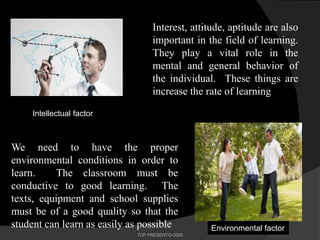
Intellectual factor
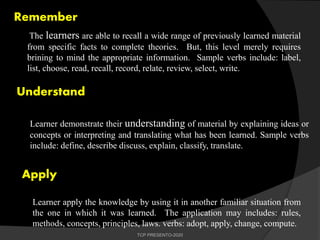
Environmental factor
Interest, attitude, aptitude are also
important in the field of learning.
They play a vital role in the
mental and general behavior of
the individual. These things are
increase the rate of learning
We need to have the proper
environmental conditions in order to
learn. The classroom must be
conductive to good learning. The
texts, equipment and school supplies
must be of a good quality so that the
student can learn as easily as possible
TCP PRESENTO-2020
Physical factor
Emotional factor
This includes things such as our
overall health, nutrition, physical
deficiencies and physical
development. If we are in poor
health we wont be able to learn the
things presented.
Things like social factors and
emotional can relate directly to
your motivation for learning. If
you cooperate with other you will
learn faster and will have more
fun in learning new things.
TCP PRESENTO-2020
The printed non printed
medias are involved in a
learning factor. It is economic
and traditional method that
can be the learner leant but the
both good and bad things are
in the system.
Media influence
Relationship with teacher
Each teacher has his/her own
personality that can be strongly
affect the individual's learning
environment. The success or
failure of the students can be
depend on the teachers
personality.
TCP PRESENTO-2020
TCP PRESENTO-2020
Remember
The learners are able to recall a wide range of previously learned material
from specific facts to complete theories. But, this level merely requires
brining to mind the appropriate information. Sample verbs include: label,
list, choose, read, recall, record, relate, review, select, write.
Understand
Learner demonstrate their understanding of material by explaining ideas or
concepts or interpreting and translating what has been learned. Sample verbs
include: define, describe discuss, explain, classify, translate.
Apply
Learner apply the knowledge by using it in another familiar situation from
the one in which it was learned. The application may includes: rules,
methods, concepts, principles, laws. verbs: adopt, apply, change, compute.
TCP PRESENTO-2020
Analyzing
Learners analysis when they break information into part to explore
understanding and relationships in an attempt to indentify evidence for a
conclusion. verbs: analyze, deduce, compare, differentiate, calculate.
Evaluating
Learners evaluate when they use in-depth reflection, critics, and assessment
to justify a decision or course of action. verbs: determine, evaluate, measure,
judge, justify, validate.
Create
Learners create when they generate new ideas products of ways of
viewing things. Verbs: assemble, construct, create, generate, plan,
prepare, produce.
TCP PRESENTO-2020
TCP PRESENTO-2020
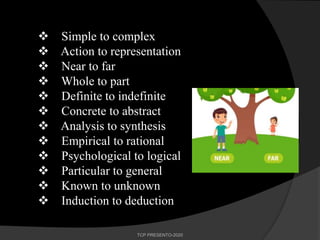
 Simple to complex
 Action to representation
 Near to far
 Whole to part
 Definite to indefinite
 Concrete to abstract
 Analysis to synthesis
 Empirical to rational
 Psychological to logical
 Particular to general
 Known to unknown
 Induction to deduction
TCP PRESENTO-2020
Pillars of learning
The four pillars of education all started with the report entitled
“learning the treasure within” of the international commission of
education for the twenty first century. It was published by the
UNESCO.
The report itself provides new insights into education for the 21st
centaury. It stresses that each individual must be equipped to seize
learning opportunities throughout life, broaden one’s knowledge,
skills and attitudes, and adapt to a changing, complex, and
interdependent world.
The argued, tends to the detriment of other that are essential to
sustaining human development.
There are four pillars of learning is learning to know, learning to do,
learning to together, learning to be.
TCP PRESENTO-2020
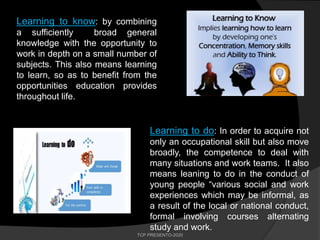
Learning to know: by combining
a sufficiently broad general
knowledge with the opportunity to
work in depth on a small number of
subjects. This also means learning
to learn, so as to benefit from the
opportunities education provides
throughout life.
Learning to do: In order to acquire not
only an occupational skill but also move
broadly, the competence to deal with
many situations and work teams. It also
means leaning to do in the conduct of
young people “various social and work
experiences which may be informal, as
a result of the local or national conduct,
formal involving courses alternating
study and work.
TCP PRESENTO-2020
Learning to live together: by developing
an understanding of other people and
an appreciation of interdependence –
caring out joint project and leaning to
manage conflicts in a sprit of respect
for the values of pluralism mutual
understand and peace
Learning to be: so as better to
develop one’s personality and be
able to act with ever greater
autonomy, judgment and personal
responsibilities . in that connection,
education must not disregard any
aspect of a persons potential :
memory, reasoning, aesthetic
senses, physical capacities and
communication skills. TCP PRESENTO-2020
Transfer of learning
Definition
“ Transfer of learning occurs when a person's learning in
one situation influence his learning performance in other
situation” - B.L.Bigge (1964)
“Transfer of learning means that experience and
performance on one task influences performance of some
sequent task” - H.C.Ellis (1965)
“Transfer of learning is the effect of some particular
course on learning or execution of a performance such effect
may be of a helpful nature or it may hinder”- K.Lovell (1970)
TCP PRESENTO-2020
Types of transfer of learning
There are three types of transfer of learning
positive transfer
Negative transfer
Zero or neutral transfer
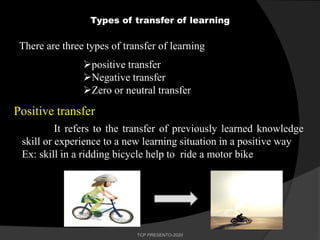
Positive transfer
It refers to the transfer of previously learned knowledge
skill or experience to a new learning situation in a positive way
Ex: skill in a ridding bicycle help to ride a motor bike
TCP PRESENTO-2020
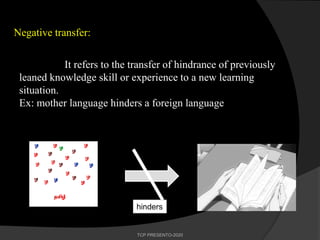
Negative transfer:
It refers to the transfer of hindrance of previously
leaned knowledge skill or experience to a new learning
situation.
Ex: mother language hinders a foreign language
hinders
TCP PRESENTO-2020
When learning of one activity neither facilitates nor
hinders of another task.
Ex : learning to dance neither help nor hinders cooking skill.
Zero transfer:
TCP PRESENTO-2020
References:
1. https://www.slideshare.net/drjayeshpatidar/learning-
44340878
2. https://www.yourarticlelibrary.com/learning/7-important-
factors-that-may-affect-the-learning-process/6064
3. https://facultyedsolutions.org/the-six-levels-of-learning/
4. https://steemit.com/steemiteducation/@mayann/what-
are-the-four-pillars-of-learning
5. http://collections.infocollections.org/ukedu/en/d/Jh1767
e/3.1.html
6. www.bud.ac.in
7. https://www.psychologydiscussion.net/essays/essay-
transfer-of-learning-types-and-
theories/594https://www.slideshare.net/SandySharma1
5/learning-ppt-60625995
TCP PRESENTO-2020
TCP PRESENTO-2020

LEARNING

  • 1.
  • 2.
    LEARNING WHAT IS LEARNING Learning is the act of acquiring new or modifying existing knowledge, behaviors, skills, values, or preferences and may involve synthesizing different types of information.  It is relative permanent change in behavior or mental state based on experience.  Learning may occur consciously or unconsciously. TCP PRESENTO-2020
  • 3.
    DEFENITION Learning is definedas “ detection and correction of error”. where an error means, “any mismatch between our intensions and what actually happens -Chris Argyris Learning is the modification of behavior through experience. -Gatee TCP PRESENTO-2020
  • 4.
    NATURE AND CHARACTESTICOF LEARNING • Learning is the change of behavior. • Learning is a continuous life long process. • Learning is a universal process. • Learning is purposive and goal directed. • Learning is transferable from one situation to another. • Learning helps in attainment of teaching. • Learning helps in the proper growth and development. TCP PRESENTO-2020
  • 5.
    • Learning helpsin the realization of goals of life. • Learning involves reconstruction of experience. • Learning does not necessarily imply improvement. • Leaning helps the proper adjustment. • Leaning helps in the balanced development of the personality. TCP PRESENTO-2020
  • 6.
    FACTOR INFLUENCING LEARNING 1.Intellectualfactor 2.Environmental factor 3.Physical factor 4.Emotional factor 5.Media influence 6.Relationship with teachers, parents and peers TCP PRESENTO-2020
  • 7.
    Intellectual factor Environmental factor Interest,attitude, aptitude are also important in the field of learning. They play a vital role in the mental and general behavior of the individual. These things are increase the rate of learning We need to have the proper environmental conditions in order to learn. The classroom must be conductive to good learning. The texts, equipment and school supplies must be of a good quality so that the student can learn as easily as possible TCP PRESENTO-2020
  • 8.
    Physical factor Emotional factor Thisincludes things such as our overall health, nutrition, physical deficiencies and physical development. If we are in poor health we wont be able to learn the things presented. Things like social factors and emotional can relate directly to your motivation for learning. If you cooperate with other you will learn faster and will have more fun in learning new things. TCP PRESENTO-2020
  • 9.
    The printed nonprinted medias are involved in a learning factor. It is economic and traditional method that can be the learner leant but the both good and bad things are in the system. Media influence Relationship with teacher Each teacher has his/her own personality that can be strongly affect the individual's learning environment. The success or failure of the students can be depend on the teachers personality. TCP PRESENTO-2020
  • 10.
  • 11.
    Remember The learners areable to recall a wide range of previously learned material from specific facts to complete theories. But, this level merely requires brining to mind the appropriate information. Sample verbs include: label, list, choose, read, recall, record, relate, review, select, write. Understand Learner demonstrate their understanding of material by explaining ideas or concepts or interpreting and translating what has been learned. Sample verbs include: define, describe discuss, explain, classify, translate. Apply Learner apply the knowledge by using it in another familiar situation from the one in which it was learned. The application may includes: rules, methods, concepts, principles, laws. verbs: adopt, apply, change, compute. TCP PRESENTO-2020
  • 12.
    Analyzing Learners analysis whenthey break information into part to explore understanding and relationships in an attempt to indentify evidence for a conclusion. verbs: analyze, deduce, compare, differentiate, calculate. Evaluating Learners evaluate when they use in-depth reflection, critics, and assessment to justify a decision or course of action. verbs: determine, evaluate, measure, judge, justify, validate. Create Learners create when they generate new ideas products of ways of viewing things. Verbs: assemble, construct, create, generate, plan, prepare, produce. TCP PRESENTO-2020
  • 13.
  • 14.
     Simple tocomplex  Action to representation  Near to far  Whole to part  Definite to indefinite  Concrete to abstract  Analysis to synthesis  Empirical to rational  Psychological to logical  Particular to general  Known to unknown  Induction to deduction TCP PRESENTO-2020
  • 15.
    Pillars of learning Thefour pillars of education all started with the report entitled “learning the treasure within” of the international commission of education for the twenty first century. It was published by the UNESCO. The report itself provides new insights into education for the 21st centaury. It stresses that each individual must be equipped to seize learning opportunities throughout life, broaden one’s knowledge, skills and attitudes, and adapt to a changing, complex, and interdependent world. The argued, tends to the detriment of other that are essential to sustaining human development. There are four pillars of learning is learning to know, learning to do, learning to together, learning to be. TCP PRESENTO-2020
  • 16.
    Learning to know:by combining a sufficiently broad general knowledge with the opportunity to work in depth on a small number of subjects. This also means learning to learn, so as to benefit from the opportunities education provides throughout life. Learning to do: In order to acquire not only an occupational skill but also move broadly, the competence to deal with many situations and work teams. It also means leaning to do in the conduct of young people “various social and work experiences which may be informal, as a result of the local or national conduct, formal involving courses alternating study and work. TCP PRESENTO-2020
  • 17.
    Learning to livetogether: by developing an understanding of other people and an appreciation of interdependence – caring out joint project and leaning to manage conflicts in a sprit of respect for the values of pluralism mutual understand and peace Learning to be: so as better to develop one’s personality and be able to act with ever greater autonomy, judgment and personal responsibilities . in that connection, education must not disregard any aspect of a persons potential : memory, reasoning, aesthetic senses, physical capacities and communication skills. TCP PRESENTO-2020
  • 18.
    Transfer of learning Definition “Transfer of learning occurs when a person's learning in one situation influence his learning performance in other situation” - B.L.Bigge (1964) “Transfer of learning means that experience and performance on one task influences performance of some sequent task” - H.C.Ellis (1965) “Transfer of learning is the effect of some particular course on learning or execution of a performance such effect may be of a helpful nature or it may hinder”- K.Lovell (1970) TCP PRESENTO-2020
  • 19.
    Types of transferof learning There are three types of transfer of learning positive transfer Negative transfer Zero or neutral transfer Positive transfer It refers to the transfer of previously learned knowledge skill or experience to a new learning situation in a positive way Ex: skill in a ridding bicycle help to ride a motor bike TCP PRESENTO-2020
  • 20.
    Negative transfer: It refersto the transfer of hindrance of previously leaned knowledge skill or experience to a new learning situation. Ex: mother language hinders a foreign language hinders TCP PRESENTO-2020
  • 21.
    When learning ofone activity neither facilitates nor hinders of another task. Ex : learning to dance neither help nor hinders cooking skill. Zero transfer: TCP PRESENTO-2020
  • 22.
    References: 1. https://www.slideshare.net/drjayeshpatidar/learning- 44340878 2. https://www.yourarticlelibrary.com/learning/7-important- factors-that-may-affect-the-learning-process/6064 3.https://facultyedsolutions.org/the-six-levels-of-learning/ 4. https://steemit.com/steemiteducation/@mayann/what- are-the-four-pillars-of-learning 5. http://collections.infocollections.org/ukedu/en/d/Jh1767 e/3.1.html 6. www.bud.ac.in 7. https://www.psychologydiscussion.net/essays/essay- transfer-of-learning-types-and- theories/594https://www.slideshare.net/SandySharma1 5/learning-ppt-60625995 TCP PRESENTO-2020
  • 23.