What is meaningful learning? PREPARED BY: MARK PHILIP E. BARING BTTE-4
the nature of the learning drives learning understanding of and effort invested in completing a task or activity completing standardized tests testing factories
education meaningful task pursue should engage active, constructive, intentional, authentic, and cooperative new situation set goals and regulate the goals technologies Active (Manipulative/Observant human process adapt to their environment
Characteristics of Meaningful Learning. Active Constructive Intentional Authentic Cooperative
Characteristics of Meaningful Learning . Manipulative/Observant Goal directed/Regulatory Complex/Contextualized Collaborative/Conversational Articulate /Reflective
Learning  From  Technology , illustrations & projectors later radio, motion pictures programmed instruction emerged educational technology Computers commercial technology information was recorded
Learning  From  Technology, films and television programs modem  computer technologies microcomputers (Becker, 1985).graphics programs desktop publishing flexible media technologies as learning tools
Learning  With  Technology cognitive learning strategies and critical thinking skills engage learners in active, constructive, intentional, authentic, and cooperative learning conveyors or communicators of meaning conceptually and intellectually engaging meaningful personal interpretations and representations of the world cognitive responsibility for performance
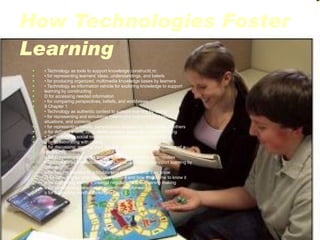
How Technologies Foster Learning •  Technology as tools to support knowledge constructi(;m: •  for representing learners' ideas, understandings, and beliefs •  for producing organized, multimedia knowledge bases by learners •  Technology as information vehicle for exploring knowledge to support learning by constructing: D for accessing needed information •  for comparing perspectives, beliefs, and worldviews 8 Chapter 1 •  Technology as authentic context to support learning by doing: •  for representing and simulating meaningful real-world problems, situations, and contexts •  for representing beliefs, perspectives, arguments, and stories of others o for defining a safe, controllable problem space for student thinking •  Technology as social medium to support learning by conversing: o for collaborating with others, , o for discussing, arguing, and, lamella  consensus among members of a community o for supporting discourse among knowledge-building communities •  Technology as intellectual partner (Jonassen, 2000) to support learning by reflecting: o for helping learners to articulate and represent what they know ,0 for reflecting on what they have learned and how they came to know it o for supporting learners' internal negotiations and meaning making o for constructing personal representations of meaning o for supporting mindful thinking
How Technologies Foster Thinking Analogical Expressive Problem Solving Experiential Causal reasoning
Conclusion Knowledge construction, not reproduction Conversation, not reception Articulation, not repetition Collaboration, not corn petition Reflection, not prescription
Things to think about If you would like' to reflect on the ideas that ~e present din this chapter, consider your responses to the following questions. If learners cannot know what the teacher knows because they do not share a common knowledge and experience base, how can we be certain that students learn important things? For instance, if you want to teach
your theory of learning (construct personal meaning) learners construct knowledge  back to your childhood  recent controversial topic Radical constructivists argue educators argue  thinking processes engaged  learn anything from that activity video, movie, slide show, or computer program
your theory of learning Radical constructivists argue educators argue  thinking processes engaged  learn anything from that activity video, movie, slide show, or computer program
References Becker, H. J.. (1985).  How schools use microcomputers: Summaryofa  1983  national survey.  (ERIC Document Reproduction Service No. EO 257448) Clark, R. (1983). Mere vehicles.  Review of Educational Research,  53(4), 445-459. Hadley, M., & Sheingold, K. (1993).Comrnonalities and distinctive patterns in teacher interaction of computers.  American Journal of Edilcation, 101(3), 261-315. Hume, D. (1739/2000).  A treatise of human nature. Oxford, UK: Oxford University Press. Jonassen, D. H. (2000).  Computers as mindtools in schools: Engaging critical thinking .  .Columbus, OH: Merrill/Prentice Hall. Chapter 1 Erlbaum. Jonassen, D. H., & Ionas, 1. G. (2007). Designing effective supports for causal reasoning.  Educational Technology: Research and Development, 55. Polkinghorne, D. (1988).  Narrative knowing and the human sciences.  Albany: State University of New York Press. Scardamalia, M. & Bereiter, C. (1994). Computer support for knowledge building communities. Journal of the Learning Sciences,  3(3), 265-283. Schank, R. C. (1994). Goal-based scenarios. In R. C. Schank & E. Langer (Eds.),  Beliefs, reasoning, and decision making: Psycho-logic in honor of Bob Abelson  (pp. 1-33). Hillsdale, NI: Lawrence

What is meaningful learning (mark baring)

  • 1.
    What is meaningfullearning? PREPARED BY: MARK PHILIP E. BARING BTTE-4
  • 2.
    the nature ofthe learning drives learning understanding of and effort invested in completing a task or activity completing standardized tests testing factories
  • 3.
    education meaningful taskpursue should engage active, constructive, intentional, authentic, and cooperative new situation set goals and regulate the goals technologies Active (Manipulative/Observant human process adapt to their environment
  • 4.
    Characteristics of MeaningfulLearning. Active Constructive Intentional Authentic Cooperative
  • 5.
    Characteristics of MeaningfulLearning . Manipulative/Observant Goal directed/Regulatory Complex/Contextualized Collaborative/Conversational Articulate /Reflective
  • 6.
    Learning From Technology , illustrations & projectors later radio, motion pictures programmed instruction emerged educational technology Computers commercial technology information was recorded
  • 7.
    Learning From Technology, films and television programs modem computer technologies microcomputers (Becker, 1985).graphics programs desktop publishing flexible media technologies as learning tools
  • 8.
    Learning With Technology cognitive learning strategies and critical thinking skills engage learners in active, constructive, intentional, authentic, and cooperative learning conveyors or communicators of meaning conceptually and intellectually engaging meaningful personal interpretations and representations of the world cognitive responsibility for performance
  • 9.
    How Technologies FosterLearning • Technology as tools to support knowledge constructi(;m: • for representing learners' ideas, understandings, and beliefs • for producing organized, multimedia knowledge bases by learners • Technology as information vehicle for exploring knowledge to support learning by constructing: D for accessing needed information • for comparing perspectives, beliefs, and worldviews 8 Chapter 1 • Technology as authentic context to support learning by doing: • for representing and simulating meaningful real-world problems, situations, and contexts • for representing beliefs, perspectives, arguments, and stories of others o for defining a safe, controllable problem space for student thinking • Technology as social medium to support learning by conversing: o for collaborating with others, , o for discussing, arguing, and, lamella consensus among members of a community o for supporting discourse among knowledge-building communities • Technology as intellectual partner (Jonassen, 2000) to support learning by reflecting: o for helping learners to articulate and represent what they know ,0 for reflecting on what they have learned and how they came to know it o for supporting learners' internal negotiations and meaning making o for constructing personal representations of meaning o for supporting mindful thinking
  • 10.
    How Technologies FosterThinking Analogical Expressive Problem Solving Experiential Causal reasoning
  • 11.
    Conclusion Knowledge construction,not reproduction Conversation, not reception Articulation, not repetition Collaboration, not corn petition Reflection, not prescription
  • 12.
    Things to thinkabout If you would like' to reflect on the ideas that ~e present din this chapter, consider your responses to the following questions. If learners cannot know what the teacher knows because they do not share a common knowledge and experience base, how can we be certain that students learn important things? For instance, if you want to teach
  • 13.
    your theory oflearning (construct personal meaning) learners construct knowledge back to your childhood recent controversial topic Radical constructivists argue educators argue thinking processes engaged learn anything from that activity video, movie, slide show, or computer program
  • 14.
    your theory oflearning Radical constructivists argue educators argue thinking processes engaged learn anything from that activity video, movie, slide show, or computer program
  • 15.
    References Becker, H.J.. (1985). How schools use microcomputers: Summaryofa 1983 national survey. (ERIC Document Reproduction Service No. EO 257448) Clark, R. (1983). Mere vehicles. Review of Educational Research, 53(4), 445-459. Hadley, M., & Sheingold, K. (1993).Comrnonalities and distinctive patterns in teacher interaction of computers. American Journal of Edilcation, 101(3), 261-315. Hume, D. (1739/2000). A treatise of human nature. Oxford, UK: Oxford University Press. Jonassen, D. H. (2000). Computers as mindtools in schools: Engaging critical thinking . .Columbus, OH: Merrill/Prentice Hall. Chapter 1 Erlbaum. Jonassen, D. H., & Ionas, 1. G. (2007). Designing effective supports for causal reasoning. Educational Technology: Research and Development, 55. Polkinghorne, D. (1988). Narrative knowing and the human sciences. Albany: State University of New York Press. Scardamalia, M. & Bereiter, C. (1994). Computer support for knowledge building communities. Journal of the Learning Sciences, 3(3), 265-283. Schank, R. C. (1994). Goal-based scenarios. In R. C. Schank & E. Langer (Eds.), Beliefs, reasoning, and decision making: Psycho-logic in honor of Bob Abelson (pp. 1-33). Hillsdale, NI: Lawrence