LEON 611: LEARNING
PERSPECTIVES
12/05/2017
DR BERNADETTE GEDULD
SNR LECTURER
Call Centre: 0182855900
bernadette.geduld@nwu.ac.za
CONTACT SESSION 4
• EXAMINATION FORMAT
• STUDY MATERIAL
• Study guide
Closed book examination
Duration: 2h00
Format: 4 questions, you have to
answer any two (2).
Marks: 100
• 1. web address to get hold of examination scopes,
previous examination question papers and tutorial
notes:
• www.olgdownloads.co.za
• 2. To access all recorded IWB sessions:
http://distance.nwu.ac.za/content/unit-open-distance-lea
Are you fit enough for the
exam?
Test and examination
anxiety
Why do students fail?
Examination information
Know your action verbs
Understand the question
Ineffective study methods
Integrate theory and practice
Mark allocation
Poor time management
Be prepared
Manage your time
Write neat and legible
Learning Perspectives
How do you define effective
learning?
Knowledge?
Skills?
Factors that influence learning?
What is the role of the learner?
Study unit 1
• Behaviourist theory
• Emphasise the formation of associations
between stimuli and responses through
selective reinforcement of correct responses
• Behavioural theories therefore seem best
suited to explain simpler forms of learning
that involve associations, such as
multiplication facts, foreign language word
meanings, and state capital cities
Cognitive theories
• Explain learning in terms of factors such as
information processing, memory networks, and
student perceptions and interpretations of
classroom variables (e.g., teachers, peers,
materials, organisation, instruction)
• Complex forms of learning; for example, solving
mathematical word problems, drawing inferences
from text, and writing essays
• Attention, effort, and persistence
• Learning is promoted by goal setting, self-
monitoring of progress, corrective feedback from
teachers and coaches, and feelings of intrinsic
motivation
Study unit 2
Distinguish between different types of
reinforcement and how it can affect learning.
Primary: satisfy basic human needs.
Secondary
Positive/Negative
Concrete
Social
Activity
Group contingencies,
Positive feedback
Intrinsic
Par. 2.5
• Criteria we should use to make decisions
concerning conditioning techniques of the
behaviourist theory
• Limitations of the theory
Study unit 3
• The factors that influence observational learning
• Enactive learning involves learning from the
consequences of one’s actions, while vicarious
learning occurs without overt performance by the
learner at the time of learning.
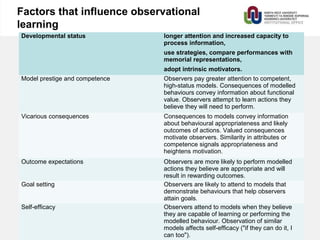
Factors that influence observational
learning
Developmental status longer attention and increased capacity to
process information,
use strategies, compare performances with
memorial representations,
adopt intrinsic motivators.
Model prestige and competence Observers pay greater attention to competent,
high-status models. Consequences of modelled
behaviours convey information about functional
value. Observers attempt to learn actions they
believe they will need to perform.
Vicarious consequences Consequences to models convey information
about behavioural appropriateness and likely
outcomes of actions. Valued consequences
motivate observers. Similarity in attributes or
competence signals appropriateness and
heightens motivation.
Outcome expectations Observers are more likely to perform modelled
actions they believe are appropriate and will
result in rewarding outcomes.
Goal setting Observers are likely to attend to models that
demonstrate behaviours that help observers
attain goals.
Self-efficacy Observers attend to models when they believe
they are capable of learning or performing the
modelled behaviour. Observation of similar
models affects self-efficacy ("if they can do it, I
can too").
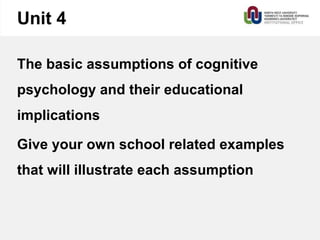
Unit 4
The basic assumptions of cognitive
psychology and their educational
implications
Give your own school related examples
that will illustrate each assumption
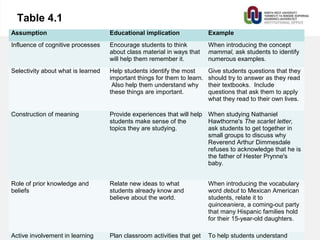
Table 4.1
Assumption Educational implication Example
Influence of cognitive processes Encourage students to think
about class material in ways that
will help them remember it.
When introducing the concept
mammal, ask students to identify
numerous examples.
Selectivity about what is learned Help students identify the most
important things for them to learn.
Also help them understand why
these things are important.
Give students questions that they
should try to answer as they read
their textbooks. Include
questions that ask them to apply
what they read to their own lives.
Construction of meaning Provide experiences that will help
students make sense of the
topics they are studying.
When studying Nathaniel
Hawthorne's The scarlet letter,
ask students to get together in
small groups to discuss why
Reverend Arthur Dimmesdale
refuses to acknowledge that he is
the father of Hester Prynne's
baby.
Role of prior knowledge and
beliefs
Relate new ideas to what
students already know and
believe about the world.
When introducing the vocabulary
word debut to Mexican American
students, relate it to
quinceaniera, a coming-out party
that many Hispanic families hold
for their 15-year-old daughters.
Active involvement in learning Plan classroom activities that get To help students understand
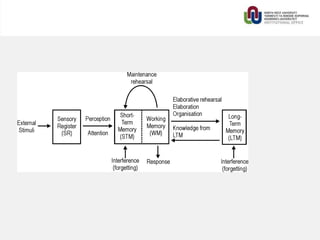
• The capacity, duration and contents of STM
• What teachers should do to help learners to retain
information in the short-term memory
• Maintenance rehearsal: Useful for retaining something
you plan to use and then forget, like a phone number
• Elaborative rehearsal involves associating the
information you are trying to remember with something
you already know
• Chunking can be used to keep more information in the
short-term memory
• Different parts of the long term memory
Study Unit 5
Critically discuss the cognitive characteristics of
learners according to Piaget’s stages of cognitive
development.
Four key principles derived from Vygotsky's ideas
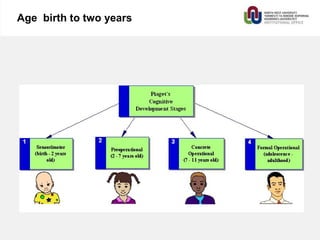
Age birth to two years
Characteristics
Actions are spontaneous and represent an attempt to
understand the world.
Understanding is rooted in present action, for example,
a ball is for throwing and a bottle for sucking.
Begin to make use of imitation, memory and thought.
Formation of concept of “object permanence”
(Recognise that objects do not cease to exist when
they are hidden)
Gradual progression from reflexive behaviour to goal-
directed behaviour
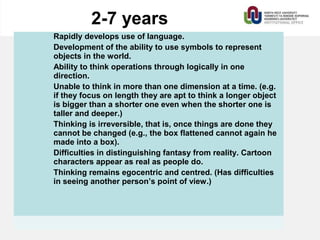
2-7 years
Rapidly develops use of language.
Development of the ability to use symbols to represent
objects in the world.
Ability to think operations through logically in one
direction.
Unable to think in more than one dimension at a time. (e.g.
if they focus on length they are apt to think a longer object
is bigger than a shorter one even when the shorter one is
taller and deeper.)
Thinking is irreversible, that is, once things are done they
cannot be changed (e.g., the box flattened cannot again he
made into a box).
Difficulties in distinguishing fantasy from reality. Cartoon
characters appear as real as people do.
Thinking remains egocentric and centred. (Has difficulties
in seeing another person’s point of view.)
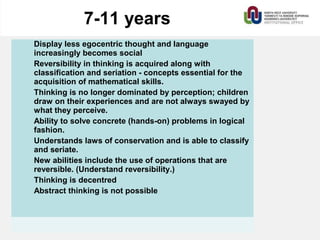
7-11 years
Display less egocentric thought and language
increasingly becomes social
Reversibility in thinking is acquired along with
classification and seriation - concepts essential for the
acquisition of mathematical skills.
Thinking is no longer dominated by perception; children
draw on their experiences and are not always swayed by
what they perceive.
Ability to solve concrete (hands-on) problems in logical
fashion.
Understands laws of conservation and is able to classify
and seriate.
New abilities include the use of operations that are
reversible. (Understand reversibility.)
Thinking is decentred
Abstract thinking is not possible
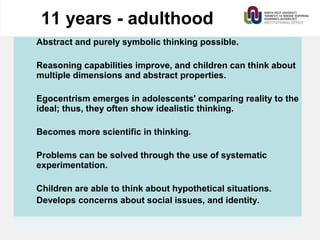
11 years - adulthood
Abstract and purely symbolic thinking possible.
Reasoning capabilities improve, and children can think about
multiple dimensions and abstract properties.
Egocentrism emerges in adolescents' comparing reality to the
ideal; thus, they often show idealistic thinking.
Becomes more scientific in thinking.
Problems can be solved through the use of systematic
experimentation.
Children are able to think about hypothetical situations.
Develops concerns about social issues, and identity.
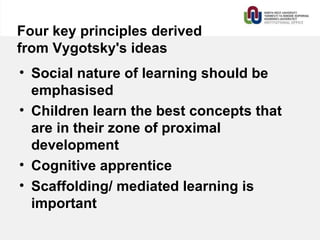
Four key principles derived
from Vygotsky's ideas
• Social nature of learning should be
emphasised
• Children learn the best concepts that
are in their zone of proximal
development
• Cognitive apprentice
• Scaffolding/ mediated learning is
important
Discuss, with relevant examples from Vygotsky’s ideas,
how teachers should apply principles of contructivism
in their teaching
Top down processing
Instructional scaffolding
Co operative learning
Discovery learning
Top-down processing
• Constructivist approaches to teaching emphasise top-down
rather than bottom-up instruction.
• Begin with complex problems to solve and then work out or
discover (with the teacher's guidance) the basic skills required.
• E.g. write compositions and only later learn about spelling,
grammar, and punctuation
• Contrasted with the traditional bottom-up strategy, in which
basic skills are gradually built into more complex skills
• In top-down teaching, the tasks learners begin with are complex,
complete, and authentic, meaning that they are not parts or
simplifications of the tasks that students are ultimately expected
to perform but are the actual tasks
• The constructivist approach works in exactly the opposite
order, beginning with problems (often proposed by the students
themselves) and then helping students figure out how to do the
operations)
Instructional scaffolding
• Helps students acquire cognitive functions
• Instructional scaffolding refers to the process of
controlling task elements that are beyond the
learners' capabilities so that they can focus on and
master those features of the task that they can grasp
quickly
• Analogy of scaffolding employed in construction
projects,
• Five major functions: provide support, function as a
tool, extend the range of the learner, permit the
• In a learning situation, a teacher initially might do
most of the work, after which the teacher and the
learners share responsibility
• As learners become more competent, the teacher
gradually withdraws the scaffolding so learners can
perform independently
• The key is to ensure that the scaffolding keeps
learners in the ZPD, which is altered as they develop
capabilities
Co-operative learning
• Constructivist approaches typically make
extensive use of co-operative learning, on the
theory that learners will more easily discover
and comprehend difficult concepts if they talk
with each other while solving problems co-
operatively
• Co-operative groups are most effective when
each learner has assigned responsibilities and
all must attain competence before any are
allowed to progress
• Peer groups for learning in mathematics,
science, and language arts, attests to the
recognised impact of the social environment
Discovery Learning
• Discovery learning is an important
component of modern constructivist
approaches that has a long history in
education innovation.
• Encouraged to learn largely on their own
through active involvement with concepts
and principles.
• Experiences and conduct experiments that
permit them to discover principles for
themselves
Study Unit 6
• Learning strategies:
Cognitive learning strategies
Metacognitve learning strategies
Resource management strategies
Affective strategies
• Goal setting
• Properties of specificity, proximity,
challenge, commitment, difficulty
• Learning Goal orientation
• 1. web address to get hold of examination scopes,
previous examination question papers and tutorial
notes:
• www.olgdownloads.co.za
• 2. To access all recorded IWB sessions:
http://distance.nwu.ac.za/content/unit-open-distance-lea
Dr Bernadette GeduldDr Bernadette Geduld
Call Centre: 0182855900Call Centre: 0182855900
bernadette.geduld@nwu.ac.zabernadette.geduld@nwu.ac.za
THANK YOU. GOOD LUCK WITH THE EXAMINATION
Leon 611 session 3 12 may 2017

Leon 611 session 3 12 may 2017

  • 1.
    LEON 611: LEARNING PERSPECTIVES 12/05/2017 DRBERNADETTE GEDULD SNR LECTURER Call Centre: 0182855900 bernadette.geduld@nwu.ac.za
  • 2.
    CONTACT SESSION 4 •EXAMINATION FORMAT • STUDY MATERIAL • Study guide Closed book examination Duration: 2h00 Format: 4 questions, you have to answer any two (2). Marks: 100
  • 3.
    • 1. webaddress to get hold of examination scopes, previous examination question papers and tutorial notes: • www.olgdownloads.co.za • 2. To access all recorded IWB sessions: http://distance.nwu.ac.za/content/unit-open-distance-lea
  • 4.
    Are you fitenough for the exam?
  • 5.
  • 6.
  • 7.
    Examination information Know youraction verbs Understand the question Ineffective study methods Integrate theory and practice Mark allocation Poor time management
  • 8.
    Be prepared Manage yourtime Write neat and legible
  • 9.
    Learning Perspectives How doyou define effective learning? Knowledge? Skills? Factors that influence learning? What is the role of the learner?
  • 10.
    Study unit 1 •Behaviourist theory • Emphasise the formation of associations between stimuli and responses through selective reinforcement of correct responses • Behavioural theories therefore seem best suited to explain simpler forms of learning that involve associations, such as multiplication facts, foreign language word meanings, and state capital cities
  • 11.
    Cognitive theories • Explainlearning in terms of factors such as information processing, memory networks, and student perceptions and interpretations of classroom variables (e.g., teachers, peers, materials, organisation, instruction) • Complex forms of learning; for example, solving mathematical word problems, drawing inferences from text, and writing essays • Attention, effort, and persistence • Learning is promoted by goal setting, self- monitoring of progress, corrective feedback from teachers and coaches, and feelings of intrinsic motivation
  • 12.
    Study unit 2 Distinguishbetween different types of reinforcement and how it can affect learning. Primary: satisfy basic human needs. Secondary Positive/Negative Concrete Social Activity Group contingencies, Positive feedback Intrinsic
  • 13.
    Par. 2.5 • Criteriawe should use to make decisions concerning conditioning techniques of the behaviourist theory • Limitations of the theory
  • 14.
    Study unit 3 •The factors that influence observational learning • Enactive learning involves learning from the consequences of one’s actions, while vicarious learning occurs without overt performance by the learner at the time of learning.
  • 15.
    Factors that influenceobservational learning Developmental status longer attention and increased capacity to process information, use strategies, compare performances with memorial representations, adopt intrinsic motivators. Model prestige and competence Observers pay greater attention to competent, high-status models. Consequences of modelled behaviours convey information about functional value. Observers attempt to learn actions they believe they will need to perform. Vicarious consequences Consequences to models convey information about behavioural appropriateness and likely outcomes of actions. Valued consequences motivate observers. Similarity in attributes or competence signals appropriateness and heightens motivation. Outcome expectations Observers are more likely to perform modelled actions they believe are appropriate and will result in rewarding outcomes. Goal setting Observers are likely to attend to models that demonstrate behaviours that help observers attain goals. Self-efficacy Observers attend to models when they believe they are capable of learning or performing the modelled behaviour. Observation of similar models affects self-efficacy ("if they can do it, I can too").
  • 16.
    Unit 4 The basicassumptions of cognitive psychology and their educational implications Give your own school related examples that will illustrate each assumption
  • 17.
    Table 4.1 Assumption Educationalimplication Example Influence of cognitive processes Encourage students to think about class material in ways that will help them remember it. When introducing the concept mammal, ask students to identify numerous examples. Selectivity about what is learned Help students identify the most important things for them to learn. Also help them understand why these things are important. Give students questions that they should try to answer as they read their textbooks. Include questions that ask them to apply what they read to their own lives. Construction of meaning Provide experiences that will help students make sense of the topics they are studying. When studying Nathaniel Hawthorne's The scarlet letter, ask students to get together in small groups to discuss why Reverend Arthur Dimmesdale refuses to acknowledge that he is the father of Hester Prynne's baby. Role of prior knowledge and beliefs Relate new ideas to what students already know and believe about the world. When introducing the vocabulary word debut to Mexican American students, relate it to quinceaniera, a coming-out party that many Hispanic families hold for their 15-year-old daughters. Active involvement in learning Plan classroom activities that get To help students understand

  • 19.
    • The capacity,duration and contents of STM • What teachers should do to help learners to retain information in the short-term memory • Maintenance rehearsal: Useful for retaining something you plan to use and then forget, like a phone number • Elaborative rehearsal involves associating the information you are trying to remember with something you already know • Chunking can be used to keep more information in the short-term memory • Different parts of the long term memory
  • 20.
    Study Unit 5 Criticallydiscuss the cognitive characteristics of learners according to Piaget’s stages of cognitive development. Four key principles derived from Vygotsky's ideas
  • 21.
    Age birth totwo years
  • 22.
    Characteristics Actions are spontaneousand represent an attempt to understand the world. Understanding is rooted in present action, for example, a ball is for throwing and a bottle for sucking. Begin to make use of imitation, memory and thought. Formation of concept of “object permanence” (Recognise that objects do not cease to exist when they are hidden) Gradual progression from reflexive behaviour to goal- directed behaviour

  • 23.
    2-7 years Rapidly developsuse of language. Development of the ability to use symbols to represent objects in the world. Ability to think operations through logically in one direction. Unable to think in more than one dimension at a time. (e.g. if they focus on length they are apt to think a longer object is bigger than a shorter one even when the shorter one is taller and deeper.) Thinking is irreversible, that is, once things are done they cannot be changed (e.g., the box flattened cannot again he made into a box). Difficulties in distinguishing fantasy from reality. Cartoon characters appear as real as people do. Thinking remains egocentric and centred. (Has difficulties in seeing another person’s point of view.)


  • 24.
    7-11 years Display lessegocentric thought and language increasingly becomes social Reversibility in thinking is acquired along with classification and seriation - concepts essential for the acquisition of mathematical skills. Thinking is no longer dominated by perception; children draw on their experiences and are not always swayed by what they perceive. Ability to solve concrete (hands-on) problems in logical fashion. Understands laws of conservation and is able to classify and seriate. New abilities include the use of operations that are reversible. (Understand reversibility.) Thinking is decentred Abstract thinking is not possible
  • 25.
    11 years -adulthood Abstract and purely symbolic thinking possible. Reasoning capabilities improve, and children can think about multiple dimensions and abstract properties. Egocentrism emerges in adolescents' comparing reality to the ideal; thus, they often show idealistic thinking. Becomes more scientific in thinking. Problems can be solved through the use of systematic experimentation. Children are able to think about hypothetical situations. Develops concerns about social issues, and identity.
  • 26.
    Four key principlesderived from Vygotsky's ideas • Social nature of learning should be emphasised • Children learn the best concepts that are in their zone of proximal development • Cognitive apprentice • Scaffolding/ mediated learning is important
  • 27.
    Discuss, with relevantexamples from Vygotsky’s ideas, how teachers should apply principles of contructivism in their teaching Top down processing Instructional scaffolding Co operative learning Discovery learning
  • 28.
    Top-down processing • Constructivistapproaches to teaching emphasise top-down rather than bottom-up instruction. • Begin with complex problems to solve and then work out or discover (with the teacher's guidance) the basic skills required. • E.g. write compositions and only later learn about spelling, grammar, and punctuation • Contrasted with the traditional bottom-up strategy, in which basic skills are gradually built into more complex skills • In top-down teaching, the tasks learners begin with are complex, complete, and authentic, meaning that they are not parts or simplifications of the tasks that students are ultimately expected to perform but are the actual tasks • The constructivist approach works in exactly the opposite order, beginning with problems (often proposed by the students themselves) and then helping students figure out how to do the operations)
  • 29.
    Instructional scaffolding • Helpsstudents acquire cognitive functions • Instructional scaffolding refers to the process of controlling task elements that are beyond the learners' capabilities so that they can focus on and master those features of the task that they can grasp quickly • Analogy of scaffolding employed in construction projects, • Five major functions: provide support, function as a tool, extend the range of the learner, permit the
  • 30.
    • In alearning situation, a teacher initially might do most of the work, after which the teacher and the learners share responsibility • As learners become more competent, the teacher gradually withdraws the scaffolding so learners can perform independently • The key is to ensure that the scaffolding keeps learners in the ZPD, which is altered as they develop capabilities
  • 31.
    Co-operative learning • Constructivistapproaches typically make extensive use of co-operative learning, on the theory that learners will more easily discover and comprehend difficult concepts if they talk with each other while solving problems co- operatively • Co-operative groups are most effective when each learner has assigned responsibilities and all must attain competence before any are allowed to progress • Peer groups for learning in mathematics, science, and language arts, attests to the recognised impact of the social environment
  • 32.
    Discovery Learning • Discoverylearning is an important component of modern constructivist approaches that has a long history in education innovation. • Encouraged to learn largely on their own through active involvement with concepts and principles. • Experiences and conduct experiments that permit them to discover principles for themselves
  • 33.
    Study Unit 6 •Learning strategies: Cognitive learning strategies Metacognitve learning strategies Resource management strategies Affective strategies • Goal setting • Properties of specificity, proximity, challenge, commitment, difficulty • Learning Goal orientation
  • 34.
    • 1. webaddress to get hold of examination scopes, previous examination question papers and tutorial notes: • www.olgdownloads.co.za • 2. To access all recorded IWB sessions: http://distance.nwu.ac.za/content/unit-open-distance-lea
  • 35.
    Dr Bernadette GeduldDrBernadette Geduld Call Centre: 0182855900Call Centre: 0182855900 bernadette.geduld@nwu.ac.zabernadette.geduld@nwu.ac.za THANK YOU. GOOD LUCK WITH THE EXAMINATION