











M2 MEEF November 2014 
Learner language 
Tarone, E., & Swierzbin, B. (2009). Exploring learner language. Oxford 
University Press.
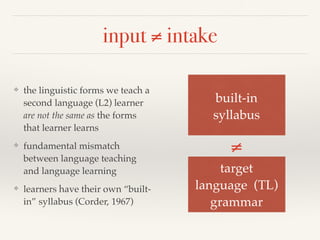
input ≠ intake
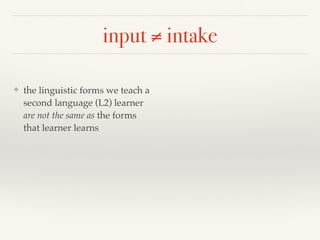
input ≠ intake 
❖ the linguistic forms we teach a 
second language (L2) learner 
are not the same as the forms 
that learner learns
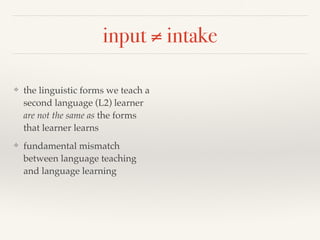
input ≠ intake 
❖ the linguistic forms we teach a 
second language (L2) learner 
are not the same as the forms 
that learner learns 
❖ fundamental mismatch 
between language teaching 
and language learning
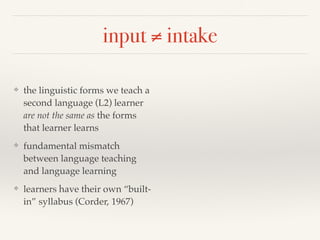
input ≠ intake 
❖ the linguistic forms we teach a 
second language (L2) learner 
are not the same as the forms 
that learner learns 
❖ fundamental mismatch 
between language teaching 
and language learning 
❖ learners have their own “built-in” 
syllabus (Corder, 1967)
input ≠ intake 
❖ the linguistic forms we teach a 
second language (L2) learner 
are not the same as the forms 
that learner learns 
❖ fundamental mismatch 
between language teaching 
and language learning 
❖ learners have their own “built-in” 
syllabus (Corder, 1967) 
built-in ! 
syllabus 
≠ 
target ! 
language (TL)! 
grammar
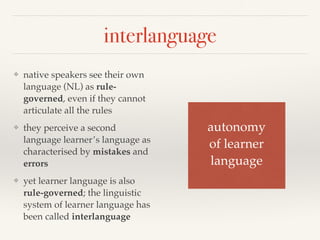
interlanguage
interlanguage 
❖ native speakers see their own 
language (NL) as rule-governed, 
even if they cannot 
articulate all the rules
interlanguage 
❖ native speakers see their own 
language (NL) as rule-governed, 
even if they cannot 
articulate all the rules 
❖ they perceive a second 
language learner’s language as 
characterised by mistakes and 
errors
interlanguage 
❖ native speakers see their own 
language (NL) as rule-governed, 
even if they cannot 
articulate all the rules 
❖ they perceive a second 
language learner’s language as 
characterised by mistakes and 
errors 
❖ yet learner language is also 
rule-governed; the linguistic 
system of learner language has 
been called interlanguage
interlanguage 
❖ native speakers see their own 
language (NL) as rule-governed, 
even if they cannot 
articulate all the rules 
❖ they perceive a second 
language learner’s language as 
characterised by mistakes and 
errors 
❖ yet learner language is also 
rule-governed; the linguistic 
system of learner language has 
been called interlanguage 
autonomy! 
of learner! 
language
transfer 
what processes! 
shape learner! 
language ! 
development?
transfer 
❖ native language transfer is 
particularly obvious in early 
stages, and with phonology 
what processes! 
shape learner! 
language ! 
development?
transfer 
❖ native language transfer is 
particularly obvious in early 
stages, and with phonology 
❖ intralingual transfer concerns 
the TL structures being 
learned; the learner may 
overgeneralise a rule 
what processes! 
shape learner! 
language ! 
development?
transfer 
❖ native language transfer is 
particularly obvious in early 
stages, and with phonology 
❖ intralingual transfer concerns 
the TL structures being 
learned; the learner may 
overgeneralise a rule 
❖ transfer of training occurs 
when instruction goes wrong 
and learner believes incorrect 
information 
what processes! 
shape learner! 
language ! 
development?
theories explaining SLA 
second ! 
language! 
acquisition! 
(SLA)
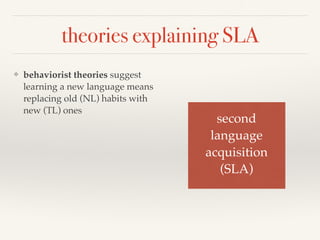
theories explaining SLA 
❖ behaviorist theories suggest 
learning a new language means 
replacing old (NL) habits with 
new (TL) ones 
second ! 
language! 
acquisition! 
(SLA)
theories explaining SLA 
❖ behaviorist theories suggest 
learning a new language means 
replacing old (NL) habits with 
new (TL) ones 
❖ innatist theories state that all 
learners follow the same 
developmental sequence 
because of innate language-learning 
capacities 
second ! 
language! 
acquisition! 
(SLA)
theories explaining SLA 
❖ behaviorist theories suggest 
learning a new language means 
replacing old (NL) habits with 
new (TL) ones 
❖ innatist theories state that all 
learners follow the same 
developmental sequence 
because of innate language-learning 
capacities 
❖ interactionist theories claim 
that acquisition results from 
interaction with other speakers 
second ! 
language! 
acquisition! 
(SLA)
behaviourism
behaviourism 
❖ behaviorist theories are based 
on contrastive analysis (CA) of 
NL and TL
behaviourism 
❖ behaviorist theories are based 
on contrastive analysis (CA) of 
NL and TL 
❖ linguistic features which are 
similar in the two languages 
are easy to learn, those which 
are different will be difficult
behaviourism 
❖ behaviorist theories are based 
on contrastive analysis (CA) of 
NL and TL 
❖ linguistic features which are 
similar in the two languages 
are easy to learn, those which 
are different will be difficult 
❖ BUT behaviorist theory does 
not predict the patterns we 
observe in learner language
behaviourism 
❖ behaviorist theories are based 
on contrastive analysis (CA) of 
NL and TL 
❖ linguistic features which are 
similar in the two languages 
are easy to learn, those which 
are different will be difficult 
❖ BUT behaviorist theory does 
not predict the patterns we 
observe in learner language 
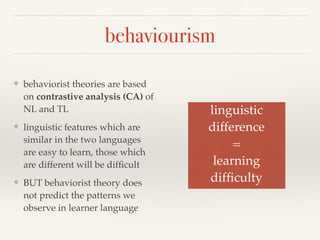
linguistic! 
difference! 
=! 
learning! 
difficulty
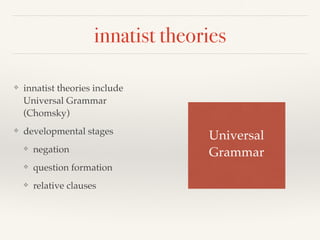
innatist theories 
Universal ! 
Grammar
innatist theories 
❖ innatist theories include 
Universal Grammar 
(Chomsky) 
Universal ! 
Grammar
innatist theories 
❖ innatist theories include 
Universal Grammar 
(Chomsky) 
❖ developmental stages! 
❖ negation! 
❖ question formation! 
❖ relative clauses 
Universal ! 
Grammar
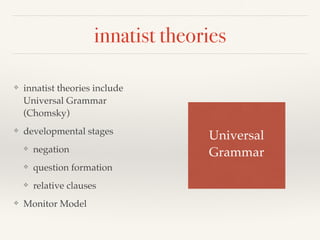
innatist theories 
❖ innatist theories include 
Universal Grammar 
(Chomsky) 
❖ developmental stages! 
❖ negation! 
❖ question formation! 
❖ relative clauses 
❖ Monitor Model 
Universal ! 
Grammar
Monitor model
Monitor model 
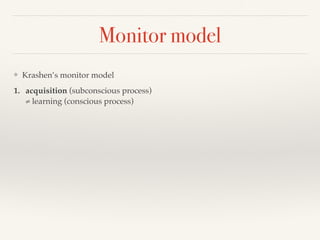
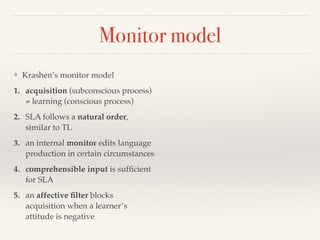
❖ Krashen’s monitor model
Monitor model 
❖ Krashen’s monitor model 
1. acquisition (subconscious process) 
≠ learning (conscious process)
Monitor model 
❖ Krashen’s monitor model 
1. acquisition (subconscious process) 
≠ learning (conscious process) 
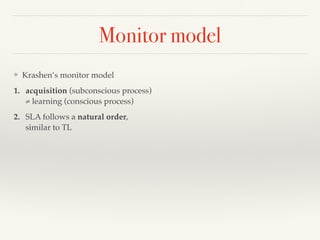
2. SLA follows a natural order, 
similar to TL
Monitor model 
❖ Krashen’s monitor model 
1. acquisition (subconscious process) 
≠ learning (conscious process) 
2. SLA follows a natural order, 
similar to TL 
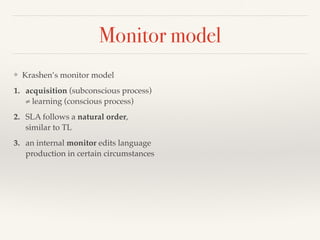
3. an internal monitor edits language 
production in certain circumstances
Monitor model 
❖ Krashen’s monitor model 
1. acquisition (subconscious process) 
≠ learning (conscious process) 
2. SLA follows a natural order, 
similar to TL 
3. an internal monitor edits language 
production in certain circumstances 
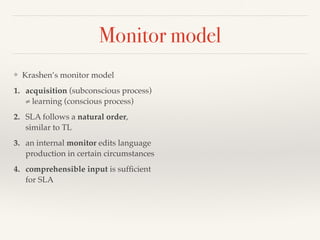
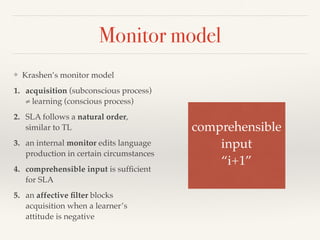
4. comprehensible input is sufficient 
for SLA
Monitor model 
❖ Krashen’s monitor model 
1. acquisition (subconscious process) 
≠ learning (conscious process) 
2. SLA follows a natural order, 
similar to TL 
3. an internal monitor edits language 
production in certain circumstances 
4. comprehensible input is sufficient 
for SLA 
5. an affective filter blocks 
acquisition when a learner’s 
attitude is negative
Monitor model 
❖ Krashen’s monitor model 
1. acquisition (subconscious process) 
≠ learning (conscious process) 
2. SLA follows a natural order, 
similar to TL 
3. an internal monitor edits language 
production in certain circumstances 
4. comprehensible input is sufficient 
for SLA 
5. an affective filter blocks 
acquisition when a learner’s 
attitude is negative 
comprehensible ! 
input! 
“i+1”
Interactionist theories
Interactionist theories 
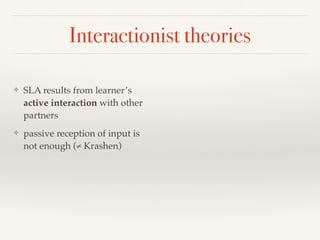
❖ SLA results from learner’s 
active interaction with other 
partners
Interactionist theories 
❖ SLA results from learner’s 
active interaction with other 
partners 
❖ passive reception of input is 
not enough (≠ Krashen)
Interactionist theories 
❖ SLA results from learner’s 
active interaction with other 
partners 
❖ passive reception of input is 
not enough (≠ Krashen) 
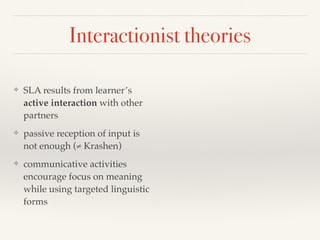
❖ communicative activities 
encourage focus on meaning 
while using targeted linguistic 
forms
Interactionist theories 
❖ SLA results from learner’s 
active interaction with other 
partners 
❖ passive reception of input is 
not enough (≠ Krashen) 
❖ communicative activities 
encourage focus on meaning 
while using targeted linguistic 
forms 
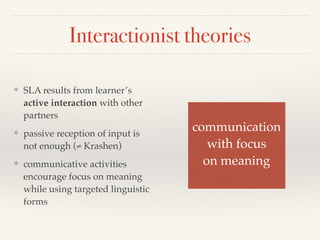
communication! 
with focus! 
on meaning
Interactionist theories
Interactionist theories 
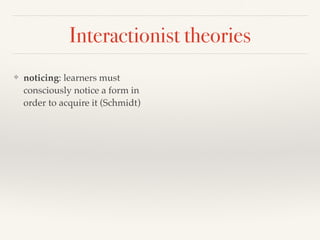
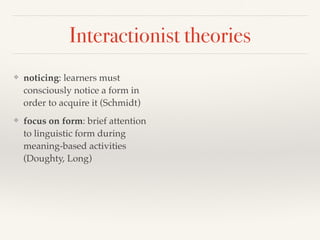
❖ noticing: learners must 
consciously notice a form in 
order to acquire it (Schmidt)
Interactionist theories 
❖ noticing: learners must 
consciously notice a form in 
order to acquire it (Schmidt) 
❖ focus on form: brief attention 
to linguistic form during 
meaning-based activities 
(Doughty, Long)
Interactionist theories 
❖ noticing: learners must 
consciously notice a form in 
order to acquire it (Schmidt) 
❖ focus on form: brief attention 
to linguistic form during 
meaning-based activities 
(Doughty, Long) 
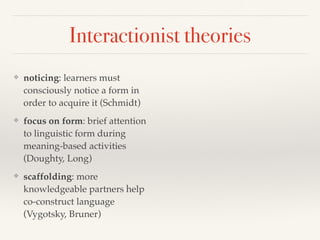
❖ scaffolding: more 
knowledgeable partners help 
co-construct language 
(Vygotsky, Bruner)
Interactionist theories 
❖ noticing: learners must 
consciously notice a form in 
order to acquire it (Schmidt) 
❖ focus on form: brief attention 
to linguistic form during 
meaning-based activities 
(Doughty, Long) 
❖ scaffolding: more 
knowledgeable partners help 
co-construct language 
(Vygotsky, Bruner) 
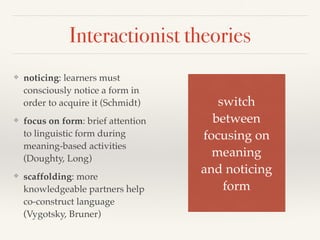
switch! 
between! 
focusing on! 
meaning! 
and noticing! 
form
Teaching implications 
explicit! 
and ! 
implicit! 
knowledge
Teaching implications 
❖ explicit knowledge from 
teacher and textbook, needed 
for tests explicit! 
and ! 
implicit! 
knowledge
Teaching implications 
❖ explicit knowledge from 
teacher and textbook, needed 
for tests 
❖ implicit knowledge is used to 
produce language when 
learners focus on meaning 
explicit! 
and ! 
implicit! 
knowledge
Teaching implications 
❖ explicit knowledge from 
teacher and textbook, needed 
for tests 
❖ implicit knowledge is used to 
produce language when 
learners focus on meaning 
❖ teaching needs to take both 
kinds of knowledge into 
account 
explicit! 
and ! 
implicit! 
knowledge
implicit language
implicit language 
❖ implicit knowledge has its 
own independent logic
implicit language 
❖ implicit knowledge has its 
own independent logic 
❖ language forms will be 
acquired in a different order 
from explicit language learning
implicit language 
❖ implicit knowledge has its 
own independent logic 
❖ language forms will be 
acquired in a different order 
from explicit language learning 
❖ this difference is no-one’s 
fault; it is due to the way the 
brain is wired to acquire 
language
implicit language 
❖ implicit knowledge has its 
own independent logic 
❖ language forms will be 
acquired in a different order 
from explicit language learning 
❖ this difference is no-one’s 
fault; it is due to the way the 
brain is wired to acquire 
language 
implicit! 
knowledge has! 
its own! 
independent! 
logic
Reading 
❖ Lightbown, P. M., Spada, N., 
Ranta, L., & Rand, J. (2006). 
How languages are learned (Vol. 
2). Oxford: Oxford University 
Press.! 
❖ Tarone, E., & Swierzbin, B. 
(2009). Exploring learner 
language. Oxford University 
Press. 
Learning and Teaching ! 
Foreign Languages 
http://unt.unice.fr/uoh/learn_teach_FL/ 
http://www.scoop.it/t/telt/

Learner language

  • 1.
    M2 MEEF November2014 Learner language Tarone, E., & Swierzbin, B. (2009). Exploring learner language. Oxford University Press.
  • 2.
  • 3.
    input ≠ intake ❖ the linguistic forms we teach a second language (L2) learner are not the same as the forms that learner learns
  • 4.
    input ≠ intake ❖ the linguistic forms we teach a second language (L2) learner are not the same as the forms that learner learns ❖ fundamental mismatch between language teaching and language learning
  • 5.
    input ≠ intake ❖ the linguistic forms we teach a second language (L2) learner are not the same as the forms that learner learns ❖ fundamental mismatch between language teaching and language learning ❖ learners have their own “built-in” syllabus (Corder, 1967)
  • 6.
    input ≠ intake ❖ the linguistic forms we teach a second language (L2) learner are not the same as the forms that learner learns ❖ fundamental mismatch between language teaching and language learning ❖ learners have their own “built-in” syllabus (Corder, 1967) built-in ! syllabus ≠ target ! language (TL)! grammar
  • 7.
  • 8.
    interlanguage ❖ nativespeakers see their own language (NL) as rule-governed, even if they cannot articulate all the rules
  • 9.
    interlanguage ❖ nativespeakers see their own language (NL) as rule-governed, even if they cannot articulate all the rules ❖ they perceive a second language learner’s language as characterised by mistakes and errors
  • 10.
    interlanguage ❖ nativespeakers see their own language (NL) as rule-governed, even if they cannot articulate all the rules ❖ they perceive a second language learner’s language as characterised by mistakes and errors ❖ yet learner language is also rule-governed; the linguistic system of learner language has been called interlanguage
  • 11.
    interlanguage ❖ nativespeakers see their own language (NL) as rule-governed, even if they cannot articulate all the rules ❖ they perceive a second language learner’s language as characterised by mistakes and errors ❖ yet learner language is also rule-governed; the linguistic system of learner language has been called interlanguage autonomy! of learner! language
  • 12.
    transfer what processes! shape learner! language ! development?
  • 13.
    transfer ❖ nativelanguage transfer is particularly obvious in early stages, and with phonology what processes! shape learner! language ! development?
  • 14.
    transfer ❖ nativelanguage transfer is particularly obvious in early stages, and with phonology ❖ intralingual transfer concerns the TL structures being learned; the learner may overgeneralise a rule what processes! shape learner! language ! development?
  • 15.
    transfer ❖ nativelanguage transfer is particularly obvious in early stages, and with phonology ❖ intralingual transfer concerns the TL structures being learned; the learner may overgeneralise a rule ❖ transfer of training occurs when instruction goes wrong and learner believes incorrect information what processes! shape learner! language ! development?
  • 16.
    theories explaining SLA second ! language! acquisition! (SLA)
  • 17.
    theories explaining SLA ❖ behaviorist theories suggest learning a new language means replacing old (NL) habits with new (TL) ones second ! language! acquisition! (SLA)
  • 18.
    theories explaining SLA ❖ behaviorist theories suggest learning a new language means replacing old (NL) habits with new (TL) ones ❖ innatist theories state that all learners follow the same developmental sequence because of innate language-learning capacities second ! language! acquisition! (SLA)
  • 19.
    theories explaining SLA ❖ behaviorist theories suggest learning a new language means replacing old (NL) habits with new (TL) ones ❖ innatist theories state that all learners follow the same developmental sequence because of innate language-learning capacities ❖ interactionist theories claim that acquisition results from interaction with other speakers second ! language! acquisition! (SLA)
  • 20.
  • 21.
    behaviourism ❖ behavioristtheories are based on contrastive analysis (CA) of NL and TL
  • 22.
    behaviourism ❖ behavioristtheories are based on contrastive analysis (CA) of NL and TL ❖ linguistic features which are similar in the two languages are easy to learn, those which are different will be difficult
  • 23.
    behaviourism ❖ behavioristtheories are based on contrastive analysis (CA) of NL and TL ❖ linguistic features which are similar in the two languages are easy to learn, those which are different will be difficult ❖ BUT behaviorist theory does not predict the patterns we observe in learner language
  • 24.
    behaviourism ❖ behavioristtheories are based on contrastive analysis (CA) of NL and TL ❖ linguistic features which are similar in the two languages are easy to learn, those which are different will be difficult ❖ BUT behaviorist theory does not predict the patterns we observe in learner language linguistic! difference! =! learning! difficulty
  • 25.
  • 26.
    innatist theories ❖innatist theories include Universal Grammar (Chomsky) Universal ! Grammar
  • 27.
    innatist theories ❖innatist theories include Universal Grammar (Chomsky) ❖ developmental stages! ❖ negation! ❖ question formation! ❖ relative clauses Universal ! Grammar
  • 28.
    innatist theories ❖innatist theories include Universal Grammar (Chomsky) ❖ developmental stages! ❖ negation! ❖ question formation! ❖ relative clauses ❖ Monitor Model Universal ! Grammar
  • 29.
  • 30.
    Monitor model ❖Krashen’s monitor model
  • 31.
    Monitor model ❖Krashen’s monitor model 1. acquisition (subconscious process) ≠ learning (conscious process)
  • 32.
    Monitor model ❖Krashen’s monitor model 1. acquisition (subconscious process) ≠ learning (conscious process) 2. SLA follows a natural order, similar to TL
  • 33.
    Monitor model ❖Krashen’s monitor model 1. acquisition (subconscious process) ≠ learning (conscious process) 2. SLA follows a natural order, similar to TL 3. an internal monitor edits language production in certain circumstances
  • 34.
    Monitor model ❖Krashen’s monitor model 1. acquisition (subconscious process) ≠ learning (conscious process) 2. SLA follows a natural order, similar to TL 3. an internal monitor edits language production in certain circumstances 4. comprehensible input is sufficient for SLA
  • 35.
    Monitor model ❖Krashen’s monitor model 1. acquisition (subconscious process) ≠ learning (conscious process) 2. SLA follows a natural order, similar to TL 3. an internal monitor edits language production in certain circumstances 4. comprehensible input is sufficient for SLA 5. an affective filter blocks acquisition when a learner’s attitude is negative
  • 36.
    Monitor model ❖Krashen’s monitor model 1. acquisition (subconscious process) ≠ learning (conscious process) 2. SLA follows a natural order, similar to TL 3. an internal monitor edits language production in certain circumstances 4. comprehensible input is sufficient for SLA 5. an affective filter blocks acquisition when a learner’s attitude is negative comprehensible ! input! “i+1”
  • 37.
  • 38.
    Interactionist theories ❖SLA results from learner’s active interaction with other partners
  • 39.
    Interactionist theories ❖SLA results from learner’s active interaction with other partners ❖ passive reception of input is not enough (≠ Krashen)
  • 40.
    Interactionist theories ❖SLA results from learner’s active interaction with other partners ❖ passive reception of input is not enough (≠ Krashen) ❖ communicative activities encourage focus on meaning while using targeted linguistic forms
  • 41.
    Interactionist theories ❖SLA results from learner’s active interaction with other partners ❖ passive reception of input is not enough (≠ Krashen) ❖ communicative activities encourage focus on meaning while using targeted linguistic forms communication! with focus! on meaning
  • 42.
  • 43.
    Interactionist theories ❖noticing: learners must consciously notice a form in order to acquire it (Schmidt)
  • 44.
    Interactionist theories ❖noticing: learners must consciously notice a form in order to acquire it (Schmidt) ❖ focus on form: brief attention to linguistic form during meaning-based activities (Doughty, Long)
  • 45.
    Interactionist theories ❖noticing: learners must consciously notice a form in order to acquire it (Schmidt) ❖ focus on form: brief attention to linguistic form during meaning-based activities (Doughty, Long) ❖ scaffolding: more knowledgeable partners help co-construct language (Vygotsky, Bruner)
  • 46.
    Interactionist theories ❖noticing: learners must consciously notice a form in order to acquire it (Schmidt) ❖ focus on form: brief attention to linguistic form during meaning-based activities (Doughty, Long) ❖ scaffolding: more knowledgeable partners help co-construct language (Vygotsky, Bruner) switch! between! focusing on! meaning! and noticing! form
  • 47.
    Teaching implications explicit! and ! implicit! knowledge
  • 48.
    Teaching implications ❖explicit knowledge from teacher and textbook, needed for tests explicit! and ! implicit! knowledge
  • 49.
    Teaching implications ❖explicit knowledge from teacher and textbook, needed for tests ❖ implicit knowledge is used to produce language when learners focus on meaning explicit! and ! implicit! knowledge
  • 50.
    Teaching implications ❖explicit knowledge from teacher and textbook, needed for tests ❖ implicit knowledge is used to produce language when learners focus on meaning ❖ teaching needs to take both kinds of knowledge into account explicit! and ! implicit! knowledge
  • 51.
  • 52.
    implicit language ❖implicit knowledge has its own independent logic
  • 53.
    implicit language ❖implicit knowledge has its own independent logic ❖ language forms will be acquired in a different order from explicit language learning
  • 54.
    implicit language ❖implicit knowledge has its own independent logic ❖ language forms will be acquired in a different order from explicit language learning ❖ this difference is no-one’s fault; it is due to the way the brain is wired to acquire language
  • 55.
    implicit language ❖implicit knowledge has its own independent logic ❖ language forms will be acquired in a different order from explicit language learning ❖ this difference is no-one’s fault; it is due to the way the brain is wired to acquire language implicit! knowledge has! its own! independent! logic
  • 56.
    Reading ❖ Lightbown,P. M., Spada, N., Ranta, L., & Rand, J. (2006). How languages are learned (Vol. 2). Oxford: Oxford University Press.! ❖ Tarone, E., & Swierzbin, B. (2009). Exploring learner language. Oxford University Press. Learning and Teaching ! Foreign Languages http://unt.unice.fr/uoh/learn_teach_FL/ http://www.scoop.it/t/telt/