Dynamic Learning Styles:
 Franklin and Hamilton


             JAMES W. MARCUM
                         2008
Relevant?


 Benjamin Franklin and Alexander
 Hamilton grew up and attained their
 learning more than 200 years ago. Is
 their example relevant, useful to our
 time and place?
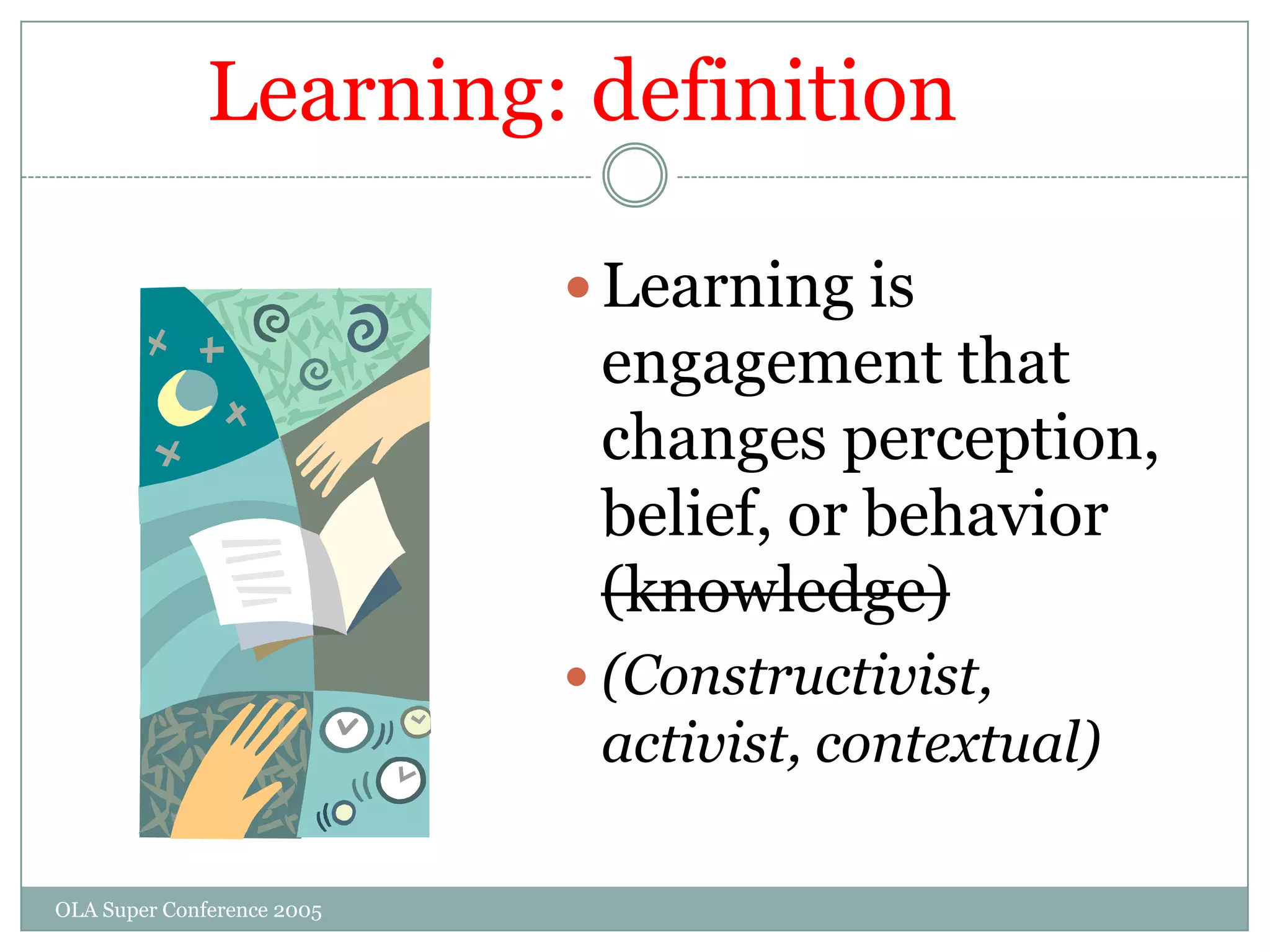
Learning: definition

                             Learning is
                             engagement that
                             changes perception,
                             belief, or behavior
                             (knowledge)
                             (Constructivist,
                             activist, contextual)

OLA Super Conference 2005
Dynamic Learning

 Engaged and reflective participation
 in a discovery process that builds new
 knowledge and enhances (changes)
 skills and competence appropriate to
 the given personal, social, and
 technical context of importance to the
 learner.
         Marcum, After the Information Age, 165.

 (Social and Contextual)
Dynamic Learning Process

Reading
Writing
Collaboration
Active, engaged learning
Reflection on „meaning‟
 Borrowed books from brother‟s
               print shop, read overnight
              Books: “true and reliable friends”
Reading:      Founder: first community library
              Collected and read books
Franklin       throughout his life
              Studied French, German, etc. in
               part to read important works in
               original language
              Book collection
                  7,000 when returned from Europe
 Silence DoGood
            Pennsylvania Gazette
            Poor Richard’s Almanac
Writing:
            Letters!
Franklin    Natural philosophy
            Political and diplomatic
            Bagatelles
            Autobiography
            (Writings/Papers, Yale 37 vols.)
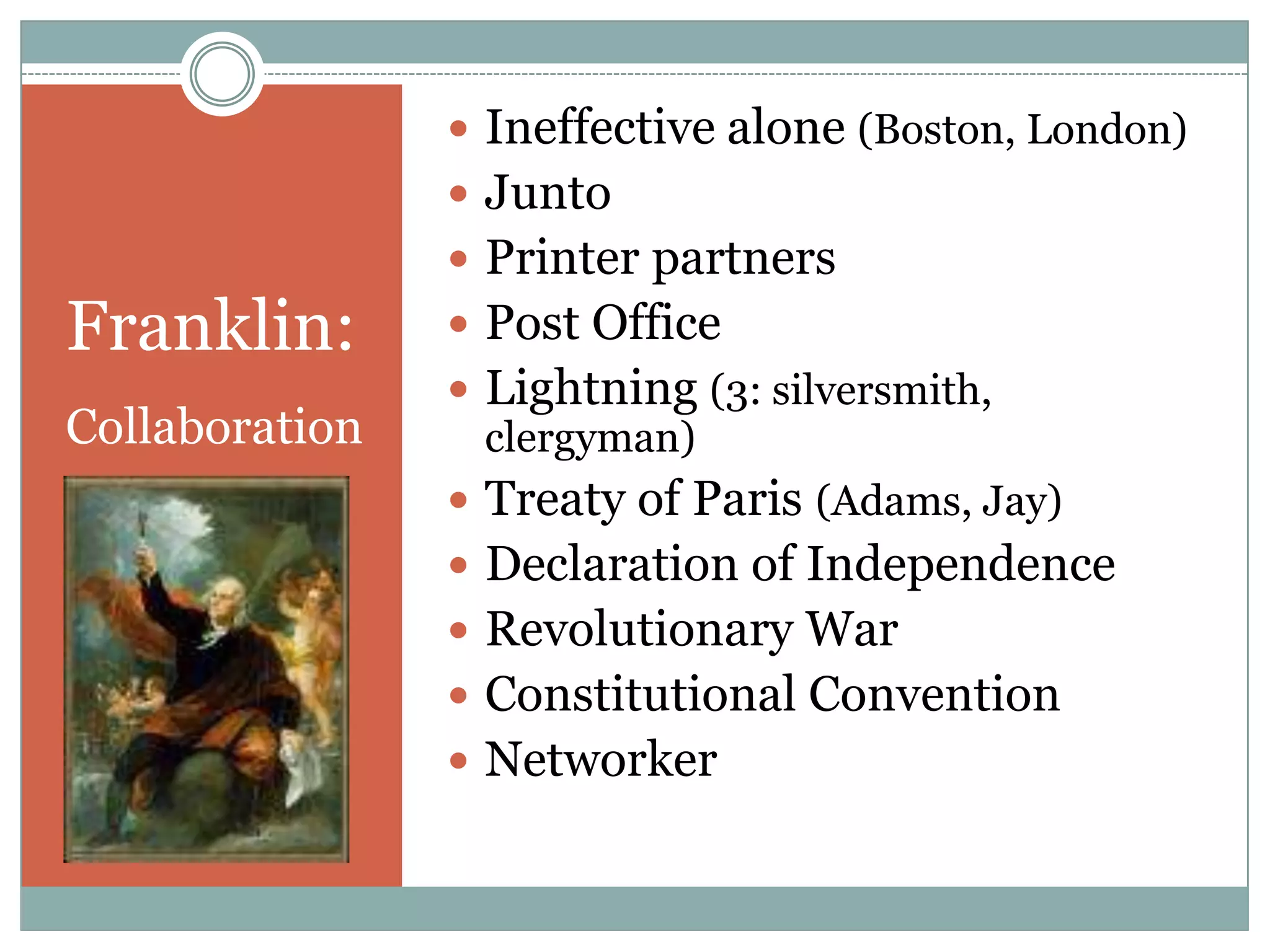
 Ineffective alone (Boston, London)
                 Junto
                 Printer partners
Franklin:        Post Office
                 Lightning (3: silversmith,
Collaboration     clergyman)
                 Treaty of Paris (Adams, Jay)
                 Declaration of Independence
                 Revolutionary War
                 Constitutional Convention
                 Networker
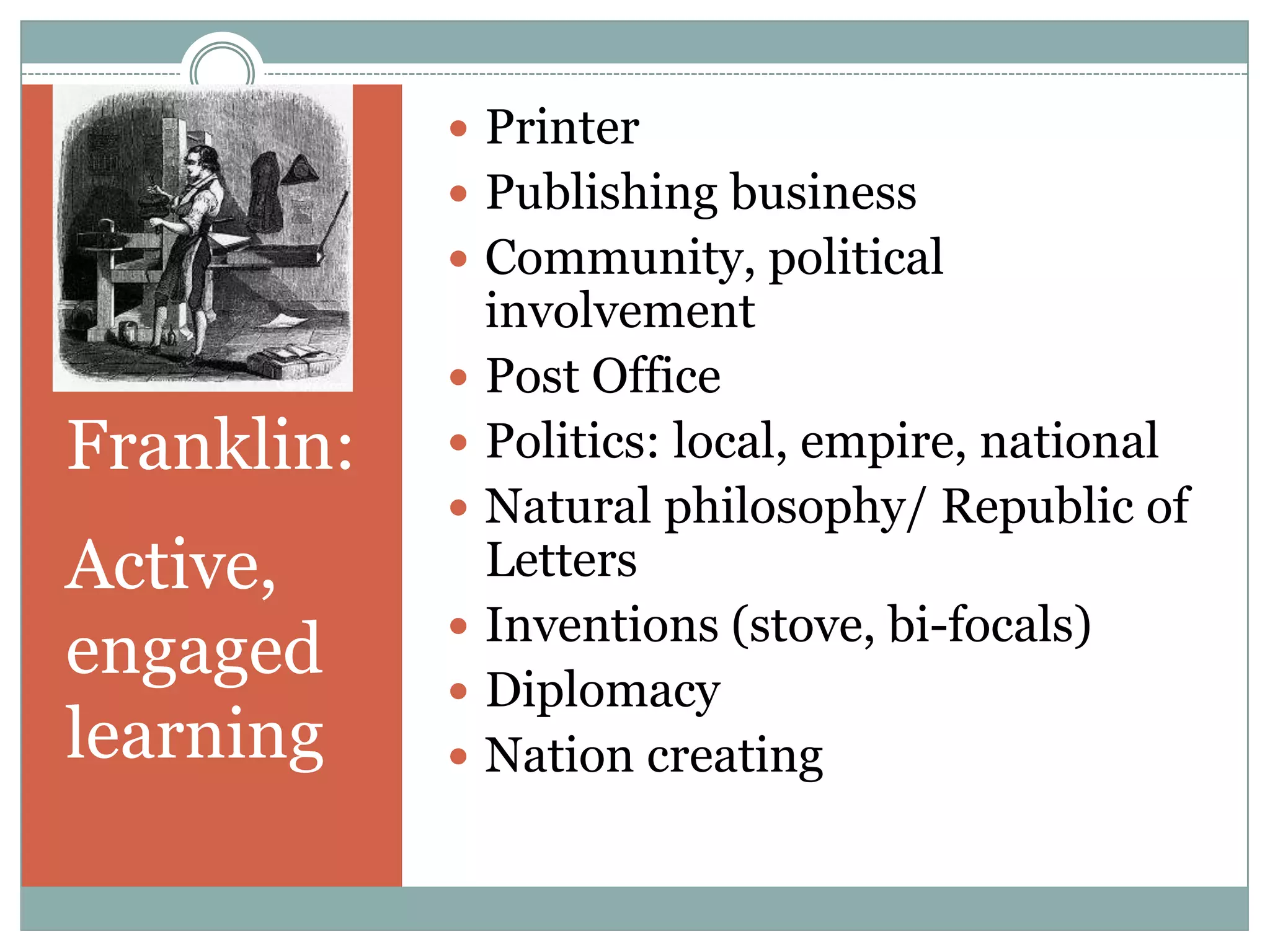
 Printer
             Publishing business
             Community, political
                involvement
               Post Office
Franklin:      Politics: local, empire, national
               Natural philosophy/ Republic of
Active,         Letters
               Inventions (stove, bi-focals)
engaged        Diplomacy
learning       Nation creating
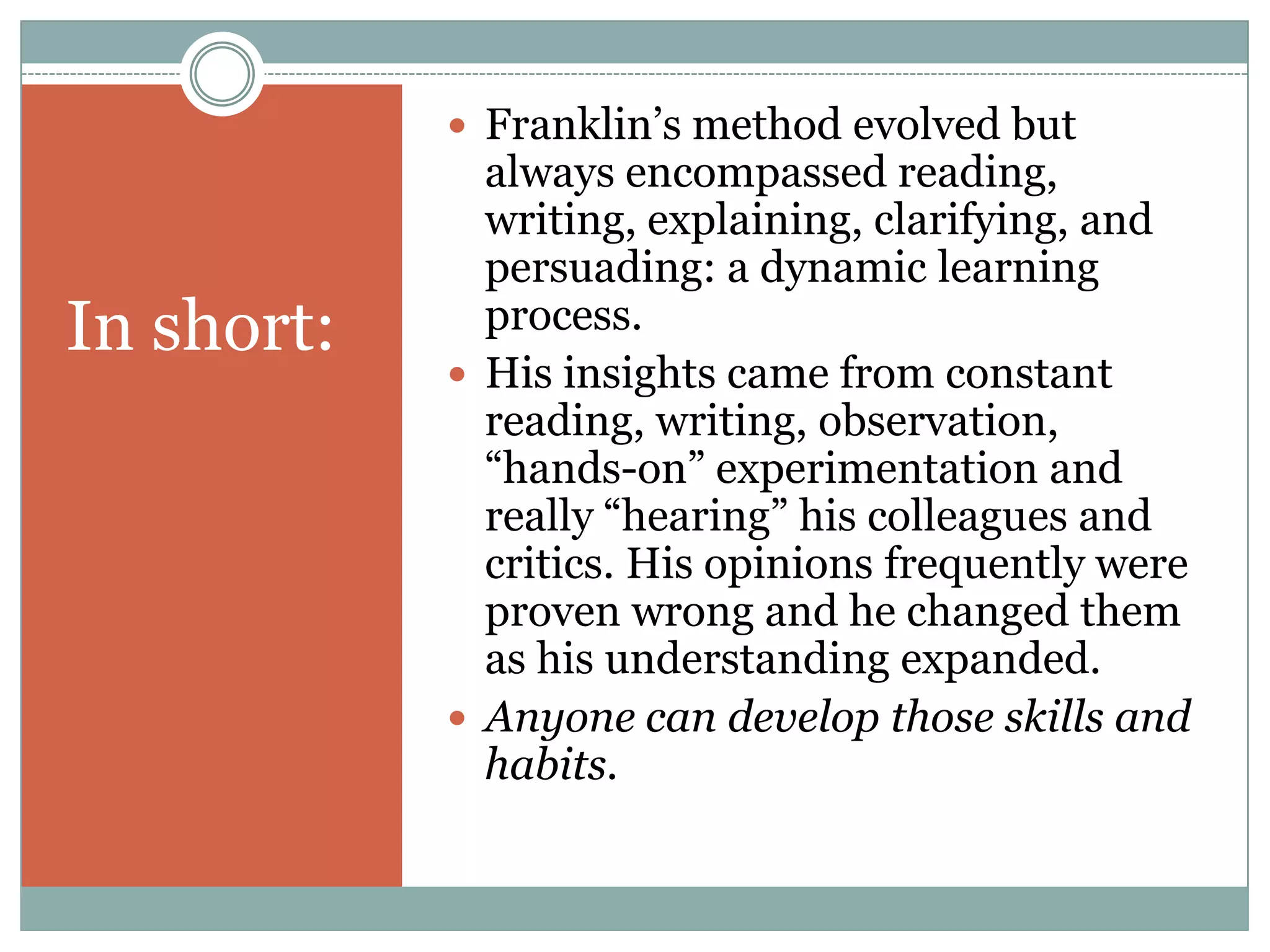
 Franklin‟s method evolved but
              always encompassed reading,
              writing, explaining, clarifying, and
              persuading: a dynamic learning
In short:     process.
             His insights came from constant
              reading, writing, observation,
              “hands-on” experimentation and
              really “hearing” his colleagues and
              critics. His opinions frequently were
              proven wrong and he changed them
              as his understanding expanded.
             Anyone can develop those skills and
              habits.
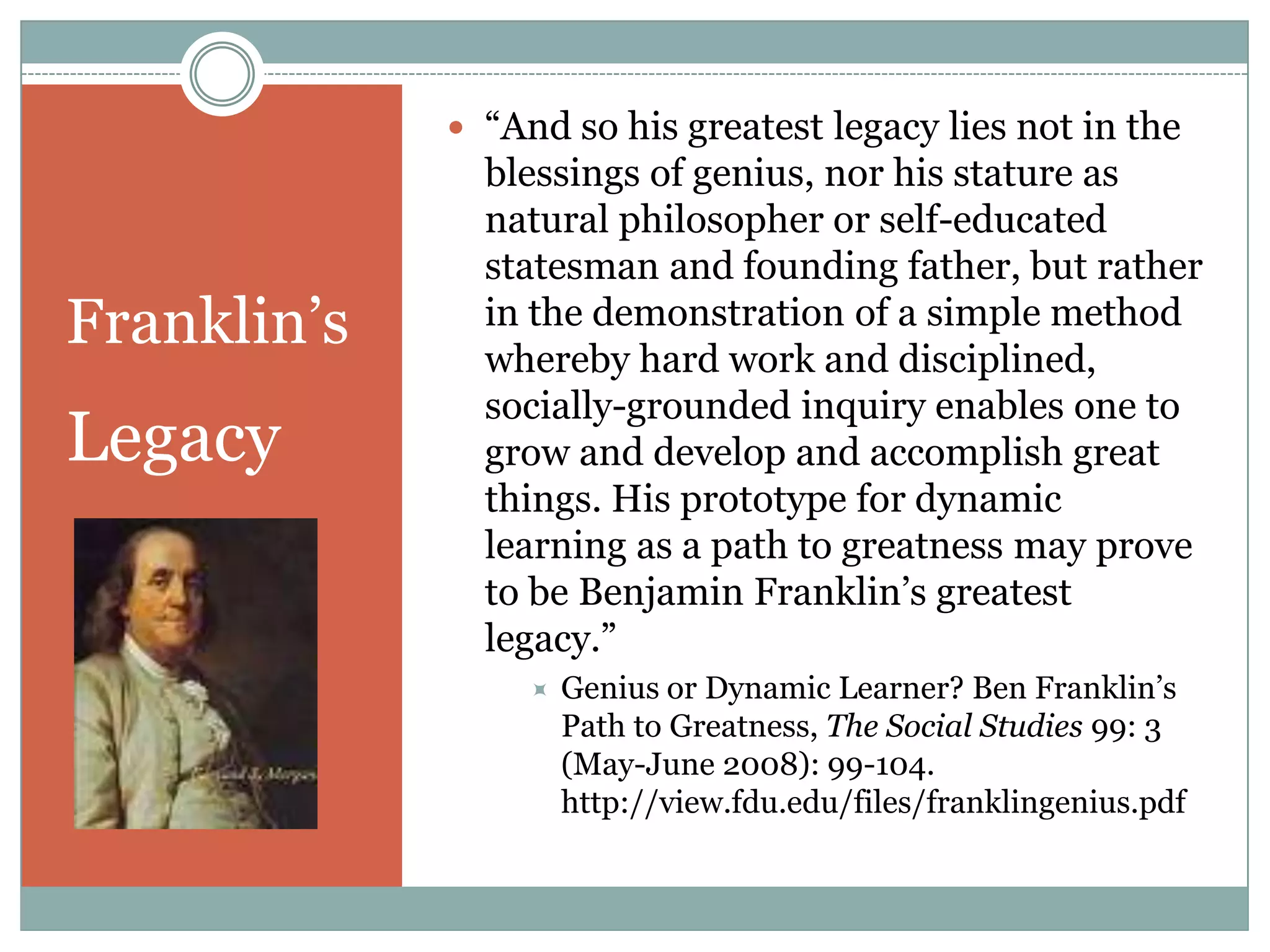
 “And so his greatest legacy lies not in the
               blessings of genius, nor his stature as
               natural philosopher or self-educated
               statesman and founding father, but rather
Franklin‟s     in the demonstration of a simple method
               whereby hard work and disciplined,
               socially-grounded inquiry enables one to
Legacy         grow and develop and accomplish great
               things. His prototype for dynamic
               learning as a path to greatness may prove
               to be Benjamin Franklin‟s greatest
               legacy.”
                     Genius or Dynamic Learner? Ben Franklin‟s
                      Path to Greatness, The Social Studies 99: 3
                      (May-June 2008): 99-104.
                      http://view.fdu.edu/files/franklingenius.pdf
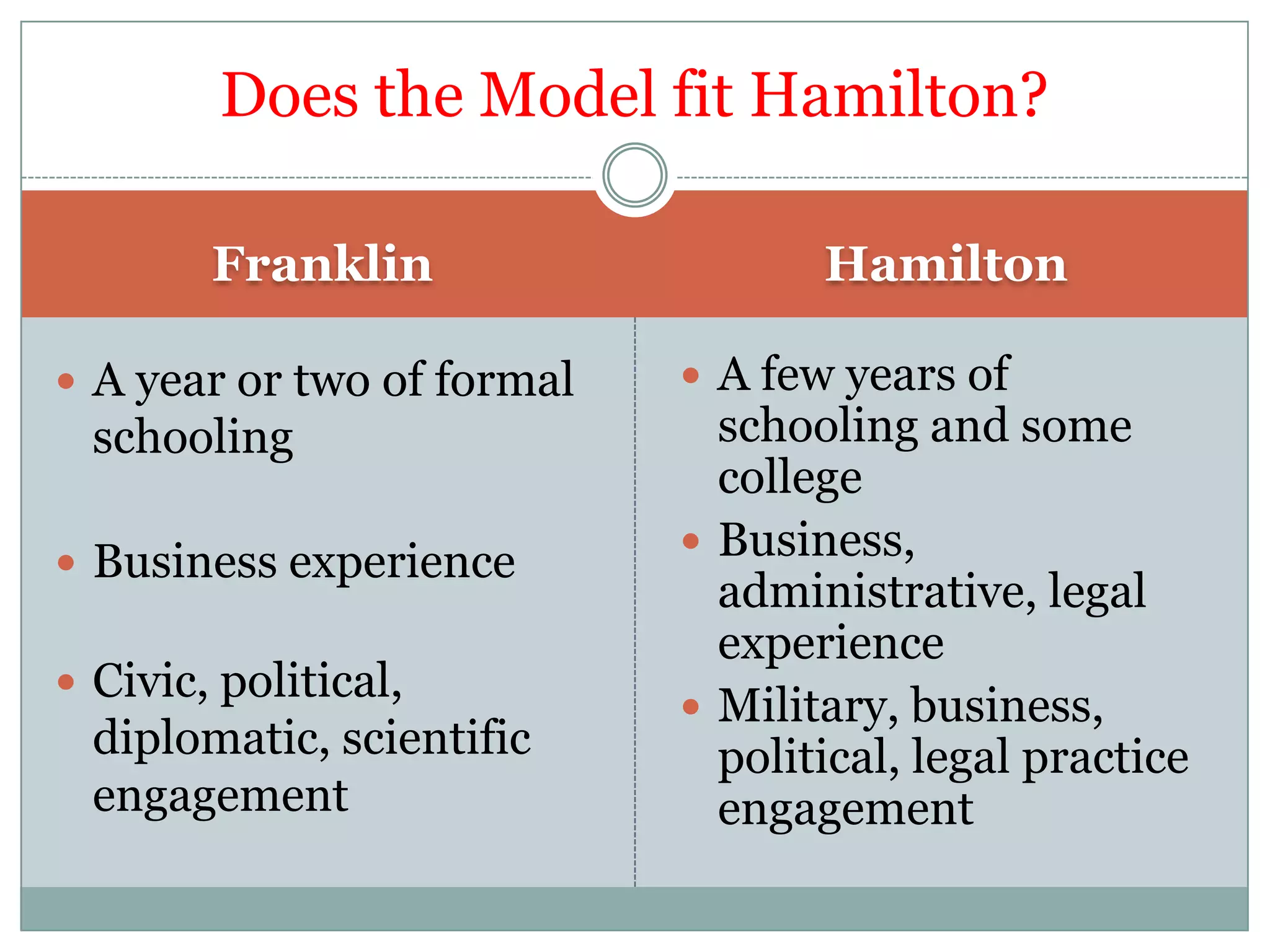
Does the Model fit Hamilton?

        Franklin                   Hamilton

 A year or two of formal    A few years of
  schooling                   schooling and some
                              college
                             Business,
 Business experience
                              administrative, legal
                              experience
 Civic, political,
                             Military, business,
  diplomatic, scientific      political, legal practice
  engagement                  engagement
 Mother: 34 books
                      Mentored, schooled St. Croix and
                       NJ/NY
                           “self improving autodidact” RC
Hamilton:
                       

                      King‟s College
                        Classics: literature, history, philosophy
Reading               Military affairs (Plutarch, Grotius)
(omniverous and       Business and finance (Postlewayt, A.
self-directed, RC)     Smith)
                      Law (Blackstone, Penn)
                      Politics – statesmanship (Plutarch,
                       Locke, Hobbes, Montesquieu)
                      Grange: 1,000 books
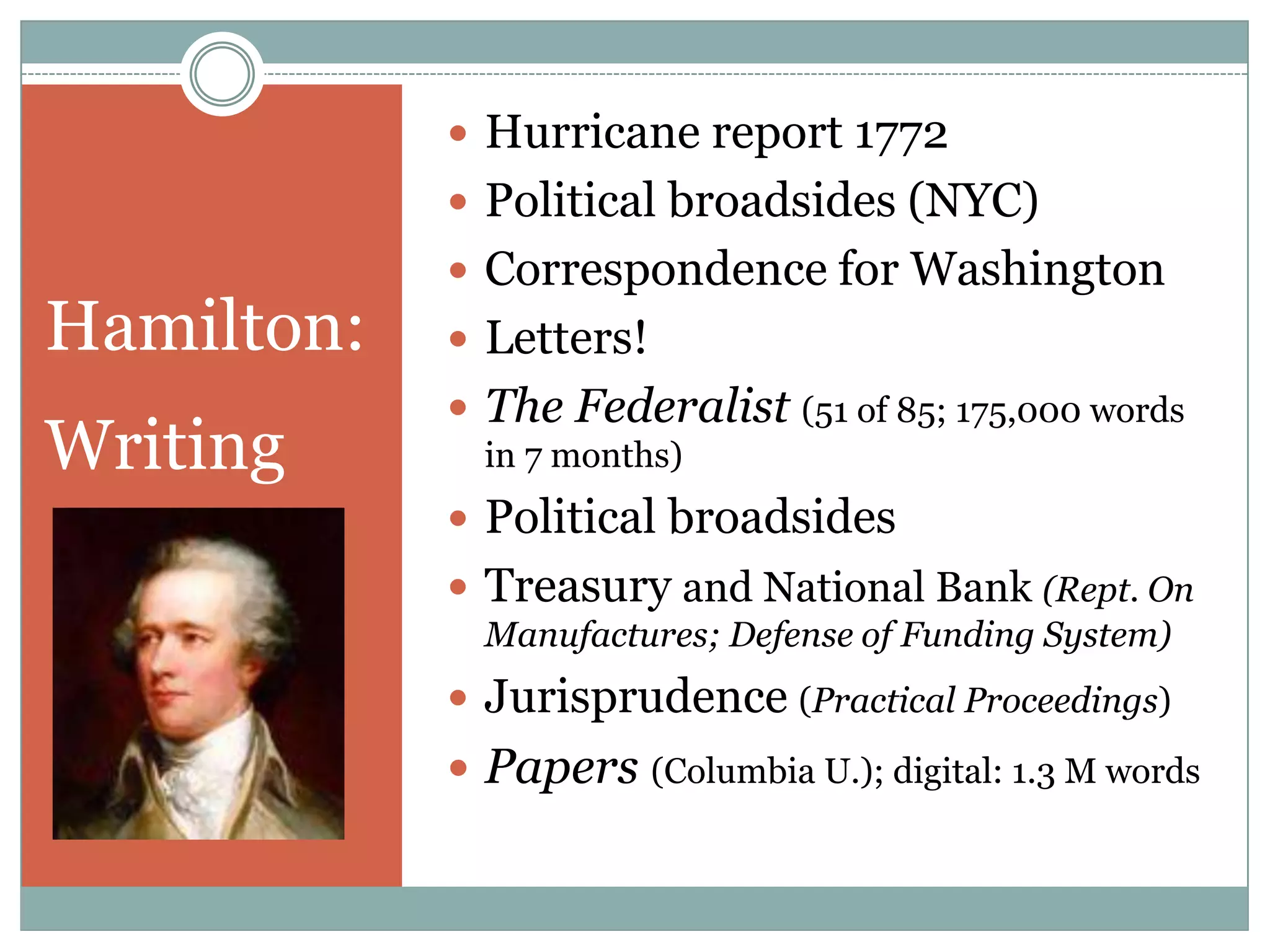
 Hurricane report 1772
             Political broadsides (NYC)
             Correspondence for Washington
Hamilton:    Letters!
             The Federalist (51 of 85; 175,000 words
Writing       in 7 months)
             Political broadsides
             Treasury and National Bank (Rept. On
              Manufactures; Defense of Funding System)
             Jurisprudence (Practical Proceedings)
             Papers (Columbia U.); digital: 1.3 M words
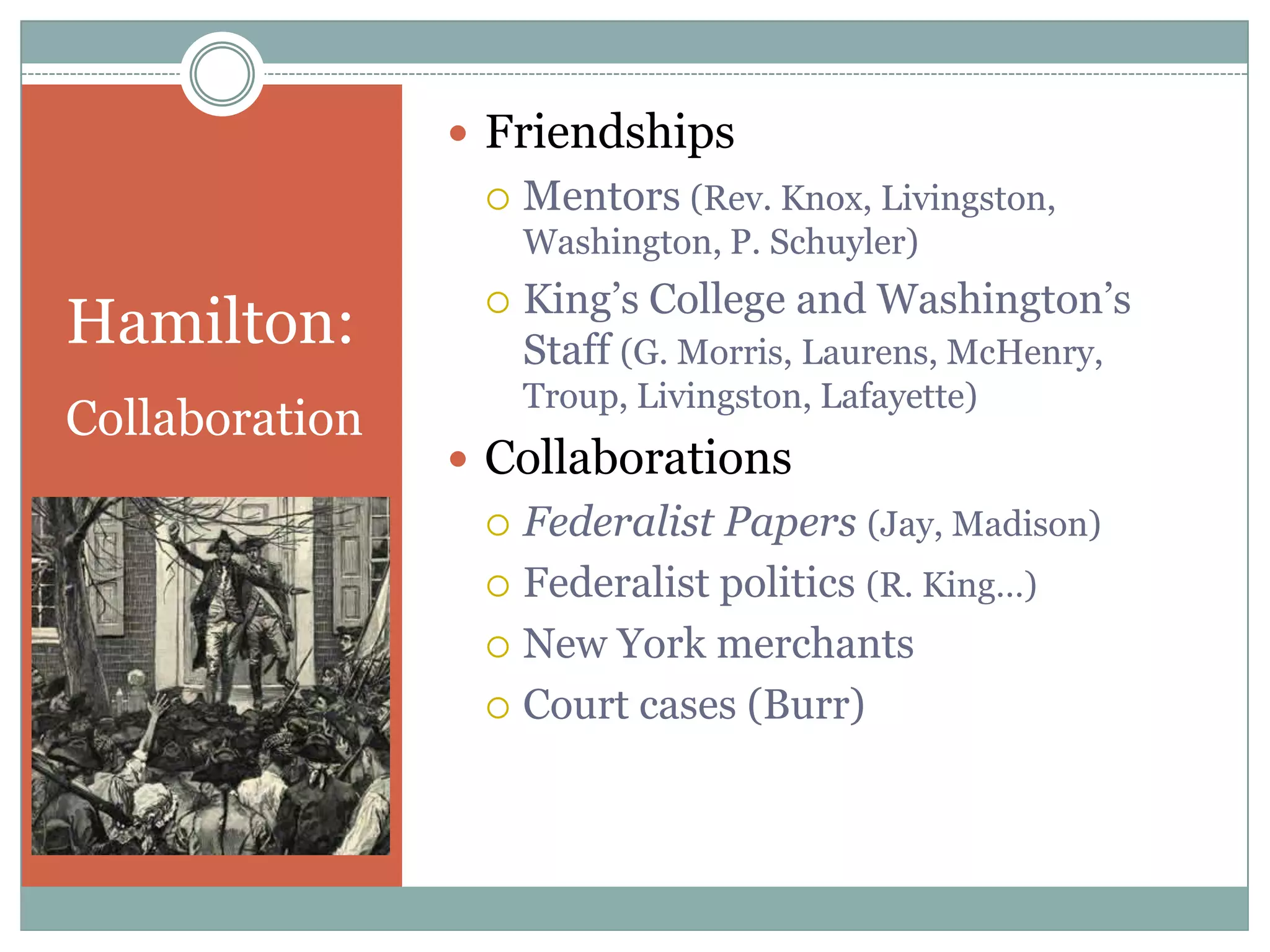
 Friendships
                    Mentors (Rev. Knox, Livingston,
                     Washington, P. Schuyler)
                     King‟s College and Washington‟s
Hamilton:        
                     Staff (G. Morris, Laurens, McHenry,
                     Troup, Livingston, Lafayette)
Collaboration
                 Collaborations
                  Federalist Papers (Jay, Madison)
                  Federalist politics (R. King…)

                  New York merchants

                  Court cases (Burr)
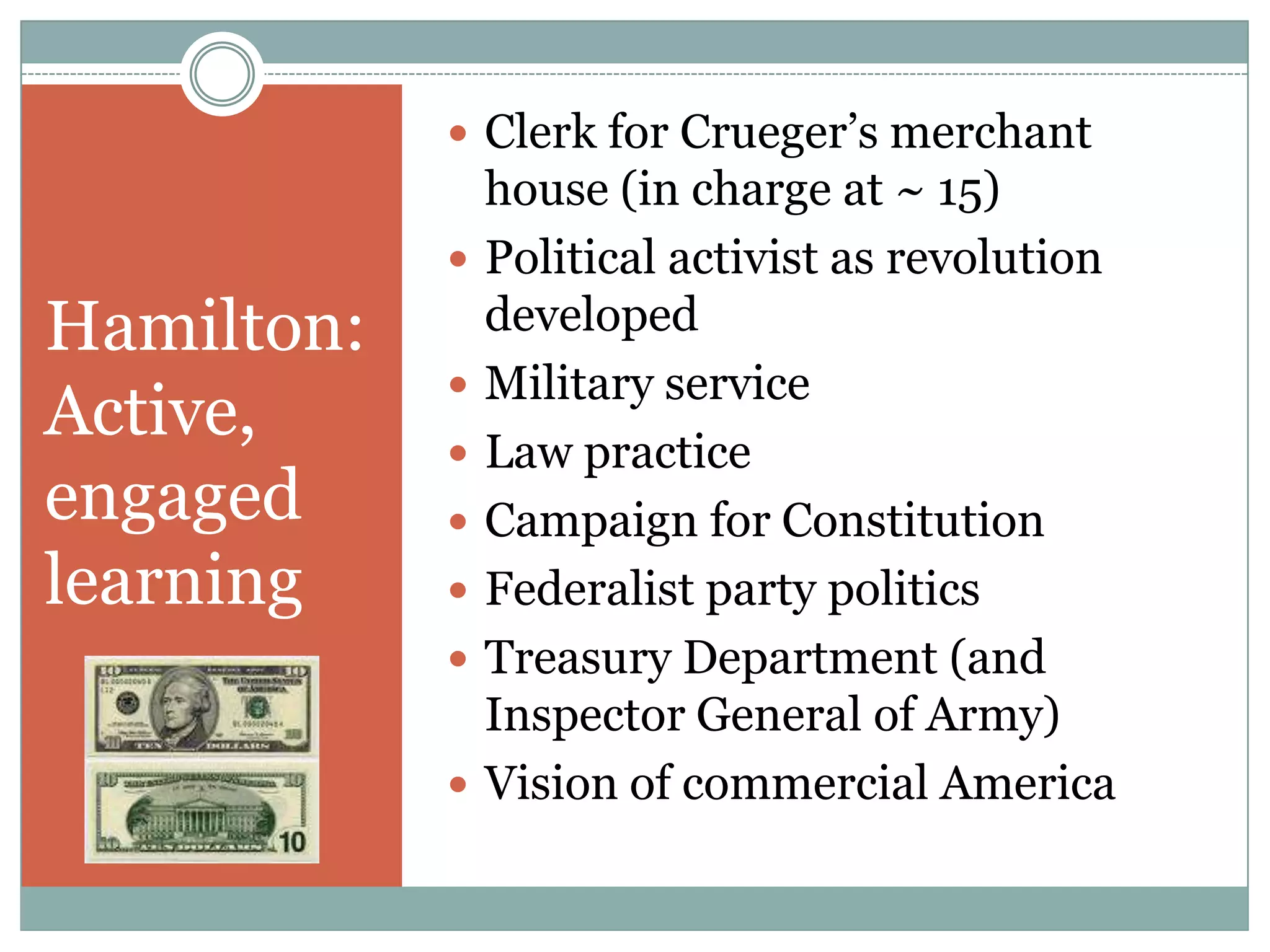
 Clerk for Crueger‟s merchant
                house (in charge at ~ 15)
               Political activist as revolution
Hamilton:       developed
               Military service
Active,        Law practice
engaged        Campaign for Constitution
learning       Federalist party politics
               Treasury Department (and
                Inspector General of Army)
               Vision of commercial America
Education vs. Dynamic Learning

 Both Hamilton and Franklin lived in times of great
    change and upheaval
   Between them they established many of the
    institutions, policies, and practices of a new nation
   “Education” did not serve them
   They had to discover or create where nothing existed
   Their “omnivorous and self-directed” reading,
    writing, collaboration, and learning provided the
    wherewithal upon which they could produce their
    remarkable contributions to the creation of the U.S.
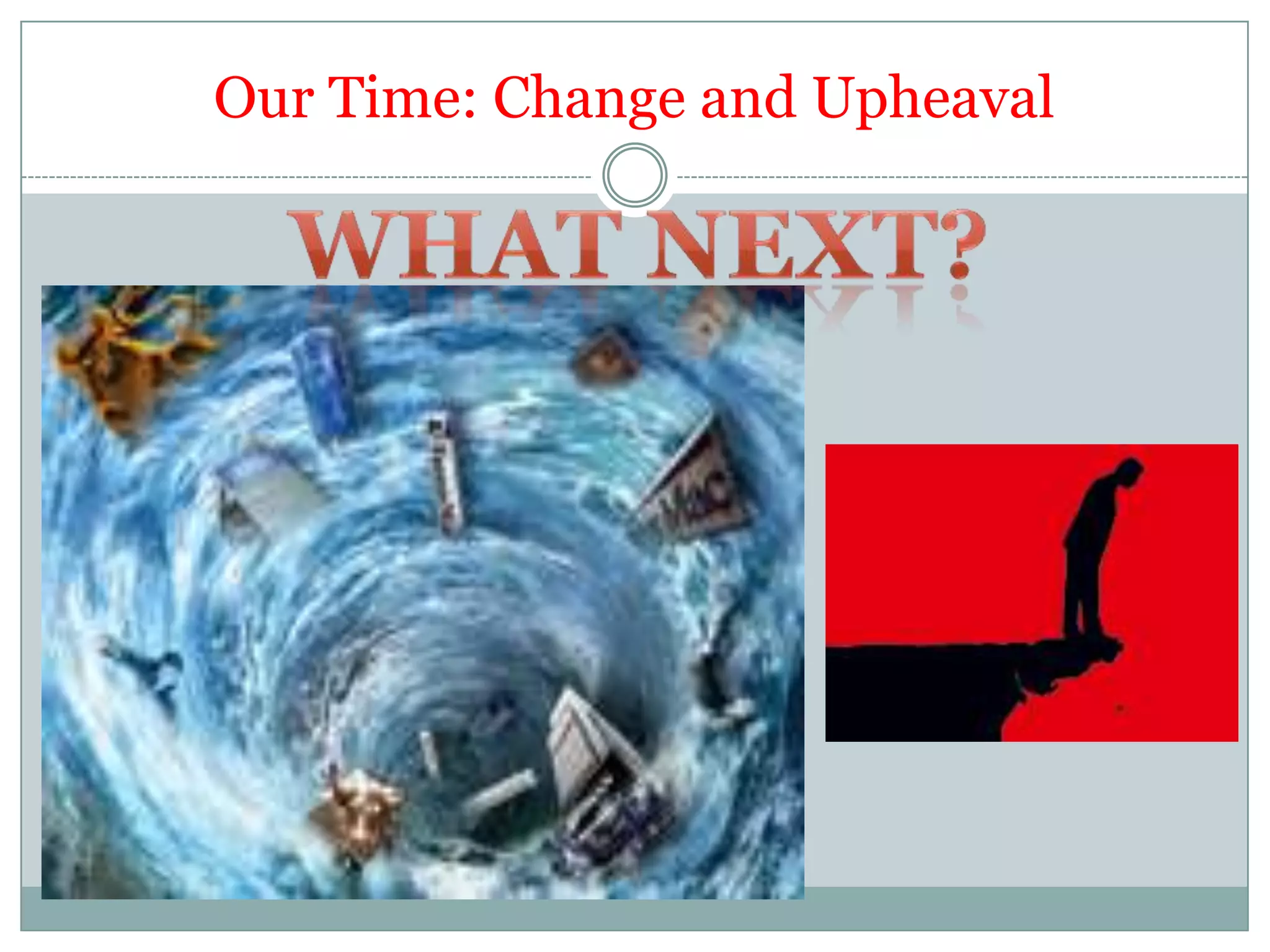
Our Time: Change and Upheaval
What is dynamic learning, again?


 Engaged and reflective participation in
 a life-creating process that builds new
 knowledge and enhances (changes) the
 skills and competence appropriate to
 the given personal, social, and technical
 context of importance to the learner.
Dynamic learning styles

Dynamic learning styles

  • 1.
    Dynamic Learning Styles: Franklin and Hamilton JAMES W. MARCUM 2008
  • 2.
    Relevant?  Benjamin Franklinand Alexander Hamilton grew up and attained their learning more than 200 years ago. Is their example relevant, useful to our time and place?
  • 3.
    Learning: definition  Learning is engagement that changes perception, belief, or behavior (knowledge)  (Constructivist, activist, contextual) OLA Super Conference 2005
  • 4.
    Dynamic Learning  Engagedand reflective participation in a discovery process that builds new knowledge and enhances (changes) skills and competence appropriate to the given personal, social, and technical context of importance to the learner. Marcum, After the Information Age, 165.  (Social and Contextual)
  • 5.
  • 6.
     Borrowed booksfrom brother‟s print shop, read overnight  Books: “true and reliable friends” Reading:  Founder: first community library  Collected and read books Franklin throughout his life  Studied French, German, etc. in part to read important works in original language  Book collection  7,000 when returned from Europe
  • 7.
     Silence DoGood  Pennsylvania Gazette  Poor Richard’s Almanac Writing:  Letters! Franklin  Natural philosophy  Political and diplomatic  Bagatelles  Autobiography  (Writings/Papers, Yale 37 vols.)
  • 8.
     Ineffective alone(Boston, London)  Junto  Printer partners Franklin:  Post Office  Lightning (3: silversmith, Collaboration clergyman)  Treaty of Paris (Adams, Jay)  Declaration of Independence  Revolutionary War  Constitutional Convention  Networker
  • 9.
     Printer  Publishing business  Community, political involvement  Post Office Franklin:  Politics: local, empire, national  Natural philosophy/ Republic of Active, Letters  Inventions (stove, bi-focals) engaged  Diplomacy learning  Nation creating
  • 10.
     Franklin‟s methodevolved but always encompassed reading, writing, explaining, clarifying, and persuading: a dynamic learning In short: process.  His insights came from constant reading, writing, observation, “hands-on” experimentation and really “hearing” his colleagues and critics. His opinions frequently were proven wrong and he changed them as his understanding expanded.  Anyone can develop those skills and habits.
  • 11.
     “And sohis greatest legacy lies not in the blessings of genius, nor his stature as natural philosopher or self-educated statesman and founding father, but rather Franklin‟s in the demonstration of a simple method whereby hard work and disciplined, socially-grounded inquiry enables one to Legacy grow and develop and accomplish great things. His prototype for dynamic learning as a path to greatness may prove to be Benjamin Franklin‟s greatest legacy.”  Genius or Dynamic Learner? Ben Franklin‟s Path to Greatness, The Social Studies 99: 3 (May-June 2008): 99-104. http://view.fdu.edu/files/franklingenius.pdf
  • 12.
    Does the Modelfit Hamilton? Franklin Hamilton  A year or two of formal  A few years of schooling schooling and some college  Business,  Business experience administrative, legal experience  Civic, political,  Military, business, diplomatic, scientific political, legal practice engagement engagement
  • 13.
     Mother: 34books  Mentored, schooled St. Croix and NJ/NY “self improving autodidact” RC Hamilton:   King‟s College  Classics: literature, history, philosophy Reading  Military affairs (Plutarch, Grotius) (omniverous and  Business and finance (Postlewayt, A. self-directed, RC) Smith)  Law (Blackstone, Penn)  Politics – statesmanship (Plutarch, Locke, Hobbes, Montesquieu)  Grange: 1,000 books
  • 14.
     Hurricane report1772  Political broadsides (NYC)  Correspondence for Washington Hamilton:  Letters!  The Federalist (51 of 85; 175,000 words Writing in 7 months)  Political broadsides  Treasury and National Bank (Rept. On Manufactures; Defense of Funding System)  Jurisprudence (Practical Proceedings)  Papers (Columbia U.); digital: 1.3 M words
  • 15.
     Friendships  Mentors (Rev. Knox, Livingston, Washington, P. Schuyler) King‟s College and Washington‟s Hamilton:  Staff (G. Morris, Laurens, McHenry, Troup, Livingston, Lafayette) Collaboration  Collaborations  Federalist Papers (Jay, Madison)  Federalist politics (R. King…)  New York merchants  Court cases (Burr)
  • 16.
     Clerk forCrueger‟s merchant house (in charge at ~ 15)  Political activist as revolution Hamilton: developed  Military service Active,  Law practice engaged  Campaign for Constitution learning  Federalist party politics  Treasury Department (and Inspector General of Army)  Vision of commercial America
  • 17.
    Education vs. DynamicLearning  Both Hamilton and Franklin lived in times of great change and upheaval  Between them they established many of the institutions, policies, and practices of a new nation  “Education” did not serve them  They had to discover or create where nothing existed  Their “omnivorous and self-directed” reading, writing, collaboration, and learning provided the wherewithal upon which they could produce their remarkable contributions to the creation of the U.S.
  • 18.
    Our Time: Changeand Upheaval
  • 19.
    What is dynamiclearning, again?  Engaged and reflective participation in a life-creating process that builds new knowledge and enhances (changes) the skills and competence appropriate to the given personal, social, and technical context of importance to the learner.