1
LeanUX NYC 2014
Enhancing Proto-Personas
With Characterization
April 12, 2014
2
Who are we?
Chelsey Delaney
Senior UX Designer, Catalyst Group
@chelseD
catalystnyc.com
Introduction
Taren Sterry
President, Taren Sterry
Communication Coaching
tarensterry.com
3
Who are you?
Introduction
4
Fill out a profile sheet
(10 minutes)
Exercise
5
About this workshop
Introduction
We’ll be learning ways to
make personas -- proto-
personas, in particular --
more valuable and useful
in the LeanUX process by
framing them as humorous
characters.
Those ways include:
- Improv
- Sketching
- Brainstorming
- Design thinking
- Discussion
6
Why improv?
Characters
Dr. Barry Kudrowitz
MIT
It is believed that wit, being
spontaneous humor production,
is strongly related to creativity as
both involve making nonobvious
connections between seemingly
unrelated things.
7
Personas & Proto-Personas
Proto-Personas & Personas
8
Personas
Proto-Personas & Personas
Alan Cooper
Cooper
The users fell into three distinct groups,
clearly differentiated by their goals,
tasks, and skill levels... These three were
the first true, Goal-Directed, personas.
9
Personas
Proto-Personas & Personas
Jeff Sauro
Measuring Usability
Personas are not what people tell you
about themselves; they are observations
and descriptions of why (motivation) a
person does what he or she does.
10
Personas
Proto-Personas & Personas
Lots of people
Personas kind of suck.
11
Proto-personas
Proto-Personas & Personas
Jeff Gothelf
Neo
Proto-personas give an organization
a starting point from which to begin
evaluating their products and to create
some early design hypotheses.
12
Proto-personas
Proto-Personas & Personas
Todd Wilkens
IBM Design
Proto-personas highlight the
importance of intuition in the process
of qualitative research. It is fundamental
to invention and discovery.
13
The difference
Proto-Personas & Personas
•	 Based on research
•	 Represents an observed and
validated pattern across people/users
•	 Based on assumptions
•	 Represents a hypothesized pattern
across people/users
Proto-Personas Personas
14
The difference
Proto-Personas & Personas
research
•	 Represents an observed and
validated pattern across people/users
assumptions
hypothesized pattern
across people/users
Proto-Personas Personas
15
So, what’s their real purpose?
Proto-Personas & Personas
•	 Communicate a user type
16
But, what’s their real purpose?
Proto-Personas & Personas
•	 Communicate a user type
•	 Help us relate
17
Characters
Characters
“It is often the source of the most important
pieces of ‘fiction’ that end up in a truly powerful
persona. Personas based purely on recorded fact
without this crucial step of intuition and
interpretation are lifeless and usually fail to create
empathy or inspire good design.”
- Todd Wilkens, IBM Design
18
What’s a character?
Characters
•	 “ the mental and moral qualities distinctive to an
individual”
•	 “a person in a narrative work of arts”
•	 “the quality of a person”
19
Why a character?
Characters
•	 Not too specific, not too abstract
20
Why a character?
Characters
•	 Not too specific, not too abstract
•	 Character creation inherently forms an
emotional bond
21
Why a character?
Characters
•	 Not too specific, not too abstract
•	 Character creation inherently forms an
emotional bond
•	 Characters evolve, as do people
22
Why a character?
Characters
•	 Not too specific, not too abstract
•	 Character creation inherently forms an
emotional bond
•	 Characters evolve, as do people
•	 Characters, particularly humorous ones, can
make certain people more relatable
23
Why humorous characters?
Characters
Comedy challenges assumptions and
humor broadens perspectives, thus
enhancing creativity.
Dr. Peter McGraw
Humor Research Lab,
The University of Colorado, Boulder
24
Humor
Characters
•	 Humor is essential to humanity
25
Humor
Characters
•	 Humor is essential to humanity
•	 Humor accounts for weakness in character
26
Humor
Characters
•	 Humor is essential to humanity
•	 Humor accounts for weakness in character
•	 Sharing humor is sharing an understanding
27
Humor
Characters
•	 Humor is essential to humanity
•	 Humor accounts for weakness in character
•	 Sharing humor is sharing an understanding
•	 Research shows that the brain can recall
humorous content more easily than non-
humorous content
28
Improv & humorous characters
Characters
•	 Characters are built from our subconscious
observance of people and patterns
29
Improv & humorous characters
Characters
•	 Characters are built from our subconscious
observance of people and patterns
•	 Traits are born implicitly and seamlessly from
spontaneous action
30
Improv exercise
(30 minutes)
Exercise
31
Creating characters
Characters
•	 How we create them depends on the
information we have up-front
32
Creating characters
Characters
•	 How we create them depends on the
information we have up-front
•	 Start with a core and build, explicitly showing
attributes
33
Draw your character
(10 minutes)
Exercise
Imagine that your character is using a
website to find a new apartment in New
York City.
34
Break
(10 minutes)
Break
35
Brainstorming
Brainstorming
“I had no idea of the character. But the moment I
was dressed, the clothes and the make-up made
me feel the person he was. I began to know him,
and by the time I walked onto the stage he was
fully born.”
- Charlie Chaplin
36
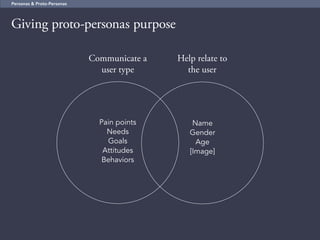
Giving purpose
Brainstorming
Communicate a
user type
Help relate to
the user
Name
Gender
Age
[Image]
Pain points
Needs
Goals
Attitudes
Behaviors
37
Giving purpose
Brainstorming
Communicate a
user type
Help relate to
the user
Name
Gender
Age
[Image]
Pain points
Needs
Goals
Attitudes
Behaviors
Depends on the projectIt depends
38
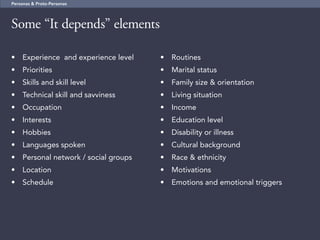
Some “It depends” elements
Brainstorming
•	 Experience and experience level
•	 Priorities
•	 Skills and skill level
•	 Technical skill and savviness
•	 Occupation
•	 Interests
•	 Hobbies
•	 Languages spoken
•	 Personal network / social groups
•	 Location
•	 Schedule
•	 Routines
•	 Marital status
•	 Family size & orientation
•	 Living situation
•	 Income
•	 Education level
•	 Disability or illness
•	 Cultural background
•	 Race & ethnicity
•	 Motivations
•	 Emotions and emotional triggers
39
Remember
Brainstorming
•	 The variables you choose are
assumptions, too
40
Remember
Brainstorming
•	 The variables you choose are
assumptions, too
•	 All choices should support one or both
of the purposes
Communicate a
user type
Help relate to
the user
Name
Gender
Age
[Image]
Pain points
Needs
Goals
Attitudes
Behaviors
Depends on the project
41
Remember
Brainstorming
•	 The variables you choose are
assumptions, too
•	 All choices should support one or both
of the purposes
•	 The choices you make can help inform
assumptions about pain points and
solutions
Communicate a
user type
Help relate to
the user
Name
Gender
Age
[Image]
Pain points
Needs
Goals
Attitudes
Behaviors
Depends on the project
42
Remember
Brainstorming
•	 The variables you choose are
assumptions, too
•	 All choices should support one or both
of the purposes
•	 The choices you make can help inform
assumptions about pain points and
solutions
•	 Every project is / can be different
Communicate a
user type
Help relate to
the user
Name
Gender
Age
[Image]
Pain points
Needs
Goals
Attitudes
Behaviors
Depends on the project
43
Mapping attributes
Brainstorming
Very general
Not useful Very useful
Very specific
44
Mapping attributes
Brainstorming
Not useful Very useful
Very general
What’s an attribute that
is important to document
for all/most of my proto-
personas?
Very specific
45
Mapping attributes
Brainstorming
Not useful Very useful
Very general
Very specific
What attributes are
useful to document,
in that they help to
fulfill the purpose of
a proto-persona?
46
Mapping attributes
Brainstorming
Not useful Very useful
Very general
Very specific
What attributes are
worth documenting
for specific personas,
but may not be
relevant for all/most?
47
Mapping attributes
Brainstorming
Not useful Very useful
Very general
Very specific
What attributes aren’t
worth documenting, and
don’t contribute to the
purpose of the proto-
persona?
48
Mapping attributes
Brainstorming
49
The story of Mike
Brainstorming
50
The story of Mike
Brainstorming
Del the Funky Homosapien
Deltron 3030
Why should I hate you/
We ain’t that different/
We may act different in some ways/
But we still group together like a survey
51
Mapping attributes
(15 minutes)
Exercise
Imagine that your character is
using a website to find a new
apartment in New York City.
What else do you want to know?
Not useful Very useful
Very specific
Very general
52
Defining the User Type
“Every character, when born, is a
stereotype.”
- Michael Patrick King,
Director, Writer & Producer
53
Improv exercise
(30 minutes)
Exercise
54
Communicating a type
Defining the User Type
•	 Embody the character
•	 How you’ve framed your character
should infer needs, behaviors, pain
points
•	 Remember to ask, “If this, then
what”
55
Discover needs, pain
points, solutions
(20 minutes)
Exercise
Pair up.
Take turns ranting.
As your partner rants, write down
pain points, ideas for solutions,
whatever comes to you.
56
Break
(10 minutes)
Break
57
Evolving Personas
Evolving Personas
“You cannot dream yourself into a
character; you must hammer and forge
yourself one.”
- Henry David Thoreau
58
Choosing a character set
Evolving Personas
•	 A character is as good as the characters
around them
59
Choosing a character set
Evolving Personas
•	 A character is as good as the characters
around them
•	 Pay attention to ALL of the attributes of
the people you research with
60
Refining after research
Evolving Personas
•	 Re-chart the usefulness of your variables
and character data
61
Refining after research
Evolving Personas
•	 Re-chart the usefulness of your variables
and character data
•	 Aim to build on the character rather
than start fresh (though sometimes this
can’t be avoided)
62
Refining after research
Evolving Personas
•	 Re-chart the usefulness of your variables
and character data
•	 Aim to build on the character rather
than start fresh (though sometimes this
can’t be avoided)
•	 Create a format that works for you and
the project
63
Photos vs. drawings
Evolving Personas
Photos of real people are great, but you might end up with thoughts like...
64
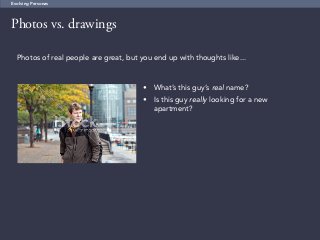
Photos vs. drawings
Evolving Personas
Photos of people are great, but you might end up with thoughts like...
•	 What’s this guy’s real name?
65
Photos vs. drawings
Evolving Personas
Photos of real people are great, but you end up with thoughts like...
•	 What’s this guy’s real name?
•	 Is this guy really looking for a new
apartment?
66
Photos vs. drawings
Evolving Personas
Photos of real people are great, but you end up with thoughts like...
•	 What’s this guy’s real name?
•	 Is this guy really looking for a new
apartment?
•	 What if this guy doesn’t deserve a nice
apartment?! (MIKE!)
67
Using the personas
Evolving Personas
The best personas
are internalized.
68
Using the personas
Evolving Personas
WW_D?
69
Post and review your
characters
(10 minutes)
Exercise
And, see who you ended up
becoming...
70
Thank you!
Chelsey Delaney
Senior UX Designer, Catalyst Group
@chelseD
catalystnyc.com
Thank You
Taren Sterry
President, Taren Sterry
Communication Coaching
tarensterry.com

LeanUX NYC 2014: "Enhancing Proto-Personas With Characterization" (Workshop)