Thinking like Humans
And you thought this was only about “personas”
In prepping for this discussion I had a hard time aligning all my thoughts around ‘just personas’ because talking only
about personas in such a restrictive lens. It detracts from the purpose of personas as a ‘tool.’ The underlining premise
of persona work is that - we need to think more like humans - hence the title.
This conversation is set to the tone of product design and development, but it should be understood from the beginning
that personas are more than for ‘designers’ or for ‘product people.’ Their place resides throughout the business but to
different depths.
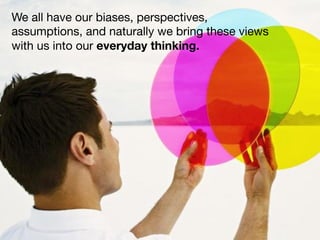
We all have our biases, perspectives,
assumptions, and naturally we bring these views
with us into our everyday thinking.
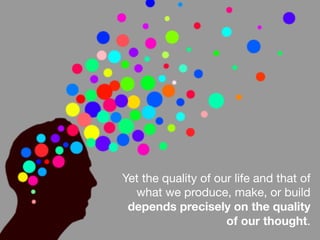
Yet the quality of our life and that of
what we produce, make, or build
depends precisely on the quality
of our thought.
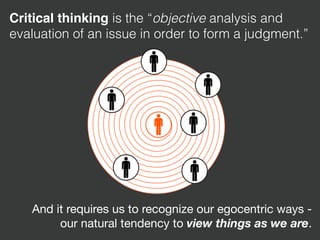
Critical thinking is the “objective analysis and
evaluation of an issue in order to form a judgment.”
And it requires us to recognize our egocentric ways -
our natural tendency to view things as we are.
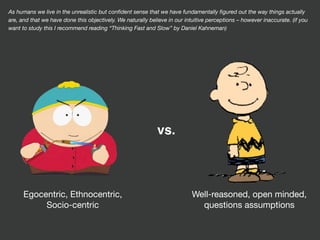
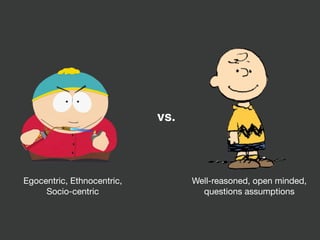
Egocentric, Ethnocentric,

Socio-centric
Well-reasoned, open minded,

questions assumptions
vs.
As humans we live in the unrealistic but confident sense that we have fundamentally figured out the way things actually
are, and that we have done this objectively. We naturally believe in our intuitive perceptions – however inaccurate. (if you
want to study this I recommend reading “Thinking Fast and Slow” by Daniel Kahneman)
Here in Silicon Valley, we forget how skewed our
population is, and we should frequently remind
ourselves of how abnormal we really are. The
average person who uses a software-based
product around here isn’t really average.
“ “
- Alan Cooper
Most people do not understand the degree to which they have uncritically internalized the dominant prejudices of their
society or culture. Sociologists and anthropologists identify this as the state of being “culture bound.”
https://www.interculturalsolutions.net/why-critical-thinking-is-so-important/
QHow do we know if what we’re
building is what is needed?
AWe have to think more like humans.
We have to think more like our users.
The adage - “Build it and they will come” is a false claim and misquote. Focusing only on ‘the thing’ creates a great deal
of business and market risk as well as great debts to be paid in technology efforts in the future
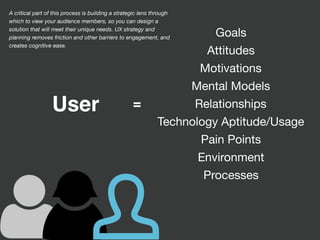
User =
Goals

Attitudes

Motivations

Mental Models

Relationships

Technology Aptitude/Usage

Pain Points

Environment

Processes
A critical part of this process is building a strategic lens through
which to view your audience members, so you can design a
solution that will meet their unique needs. UX strategy and
planning removes friction and other barriers to engagement, and
creates cognitive ease.
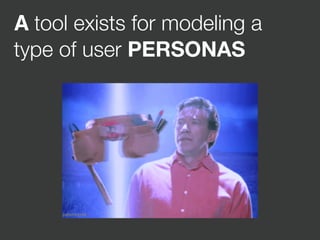
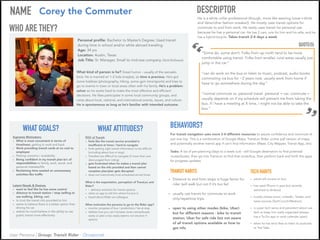
A tool exists for modeling a
type of user PERSONAS
When you think of Personas
- what comes to mind?
Are personas profiles of hypothetical customers that marketing
invented? Or, are personas developed from customer surveys
asking what they want and don’t want from your website? Are
they segments of your web visitors?
The answer is - No.
Persona seek to push ourselves to ask the ‘whys’ around why
users do something or why they behave in a certain way
So, what’s a Persona?
Way to model (archetype), summarize, and
communicate understanding about groups
of real users pains, behaviors, goals, and
motivations.
A persona is not a demographic profile, a market segment or a
summation of survey data. Rather, a persona is a combination of
data modeled from ethnographic and behavioral user research, as
well as narrative. The term persona often gets clumped together
with market research (surveys, focus groups, etc), and though
they are not the same thing, market research can certainly
complement persona studies.
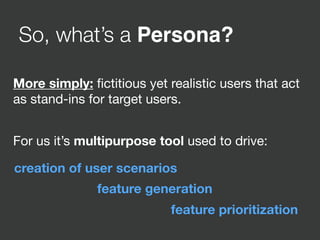
More simply: fictitious yet realistic users that act
as stand-ins for target users. 

For us it’s multipurpose tool used to drive:
creation of user scenarios
feature generation
feature prioritization
So, what’s a Persona?
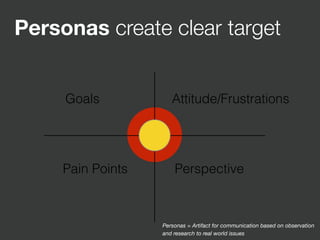
Personas create clear target
Goals Attitude/Frustrations
Pain Points Perspective
Personas = Artifact for communication based on observation
and research to real world issues
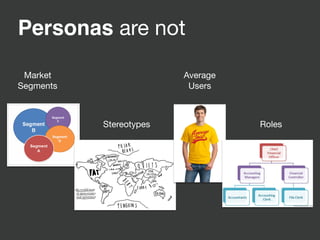
Personas are not
Market 

Segments
Stereotypes
Average 

Users
Roles
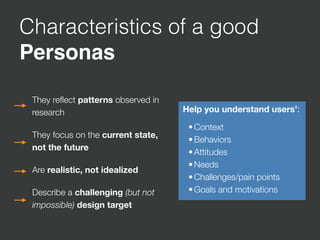
Characteristics of a good
Personas
They reflect patterns observed in
research
They focus on the current state,
not the future
Are realistic, not idealized
Describe a challenging (but not
impossible) design target
Help you understand users’:

•Context
•Behaviors
•Attitudes
•Needs
•Challenges/pain points
•Goals and motivations
But wait…
this shit seems fake
Persona development isn’t about
“listening to the customer.”
It’s about framing the problem correctly, asking the
“whys”, and looking for “jobs to be done.”
Ethnographer* Hat
*Ethnography - research method based on observing
people in their natural environment rather than in the formal
research setting.
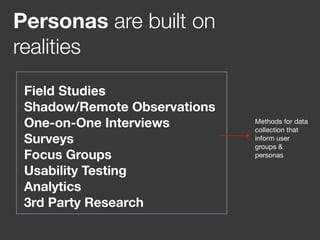
Personas are built on
realities
Field Studies

Shadow/Remote Observations
One-on-One Interviews
Surveys
Focus Groups
Usability Testing
Analytics
3rd Party Research
Methods for data
collection that
inform user
groups &
personas
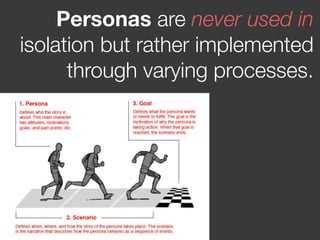
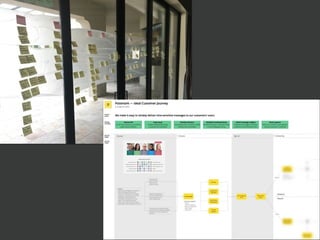
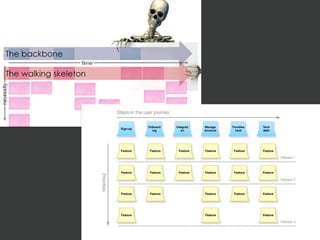
Personas are never used in
isolation but rather implemented
through varying processes.
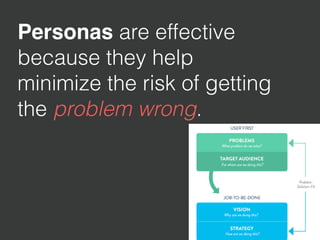
Personas are effective
because they help
minimize the risk of getting
the problem wrong.
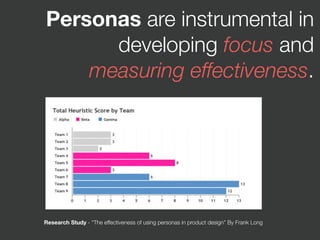
Personas are instrumental in
developing focus and
measuring effectiveness.
Research Study - “The effectiveness of using personas in product design” By Frank Long
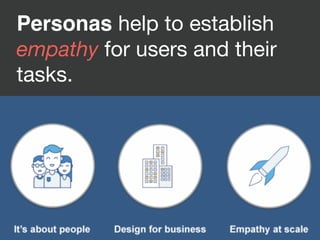
Personas help to establish
empathy for users and their
tasks.
User
Personas
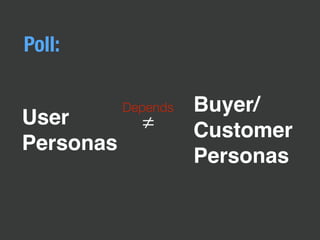
Poll:
≠
Buyer/
Customer
Personas
Depends
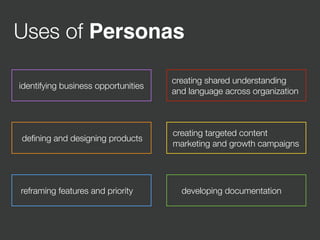
Uses of Personas
identifying business opportunities
defining and designing products
creating shared understanding
and language across organization
creating targeted content
marketing and growth campaigns
reframing features and priority developing documentation
Egocentric, Ethnocentric,

Socio-centric
Well-reasoned, open minded,

questions assumptions
vs.
…it’s in [Apple’s] DNA that technology alone is
not enough — that it’s technology married with
liberal arts, married with the humanities, that
yields us the result that makes our hearts sing.
“ “
- Steve Jobs
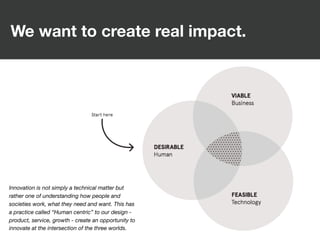
We want to create real impact.
Innovation is not simply a technical matter but
rather one of understanding how people and
societies work, what they need and want. This has
a practice called “Human centric” to our design -
product, service, growth - create an opportunity to
innovate at the intersection of the three worlds.
Any Questions?
Resources
http://www.slideshare.net/TheConartist/what-are-personas-and-how-to-use-them-a-presentation-by-shlomo-goltz

http://www.userphilosophy.com/wp-content/uploads/2009/02/reprint-hfes08-chapman-love-milham-elrif-alford.pdf
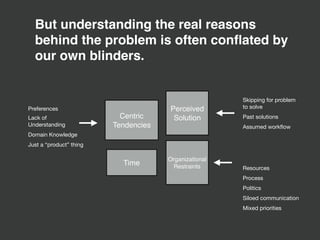
But understanding the real reasons
behind the problem is often conflated by
our own blinders.
Centric
Tendencies
Organizational
Restraints
Time
Perceived
Solution
Preferences

Lack of
Understanding

Domain Knowledge

Just a “product” thing
Resources

Process

Politics

Siloed communication

Mixed priorities
Skipping for problem
to solve

Past solutions

Assumed workflow
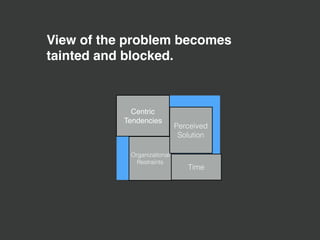
View of the problem becomes
tainted and blocked.
Centric
Tendencies
Organizational
Restraints
Time
Perceived
Solution
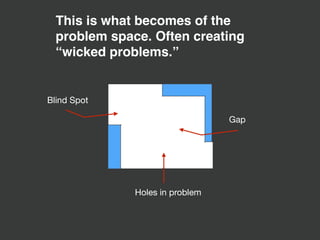
This is what becomes of the
problem space. Often creating
“wicked problems.”
Blind Spot
Holes in problem
Gap

Thinking like Humans - Tools to improve how we solve problems for our users

  • 1.
    Thinking like Humans Andyou thought this was only about “personas” In prepping for this discussion I had a hard time aligning all my thoughts around ‘just personas’ because talking only about personas in such a restrictive lens. It detracts from the purpose of personas as a ‘tool.’ The underlining premise of persona work is that - we need to think more like humans - hence the title. This conversation is set to the tone of product design and development, but it should be understood from the beginning that personas are more than for ‘designers’ or for ‘product people.’ Their place resides throughout the business but to different depths.
  • 4.
    We all haveour biases, perspectives, assumptions, and naturally we bring these views with us into our everyday thinking.
  • 5.
    Yet the qualityof our life and that of what we produce, make, or build depends precisely on the quality of our thought.
  • 6.
    Critical thinking isthe “objective analysis and evaluation of an issue in order to form a judgment.” And it requires us to recognize our egocentric ways - our natural tendency to view things as we are.
  • 7.
    Egocentric, Ethnocentric, Socio-centric Well-reasoned, openminded, questions assumptions vs. As humans we live in the unrealistic but confident sense that we have fundamentally figured out the way things actually are, and that we have done this objectively. We naturally believe in our intuitive perceptions – however inaccurate. (if you want to study this I recommend reading “Thinking Fast and Slow” by Daniel Kahneman)
  • 8.
    Here in SiliconValley, we forget how skewed our population is, and we should frequently remind ourselves of how abnormal we really are. The average person who uses a software-based product around here isn’t really average. “ “ - Alan Cooper Most people do not understand the degree to which they have uncritically internalized the dominant prejudices of their society or culture. Sociologists and anthropologists identify this as the state of being “culture bound.” https://www.interculturalsolutions.net/why-critical-thinking-is-so-important/
  • 9.
    QHow do weknow if what we’re building is what is needed?
  • 10.
    AWe have tothink more like humans. We have to think more like our users. The adage - “Build it and they will come” is a false claim and misquote. Focusing only on ‘the thing’ creates a great deal of business and market risk as well as great debts to be paid in technology efforts in the future
  • 11.
    User = Goals Attitudes Motivations Mental Models Relationships TechnologyAptitude/Usage Pain Points Environment Processes A critical part of this process is building a strategic lens through which to view your audience members, so you can design a solution that will meet their unique needs. UX strategy and planning removes friction and other barriers to engagement, and creates cognitive ease.
  • 13.
    A tool existsfor modeling a type of user PERSONAS
  • 14.
    When you thinkof Personas - what comes to mind? Are personas profiles of hypothetical customers that marketing invented? Or, are personas developed from customer surveys asking what they want and don’t want from your website? Are they segments of your web visitors?
  • 15.
    The answer is- No. Persona seek to push ourselves to ask the ‘whys’ around why users do something or why they behave in a certain way
  • 16.
    So, what’s aPersona? Way to model (archetype), summarize, and communicate understanding about groups of real users pains, behaviors, goals, and motivations. A persona is not a demographic profile, a market segment or a summation of survey data. Rather, a persona is a combination of data modeled from ethnographic and behavioral user research, as well as narrative. The term persona often gets clumped together with market research (surveys, focus groups, etc), and though they are not the same thing, market research can certainly complement persona studies.
  • 17.
    More simply: fictitiousyet realistic users that act as stand-ins for target users. For us it’s multipurpose tool used to drive: creation of user scenarios feature generation feature prioritization So, what’s a Persona?
  • 18.
    Personas create cleartarget Goals Attitude/Frustrations Pain Points Perspective Personas = Artifact for communication based on observation and research to real world issues
  • 19.
    Personas are not Market Segments Stereotypes Average Users Roles
  • 20.
    Characteristics of agood Personas They reflect patterns observed in research They focus on the current state, not the future Are realistic, not idealized Describe a challenging (but not impossible) design target Help you understand users’: •Context •Behaviors •Attitudes •Needs •Challenges/pain points •Goals and motivations
  • 22.
  • 23.
    Persona development isn’tabout “listening to the customer.” It’s about framing the problem correctly, asking the “whys”, and looking for “jobs to be done.”
  • 24.
    Ethnographer* Hat *Ethnography -research method based on observing people in their natural environment rather than in the formal research setting.
  • 25.
    Personas are builton realities Field Studies Shadow/Remote Observations One-on-One Interviews Surveys Focus Groups Usability Testing Analytics 3rd Party Research Methods for data collection that inform user groups & personas
  • 26.
    Personas are neverused in isolation but rather implemented through varying processes.
  • 29.
    Personas are effective becausethey help minimize the risk of getting the problem wrong.
  • 30.
    Personas are instrumentalin developing focus and measuring effectiveness. Research Study - “The effectiveness of using personas in product design” By Frank Long
  • 31.
    Personas help toestablish empathy for users and their tasks.
  • 32.
  • 33.
    Uses of Personas identifyingbusiness opportunities defining and designing products creating shared understanding and language across organization creating targeted content marketing and growth campaigns reframing features and priority developing documentation
  • 34.
  • 35.
    …it’s in [Apple’s]DNA that technology alone is not enough — that it’s technology married with liberal arts, married with the humanities, that yields us the result that makes our hearts sing. “ “ - Steve Jobs
  • 36.
    We want tocreate real impact. Innovation is not simply a technical matter but rather one of understanding how people and societies work, what they need and want. This has a practice called “Human centric” to our design - product, service, growth - create an opportunity to innovate at the intersection of the three worlds.
  • 37.
  • 38.
  • 39.
    But understanding thereal reasons behind the problem is often conflated by our own blinders. Centric Tendencies Organizational Restraints Time Perceived Solution Preferences Lack of Understanding Domain Knowledge Just a “product” thing Resources Process Politics Siloed communication Mixed priorities Skipping for problem to solve Past solutions Assumed workflow
  • 40.
    View of theproblem becomes tainted and blocked. Centric Tendencies Organizational Restraints Time Perceived Solution
  • 41.
    This is whatbecomes of the problem space. Often creating “wicked problems.” Blind Spot Holes in problem Gap