


William Hudson 
• Consultant, teacher, writer, designer 
• > 40 years experience in the development 
of interactive systems 
• > 30 articles and papers
“The simplest and the most obvious way of creatinga 
good product or service is to create something, that 
you need yourself. This will allow you to create 
something you perfectly understand and you will have a 
clear idea if that is smth valuable from the beginning.” 
37signals
Deep understanding of user’s needs 
is crucial for building a successful service
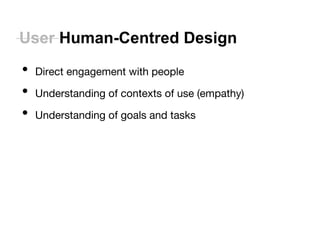
User Human-Centred Design 
• Direct engagement with people 
• Understanding of contexts of use (empathy) 
• Understanding of goals and tasks
Research 
• User observation 
• User Research 
• Industry 
• Сompetitors 
• Additional needfinding strategies
User Observation 
• What do people do now? 
• What values and goals do people have? 
• Types of context 
• The importance of being curios
Choosing Participants 
• Representative of target users 
• May be current users of a similar system
User Research 
• Qualitative 
o Representative of target users (8-10) 
o Ethnographic 
• Quantitative 
o Large number of respondents 
o Questionnaire
Approximate better that nothing (may not 
be ideal, but better that nothing)
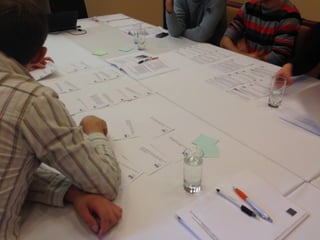
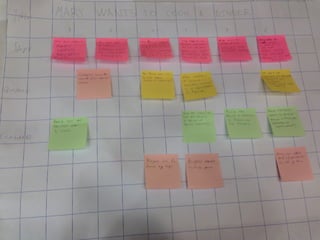
Affinity Diagram 
• A business tool used to organize ideas and data 
• Process: 
o Record each idea on cards or notes 
o Look for ideas that seem to be related 
o Sort cards into groups until all cards have been 
used
Personas 
• Personas provide empathy 
• Strong psychological evidence for personal bias (Our 
brains are wired to empathize with individuals rather 
than groups)
Without Personas 
• Low empathy 
• Technology focus 
• Featuritis 
• Time scales 
• Narrow scope 
• Ignorance/bliss
Persona 
• Name, age, demographic details 
• Photo 
• Primary goals, motivations and begaviours 
• Related pain points 
• Give the persona story to tell
Primary & Secondary Personas 
• Primary personas represent behaviours that define 
your product or service (customer checking in) 
• Secondary personas have relatively minor differences 
in goals, motivation or behaviour (manager)
Personas Summary 
• A persona is the face of a user community 
• These are used for 
o Recruitment (research and usability testing) 
o Sales and marketing 
• Use case and user story 
• Merchandising
Use Cases and User Stories
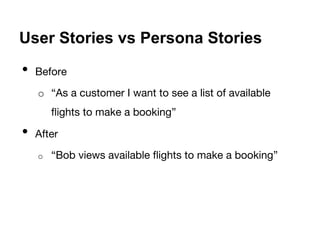
User Stories vs Persona Stories 
• Before 
o “As a customer I want to see a list of available 
flights to make a booking” 
• After 
o “Bob views available flights to make a booking”
The main difference is that personas 
describe researched (not fabricated) 
behaviours
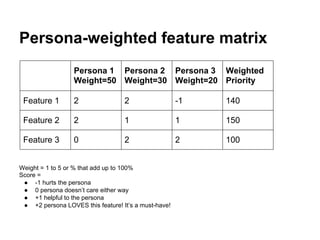
Persona-weighted feature matrix 
Persona 1 
Weight=50 
Persona 2 
Weight=30 
Persona 3 
Weight=20 
Weighted 
Priority 
Feature 1 2 2 -1 140 
Feature 2 2 1 1 150 
Feature 3 0 2 2 100 
Weight = 1 to 5 or % that add up to 100% 
Score = 
● -1 hurts the persona 
● 0 persona doesn’t care either way 
● +1 helpful to the persona 
● +2 persona LOVES this feature! It’s a must-have!
Design Map 
• Who 
o Personas 
o Persona‐weighted feature matrix 
• What 
o Use Cases 
o Persona Stories 
• How 
o Customer Journey (Design Map) 
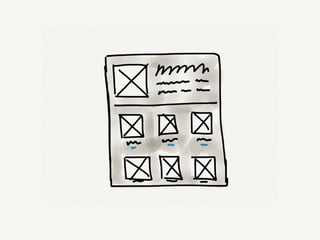
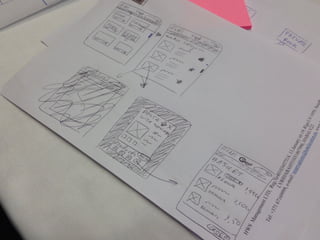
o Wireframes, Sketch
Be creative and have fun!
Books 
• Alan Cooper (2004). The Inmates Are Running the Asylum 
• Don Norman (2009). Design of everyday things 
• Tim Brown (IDEO, 2012). Change by Design 
• Goodwin, K. (2009). Designing for the Digital Age: How to Create Human‐ 
Centered Products and Services, John Wiley & Sons 
• Hudson, W. (2013). “User Stories Don’t Help Users: Introducing Persona 
Stories” in Interactions Magazine, Nov‐Dec 2013, ACM. 
www.personastories.com

Persona-Driven Design

  • 2.
    William Hudson •Consultant, teacher, writer, designer • > 40 years experience in the development of interactive systems • > 30 articles and papers
  • 5.
    “The simplest andthe most obvious way of creatinga good product or service is to create something, that you need yourself. This will allow you to create something you perfectly understand and you will have a clear idea if that is smth valuable from the beginning.” 37signals
  • 7.
    Deep understanding ofuser’s needs is crucial for building a successful service
  • 8.
    User Human-Centred Design • Direct engagement with people • Understanding of contexts of use (empathy) • Understanding of goals and tasks
  • 9.
    Research • Userobservation • User Research • Industry • Сompetitors • Additional needfinding strategies
  • 10.
    User Observation •What do people do now? • What values and goals do people have? • Types of context • The importance of being curios
  • 11.
    Choosing Participants •Representative of target users • May be current users of a similar system
  • 13.
    User Research •Qualitative o Representative of target users (8-10) o Ethnographic • Quantitative o Large number of respondents o Questionnaire
  • 14.
    Approximate better thatnothing (may not be ideal, but better that nothing)
  • 15.
    Affinity Diagram •A business tool used to organize ideas and data • Process: o Record each idea on cards or notes o Look for ideas that seem to be related o Sort cards into groups until all cards have been used
  • 21.
    Personas • Personasprovide empathy • Strong psychological evidence for personal bias (Our brains are wired to empathize with individuals rather than groups)
  • 22.
    Without Personas •Low empathy • Technology focus • Featuritis • Time scales • Narrow scope • Ignorance/bliss
  • 23.
    Persona • Name,age, demographic details • Photo • Primary goals, motivations and begaviours • Related pain points • Give the persona story to tell
  • 28.
    Primary & SecondaryPersonas • Primary personas represent behaviours that define your product or service (customer checking in) • Secondary personas have relatively minor differences in goals, motivation or behaviour (manager)
  • 29.
    Personas Summary •A persona is the face of a user community • These are used for o Recruitment (research and usability testing) o Sales and marketing • Use case and user story • Merchandising
  • 30.
    Use Cases andUser Stories
  • 31.
    User Stories vsPersona Stories • Before o “As a customer I want to see a list of available flights to make a booking” • After o “Bob views available flights to make a booking”
  • 32.
    The main differenceis that personas describe researched (not fabricated) behaviours
  • 33.
    Persona-weighted feature matrix Persona 1 Weight=50 Persona 2 Weight=30 Persona 3 Weight=20 Weighted Priority Feature 1 2 2 -1 140 Feature 2 2 1 1 150 Feature 3 0 2 2 100 Weight = 1 to 5 or % that add up to 100% Score = ● -1 hurts the persona ● 0 persona doesn’t care either way ● +1 helpful to the persona ● +2 persona LOVES this feature! It’s a must-have!
  • 37.
    Design Map •Who o Personas o Persona‐weighted feature matrix • What o Use Cases o Persona Stories • How o Customer Journey (Design Map) o Wireframes, Sketch
  • 43.
    Be creative andhave fun!
  • 44.
    Books • AlanCooper (2004). The Inmates Are Running the Asylum • Don Norman (2009). Design of everyday things • Tim Brown (IDEO, 2012). Change by Design • Goodwin, K. (2009). Designing for the Digital Age: How to Create Human‐ Centered Products and Services, John Wiley & Sons • Hudson, W. (2013). “User Stories Don’t Help Users: Introducing Persona Stories” in Interactions Magazine, Nov‐Dec 2013, ACM. www.personastories.com