5 ‘S ’
•Total Quality remains incomplete
unless suitable Environment for
creation & sustenance of Quality is
provided.
• Much importance not for good
housekeeping . 1
What is 5 ‘ S ’
• Many have confused 5 ‘ S ’ with
cleanliness .
• A systematic approach leading to a
Cleaner, Safer & Better workplace which
is fundamental to Productivity & Quality is
known as 5 ‘S ’ & pioneered by Toyota
Motors in early 80’s and created super
Quality of workplace 2
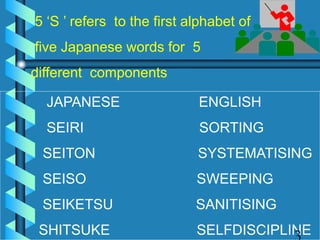
5 ‘S ’ refers to the first alphabet of
five Japanese words for 5
different components
JAPANESE ENGLISH
SEIRI SORTING
SEITON SYSTEMATISING
SEISO SWEEPING
SEIKETSU SANITISING
SHITSUKE SELFDISCIPLINE
5 ‘S ’ is systematic participation
programme for improving the workplace
environment which is base of continual
improvement in the organisation
4
SHITSUKOKU STICKINGLY
5
•Quality Improvement
•Accident prevention's
•Pollution prevention's
•Productivity improvement
•Cost and down time reduction
•Creativity improvement
Main objectives of 5 ‘S ’
•5S concept is itself not a theory but a very
powerful tool when every employees from
top to workers should participate
• It is management barometer , if you can
do 5S you can do anything,
•The company is doing badly is doing its.
5S badly 6
1. SORTING ( SEIRI )
MEANING
Distinguishing between the necessary &
the unnecessary and getting rid of the
unnecessary.
PRINCIPLES
Stratification Management ( Entailing value
judgement & creating strata of importance )
7
TYPICAL ACTIVITIES
(SEIRI )
• Identify the unnecessary
IN & OF
Shelves, lockers , drawers , Racks,
Passageways, Corners, Floors , Pits,
Partition, storehouse ,sheds, Walls , Bulletin
board, Tools, Measuring devices , Spares
,Small items, Consumables,wires,ducts,
oils ,etc.
8
•Throw out the things not needed.
•Through house cleaning.
•Deal with the causes of dirt & leaks.
•Treat defects & breakage.
•Organise the warehouse .
•Eliminate grime & burrs .
9
2.SYSTEMATISING(SEITON )
MEANING
Establishing a systematic layout so you
can always get just as much of what you
need when you need it
PRINCIPLES
Functional storage of all items based on
5W’s and 1H 10
•Everything's at designated place.
•Thirty second storage & retrieval .
•Filing standards.
TYPICAL ACTIVITIES
11
•Zoning & placement marks .
•First in & First out.
•Neat notice board.
•Easy to read notices
&
•Functional placement for
Material, Parts, Carts, Tools, Equipment's ,
Files , Stationery items and Everything
else
12
3. SWEEPING ( SEISO )
MEANING
•Eliminating trash, filth & Foreign matter
for a cleaner workplace
PRINCIPLES
•Cleaning as a form of inspection
13
•Cleaning, inspecting & correcting minor
problems.
•Pneumatics,,Mechanical,Electrical, tools,
Measuring devices , Stationery, Hydraulics.
•Cleaning even the places most people do
not notice Making cleaning and inspection
easier .
TYPICAL ACTIVITIES
OF & FOR
4.SANITISING ( SEIKETSU )
MEANING
Making everything pollution free &
supportive to healthy Environment .
PRINCIPLES
Making Environmental friendly noise or
any vibration . 15
•Reducing air & water pollution.
•Proper illumination without glare in working
area . 16
•Dealing with leakage of toxic & explosive
fumes.
•Dealing with any uncomfortable Chemical
waste treatment.
TYPICAL ACTIVITIES
•Pure drinking water .
•Spotless cleanliness of workplace, floor,
tables, ceiling, equipment's etc.
•Temperature & humidity maintenance.
•Effective air ducting & suction system for
reducing fly content.
17
5.SELFDISCIPLINE(SHITSUKE )
MEANING
Doing the Right thing Naturally.
PRINCIPLES
Good habit formation and discipline .
18
TYPICAL ACTIVITIES
•All together cleaning training and
practice for regular cleaning.
•Training & insistence on wearing safety
workplace glasses , shoes etc.
•Telephone,communication & feedback
practices.
•Follow-up on standardization and checklists
•Practice for dealing with emergencies. 19
6.STICKINGLY ( SHITSUKOKO )
MEANING
Ensuring 5 S , avoid making status is
maintained or repetition of sanitizing,sorting
,systematizing &sweeping .
PRINCIPLES
•Visual Management & 5S standardization
20
TYPICAL ACTIVITIES
•Displays to help people operating errors.
•Danger alerts.
•Indications where things should be .
•PM displays.
•Equipment's designations,Inspection marks .
•Color coding,warning colours.
•Fire extinguishers sign.
•Open-shut & other directional labels 21
22
CLUE FOR 5 S SURVEY
Lighting -
Operation difficulty by insufficient light /
bother by glare,reading the instrument
dial , bulletin board reading
Smell -
•Any leakage of toxic ,uncomfortable or
explosive fumes.
•Any leakage of toxic or explosive material
at workplace .
16
Noise
•Any squeaking , uncomfortable noise
•Any action for elimination of source of
uncomfortable noise
•Any noise source that is identifiable
Vibration -
•any uncomfortable vibration felt
continuously or occasionally
•Any vibration sources that are identifiable
Temperature
•any low or high temp in shopfloor
•Heat sources which can be eliminated
24
POWDERY DUST
•Any uncomfortable powdery dust
floating in workplace occasionally or
continuously.
TOXIC , VOLATILE & EXPLOSIVE
MATERIAL
•Identify & indicate clearly as a dangerous
material.
•Establish & disseminate emergency
evacuation procedure to every one. 25
WORK SHOP
•Install all necessary safety media
•Have enough open space in every
workshop
•Maintain slip free floor
26
COLOUR CODING
•Specify colour coding on dangerous
/risky area / material
•Specify colour coding for eye fatigue
protection for using equipment.
•Specify colour coding for operational
limits on instruments / indicators.
HUMAN BEHAVIOUR
•Use of PPE such as safety shoes ,
helmet, masks ear plugs , goggles, etc.
28

Presentation Slides- 5 S.ppt

  • 1.
    5 ‘S ’ •TotalQuality remains incomplete unless suitable Environment for creation & sustenance of Quality is provided. • Much importance not for good housekeeping . 1
  • 2.
    What is 5‘ S ’ • Many have confused 5 ‘ S ’ with cleanliness . • A systematic approach leading to a Cleaner, Safer & Better workplace which is fundamental to Productivity & Quality is known as 5 ‘S ’ & pioneered by Toyota Motors in early 80’s and created super Quality of workplace 2
  • 3.
    5 ‘S ’refers to the first alphabet of five Japanese words for 5 different components JAPANESE ENGLISH SEIRI SORTING SEITON SYSTEMATISING SEISO SWEEPING SEIKETSU SANITISING SHITSUKE SELFDISCIPLINE
  • 4.
    5 ‘S ’is systematic participation programme for improving the workplace environment which is base of continual improvement in the organisation 4 SHITSUKOKU STICKINGLY
  • 5.
    5 •Quality Improvement •Accident prevention's •Pollutionprevention's •Productivity improvement •Cost and down time reduction •Creativity improvement Main objectives of 5 ‘S ’
  • 6.
    •5S concept isitself not a theory but a very powerful tool when every employees from top to workers should participate • It is management barometer , if you can do 5S you can do anything, •The company is doing badly is doing its. 5S badly 6
  • 7.
    1. SORTING (SEIRI ) MEANING Distinguishing between the necessary & the unnecessary and getting rid of the unnecessary. PRINCIPLES Stratification Management ( Entailing value judgement & creating strata of importance ) 7
  • 8.
    TYPICAL ACTIVITIES (SEIRI ) •Identify the unnecessary IN & OF Shelves, lockers , drawers , Racks, Passageways, Corners, Floors , Pits, Partition, storehouse ,sheds, Walls , Bulletin board, Tools, Measuring devices , Spares ,Small items, Consumables,wires,ducts, oils ,etc. 8
  • 9.
    •Throw out thethings not needed. •Through house cleaning. •Deal with the causes of dirt & leaks. •Treat defects & breakage. •Organise the warehouse . •Eliminate grime & burrs . 9
  • 10.
    2.SYSTEMATISING(SEITON ) MEANING Establishing asystematic layout so you can always get just as much of what you need when you need it PRINCIPLES Functional storage of all items based on 5W’s and 1H 10
  • 11.
    •Everything's at designatedplace. •Thirty second storage & retrieval . •Filing standards. TYPICAL ACTIVITIES 11 •Zoning & placement marks . •First in & First out. •Neat notice board.
  • 12.
    •Easy to readnotices & •Functional placement for Material, Parts, Carts, Tools, Equipment's , Files , Stationery items and Everything else 12
  • 13.
    3. SWEEPING (SEISO ) MEANING •Eliminating trash, filth & Foreign matter for a cleaner workplace PRINCIPLES •Cleaning as a form of inspection 13
  • 14.
    •Cleaning, inspecting &correcting minor problems. •Pneumatics,,Mechanical,Electrical, tools, Measuring devices , Stationery, Hydraulics. •Cleaning even the places most people do not notice Making cleaning and inspection easier . TYPICAL ACTIVITIES OF & FOR
  • 15.
    4.SANITISING ( SEIKETSU) MEANING Making everything pollution free & supportive to healthy Environment . PRINCIPLES Making Environmental friendly noise or any vibration . 15
  • 16.
    •Reducing air &water pollution. •Proper illumination without glare in working area . 16 •Dealing with leakage of toxic & explosive fumes. •Dealing with any uncomfortable Chemical waste treatment. TYPICAL ACTIVITIES
  • 17.
    •Pure drinking water. •Spotless cleanliness of workplace, floor, tables, ceiling, equipment's etc. •Temperature & humidity maintenance. •Effective air ducting & suction system for reducing fly content. 17
  • 18.
    5.SELFDISCIPLINE(SHITSUKE ) MEANING Doing theRight thing Naturally. PRINCIPLES Good habit formation and discipline . 18
  • 19.
    TYPICAL ACTIVITIES •All togethercleaning training and practice for regular cleaning. •Training & insistence on wearing safety workplace glasses , shoes etc. •Telephone,communication & feedback practices. •Follow-up on standardization and checklists •Practice for dealing with emergencies. 19
  • 20.
    6.STICKINGLY ( SHITSUKOKO) MEANING Ensuring 5 S , avoid making status is maintained or repetition of sanitizing,sorting ,systematizing &sweeping . PRINCIPLES •Visual Management & 5S standardization 20
  • 21.
    TYPICAL ACTIVITIES •Displays tohelp people operating errors. •Danger alerts. •Indications where things should be . •PM displays. •Equipment's designations,Inspection marks . •Color coding,warning colours. •Fire extinguishers sign. •Open-shut & other directional labels 21
  • 22.
    22 CLUE FOR 5S SURVEY Lighting - Operation difficulty by insufficient light / bother by glare,reading the instrument dial , bulletin board reading Smell - •Any leakage of toxic ,uncomfortable or explosive fumes. •Any leakage of toxic or explosive material at workplace .
  • 23.
    16 Noise •Any squeaking ,uncomfortable noise •Any action for elimination of source of uncomfortable noise •Any noise source that is identifiable
  • 24.
    Vibration - •any uncomfortablevibration felt continuously or occasionally •Any vibration sources that are identifiable Temperature •any low or high temp in shopfloor •Heat sources which can be eliminated 24
  • 25.
    POWDERY DUST •Any uncomfortablepowdery dust floating in workplace occasionally or continuously. TOXIC , VOLATILE & EXPLOSIVE MATERIAL •Identify & indicate clearly as a dangerous material. •Establish & disseminate emergency evacuation procedure to every one. 25
  • 26.
    WORK SHOP •Install allnecessary safety media •Have enough open space in every workshop •Maintain slip free floor 26
  • 27.
    COLOUR CODING •Specify colourcoding on dangerous /risky area / material •Specify colour coding for eye fatigue protection for using equipment. •Specify colour coding for operational limits on instruments / indicators.
  • 28.
    HUMAN BEHAVIOUR •Use ofPPE such as safety shoes , helmet, masks ear plugs , goggles, etc. 28