


16 October 2006 1
Reducing Waste – London Underground 
Chris Samson 
Dan Rahamim
Presentation Agenda 
What the session will cover: 
• 
Understand the principles of Lean practices 
• 
Be confident leading problem solving exercises 
• 
Become familiar with Value Stream Mapping 
• 
How SUP implemented these principles 
• 
SUP benefits realised 
What you will take away (how we): 
•Identify and minimise practices that waste money and time 
•Measure business improvements 
•Motivate employees and encourage cross-organisation participation 
•Knowledge sharing methods leading to better performance.
Who we are 
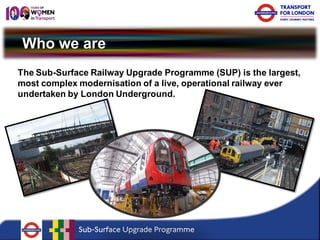
The Sub-Surface Railway Upgrade Programme (SUP) is the largest, most complex modernisation of a live, operational railway ever undertaken by London Underground.
Where we were 
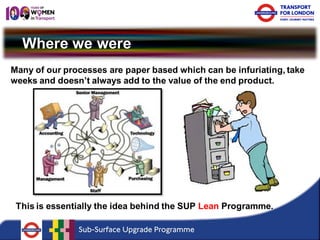
This is essentially the idea behind the SUP Lean Programme. 
Many of our processes are paper based which can be infuriating, take weeks and doesn’t always add to the value of the end product.
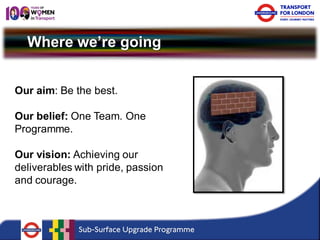
Where we’re going 
Our aim: Be the best. 
Our belief: One Team. One Programme. 
Our vision: Achieving our deliverables with pride, passion and courage.
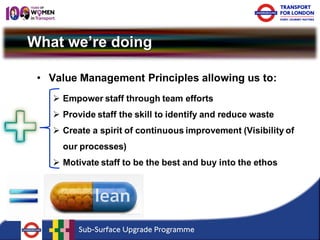
What we’re doing 
• 
Value Management Principles allowing us to: 
 
Empower staff through team efforts 
 
Provide staff the skill to identify and reduce waste 
 
Create a spirit of continuous improvement (Visibility of our processes) 
 
Motivate staff to be the best and buy into the ethos
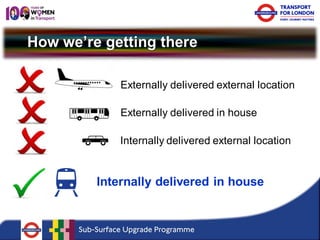
How we’re getting there 
Internally delivered in house 
Internally delivered external location 
Externally delivered in house 
Externally delivered external location
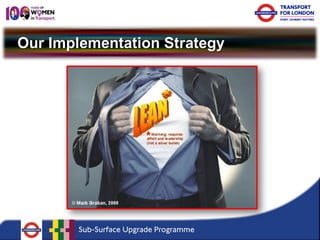
Our Implementation Strategy
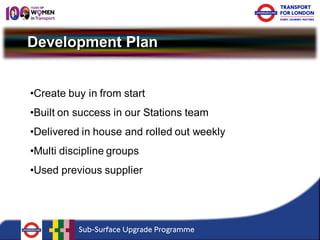
Development Plan 
• 
Create buy in from start 
• 
Built on success in our Stations team 
• 
Delivered in house and rolled out weekly 
• 
Multi discipline groups 
• 
Used previous supplier
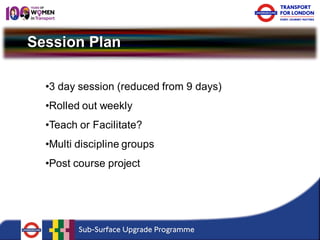
Session Plan 
• 
3 day session (reduced from 9 days) 
• 
Rolled out weekly 
• 
Teach or Facilitate? 
• 
Multi discipline groups 
• 
Post course project
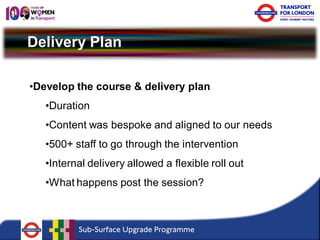
Delivery Plan 
• 
Develop the course & delivery plan 
• 
Duration 
• 
Content was bespoke and aligned to our needs 
• 
500+ staff to go through the intervention 
• 
Internal delivery allowed a flexible roll out 
• 
What happens post the session?
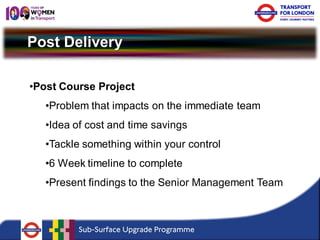
Post Delivery 
• 
Post Course Project 
• 
Problem that impacts on the immediate team 
• 
Idea of cost and time savings 
• 
Tackle something within your control 
• 
6 Week timeline to complete 
• 
Present findings to the Senior Management Team
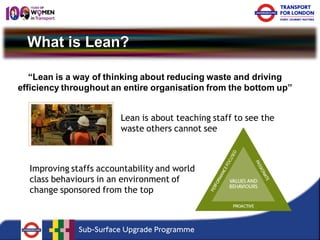
What is Lean? 
“Lean is a way of thinking about reducing waste and driving efficiency throughout an entire organisation from the bottom up” 
Lean is about teaching staff to see the waste others cannot see 
Improving staffs accountability and world class behaviours in an environment of change sponsored from the top
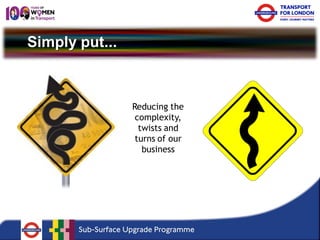
Simply put... 
Reducing the complexity, twists and turns of our business
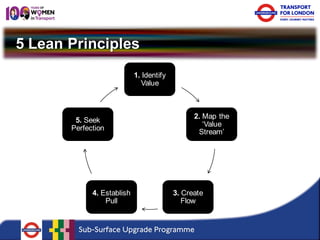
5 Lean Principles 
1. Identify Value 
2. Map the ‘Value Stream’ 
3. Create Flow 
4. Establish Pull 
5. Seek Perfection
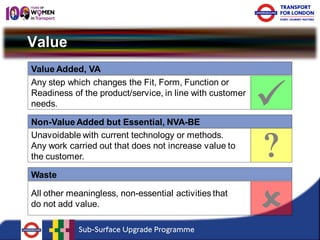
Value 
Unavoidable with current technology or methods. 
Any work carried out that does not increase value to the customer. 
Non-Value Added but Essential, NVA-BE 
Any step which changes the Fit, Form, Function or Readiness of the product/service, in line with customer needs. 
Value Added, VA 
All other meaningless, non-essential activities that do not add value. 
Waste
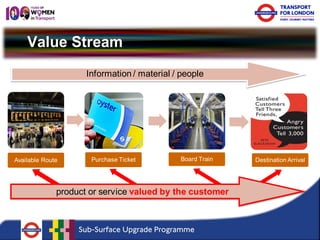
Available Route 
Purchase Ticket 
Board Train 
Destination Arrival 
Value Stream 
Information / material / people 
product or service valued by the customer
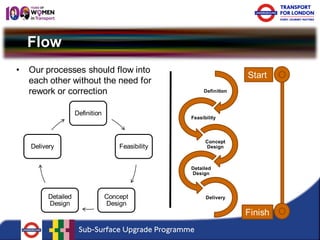
Flow 
Definition 
Feasibility 
Concept Design 
Detailed Design 
Delivery 
• 
Our processes should flow into each other without the need for rework or correction 
Definition 
Feasibility 
Concept Design 
Detailed Design 
Delivery 
Start 
Finish
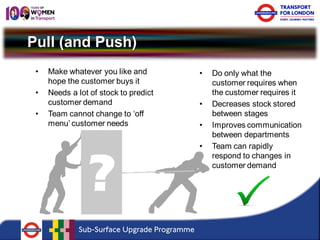
Pull (and Push) 
• 
Do only what the customer requires when the customer requires it 
• 
Decreases stock stored between stages 
• 
Improves communication between departments 
• 
Team can rapidly respond to changes in customer demand 
• 
Make whatever you like and hope the customer buys it 
• 
Needs a lot of stock to predict customer demand 
• 
Team cannot change to ‘off menu’ customer needs
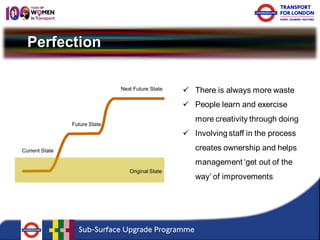
Perfection 
Current State 
Future State 
Next Future State 
Original State 
 
There is always more waste 
 
People learn and exercise more creativity through doing 
 
Involving staff in the process creates ownership and helps management ‘get out of the way’ of improvements
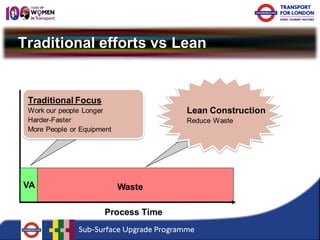
Traditional efforts vs Lean 
Process Time 
Waste 
VA 
Traditional Focus Work our people Longer Harder-Faster More People or Equipment 
Lean Construction Reduce Waste
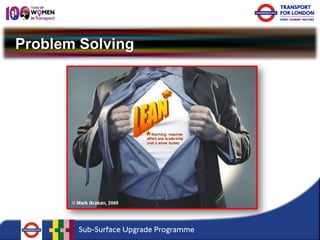
Problem Solving
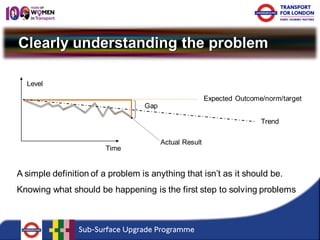
Clearly understanding the problem 
Gap 
Expected Outcome/norm/target 
Actual Result 
Trend 
Time 
Level 
A simple definition of a problem is anything that isn’t as it should be. Knowing what should be happening is the first step to solving problems
Quantify what’s happening 
 
Use a series of bullet points covering facts to demonstrate why you have a problem 
 
State how many / how much / how long 
 
Give factual consequences (Is branding / organisational reputation at stake)? 
 
Include as much evidence as possible 
 
This will provide the justification to resolve the problem
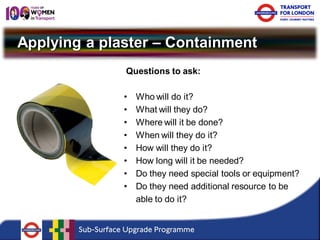
Applying a plaster – Containment 
Questions to ask: 
• 
Who will do it? 
• 
What will they do? 
• 
Where will it be done? 
• 
When will they do it? 
• 
How will they do it? 
• 
How long will it be needed? 
• 
Do they need special tools or equipment? 
• 
Do they need additional resource to be able to do it?
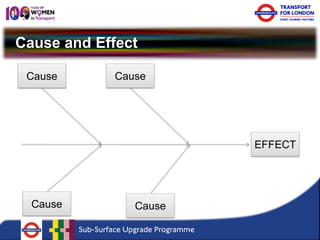
Cause and Effect 
EFFECT 
Cause 
Cause 
Cause 
Cause
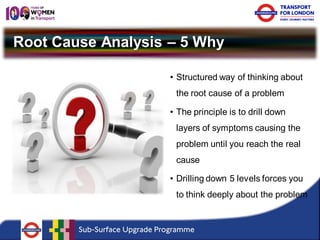
Root Cause Analysis – 5 Why 
• 
Structured way of thinking about the root cause of a problem 
• 
The principle is to drill down layers of symptoms causing the problem until you reach the real cause 
• 
Drilling down 5 levels forces you to think deeply about the problem
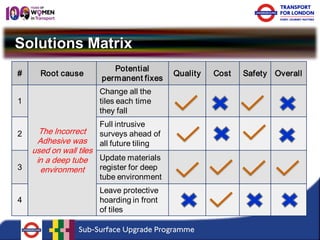
Solutions Matrix 
# 
Root cause 
Potential permanent fixes 
Quality 
Cost 
Safety 
Overall 
1 
The Incorrect Adhesive was used on wall tiles in a deep tube environment 
Change all the tiles each time they fall 
2 
Full intrusive surveys ahead of all future tiling 
3 
Updatematerials register for deep tube environment 
4 
Leave protective hoarding in front of tiles
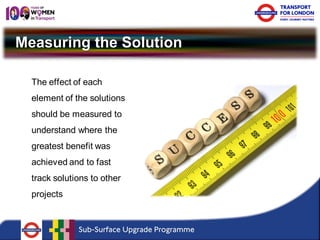
Measuring the Solution 
The effect of each element of the solutions should be measured to understand where the greatest benefit was achieved and to fast track solutions to other projects
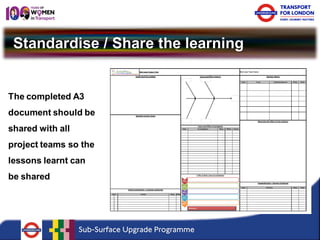
Standardise / Share the learning 
The completed A3 document should be shared with all project teams so the lessons learnt can be shared
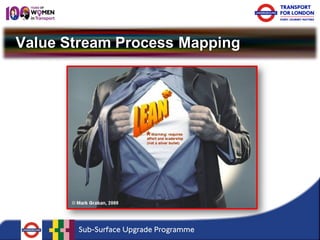
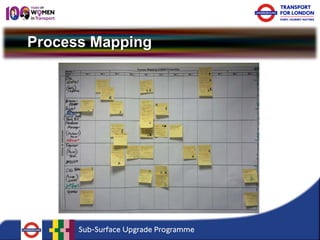
Value Stream Process Mapping
Value Stream Process Mapping 
What is a process? 
• 
A group of activities that grouped together achieve a specific goal 
• 
The essence of project management, Scopes are turned into inputs, work is processed and outputs are produced 
Are they visible and clear to all? 
• 
Often processes are locked inside the heads of our staff 
• 
Issues remain hidden and improvement activities focus on what should be happening rather than what actually is happening
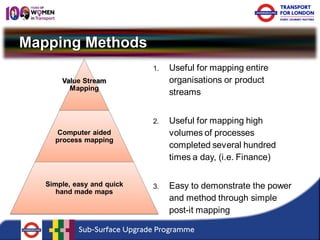
Mapping Methods 
Value Stream Mapping 
Computer aided process mapping 
Simple, easy and quick hand made maps 
1. 
Useful for mapping entire organisations or product streams 
2. 
Useful for mapping high volumes of processes completed several hundred times a day, (i.e. Finance) 
3. 
Easy to demonstrate the power and method through simple post-it mapping
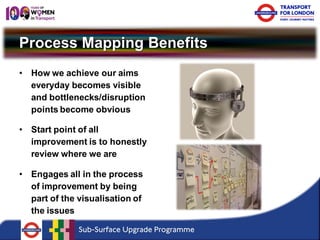
Process Mapping Benefits 
• 
How we achieve our aims everyday becomes visible and bottlenecks/disruption points become obvious 
• 
Start point of all improvement is to honestly review where we are 
• 
Engages all in the process of improvement by being part of the visualisation of the issues
Our Implementation Strategy
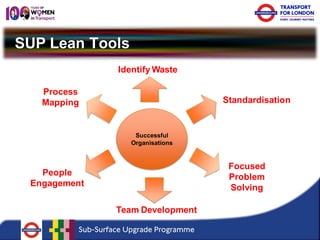
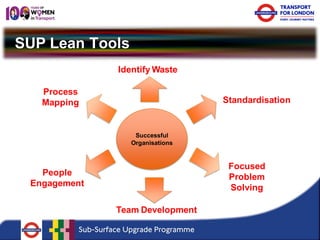
SUP Lean Tools 
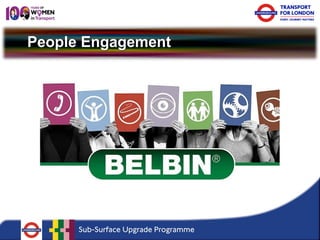
People Engagement 
Focused Problem Solving 
Standardisation 
Successful Organisations 
Identify Waste 
Process Mapping 
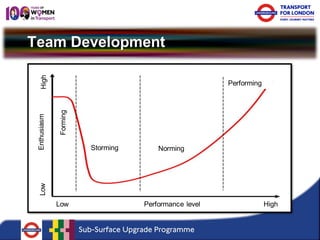
Team Development
Identify Waste
Standardisation
Focused Problem Solving
Team Development 
Storming 
Norming 
Performing 
Forming 
Enthusiasm 
Performance level 
Low 
Low 
High 
High
People Engagement
Process Mapping
SUP Lean Tools 
People Engagement 
Focused Problem Solving 
Standardisation 
Successful Organisations 
Identify Waste 
Process Mapping 
Team Development
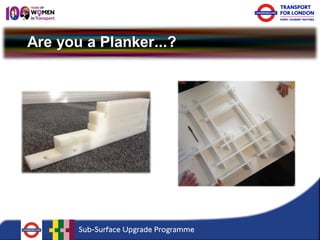
Are you a Planker...?
SUP Lean Course Outcomes
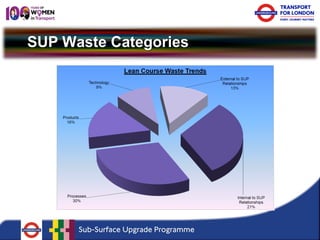
SUP Waste Categories
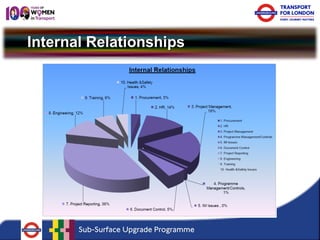
Internal Relationships
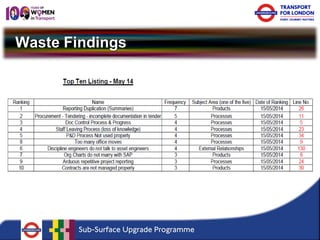
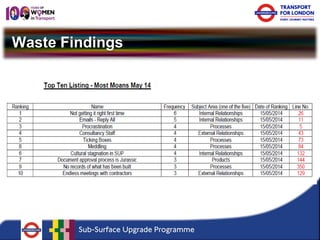
Waste Findings
Waste Findings
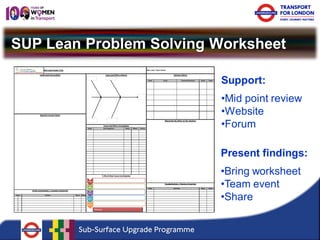
SUP Lean Problem Solving Worksheet 
Support: 
• 
Mid point review 
• 
Website 
• 
Forum 
Present findings: 
• 
Bring worksheet 
• 
Team event 
• 
Share
Problem Solving Success Factors 
We can now : 
• 
Clarify the problem BEFORE jumping into action 
• 
Establish what has gone wrong and why 
• 
Understand the Root Cause of the issue 
• 
Understand what’s missing / gone wrong with our process 
• 
Propose a change to the process that will prevent this happening again 
• 
Share our experience with the rest of the business
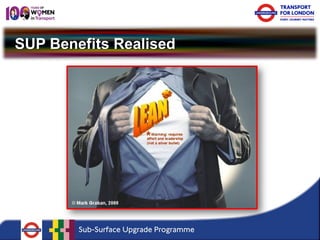
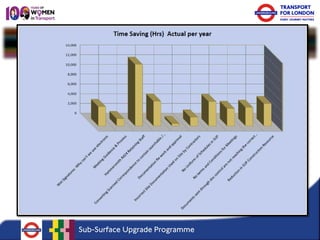
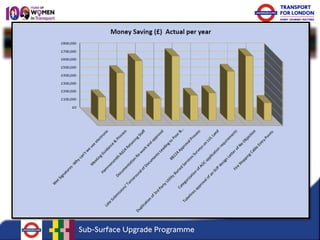
SUP Benefits Realised
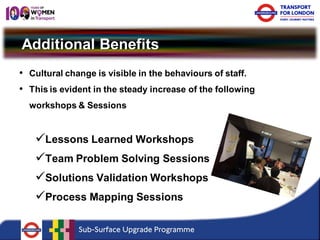
Additional Benefits 
• 
Cultural change is visible in the behaviours of staff. 
• 
This is evident in the steady increase of the following workshops & Sessions 
 
Lessons Learned Workshops 
 
Team Problem Solving Sessions 
 
Solutions Validation Workshops 
 
Process Mapping Sessions
SUP Lean - Summary 
1. 
Engage with staff to ensure everyone is aligned to your purpose 
2. 
Use engaging team methodologies with an initial focus on “what’s in it for me” to motivate and encourage people to talk 
3. 
Have a period of review and be clear what success looks like before you start 
4. 
Use process mapping to provide visibility of how your organisation does things 
5. 
When tackling problems, avoid making assumptions and following pre- conceived ideas – let the facts guide you 
6. 
Share, share and share! Success and real improvements will always be embraced by staff
Questions?
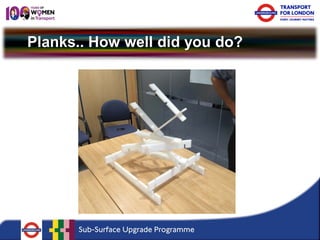
Planks.. How well did you do?
Presentation Close
16 October 2006 61

Changing culture and building efficiencies by applying the Lean principles to your/our organisation

  • 1.
  • 2.
    Reducing Waste –London Underground Chris Samson Dan Rahamim
  • 3.
    Presentation Agenda Whatthe session will cover: • Understand the principles of Lean practices • Be confident leading problem solving exercises • Become familiar with Value Stream Mapping • How SUP implemented these principles • SUP benefits realised What you will take away (how we): •Identify and minimise practices that waste money and time •Measure business improvements •Motivate employees and encourage cross-organisation participation •Knowledge sharing methods leading to better performance.
  • 4.
    Who we are The Sub-Surface Railway Upgrade Programme (SUP) is the largest, most complex modernisation of a live, operational railway ever undertaken by London Underground.
  • 5.
    Where we were This is essentially the idea behind the SUP Lean Programme. Many of our processes are paper based which can be infuriating, take weeks and doesn’t always add to the value of the end product.
  • 6.
    Where we’re going Our aim: Be the best. Our belief: One Team. One Programme. Our vision: Achieving our deliverables with pride, passion and courage.
  • 7.
    What we’re doing • Value Management Principles allowing us to:  Empower staff through team efforts  Provide staff the skill to identify and reduce waste  Create a spirit of continuous improvement (Visibility of our processes)  Motivate staff to be the best and buy into the ethos
  • 8.
    How we’re gettingthere Internally delivered in house Internally delivered external location Externally delivered in house Externally delivered external location
  • 9.
  • 10.
    Development Plan • Create buy in from start • Built on success in our Stations team • Delivered in house and rolled out weekly • Multi discipline groups • Used previous supplier
  • 11.
    Session Plan • 3 day session (reduced from 9 days) • Rolled out weekly • Teach or Facilitate? • Multi discipline groups • Post course project
  • 12.
    Delivery Plan • Develop the course & delivery plan • Duration • Content was bespoke and aligned to our needs • 500+ staff to go through the intervention • Internal delivery allowed a flexible roll out • What happens post the session?
  • 13.
    Post Delivery • Post Course Project • Problem that impacts on the immediate team • Idea of cost and time savings • Tackle something within your control • 6 Week timeline to complete • Present findings to the Senior Management Team
  • 14.
    What is Lean? “Lean is a way of thinking about reducing waste and driving efficiency throughout an entire organisation from the bottom up” Lean is about teaching staff to see the waste others cannot see Improving staffs accountability and world class behaviours in an environment of change sponsored from the top
  • 15.
    Simply put... Reducingthe complexity, twists and turns of our business
  • 16.
    5 Lean Principles 1. Identify Value 2. Map the ‘Value Stream’ 3. Create Flow 4. Establish Pull 5. Seek Perfection
  • 17.
    Value Unavoidable withcurrent technology or methods. Any work carried out that does not increase value to the customer. Non-Value Added but Essential, NVA-BE Any step which changes the Fit, Form, Function or Readiness of the product/service, in line with customer needs. Value Added, VA All other meaningless, non-essential activities that do not add value. Waste
  • 18.
    Available Route PurchaseTicket Board Train Destination Arrival Value Stream Information / material / people product or service valued by the customer
  • 19.
    Flow Definition Feasibility Concept Design Detailed Design Delivery • Our processes should flow into each other without the need for rework or correction Definition Feasibility Concept Design Detailed Design Delivery Start Finish
  • 20.
    Pull (and Push) • Do only what the customer requires when the customer requires it • Decreases stock stored between stages • Improves communication between departments • Team can rapidly respond to changes in customer demand • Make whatever you like and hope the customer buys it • Needs a lot of stock to predict customer demand • Team cannot change to ‘off menu’ customer needs
  • 21.
    Perfection Current State Future State Next Future State Original State  There is always more waste  People learn and exercise more creativity through doing  Involving staff in the process creates ownership and helps management ‘get out of the way’ of improvements
  • 22.
    Traditional efforts vsLean Process Time Waste VA Traditional Focus Work our people Longer Harder-Faster More People or Equipment Lean Construction Reduce Waste
  • 23.
  • 24.
    Clearly understanding theproblem Gap Expected Outcome/norm/target Actual Result Trend Time Level A simple definition of a problem is anything that isn’t as it should be. Knowing what should be happening is the first step to solving problems
  • 25.
    Quantify what’s happening  Use a series of bullet points covering facts to demonstrate why you have a problem  State how many / how much / how long  Give factual consequences (Is branding / organisational reputation at stake)?  Include as much evidence as possible  This will provide the justification to resolve the problem
  • 26.
    Applying a plaster– Containment Questions to ask: • Who will do it? • What will they do? • Where will it be done? • When will they do it? • How will they do it? • How long will it be needed? • Do they need special tools or equipment? • Do they need additional resource to be able to do it?
  • 27.
    Cause and Effect EFFECT Cause Cause Cause Cause
  • 28.
    Root Cause Analysis– 5 Why • Structured way of thinking about the root cause of a problem • The principle is to drill down layers of symptoms causing the problem until you reach the real cause • Drilling down 5 levels forces you to think deeply about the problem
  • 29.
    Solutions Matrix # Root cause Potential permanent fixes Quality Cost Safety Overall 1 The Incorrect Adhesive was used on wall tiles in a deep tube environment Change all the tiles each time they fall 2 Full intrusive surveys ahead of all future tiling 3 Updatematerials register for deep tube environment 4 Leave protective hoarding in front of tiles
  • 30.
    Measuring the Solution The effect of each element of the solutions should be measured to understand where the greatest benefit was achieved and to fast track solutions to other projects
  • 31.
    Standardise / Sharethe learning The completed A3 document should be shared with all project teams so the lessons learnt can be shared
  • 32.
  • 33.
    Value Stream ProcessMapping What is a process? • A group of activities that grouped together achieve a specific goal • The essence of project management, Scopes are turned into inputs, work is processed and outputs are produced Are they visible and clear to all? • Often processes are locked inside the heads of our staff • Issues remain hidden and improvement activities focus on what should be happening rather than what actually is happening
  • 34.
    Mapping Methods ValueStream Mapping Computer aided process mapping Simple, easy and quick hand made maps 1. Useful for mapping entire organisations or product streams 2. Useful for mapping high volumes of processes completed several hundred times a day, (i.e. Finance) 3. Easy to demonstrate the power and method through simple post-it mapping
  • 35.
    Process Mapping Benefits • How we achieve our aims everyday becomes visible and bottlenecks/disruption points become obvious • Start point of all improvement is to honestly review where we are • Engages all in the process of improvement by being part of the visualisation of the issues
  • 36.
  • 37.
    SUP Lean Tools People Engagement Focused Problem Solving Standardisation Successful Organisations Identify Waste Process Mapping Team Development
  • 38.
  • 39.
  • 40.
  • 41.
    Team Development Storming Norming Performing Forming Enthusiasm Performance level Low Low High High
  • 42.
  • 43.
  • 44.
    SUP Lean Tools People Engagement Focused Problem Solving Standardisation Successful Organisations Identify Waste Process Mapping Team Development
  • 45.
    Are you aPlanker...?
  • 46.
  • 47.
  • 48.
  • 49.
  • 50.
  • 51.
    SUP Lean ProblemSolving Worksheet Support: • Mid point review • Website • Forum Present findings: • Bring worksheet • Team event • Share
  • 52.
    Problem Solving SuccessFactors We can now : • Clarify the problem BEFORE jumping into action • Establish what has gone wrong and why • Understand the Root Cause of the issue • Understand what’s missing / gone wrong with our process • Propose a change to the process that will prevent this happening again • Share our experience with the rest of the business
  • 53.
  • 56.
    Additional Benefits • Cultural change is visible in the behaviours of staff. • This is evident in the steady increase of the following workshops & Sessions  Lessons Learned Workshops  Team Problem Solving Sessions  Solutions Validation Workshops  Process Mapping Sessions
  • 57.
    SUP Lean -Summary 1. Engage with staff to ensure everyone is aligned to your purpose 2. Use engaging team methodologies with an initial focus on “what’s in it for me” to motivate and encourage people to talk 3. Have a period of review and be clear what success looks like before you start 4. Use process mapping to provide visibility of how your organisation does things 5. When tackling problems, avoid making assumptions and following pre- conceived ideas – let the facts guide you 6. Share, share and share! Success and real improvements will always be embraced by staff
  • 58.
  • 59.
    Planks.. How welldid you do?
  • 60.
  • 61.