Lean Concepts and major tools for the journey Brian J. Stawski, C.P.M., CPIM
Sound Advice “ The world we have created is a product of our thinking; it cannot be changed without changing our thinking. ” Albert Einstein
10/20/11 Lean Manufacturing   A systemic approach to manufacturing which is based on the premise that anywhere work is being done; waste is being generated.  Lean manufacturing seeks to organize the system through the identification and elimination of waste.
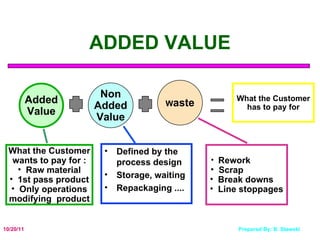
ADDED VALUE Defined by the process design Storage, waiting Repackaging .... W aste Added Value Non Added Value What the Customer has to pay for Rework  Scrap  Break downs  Line stoppages What the Customer wants to pay for : Raw material 1st pass product Only operations modifying  product
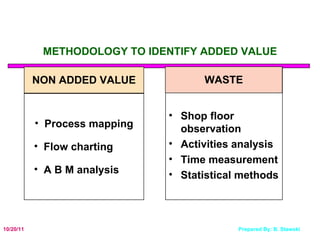
METHODOLOGY TO IDENTIFY ADDED VALUE Shop floor observation Activities analysis Time measurement Statistical methods NON ADDED VALUE Process mapping Flow charting  A B M analysis  WASTE
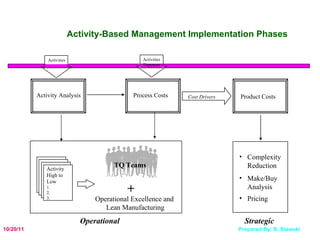
Activity-Based Management Implementation Phases Activity Analysis Process Costs Product Costs + Operational Excellence and  Lean Manufacturing Operational Strategic Complexity Reduction Make/Buy Analysis Pricing Activities Activities Expenses Cost Drivers Activity High to Low 1. 2. 3. TQ Teams
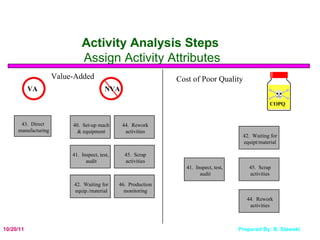
Activity Analysis Steps  Assign Activity Attributes Value-Added Cost of Poor Quality COPQ 43.  Direct  manufacturing VA NVA 40.  Set-up mach & equipment 41.  Inspect, test,  audit 42.  Waiting for equip./material 44.  Rework activities 45.  Scrap activities 46.  Production monitoring 41.  Inspect, test,  audit 42.  Waiting for equipt/material 44.  Rework activities 45.  Scrap activities
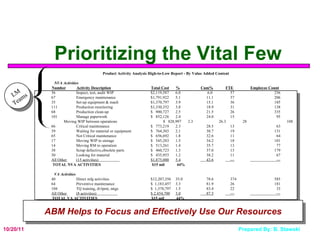
Prioritizing the Vital Few Product Activity Analysis High-to-Low Report - By Value Added Content NVA Activities Number Activity Description Total Cost % Cum% FTE Employee Count   36 Inspect, test, audit WIP $2,119,587 6.0   6.0   57   256 67 Emergency maintenance $1,791,922 5.1   11.1   37   206 35 Set-up equipment & mach $1,370,797 3.9   15.1   36   185 111 Production monitoring $1,330,352 3.8   18.9   31   138 68 Production clean-up $  900,727 2.5   21.5   26   335 101 Manage paperwork $  852,126 2.4   24.0   15   95 16 Moving WIP between operations $  828,997 2.3   26.3   28   108 66 Critical maintenance $  773,219 2.3   28.5   13   63 39 Waiting for material or equipment $  764,303 2.1   30.7   19   131 65 Not Critical maintenance $  656,692 1.8   32.6   11   64 17 Moving WIP to storage $  545,283 1.5   34.2   18   101 14 Moving RM to operation $  513,261 1.4   35.7   13   77 38 Scrap defective,obsolete parts $  460,723 1.3   37.0   13   179 30 Looking for material $  435,953 1.2   38.2   11   67 All Other  (15 activities)  $1,875,000 5.4   43.6   ---   --- TOTAL NVA ACTIVITIES $15 mil 44%   VA Activities   40 Direct mfg activities $12,207,356 35.0   78.6   374   585 64 Preventive maintenance $  1,183,457 3.3   81.9   26   181 104 TQ training, dvlpmt, mtgs $  1,370,797 1.5   83.4   22   33 All Other  (8 activities)  $ 2.454,700 3.0   87.5   ---   --- TOTAL VA ACTIVITIES $15 mil  44%   ALL OTHER ACTIVITIES $ 5 mil 12%   TOTAL ACTIVITIES $35 mil  (Wages, Salary, Fringes, Overtime)   ABM Helps to Focus and Effectively Use Our Resources LM Teams
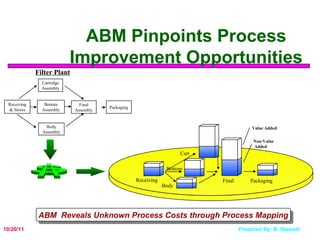
ABM Pinpoints Process Improvement Opportunities Receiving & Stores Bottom Assembly Final Assembly Packaging Body Assembly Cartridge Assembly Filter Plant ABM  Reveals Unknown Process Costs through Process Mapping Final Packaging Receiving Body Cart Bottom Value Added Non-Value Added
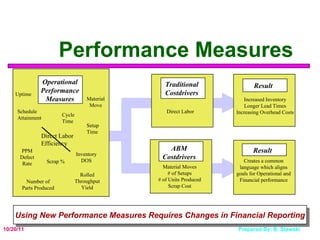
Performance Measures Operational Performance Measures Scrap % Inventory DOS Schedule Attainment Material Move Rolled Throughput Yield PPM Defect Rate Direct Labor Efficiency Number of Parts Produced Cycle Time Setup Time Uptime Direct Labor Material Moves # of Setups # of Units Produced Scrap Cost Increased Inventory Longer Lead Times Increasing Overhead Costs Creates a common language which aligns goals for Operational and Financial performance Traditional Costdrivers ABM Costdrivers Result Result Using New Performance Measures Requires Changes in Financial Reporting
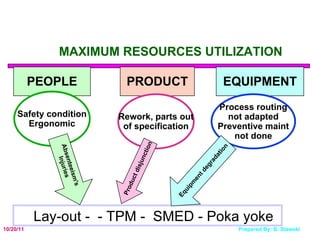
MAXIMUM RESOURCES UTILIZATION Lay-out -  - TPM -  SMED - Poka yoke PEOPLE PRODUCT EQUIPMENT Safety condition Ergonomic Rework, parts out of specification Process routing  not adapted Preventive maint not done Absenteeism's Injuries Equipment degradation Product disjunction
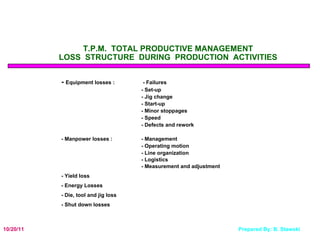
T.P.M.  TOTAL PRODUCTIVE MANAGEMENT LOSS  STRUCTURE  DURING  PRODUCTION  ACTIVITIES -  Equipment losses :   - Failures - Set-up  - Jig change - Start-up - Minor stoppages - Speed - Defects and rework - Manpower losses :  - Management - Operating motion - Line organization - Logistics - Measurement and adjustment - Yield loss  - Energy Losses - Die, tool and jig loss - Shut down losses
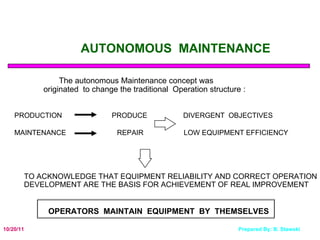
AUTONOMOUS  MAINTENANCE   The autonomous Maintenance concept was  originated  to change the traditional  Operation structure : PRODUCTION   PRODUCE  DIVERGENT  OBJECTIVES MAINTENANCE   REPAIR   LOW EQUIPMENT EFFICIENCY TO ACKNOWLEDGE THAT EQUIPMENT RELIABILITY AND CORRECT OPERATION DEVELOPMENT ARE THE BASIS FOR ACHIEVEMENT OF REAL IMPROVEMENT OPERATORS  MAINTAIN  EQUIPMENT  BY  THEMSELVES
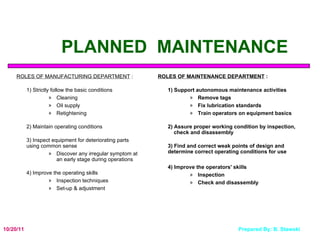
ROLES OF MANUFACTURING DEPARTMENT  : 1) Strictly follow the basic conditions Cleaning Oil supply Retightening 2) Maintain operating conditions 3) Inspect equipment for deteriorating parts using common sense Discover any irregular symptom at an early stage during operations 4) Improve the operating skills Inspection techniques Set-up & adjustment PLANNED  MAINTENANCE ROLES OF MAINTENANCE DEPARTMENT  : 1) Support autonomous maintenance activities Remove tags Fix lubrication standards Train operators on equipment basics 2) Assure proper working condition by inspection,   check and disassembly 3) Find and correct weak points of design and  determine correct operating conditions for use 4) Improve the operators' skills Inspection Check and disassembly
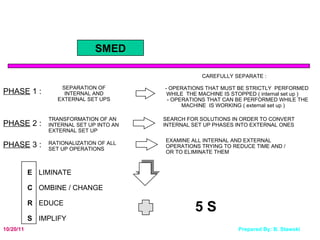
PHASE  1 : SEPARATION OF INTERNAL AND EXTERNAL SET UPS CAREFULLY SEPARATE : - OPERATIONS THAT MUST BE STRICTLY  PERFORMED  WHILE  THE MACHINE IS STOPPED ( internal set up )  - OPERATIONS THAT CAN BE PERFORMED WHILE THE MACHINE  IS WORKING ( external set up ) PHASE  2 : TRANSFORMATION OF AN  INTERNAL SET UP INTO AN EXTERNAL SET UP SEARCH FOR SOLUTIONS IN ORDER TO CONVERT INTERNAL SET UP PHASES INTO EXTERNAL ONES RATIONALIZATION OF ALL SET UP OPERATIONS EXAMINE ALL INTERNAL AND EXTERNAL OPERATIONS TRYING TO REDUCE TIME AND / OR TO ELIMINATE THEM E C R S LIMINATE OMBINE / CHANGE EDUCE IMPLIFY 5 S PHASE  3 : SMED
Waste = MUDA 7 Elements of Waste (MUDA) MUDA of Correction MUDA of Overproduction MUDA of Processing MUDA of Conveyance MUDA of Inventory MUDA of Motion MUDA of Waiting
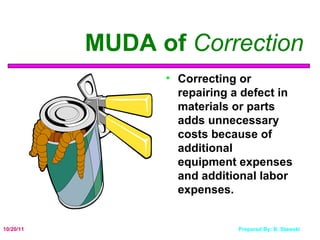
MUDA of  Correction Correcting or repairing a defect in materials or parts adds unnecessary costs because of additional equipment expenses and additional labor expenses.
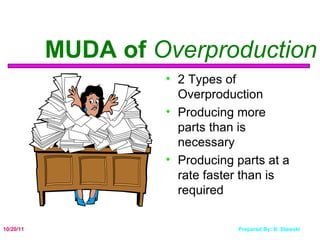
MUDA of  Overproduction 2 Types of Overproduction  Producing more parts than is necessary Producing parts at a rate faster than is  required
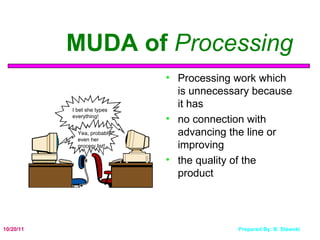
MUDA of  Processing Processing work which is unnecessary because it has no connection with advancing the line or improving the quality of the product I bet she types everything! Yea, probably even her grocery list!
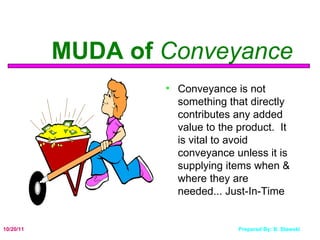
MUDA of  Conveyance Conveyance is not something that directly contributes any added value to the product.  It is vital to avoid conveyance unless it is supplying items when & where they are needed... Just-In-Time
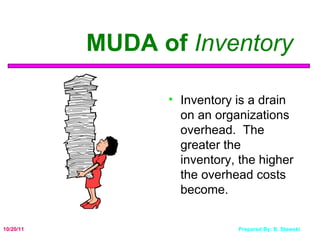
MUDA of  Inventory Inventory is a drain on an organizations overhead.  The greater the inventory, the higher the overhead costs become.
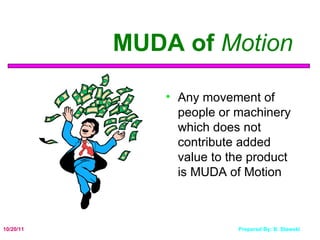
MUDA of  Motion Any movement of people or machinery which does not contribute added value to the product is MUDA of Motion
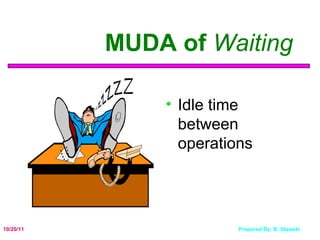
MUDA of  Waiting Idle time between operations
Objectives in Relation to MUDA Defining Waste Identify source of  Waste Planning Required for Elimination Establish permanent control to prevent recurrence
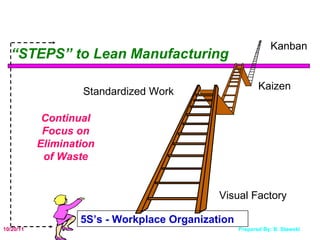
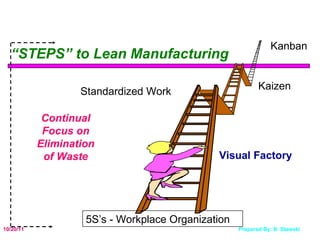
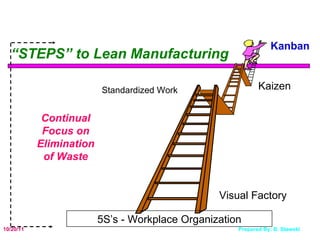
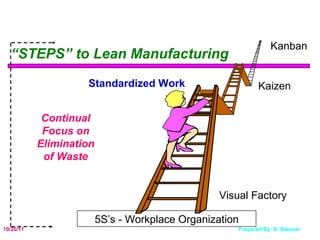
Visual Factory Standardized Work Kaizen Kanban 5S’s - Workplace Organization “ STEPS” to Lean Manufacturing Continual Focus on Elimination of Waste
Like A Rock System can only be as strong as the foundation it is built upon. Establish the 5S Standards with the Understanding that this will be the foundation of your production system.
5S Standards Sifting Identify all items within the wrk area which are not required to perform the manufacturing process -- remove these items from the work area. Sorting Any items identified as ‘required’ must be assigned a specific location -- this location   should be identified by outlining and/or labeling the item and it’s location . Sweeping All grease, irt, et. Must be cleaned, set a new level of cleanliness in our organization -- cleanliness not only provides a safe work area, it also highlights potential problems in the work area. Spic-n-Span The ultimate workplace organization -- this is the acceptable level of sifting, sorting, and sweeping -- are minimum. Self Discipline Individual commitment to the maintenance of 5S standards -- from top down !
Visual Factory Standardized Work Kaizen Kanban 5S’s - Workplace Organization “ STEPS” to Lean Manufacturing Continual Focus on Elimination of Waste
The “ Visual Factory” Take a close look at the process, How easily can you identify… Downtime Issues Scrap Issues Changeover Problems Line Balance Opportunities Excessive Inventory Extraneous Tools/Supplies
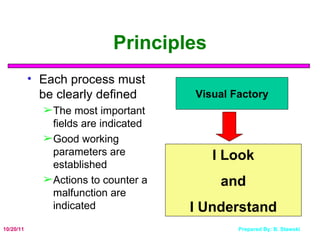
Principles Each process must be clearly defined The most important fields are indicated Good working parameters are established Actions to counter a malfunction are indicated I Look and  I Understand Visual Factory
Visual Factory Standardized Work Kaizen Kanban 5S’s - Workplace Organization “ STEPS” to Lean Manufacturing Continual Focus on Elimination of Waste
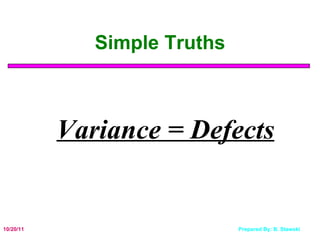
Simple Truths Variance = Defects
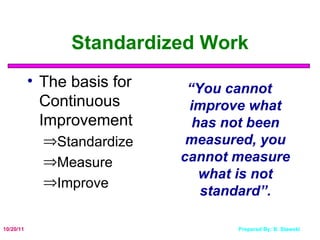
Standardized Work The basis for Continuous Improvement Standardize Measure Improve “ You cannot improve what has not been measured, you cannot measure what is not standard”.
Question: How do you standardize an  operator process? Answer: YOU DON’T !!!
How ? Standardized Work Procedures should be established by the Operators with input from Supervisors. After the ‘one best way’ to perform each operation has been identified and agreed upon through general consensus from the operators; the standard is set. The operators should understand that once they have identified the standard, they will be expected to perform the job according to that standard.
Prerequisites for Standardized Work Availability of required tools Consistent flow of raw material Visual alert of variance in the process Standard in-process stock
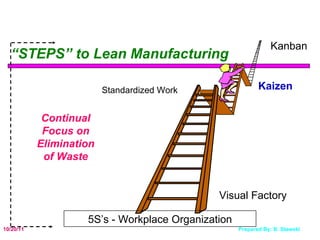
Visual Factory Standardized Work Kaizen Kanban 5S’s - Workplace Organization “ STEPS” to Lean Manufacturing Continual Focus on Elimination of Waste
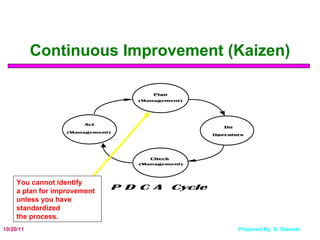
Continuous Improvement (Kaizen) You cannot identify a plan for improvement unless you have standardized the process.
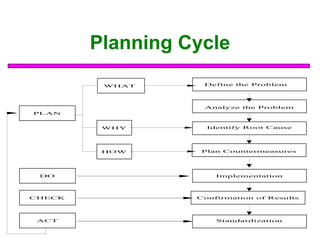
Planning Cycle
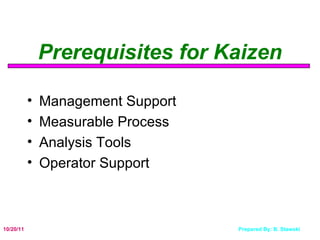
Prerequisites for Kaizen Management Support  Measurable Process Analysis Tools Operator Support
Visual Factory Standardized Work Kaizen Kanban 5S’s - Workplace Organization “ STEPS” to Lean Manufacturing Continual Focus on Elimination of Waste
Kanban The Japanese word which defines a communication signal or card.  A signal to begin work. It is the technique that is used to pull products and material through and into the lean manufacturing system.  It can be a physical signal such as a container or it can be a card.
Preconditions for Successful Kanban Implementation Improve changeover procedures so they can be executed rapidly. The number of parts per Kanban must be standard, and should be kept to as few as possible. Zero defects should be sent to assembly process. Consistent cycle times. Material handlers must be trained in the organization of the transportation system, particularly in techniques for handling mixed loads, routing methods and Kanban rules.
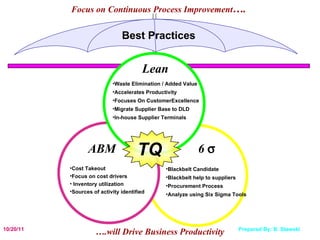
… .will Drive Business Productivity Focus on Continuous Process Improvement …. 6     Cost Takeout Focus on cost drivers Inventory utilization Sources of activity identified Waste Elimination / Added Value Accelerates Productivity Focuses On CustomerExcellence Migrate Supplier Base to DLD In-house Supplier Terminals Blackbelt Candidate  Blackbelt help to suppliers Procurement Process Analyze using Six Sigma Tools TQ Lean ABM Best Practices

Lean Bski Essentials

  • 1.
    Lean Concepts andmajor tools for the journey Brian J. Stawski, C.P.M., CPIM
  • 2.
    Sound Advice “The world we have created is a product of our thinking; it cannot be changed without changing our thinking. ” Albert Einstein
  • 3.
    10/20/11 Lean Manufacturing A systemic approach to manufacturing which is based on the premise that anywhere work is being done; waste is being generated. Lean manufacturing seeks to organize the system through the identification and elimination of waste.
  • 4.
    ADDED VALUE Definedby the process design Storage, waiting Repackaging .... W aste Added Value Non Added Value What the Customer has to pay for Rework Scrap Break downs Line stoppages What the Customer wants to pay for : Raw material 1st pass product Only operations modifying product
  • 5.
    METHODOLOGY TO IDENTIFYADDED VALUE Shop floor observation Activities analysis Time measurement Statistical methods NON ADDED VALUE Process mapping Flow charting A B M analysis WASTE
  • 6.
    Activity-Based Management ImplementationPhases Activity Analysis Process Costs Product Costs + Operational Excellence and Lean Manufacturing Operational Strategic Complexity Reduction Make/Buy Analysis Pricing Activities Activities Expenses Cost Drivers Activity High to Low 1. 2. 3. TQ Teams
  • 7.
    Activity Analysis Steps Assign Activity Attributes Value-Added Cost of Poor Quality COPQ 43. Direct manufacturing VA NVA 40. Set-up mach & equipment 41. Inspect, test, audit 42. Waiting for equip./material 44. Rework activities 45. Scrap activities 46. Production monitoring 41. Inspect, test, audit 42. Waiting for equipt/material 44. Rework activities 45. Scrap activities
  • 8.
    Prioritizing the VitalFew Product Activity Analysis High-to-Low Report - By Value Added Content NVA Activities Number Activity Description Total Cost % Cum% FTE Employee Count 36 Inspect, test, audit WIP $2,119,587 6.0 6.0 57 256 67 Emergency maintenance $1,791,922 5.1 11.1 37 206 35 Set-up equipment & mach $1,370,797 3.9 15.1 36 185 111 Production monitoring $1,330,352 3.8 18.9 31 138 68 Production clean-up $ 900,727 2.5 21.5 26 335 101 Manage paperwork $ 852,126 2.4 24.0 15 95 16 Moving WIP between operations $ 828,997 2.3 26.3 28 108 66 Critical maintenance $ 773,219 2.3 28.5 13 63 39 Waiting for material or equipment $ 764,303 2.1 30.7 19 131 65 Not Critical maintenance $ 656,692 1.8 32.6 11 64 17 Moving WIP to storage $ 545,283 1.5 34.2 18 101 14 Moving RM to operation $ 513,261 1.4 35.7 13 77 38 Scrap defective,obsolete parts $ 460,723 1.3 37.0 13 179 30 Looking for material $ 435,953 1.2 38.2 11 67 All Other (15 activities) $1,875,000 5.4 43.6 --- --- TOTAL NVA ACTIVITIES $15 mil 44% VA Activities 40 Direct mfg activities $12,207,356 35.0 78.6 374 585 64 Preventive maintenance $ 1,183,457 3.3 81.9 26 181 104 TQ training, dvlpmt, mtgs $ 1,370,797 1.5 83.4 22 33 All Other (8 activities) $ 2.454,700 3.0 87.5 --- --- TOTAL VA ACTIVITIES $15 mil 44% ALL OTHER ACTIVITIES $ 5 mil 12% TOTAL ACTIVITIES $35 mil (Wages, Salary, Fringes, Overtime) ABM Helps to Focus and Effectively Use Our Resources LM Teams
  • 9.
    ABM Pinpoints ProcessImprovement Opportunities Receiving & Stores Bottom Assembly Final Assembly Packaging Body Assembly Cartridge Assembly Filter Plant ABM Reveals Unknown Process Costs through Process Mapping Final Packaging Receiving Body Cart Bottom Value Added Non-Value Added
  • 10.
    Performance Measures OperationalPerformance Measures Scrap % Inventory DOS Schedule Attainment Material Move Rolled Throughput Yield PPM Defect Rate Direct Labor Efficiency Number of Parts Produced Cycle Time Setup Time Uptime Direct Labor Material Moves # of Setups # of Units Produced Scrap Cost Increased Inventory Longer Lead Times Increasing Overhead Costs Creates a common language which aligns goals for Operational and Financial performance Traditional Costdrivers ABM Costdrivers Result Result Using New Performance Measures Requires Changes in Financial Reporting
  • 11.
    MAXIMUM RESOURCES UTILIZATIONLay-out - - TPM - SMED - Poka yoke PEOPLE PRODUCT EQUIPMENT Safety condition Ergonomic Rework, parts out of specification Process routing not adapted Preventive maint not done Absenteeism's Injuries Equipment degradation Product disjunction
  • 12.
    T.P.M. TOTALPRODUCTIVE MANAGEMENT LOSS STRUCTURE DURING PRODUCTION ACTIVITIES - Equipment losses : - Failures - Set-up - Jig change - Start-up - Minor stoppages - Speed - Defects and rework - Manpower losses : - Management - Operating motion - Line organization - Logistics - Measurement and adjustment - Yield loss - Energy Losses - Die, tool and jig loss - Shut down losses
  • 13.
    AUTONOMOUS MAINTENANCE The autonomous Maintenance concept was originated to change the traditional Operation structure : PRODUCTION PRODUCE DIVERGENT OBJECTIVES MAINTENANCE REPAIR LOW EQUIPMENT EFFICIENCY TO ACKNOWLEDGE THAT EQUIPMENT RELIABILITY AND CORRECT OPERATION DEVELOPMENT ARE THE BASIS FOR ACHIEVEMENT OF REAL IMPROVEMENT OPERATORS MAINTAIN EQUIPMENT BY THEMSELVES
  • 14.
    ROLES OF MANUFACTURINGDEPARTMENT : 1) Strictly follow the basic conditions Cleaning Oil supply Retightening 2) Maintain operating conditions 3) Inspect equipment for deteriorating parts using common sense Discover any irregular symptom at an early stage during operations 4) Improve the operating skills Inspection techniques Set-up & adjustment PLANNED MAINTENANCE ROLES OF MAINTENANCE DEPARTMENT : 1) Support autonomous maintenance activities Remove tags Fix lubrication standards Train operators on equipment basics 2) Assure proper working condition by inspection, check and disassembly 3) Find and correct weak points of design and determine correct operating conditions for use 4) Improve the operators' skills Inspection Check and disassembly
  • 15.
    PHASE 1: SEPARATION OF INTERNAL AND EXTERNAL SET UPS CAREFULLY SEPARATE : - OPERATIONS THAT MUST BE STRICTLY PERFORMED WHILE THE MACHINE IS STOPPED ( internal set up ) - OPERATIONS THAT CAN BE PERFORMED WHILE THE MACHINE IS WORKING ( external set up ) PHASE 2 : TRANSFORMATION OF AN INTERNAL SET UP INTO AN EXTERNAL SET UP SEARCH FOR SOLUTIONS IN ORDER TO CONVERT INTERNAL SET UP PHASES INTO EXTERNAL ONES RATIONALIZATION OF ALL SET UP OPERATIONS EXAMINE ALL INTERNAL AND EXTERNAL OPERATIONS TRYING TO REDUCE TIME AND / OR TO ELIMINATE THEM E C R S LIMINATE OMBINE / CHANGE EDUCE IMPLIFY 5 S PHASE 3 : SMED
  • 16.
    Waste = MUDA7 Elements of Waste (MUDA) MUDA of Correction MUDA of Overproduction MUDA of Processing MUDA of Conveyance MUDA of Inventory MUDA of Motion MUDA of Waiting
  • 17.
    MUDA of Correction Correcting or repairing a defect in materials or parts adds unnecessary costs because of additional equipment expenses and additional labor expenses.
  • 18.
    MUDA of Overproduction 2 Types of Overproduction Producing more parts than is necessary Producing parts at a rate faster than is required
  • 19.
    MUDA of Processing Processing work which is unnecessary because it has no connection with advancing the line or improving the quality of the product I bet she types everything! Yea, probably even her grocery list!
  • 20.
    MUDA of Conveyance Conveyance is not something that directly contributes any added value to the product. It is vital to avoid conveyance unless it is supplying items when & where they are needed... Just-In-Time
  • 21.
    MUDA of Inventory Inventory is a drain on an organizations overhead. The greater the inventory, the higher the overhead costs become.
  • 22.
    MUDA of Motion Any movement of people or machinery which does not contribute added value to the product is MUDA of Motion
  • 23.
    MUDA of Waiting Idle time between operations
  • 24.
    Objectives in Relationto MUDA Defining Waste Identify source of Waste Planning Required for Elimination Establish permanent control to prevent recurrence
  • 25.
    Visual Factory StandardizedWork Kaizen Kanban 5S’s - Workplace Organization “ STEPS” to Lean Manufacturing Continual Focus on Elimination of Waste
  • 26.
    Like A RockSystem can only be as strong as the foundation it is built upon. Establish the 5S Standards with the Understanding that this will be the foundation of your production system.
  • 27.
    5S Standards SiftingIdentify all items within the wrk area which are not required to perform the manufacturing process -- remove these items from the work area. Sorting Any items identified as ‘required’ must be assigned a specific location -- this location should be identified by outlining and/or labeling the item and it’s location . Sweeping All grease, irt, et. Must be cleaned, set a new level of cleanliness in our organization -- cleanliness not only provides a safe work area, it also highlights potential problems in the work area. Spic-n-Span The ultimate workplace organization -- this is the acceptable level of sifting, sorting, and sweeping -- are minimum. Self Discipline Individual commitment to the maintenance of 5S standards -- from top down !
  • 28.
    Visual Factory StandardizedWork Kaizen Kanban 5S’s - Workplace Organization “ STEPS” to Lean Manufacturing Continual Focus on Elimination of Waste
  • 29.
    The “ VisualFactory” Take a close look at the process, How easily can you identify… Downtime Issues Scrap Issues Changeover Problems Line Balance Opportunities Excessive Inventory Extraneous Tools/Supplies
  • 30.
    Principles Each processmust be clearly defined The most important fields are indicated Good working parameters are established Actions to counter a malfunction are indicated I Look and I Understand Visual Factory
  • 31.
    Visual Factory StandardizedWork Kaizen Kanban 5S’s - Workplace Organization “ STEPS” to Lean Manufacturing Continual Focus on Elimination of Waste
  • 32.
  • 33.
    Standardized Work Thebasis for Continuous Improvement Standardize Measure Improve “ You cannot improve what has not been measured, you cannot measure what is not standard”.
  • 34.
    Question: How doyou standardize an operator process? Answer: YOU DON’T !!!
  • 35.
    How ? StandardizedWork Procedures should be established by the Operators with input from Supervisors. After the ‘one best way’ to perform each operation has been identified and agreed upon through general consensus from the operators; the standard is set. The operators should understand that once they have identified the standard, they will be expected to perform the job according to that standard.
  • 36.
    Prerequisites for StandardizedWork Availability of required tools Consistent flow of raw material Visual alert of variance in the process Standard in-process stock
  • 37.
    Visual Factory StandardizedWork Kaizen Kanban 5S’s - Workplace Organization “ STEPS” to Lean Manufacturing Continual Focus on Elimination of Waste
  • 38.
    Continuous Improvement (Kaizen)You cannot identify a plan for improvement unless you have standardized the process.
  • 39.
  • 40.
    Prerequisites for KaizenManagement Support Measurable Process Analysis Tools Operator Support
  • 41.
    Visual Factory StandardizedWork Kaizen Kanban 5S’s - Workplace Organization “ STEPS” to Lean Manufacturing Continual Focus on Elimination of Waste
  • 42.
    Kanban The Japaneseword which defines a communication signal or card. A signal to begin work. It is the technique that is used to pull products and material through and into the lean manufacturing system. It can be a physical signal such as a container or it can be a card.
  • 43.
    Preconditions for SuccessfulKanban Implementation Improve changeover procedures so they can be executed rapidly. The number of parts per Kanban must be standard, and should be kept to as few as possible. Zero defects should be sent to assembly process. Consistent cycle times. Material handlers must be trained in the organization of the transportation system, particularly in techniques for handling mixed loads, routing methods and Kanban rules.
  • 44.
    … .will DriveBusiness Productivity Focus on Continuous Process Improvement …. 6  Cost Takeout Focus on cost drivers Inventory utilization Sources of activity identified Waste Elimination / Added Value Accelerates Productivity Focuses On CustomerExcellence Migrate Supplier Base to DLD In-house Supplier Terminals Blackbelt Candidate Blackbelt help to suppliers Procurement Process Analyze using Six Sigma Tools TQ Lean ABM Best Practices

Editor's Notes

  • #4 Lean Manufacturing provides a vehicle for waste elimination. The goal of Lean Manufacturing is to totally eliminate all waste from the system. This goal while being unrealistic in practical application sets the stage for continuous improvement. It is necessary to understand that the inherent nature of continuous improvement philosophy is de-motivational for operators, undoubtedly the workforce will realize that no matter how hard they work to improve, there will always be another opportunity for improvement. In order to sustain operator enthusiasm toward waste reduction, it is important to recognize and celebrate small successes as they occur.
  • #26 Though out the gradual implementation of Lean Manufacturing, it is vital to maintain focus on the elimination of waste. Each of the 5 Steps to lean manufacturing incorporates specific practices that are required to maintain the next level. It is not possible to move ahead with implementation until the practices have been successfully implemented.
  • #29 Though out the gradual implementation of Lean Manufacturing, it is vital to maintain focus on the elimination of waste. Each of the 5 Steps to lean manufacturing incorporates specific practices that are required to maintain the next level. It is not possible to move ahead with implementation until the practices have been successfully implemented.
  • #32 Though out the gradual implementation of Lean Manufacturing, it is vital to maintain focus on the elimination of waste. Each of the 5 Steps to lean manufacturing incorporates specific practices that are required to maintain the next level. It is not possible to move ahead with implementation until the practices have been successfully implemented.
  • #38 Though out the gradual implementation of Lean Manufacturing, it is vital to maintain focus on the elimination of waste. Each of the 5 Steps to lean manufacturing incorporates specific practices that are required to maintain the next level. It is not possible to move ahead with implementation until the practices have been successfully implemented.
  • #42 Though out the gradual implementation of Lean Manufacturing, it is vital to maintain focus on the elimination of waste. Each of the 5 Steps to lean manufacturing incorporates specific practices that are required to maintain the next level. It is not possible to move ahead with implementation until the practices have been successfully implemented.