CONCEPT
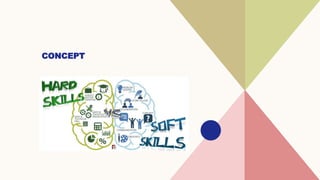
WHAT IS SKILL
Skill is the sum of some qualities required to complete any task successfully.
3
ESSENTIAL SKILLS FOR CAREER
ADVANCEMENT
• Communication
• Goal setting
• Motivation
• Leadership
• Teamwork
• Time Management
4
ACTIVITY
6
GOAL
SMART GOAL
• Specific
• Measurable
• Achievable
• Realistic
• Time Bound
8
ACTIVITY
HABIT
• Write any 5 habits you want to develop for any achievement
• Convert “should” in to “must”
• Our habits put our actions on “auto pilot”
• Success is the product of daily habits – not once in a lifetime
transformation
10
MOTIVATION
12
Complete the sentence with BUT and AND
….
What is Learning??
A mental force that induces an action.
Three types of motivation
1. Biological/ physiological
2. Extrinsic
3. Intrinsic
It is about igniting fire with in you.
This is person’s “WHY”
13
DEFINATION
WORD EFFECT
• Nervous - Excited
• Worrying - Planning
• Mistake - Feedback
• Unbearable - Hard
• Impossible - Difficult
• Problem - Challenge
• Failure - Feedback , learning
• I ‘m a loser - I had a set back
14
• Motivational story reading
• Talk 2 minutes in front of Mirror , ask better question to
your self
• Help others in society.
• Develop Positive mindset
• Yoga and meditation or simple prayer
• Never stop learning
• Celebrate small success
• Tell everyone about your goals and commitment
• Release the brakes – self doubt , self hate, self
defeating, thoughts of limiting beliefs
• 15
HOW TO MOTIVATE YOUR SELF
LEADERSHIP
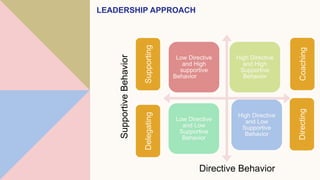
LEADERSHIP APPROACH
Low Directive
and High
supportive
Behavior
High Directive
and High
Supportive
Behavior
Low Directive
and Low
Supportive
Behavior
High Directive
and Low
Supportive
Behavior
Supportive
Behavior
Directive Behavior
Directing
Coaching
Supporting
Delegating
• The team cannot succeed without a Vision
• The Vision must be shared by the Leader with the Team
Members
• The Team must also own the vision to succeed
1. LEADER MUST HAVE A VISION
• If you keep on doing the same old things, you will keep
on getting the same old results
• A leader needs to take risk and challenge to travel that
extra mile and explore the unexplored…
2. LEADER MUST BE ABLE TO
TRAVEL THE UNEXPLORED PATH
• Success is Important, but along with that Failure is equally
important
• It is not failure that counts, but what you do after the failure is
very important… Can you bounce back into action
3. HOW TO MANGE SUCCESS & MOST
IMPORTANTLY FAILURE
• Ineffectiveness is when a leader maintains status quo and
does not makes decisions
• At time a leader needs to make tough decision
4. LEADER MUST HAVE THE COURAGE
TO TAKE THE DECISION
• Every Action of the Leader must be Transparent
• Work with Integrity and Succeed with Integrity
5. NOBILITY IN MANAGEMENT
• A leader when he says “I” it means my “Team”
• Have Trust and Faith in your Team Members
• Appreciate and Acknowledge Team/Members
6. I MEANS MY TEAM
• Rashtrapati Bhuwan was known as People’s Bhuwan
• Always connected with the people
7. LEADER MUST BE APPROACHABLE
• “If you really want to be a leader, then you have to be a coach
rather than a commander, or an advisor rather than a
manager and a representative of your colleagues instead of
becoming a director”
8. THE LEADER MUST BE CREATIVE
The leader Should be the
person who adhere to process..
9. STRONG IN PROCESS :-
• The leader should learn to forgive fellow beings.
• A ordinary leader becomes a great leaders because of
bad/unskilled members in team.
• Eg: Nelson Mandella, Dr. APJ Kalam,
10. FORGIVING QUALITY OF
LEADERSHIP
TRAITS THAT YOU SHOULD HAVE…
• Honest & Sincere
• Care for others
• Strong in processes
• Logical reasoning
• Take ownership
TEAM WORK
•Together
•Everyone
•Achieve
• More
TEAM WORK
The process of working collaboratively with a group of people to
achieve some common goal.
Presentation title
31
SKILLS FOR TEAM WORK
•Communication
•Conflict management
•Listening
•Reliable
•Respect
•Cooperation
32
BENEFITS
•Fosters creativity
•Builds Trust
•Conflict resolution or problem solution
•Encourage healthy risk taking
33
TIME MANAGEMENT
TIME MANAGEMENT ( EISENHOWER MATRIX )
SIMPLE PRACTICE FOR TIME
MANAGEMENT
• Be Intentional : Keep to do list
• Be prioritize : Rank your task
• Be Focused : manage distractions
• Be structured : Time block your work
• Be Self Aware : Balance forward
ACTIVITY
THANK YOU
KHANJAN KADI
9909965218

Essential Skills for career Development.pptx

  • 2.
  • 3.
    WHAT IS SKILL Skillis the sum of some qualities required to complete any task successfully. 3
  • 4.
    ESSENTIAL SKILLS FORCAREER ADVANCEMENT • Communication • Goal setting • Motivation • Leadership • Teamwork • Time Management 4
  • 5.
  • 6.
  • 7.
  • 8.
    SMART GOAL • Specific •Measurable • Achievable • Realistic • Time Bound 8
  • 9.
  • 10.
    HABIT • Write any5 habits you want to develop for any achievement • Convert “should” in to “must” • Our habits put our actions on “auto pilot” • Success is the product of daily habits – not once in a lifetime transformation 10
  • 11.
  • 12.
    12 Complete the sentencewith BUT and AND …. What is Learning??
  • 13.
    A mental forcethat induces an action. Three types of motivation 1. Biological/ physiological 2. Extrinsic 3. Intrinsic It is about igniting fire with in you. This is person’s “WHY” 13 DEFINATION
  • 14.
    WORD EFFECT • Nervous- Excited • Worrying - Planning • Mistake - Feedback • Unbearable - Hard • Impossible - Difficult • Problem - Challenge • Failure - Feedback , learning • I ‘m a loser - I had a set back 14
  • 15.
    • Motivational storyreading • Talk 2 minutes in front of Mirror , ask better question to your self • Help others in society. • Develop Positive mindset • Yoga and meditation or simple prayer • Never stop learning • Celebrate small success • Tell everyone about your goals and commitment • Release the brakes – self doubt , self hate, self defeating, thoughts of limiting beliefs • 15 HOW TO MOTIVATE YOUR SELF
  • 16.
  • 17.
    LEADERSHIP APPROACH Low Directive andHigh supportive Behavior High Directive and High Supportive Behavior Low Directive and Low Supportive Behavior High Directive and Low Supportive Behavior Supportive Behavior Directive Behavior Directing Coaching Supporting Delegating
  • 18.
    • The teamcannot succeed without a Vision • The Vision must be shared by the Leader with the Team Members • The Team must also own the vision to succeed 1. LEADER MUST HAVE A VISION
  • 19.
    • If youkeep on doing the same old things, you will keep on getting the same old results • A leader needs to take risk and challenge to travel that extra mile and explore the unexplored… 2. LEADER MUST BE ABLE TO TRAVEL THE UNEXPLORED PATH
  • 20.
    • Success isImportant, but along with that Failure is equally important • It is not failure that counts, but what you do after the failure is very important… Can you bounce back into action 3. HOW TO MANGE SUCCESS & MOST IMPORTANTLY FAILURE
  • 21.
    • Ineffectiveness iswhen a leader maintains status quo and does not makes decisions • At time a leader needs to make tough decision 4. LEADER MUST HAVE THE COURAGE TO TAKE THE DECISION
  • 22.
    • Every Actionof the Leader must be Transparent • Work with Integrity and Succeed with Integrity 5. NOBILITY IN MANAGEMENT
  • 23.
    • A leaderwhen he says “I” it means my “Team” • Have Trust and Faith in your Team Members • Appreciate and Acknowledge Team/Members 6. I MEANS MY TEAM
  • 24.
    • Rashtrapati Bhuwanwas known as People’s Bhuwan • Always connected with the people 7. LEADER MUST BE APPROACHABLE
  • 25.
    • “If youreally want to be a leader, then you have to be a coach rather than a commander, or an advisor rather than a manager and a representative of your colleagues instead of becoming a director” 8. THE LEADER MUST BE CREATIVE
  • 26.
    The leader Shouldbe the person who adhere to process.. 9. STRONG IN PROCESS :-
  • 27.
    • The leadershould learn to forgive fellow beings. • A ordinary leader becomes a great leaders because of bad/unskilled members in team. • Eg: Nelson Mandella, Dr. APJ Kalam, 10. FORGIVING QUALITY OF LEADERSHIP
  • 28.
    TRAITS THAT YOUSHOULD HAVE… • Honest & Sincere • Care for others • Strong in processes • Logical reasoning • Take ownership
  • 29.
  • 30.
  • 31.
    TEAM WORK The processof working collaboratively with a group of people to achieve some common goal. Presentation title 31
  • 32.
    SKILLS FOR TEAMWORK •Communication •Conflict management •Listening •Reliable •Respect •Cooperation 32
  • 33.
    BENEFITS •Fosters creativity •Builds Trust •Conflictresolution or problem solution •Encourage healthy risk taking 33
  • 34.
  • 35.
    TIME MANAGEMENT (EISENHOWER MATRIX )
  • 36.
    SIMPLE PRACTICE FORTIME MANAGEMENT • Be Intentional : Keep to do list • Be prioritize : Rank your task • Be Focused : manage distractions • Be structured : Time block your work • Be Self Aware : Balance forward
  • 37.
  • 38.