Leading Change Administration
A leader leads from the front by example Leads by building people And leads by creating something that is long lasting S. Ramadorai
Ramadorai on Alignment… “ A  dream without alignment is just theory . A personal goal for each employee aligned to the company's vision: that is how we wish to set the organizational structure . If everybody is not aligned, a vision of being one of the top ten IT companies in the world does not make any sense. Alignment is the key. At the end of the day people must believe in what the organization wants to achieve and be able to see their role within that chain… ……  There is a continuous assessment of how a person is performing vis-à-vis those goals. This assessment evaluates how that goal translates into a competency and how that competency translates into a meaningful deployment in terms of value addition to the self, value addition to the business unit, value addition to the organization .”
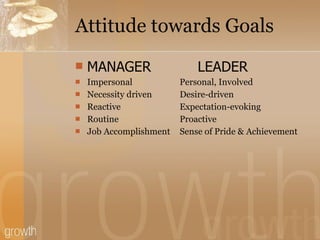
Attitude towards Goals MANAGER   LEADER Impersonal   Personal, Involved Necessity driven   Desire-driven Reactive   Expectation-evoking Routine   Proactive Job Accomplishment   Sense of Pride & Achievement
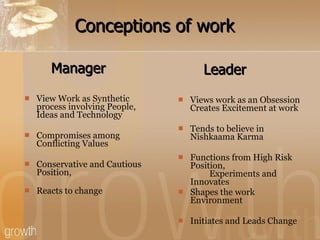
Conceptions of work Manager View Work as Synthetic process involving People, Ideas and Technology  Compromises among Conflicting Values Conservative and Cautious  Position,    Reacts to change    Leader Views work as an Obsession Creates Excitement at work Tends to believe in    Nishkaama Karma   Functions from High Risk Position,  Experiments and Innovates Shapes the work    Environment Initiates and Leads Change
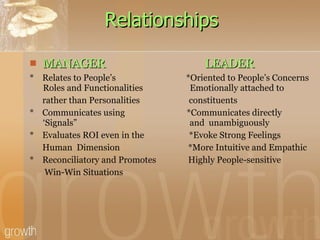
Relationships MANAGER  LEADER *  Relates to People’s  *Oriented to People’s Concerns Roles and Functionalities  Emotionally attached to  rather than Personalities  constituents *  Communicates using  *Communicates directly  ‘Signals”  and  unambiguously *  Evaluates ROI even in the  *Evoke Strong Feelings Human  Dimension  *More Intuitive and Empathic *  Reconciliatory and Promotes  Highly People-sensitive  Win-Win Situations
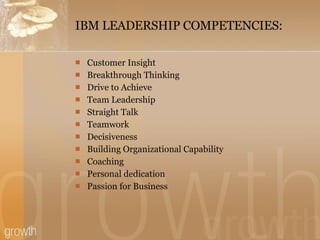
IBM LEADERSHIP COMPETENCIES: Customer Insight Breakthrough Thinking Drive to Achieve Team Leadership Straight Talk Teamwork Decisiveness Building Organizational Capability Coaching Personal dedication Passion for Business
LEADERSHIP COMPETENCIES Organizing Ability Reasoning Ability Power of Expression Effective Intelligence Team Spirit Cooperation Adaptability Liveliness Ability to influence a group Initiative Decision-making ability Sense of Responsibility Drive & Stamina Determination Courage
ETHICS refers to the importance of people and Integrity.   It means caring about people;   being sensitive and of service to them;   and behaving in accordance with moral principles. To strengthen your Ethics orientation: Value and develop teamwork Strive for meaningful work Prioritize good communication and mature commitment Act with integrity and in accordance with your principles
VISION:    A mental image of a possible and desirable future state that is attractive, Credible & realistic in the organizational context. To strengthen your vision orientation: Exercise abstract reasoning Cultivate a Strategic and systemic perspective providing direction and seeing the interrelationships within the big picture Engage your creativity Practice reflection
REALITY Refers to a no-nonsense approach to facing life without illusions, relying on data that is factual rather than emotional; and being tough, task-oriented and results-focused. To develop your Reality orientation: Pay attention to bureaucratic detail Be objective and well-informed  Do what it takes to survive Seek shared reality
COURAGE is defined as taking charge; using power wisely; acting with sustained initiative; managing anxiety; To expand your courage orientation: Advocate and stand for something Be willing to stand alone Constructively experience anxiety Take responsibility for your choices and accept being free
WHY DO PEOPLE FAIL? What are the Symptom I am never wrong The problem is not with me What I do is right Nobody can fault me Arrogance Complacency Contentment We are never wrong The problem is not with us What we do is right Nobody can fault us
This leads to… Tunnel vision Zero creativity Zero innovation Inability to resolve conflicts Inability to produce results
Creating success requires… Clear understanding of goals Developing people Corrective feedback
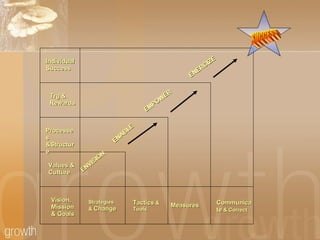
Individual Success Measures Tactics  & Tools Strategies &  Change   Vision, Mission & Goals Values & Culture Processes &Structure Trg & Rewards Communicate  & Correct ENVISION ENABLE EMPOWER ENERGIZE SUCCESS
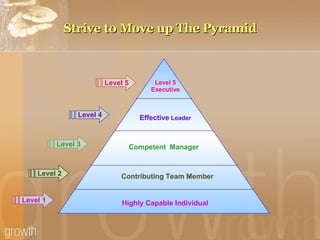
Strive to Move up The Pyramid Level 5 Executive Highly Capable Individual Contributing Team Member Competent  Manager Effective  Leader Level 5 Level 4 Level 3 Level 2 Level 1
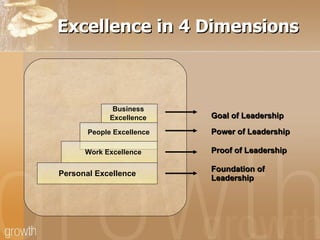
Excellence in 4 Dimensions Personal Excellence Business  Excellence   People Excellence Work Excellence Goal of Leadership Power of Leadership Proof of Leadership Foundation of Leadership
Developing People HOW TO BUILD PERSONAL POWER? Focusing in your circle of influence give you the following ability which demonstrate your courage, conviction, knowledge & expertise: Ability to willingly accept challenges and take risks for the cause you believe in or to protect others Ability to earn what you want rather than to plead or beg Willingness to pay the required price and not to expect anything free Courage to allow people to take their own decisions and not to treat them like an enemy when they disagree Ability to observe and learn Contd….
Developing People HOW TO BUILD PERSONAL POWER? Ability not to sulk Ability to think big Ability to make a difficult task look easy, exciting , achievable and fun Ability to take pride in your achievements and what you have rather than being ashamed of what you don’t have Ability to articulate with passion Contd…..
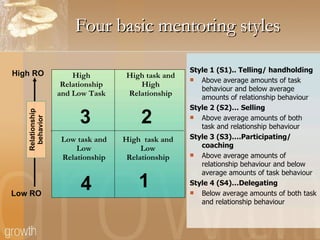
Four basic mentoring styles Style 1 (S1).. Telling/ handholding   Above average amounts of task behaviour and below average amounts of relationship behaviour Style 2 (S2)… Selling Above average amounts of both task and relationship behaviour Style 3 (S3)….Participating/ coaching Above average amounts of relationship behaviour and below average amounts of task behaviour Style 4 (S4)…Delegating Below average amounts of both task and relationship behaviour Relationship behavior High Relationship and Low Task 3 1 4 2 High  task and Low Relationship High task and High Relationship Low task and Low Relationship High RO Low RO
Rules of giving feedback Feedback must be given regularly- on the job  A daily feedback is the best If not, a weekly feedback is a must Feedback must be given instantaneously … a delayed feedback is not feedback at all A Feedback should not be critical of the person…it is critical of the task Feedback should never come with a threat.. It must always be friendly
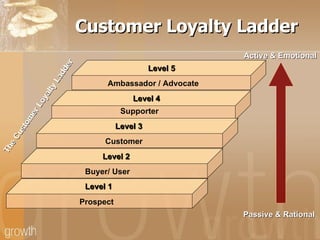
Customer Loyalty Ladder Level 5 Level 4 Level 3 Level 2 Level 1 Ambassador / Advocate  Prospect  Supporter  Customer  Buyer/ User The Customer Loyalty Ladder Passive & Rational Active & Emotional
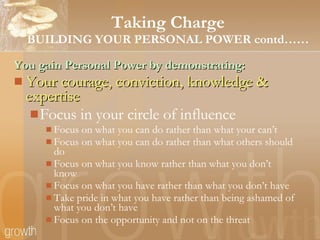
Taking Charge BUILDING YOUR PERSONAL POWER contd…… You gain Personal Power by demonstrating: Your courage, conviction, knowledge & expertise Focus in your circle of influence Focus on what you can do rather than what your can’t Focus on what you can do rather than what others should do Focus on what you know rather than what you don’t know Focus on what you have rather than what you don’t have Take pride in what you have rather than being ashamed of what you don’t have Focus on the opportunity and not on the threat
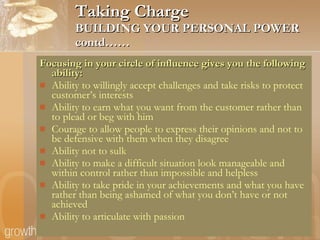
Taking Charge BUILDING YOUR PERSONAL POWER contd…… Focusing in your circle of influence gives you the following ability: Ability to willingly accept challenges and take risks to protect customer’s interests Ability to earn what you want from the customer rather than to plead or beg with him Courage to allow people to express their opinions and not to be defensive with them when they disagree Ability not to sulk  Ability to make a difficult situation look manageable and within control rather than impossible and helpless Ability to take pride in your achievements and what you have rather than being ashamed of what you don’t have or not achieved Ability to articulate with passion
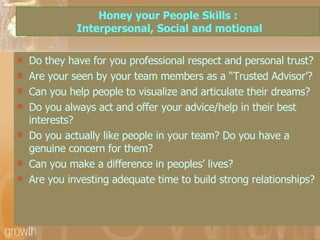
Honey your People Skills :  Interpersonal, Social and motional Do they have for you professional respect and personal trust? Are your seen by your team members as a “Trusted Advisor’? Can you help people to visualize and articulate their dreams? Do you always act and offer your advice/help in their best interests? Do you actually like people in your team? Do you have a genuine concern for them? Can you make a difference in peoples’ lives? Are you investing adequate time to build strong relationships?
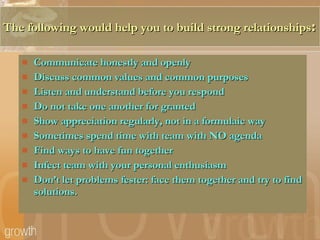
The following would help you to build strong relationships : Communicate honestly and openly Discuss common values and common purposes Listen and understand before you respond Do not take one another for granted Show appreciation regularly, not in a formulaic way Sometimes spend time with team with NO agenda Find ways to have fun together Infect team with your personal enthusiasm Don’t let problems fester: face them together and try to find solutions.
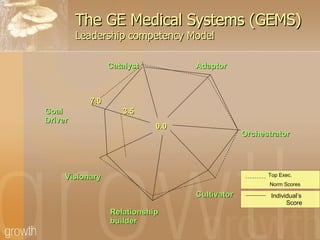
The GE Medical Systems (GEMS) Leadership competency Model Individual’s  ‘   Score Top Exec. Norm Scores Catalyst Orchestrator Adaptor Cultivator Relationship builder Visionary Goal Driver 7.0 3.5 0.0
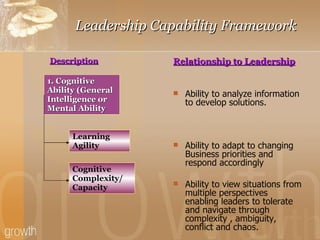
Leadership Capability Framework Relationship to Leadership Ability to analyze information to develop solutions. Ability to adapt to changing Business priorities and respond accordingly Ability to view situations from multiple perspectives enabling leaders to tolerate and navigate through complexity , ambiguity, conflict and chaos. 1. Cognitive Ability (General Intelligence or Mental Ability Learning Agility Cognitive Complexity/ Capacity Description
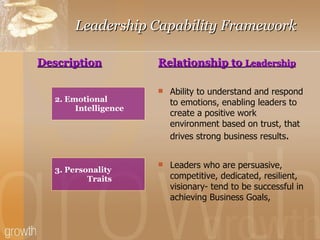
Leadership Capability Framework Description Relationship to  Leadership Ability to understand and respond to emotions, enabling leaders to create a positive work environment based on trust, that drives strong business results . Leaders who are persuasive, competitive, dedicated, resilient, visionary- tend to be successful in achieving Business Goals, 2. Emotional  Intelligence 3. Personality  Traits
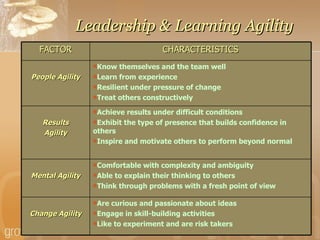
Leadership & Learning Agility Are curious and passionate about ideas Engage in skill-building activities Like to experiment and are risk takers Change Agility Comfortable with complexity and ambiguity Able to explain their thinking to others Think through problems with a fresh point of view Mental Agility Achieve results under difficult conditions Exhibit the type of presence that builds confidence in others Inspire and motivate others to perform beyond normal Results Agility Know themselves and the team well Learn from experience Resilient under pressure of change Treat others constructively People Agility CHARACTERISTICS FACTOR
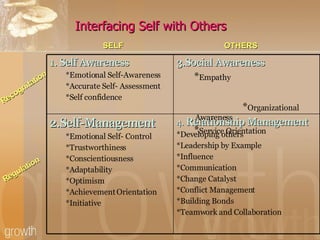
Interfacing Self with Others Recognitation Regulation SELF OTHERS 4.   Relationship Management *Developing others *Leadership by Example *Influence *Communication *Change Catalyst *Conflict Management *Building Bonds *Teamwork and Collaboration 2.Self-Management *Emotional Self- Control *Trustworthiness *Conscientiousness *Adaptability *Optimism *Achievement Orientation *Initiative 3.Social Awareness * Empathy  * Organizational Awareness * Service Orientation 1.   Self Awareness *Emotional Self-Awareness *Accurate Self- Assessment *Self confidence
Sutra   1 :  Know Your Constituents
Ramadorai on Racing Along … “ A dream is like a hundred- meter race. If you do it in eleven seconds, the next bar is doing it is ten seconds. The next bar is can you go below the ten- second level. The next bar is can you below the ten-second level. There is no stopping, no end of story, no last milestone. Challenges are continuously being set in the organization which is made up of people. A good vision is one where there is a difficult milestone, a stretch milestone, but one which you honestly believe is possible if you put the right teams in place, the right leadership in place, and it addresses the needs of the customer…. To us, and to me personally, a vision is a moving target and a target you set for yourself. It has to be a very aggressive target because that is when people   believe we can achieve the impossible.”
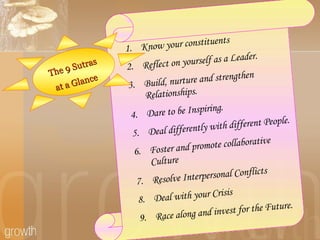
Know your constituents Reflect on yourself as a Leader. Build, nurture and strengthen Relationships. Dare to be Inspiring. Deal differently with different People. Foster and promote collaborative Culture Resolve Interpersonal Conflicts Deal with your Crisis Race along and invest for the Future. The 9 Sutras at a Glance
Thank You

Leader ship laws

  • 1.
  • 2.
    A leader leadsfrom the front by example Leads by building people And leads by creating something that is long lasting S. Ramadorai
  • 3.
    Ramadorai on Alignment…“ A dream without alignment is just theory . A personal goal for each employee aligned to the company's vision: that is how we wish to set the organizational structure . If everybody is not aligned, a vision of being one of the top ten IT companies in the world does not make any sense. Alignment is the key. At the end of the day people must believe in what the organization wants to achieve and be able to see their role within that chain… …… There is a continuous assessment of how a person is performing vis-à-vis those goals. This assessment evaluates how that goal translates into a competency and how that competency translates into a meaningful deployment in terms of value addition to the self, value addition to the business unit, value addition to the organization .”
  • 4.
    Attitude towards GoalsMANAGER LEADER Impersonal Personal, Involved Necessity driven Desire-driven Reactive Expectation-evoking Routine Proactive Job Accomplishment Sense of Pride & Achievement
  • 5.
    Conceptions of workManager View Work as Synthetic process involving People, Ideas and Technology Compromises among Conflicting Values Conservative and Cautious Position, Reacts to change Leader Views work as an Obsession Creates Excitement at work Tends to believe in Nishkaama Karma Functions from High Risk Position, Experiments and Innovates Shapes the work Environment Initiates and Leads Change
  • 6.
    Relationships MANAGER LEADER * Relates to People’s *Oriented to People’s Concerns Roles and Functionalities Emotionally attached to rather than Personalities constituents * Communicates using *Communicates directly ‘Signals” and unambiguously * Evaluates ROI even in the *Evoke Strong Feelings Human Dimension *More Intuitive and Empathic * Reconciliatory and Promotes Highly People-sensitive Win-Win Situations
  • 7.
    IBM LEADERSHIP COMPETENCIES:Customer Insight Breakthrough Thinking Drive to Achieve Team Leadership Straight Talk Teamwork Decisiveness Building Organizational Capability Coaching Personal dedication Passion for Business
  • 8.
    LEADERSHIP COMPETENCIES OrganizingAbility Reasoning Ability Power of Expression Effective Intelligence Team Spirit Cooperation Adaptability Liveliness Ability to influence a group Initiative Decision-making ability Sense of Responsibility Drive & Stamina Determination Courage
  • 9.
    ETHICS refers tothe importance of people and Integrity. It means caring about people; being sensitive and of service to them; and behaving in accordance with moral principles. To strengthen your Ethics orientation: Value and develop teamwork Strive for meaningful work Prioritize good communication and mature commitment Act with integrity and in accordance with your principles
  • 10.
    VISION: A mental image of a possible and desirable future state that is attractive, Credible & realistic in the organizational context. To strengthen your vision orientation: Exercise abstract reasoning Cultivate a Strategic and systemic perspective providing direction and seeing the interrelationships within the big picture Engage your creativity Practice reflection
  • 11.
    REALITY Refers toa no-nonsense approach to facing life without illusions, relying on data that is factual rather than emotional; and being tough, task-oriented and results-focused. To develop your Reality orientation: Pay attention to bureaucratic detail Be objective and well-informed Do what it takes to survive Seek shared reality
  • 12.
    COURAGE is definedas taking charge; using power wisely; acting with sustained initiative; managing anxiety; To expand your courage orientation: Advocate and stand for something Be willing to stand alone Constructively experience anxiety Take responsibility for your choices and accept being free
  • 13.
    WHY DO PEOPLEFAIL? What are the Symptom I am never wrong The problem is not with me What I do is right Nobody can fault me Arrogance Complacency Contentment We are never wrong The problem is not with us What we do is right Nobody can fault us
  • 14.
    This leads to…Tunnel vision Zero creativity Zero innovation Inability to resolve conflicts Inability to produce results
  • 15.
    Creating success requires…Clear understanding of goals Developing people Corrective feedback
  • 16.
    Individual Success MeasuresTactics & Tools Strategies & Change Vision, Mission & Goals Values & Culture Processes &Structure Trg & Rewards Communicate & Correct ENVISION ENABLE EMPOWER ENERGIZE SUCCESS
  • 17.
    Strive to Moveup The Pyramid Level 5 Executive Highly Capable Individual Contributing Team Member Competent Manager Effective Leader Level 5 Level 4 Level 3 Level 2 Level 1
  • 18.
    Excellence in 4Dimensions Personal Excellence Business Excellence People Excellence Work Excellence Goal of Leadership Power of Leadership Proof of Leadership Foundation of Leadership
  • 19.
    Developing People HOWTO BUILD PERSONAL POWER? Focusing in your circle of influence give you the following ability which demonstrate your courage, conviction, knowledge & expertise: Ability to willingly accept challenges and take risks for the cause you believe in or to protect others Ability to earn what you want rather than to plead or beg Willingness to pay the required price and not to expect anything free Courage to allow people to take their own decisions and not to treat them like an enemy when they disagree Ability to observe and learn Contd….
  • 20.
    Developing People HOWTO BUILD PERSONAL POWER? Ability not to sulk Ability to think big Ability to make a difficult task look easy, exciting , achievable and fun Ability to take pride in your achievements and what you have rather than being ashamed of what you don’t have Ability to articulate with passion Contd…..
  • 21.
    Four basic mentoringstyles Style 1 (S1).. Telling/ handholding Above average amounts of task behaviour and below average amounts of relationship behaviour Style 2 (S2)… Selling Above average amounts of both task and relationship behaviour Style 3 (S3)….Participating/ coaching Above average amounts of relationship behaviour and below average amounts of task behaviour Style 4 (S4)…Delegating Below average amounts of both task and relationship behaviour Relationship behavior High Relationship and Low Task 3 1 4 2 High task and Low Relationship High task and High Relationship Low task and Low Relationship High RO Low RO
  • 22.
    Rules of givingfeedback Feedback must be given regularly- on the job A daily feedback is the best If not, a weekly feedback is a must Feedback must be given instantaneously … a delayed feedback is not feedback at all A Feedback should not be critical of the person…it is critical of the task Feedback should never come with a threat.. It must always be friendly
  • 23.
    Customer Loyalty LadderLevel 5 Level 4 Level 3 Level 2 Level 1 Ambassador / Advocate Prospect Supporter Customer Buyer/ User The Customer Loyalty Ladder Passive & Rational Active & Emotional
  • 24.
    Taking Charge BUILDINGYOUR PERSONAL POWER contd…… You gain Personal Power by demonstrating: Your courage, conviction, knowledge & expertise Focus in your circle of influence Focus on what you can do rather than what your can’t Focus on what you can do rather than what others should do Focus on what you know rather than what you don’t know Focus on what you have rather than what you don’t have Take pride in what you have rather than being ashamed of what you don’t have Focus on the opportunity and not on the threat
  • 25.
    Taking Charge BUILDINGYOUR PERSONAL POWER contd…… Focusing in your circle of influence gives you the following ability: Ability to willingly accept challenges and take risks to protect customer’s interests Ability to earn what you want from the customer rather than to plead or beg with him Courage to allow people to express their opinions and not to be defensive with them when they disagree Ability not to sulk Ability to make a difficult situation look manageable and within control rather than impossible and helpless Ability to take pride in your achievements and what you have rather than being ashamed of what you don’t have or not achieved Ability to articulate with passion
  • 26.
    Honey your PeopleSkills : Interpersonal, Social and motional Do they have for you professional respect and personal trust? Are your seen by your team members as a “Trusted Advisor’? Can you help people to visualize and articulate their dreams? Do you always act and offer your advice/help in their best interests? Do you actually like people in your team? Do you have a genuine concern for them? Can you make a difference in peoples’ lives? Are you investing adequate time to build strong relationships?
  • 27.
    The following wouldhelp you to build strong relationships : Communicate honestly and openly Discuss common values and common purposes Listen and understand before you respond Do not take one another for granted Show appreciation regularly, not in a formulaic way Sometimes spend time with team with NO agenda Find ways to have fun together Infect team with your personal enthusiasm Don’t let problems fester: face them together and try to find solutions.
  • 28.
    The GE MedicalSystems (GEMS) Leadership competency Model Individual’s ‘ Score Top Exec. Norm Scores Catalyst Orchestrator Adaptor Cultivator Relationship builder Visionary Goal Driver 7.0 3.5 0.0
  • 29.
    Leadership Capability FrameworkRelationship to Leadership Ability to analyze information to develop solutions. Ability to adapt to changing Business priorities and respond accordingly Ability to view situations from multiple perspectives enabling leaders to tolerate and navigate through complexity , ambiguity, conflict and chaos. 1. Cognitive Ability (General Intelligence or Mental Ability Learning Agility Cognitive Complexity/ Capacity Description
  • 30.
    Leadership Capability FrameworkDescription Relationship to Leadership Ability to understand and respond to emotions, enabling leaders to create a positive work environment based on trust, that drives strong business results . Leaders who are persuasive, competitive, dedicated, resilient, visionary- tend to be successful in achieving Business Goals, 2. Emotional Intelligence 3. Personality Traits
  • 31.
    Leadership & LearningAgility Are curious and passionate about ideas Engage in skill-building activities Like to experiment and are risk takers Change Agility Comfortable with complexity and ambiguity Able to explain their thinking to others Think through problems with a fresh point of view Mental Agility Achieve results under difficult conditions Exhibit the type of presence that builds confidence in others Inspire and motivate others to perform beyond normal Results Agility Know themselves and the team well Learn from experience Resilient under pressure of change Treat others constructively People Agility CHARACTERISTICS FACTOR
  • 32.
    Interfacing Self withOthers Recognitation Regulation SELF OTHERS 4. Relationship Management *Developing others *Leadership by Example *Influence *Communication *Change Catalyst *Conflict Management *Building Bonds *Teamwork and Collaboration 2.Self-Management *Emotional Self- Control *Trustworthiness *Conscientiousness *Adaptability *Optimism *Achievement Orientation *Initiative 3.Social Awareness * Empathy * Organizational Awareness * Service Orientation 1. Self Awareness *Emotional Self-Awareness *Accurate Self- Assessment *Self confidence
  • 33.
    Sutra 1 : Know Your Constituents
  • 34.
    Ramadorai on RacingAlong … “ A dream is like a hundred- meter race. If you do it in eleven seconds, the next bar is doing it is ten seconds. The next bar is can you go below the ten- second level. The next bar is can you below the ten-second level. There is no stopping, no end of story, no last milestone. Challenges are continuously being set in the organization which is made up of people. A good vision is one where there is a difficult milestone, a stretch milestone, but one which you honestly believe is possible if you put the right teams in place, the right leadership in place, and it addresses the needs of the customer…. To us, and to me personally, a vision is a moving target and a target you set for yourself. It has to be a very aggressive target because that is when people believe we can achieve the impossible.”
  • 35.
    Know your constituentsReflect on yourself as a Leader. Build, nurture and strengthen Relationships. Dare to be Inspiring. Deal differently with different People. Foster and promote collaborative Culture Resolve Interpersonal Conflicts Deal with your Crisis Race along and invest for the Future. The 9 Sutras at a Glance
  • 36.