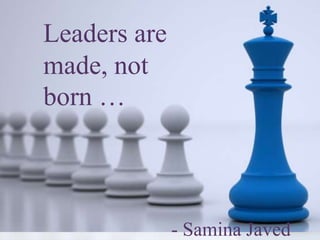
Leaders are
made, not
born …
- Samina Javed
 Good leaders are made not born. If you
have the desire and willpower, you can
become an effective leader. Good leaders
develop through a never ending process
of self-study, education, training, and
experience (Jago, 1982).
 Leadership is a process whereby an
individual influences a group of
individuals to achieve a common goal.
Northouse's (2007, p3)
Four major factors of leadership:
Leader
Follower
Situation
Communication
Follower Leader
 Leader
You must have an honest understanding of who you are, what you know, and
what you can do. Also, note that it is the followers, not the leader or someone else
who determines if the leader is successful. If they do not trust or lack confidence in
their leader, then they will be uninspired. To be successful you have to convince
your followers, not yourself or your superiors, that you are worthy of being
followed.
 Followers
Different people require different styles of leadership. For example, a new hire
requires more supervision than an experienced employee. A person who lacks
motivation requires a different approach than one with a high degree of
motivation. You must know your people! The fundamental starting point is having
a good understanding of human nature, such as needs, emotions, and motivation.
You must come to know your employees' be, know, and do attributes.
 Communication
You lead through two-way communication. Much of it is nonverbal. For instance, when
you “set the example,” that communicates to your people that you would not ask them
to perform anything that you would not be willing to do. What and how you
communicate either builds or harms the relationship between you and your employees.
 Situation
All situations are different. What you do in one situation will not always work in
another. You must use your judgment to decide the best course of action and the
leadership style needed for each situation. For example, you may need to confront an
employee for inappropriate behavior, but if the confrontation is too late or too early, too
harsh or too weak, then the results may prove ineffective.
The Leadership Effectiveness model gives rich and practical
insight to expand both individual and organizational
development.
 Identify specific leadership practices needed to achieve your
organization's strategic goals
 Identify leadership behaviors currently in practice within an
organization
Leadership can be described as:
(1) an intra-individual process,
(2) a dyadic process,
(3)a group process,
(4) an organizational process.
 Trait Theory
 Behavioral Theory
 Situational Theory
 Participative Theory
 The trait model of leadership is based on the
characteristics of many leaders - both
successful and unsuccessful -
 Scholars taking the trait approach attempted to
identify physiological factors of leadership.
 Successful leaders definitely have
interests, abilities, and personality traits
that are different from those of the less
effective leaders.
 Through these traits successful leaders
have been identified but these traits are
not responsible solely to predict whether
a person will be a successful leader or
not.
Trait Theorists refer to people like M. K.
Gandhi, Indira Gandhi, Nelson Mandela,
Ratan Tata of TATA Groups, Azim Prem
Ji of Wipro, Apple Co founder Steve
Jobs, and claim that all of them have
some traits in common.
Behavioral theories of leadership are
based upon the belief that great
leaders are made, not born.
Rooted in behaviorism, this
leadership theory focuses on the
actions of leaders not on mental
qualities or internal states.
According to this theory, people
can learn to become leaders through
teaching and observation.
 Situational theories propose that leaders
choose the best course of action based
upon situational variables.
 Different styles of leadership may be
more appropriate for certain types of
decision-making situations.
For example, in a situation where the leader is
the most knowledgeable and experienced
member of a group, an authoritarian
style might best work.be most appropriate.
 Participative leadership theories suggest that
the ideal leadership style is one that takes the
input of others into account.
 These leaders encourage participation
and contributions from group members
and help group members feel more
relevant and committed to the decision-
making process.

Leadership show

  • 1.
    Leaders are made, not born… - Samina Javed
  • 2.
     Good leadersare made not born. If you have the desire and willpower, you can become an effective leader. Good leaders develop through a never ending process of self-study, education, training, and experience (Jago, 1982).  Leadership is a process whereby an individual influences a group of individuals to achieve a common goal. Northouse's (2007, p3)
  • 3.
    Four major factorsof leadership: Leader Follower Situation Communication Follower Leader
  • 4.
     Leader You musthave an honest understanding of who you are, what you know, and what you can do. Also, note that it is the followers, not the leader or someone else who determines if the leader is successful. If they do not trust or lack confidence in their leader, then they will be uninspired. To be successful you have to convince your followers, not yourself or your superiors, that you are worthy of being followed.  Followers Different people require different styles of leadership. For example, a new hire requires more supervision than an experienced employee. A person who lacks motivation requires a different approach than one with a high degree of motivation. You must know your people! The fundamental starting point is having a good understanding of human nature, such as needs, emotions, and motivation. You must come to know your employees' be, know, and do attributes.
  • 5.
     Communication You leadthrough two-way communication. Much of it is nonverbal. For instance, when you “set the example,” that communicates to your people that you would not ask them to perform anything that you would not be willing to do. What and how you communicate either builds or harms the relationship between you and your employees.  Situation All situations are different. What you do in one situation will not always work in another. You must use your judgment to decide the best course of action and the leadership style needed for each situation. For example, you may need to confront an employee for inappropriate behavior, but if the confrontation is too late or too early, too harsh or too weak, then the results may prove ineffective.
  • 6.
    The Leadership Effectivenessmodel gives rich and practical insight to expand both individual and organizational development.  Identify specific leadership practices needed to achieve your organization's strategic goals  Identify leadership behaviors currently in practice within an organization
  • 7.
    Leadership can bedescribed as: (1) an intra-individual process, (2) a dyadic process, (3)a group process, (4) an organizational process.
  • 8.
     Trait Theory Behavioral Theory  Situational Theory  Participative Theory
  • 9.
     The traitmodel of leadership is based on the characteristics of many leaders - both successful and unsuccessful -  Scholars taking the trait approach attempted to identify physiological factors of leadership.
  • 10.
     Successful leadersdefinitely have interests, abilities, and personality traits that are different from those of the less effective leaders.  Through these traits successful leaders have been identified but these traits are not responsible solely to predict whether a person will be a successful leader or not.
  • 11.
    Trait Theorists referto people like M. K. Gandhi, Indira Gandhi, Nelson Mandela, Ratan Tata of TATA Groups, Azim Prem Ji of Wipro, Apple Co founder Steve Jobs, and claim that all of them have some traits in common.
  • 12.
    Behavioral theories ofleadership are based upon the belief that great leaders are made, not born. Rooted in behaviorism, this leadership theory focuses on the actions of leaders not on mental qualities or internal states.
  • 13.
    According to thistheory, people can learn to become leaders through teaching and observation.
  • 14.
     Situational theoriespropose that leaders choose the best course of action based upon situational variables.  Different styles of leadership may be more appropriate for certain types of decision-making situations.
  • 15.
    For example, ina situation where the leader is the most knowledgeable and experienced member of a group, an authoritarian style might best work.be most appropriate.
  • 16.
     Participative leadershiptheories suggest that the ideal leadership style is one that takes the input of others into account.
  • 17.
     These leadersencourage participation and contributions from group members and help group members feel more relevant and committed to the decision- making process.