Leadership: an introduction Ed Walker MD, MHA Director, UW Healthcare Leadership Development Alliance
What is your definition of leadership? Pick a word or phrase that best describes what you think leadership is
Four important components of a definition of leadership Leadership  is a  1)  process  whereby an  2)  individual influences  a  3)  group of individuals  to  4)  achieve a common goal .
But what exactly is it? Trait of the leader? Skill set? Situational moment? Stylistic process A set of transactions? Ability to influence or manipulate? A transformational experience of inspiration? Knowledge of people and their motivations? Clear understanding of goals and paths?
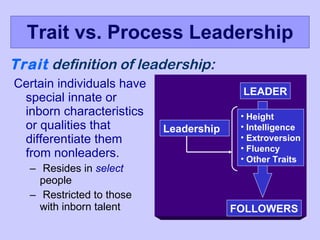
Trait vs. Process Leadership Certain individuals have special innate or inborn characteristics or qualities that differentiate them from nonleaders.  Resides in  select  people Restricted to those with inborn talent Trait  definition of leadership: LEADER FOLLOWERS Leadership Height Intelligence Extroversion Fluency Other Traits
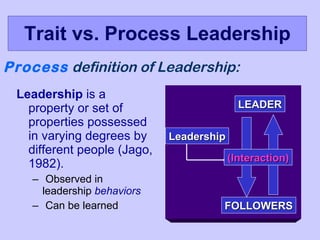
Trait vs. Process Leadership Leadership  is a property or set of properties possessed in varying degrees by different people (Jago, 1982). Observed in leadership  behaviors Can be learned Process  definition of Leadership: LEADER Leadership (Interaction) FOLLOWERS
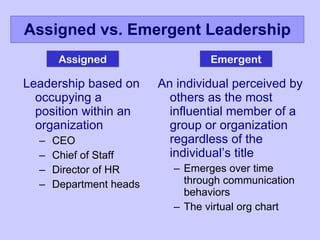
Assigned vs. Emergent Leadership Leadership based on occupying a position within an organization CEO Chief of Staff Director of HR Department heads An individual perceived by others as the most influential member of a group or organization regardless of the individual’s title Emerges over time through communication behaviors The virtual org chart Assigned Emergent
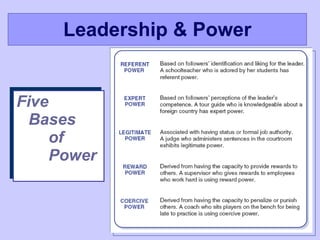
Leadership & Power Five  Bases  of    Power
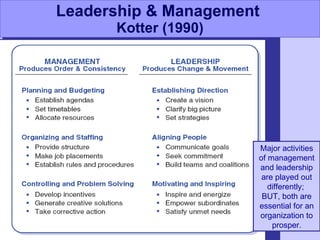
Leadership & Management  Kotter (1990) Major activities of management and leadership are played out differently;  BUT, both are essential for an organization to prosper.
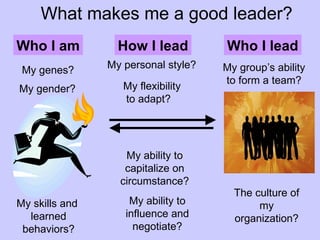
My gender? My skills and  learned behaviors? My ability to capitalize on circumstance? My personal style? My ability to influence and negotiate? My group’s ability to form a team? The culture of my organization? My flexibility to adapt? My genes? What makes me a good leader? Who I am Who I lead How I lead
Is leadership a trait?
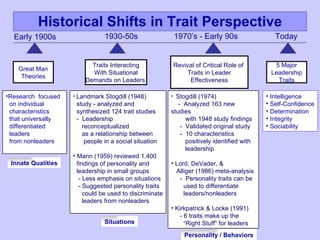
Historical Shifts in Trait Perspective Great Man Theories Early 1900s Research  focused on individual characteristics that universally  differentiated leaders from nonleaders Traits Interacting With Situational  Demands on Leaders   1930-50s Landmark Stogdill (1948) study - analyzed and  synthesized 124 trait studies -  Leadership reconceptualized as a relationship between people in a social situation Mann (1959) reviewed 1,400  findings of personality and leadership in small groups - Less emphasis on situations - Suggested personality traits could be used to discriminate leaders from nonleaders Revival of Critical Role of  Traits in Leader Effectiveness Stogdill (1974) -  Analyzed 163 new studies with 1948 study findings -  Validated original study -  10 characteristics  positively identified with  leadership Lord, DeVader, & Alliger (1986) meta-analysis -  Personality traits can be used to differentiate leaders/nonleaders Kirkpatrick & Locke (1991) - 6 traits make up the  “ Right Stuff” for leaders 1970’s - Early 90s Innate Qualities Situations Personality / Behaviors Today Intelligence Self-Confidence Determination Integrity Sociability 5 Major Leadership Traits
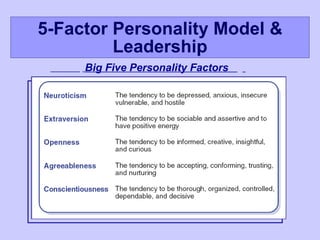
5-Factor Personality Model & Leadership   Big Five Personality Factors
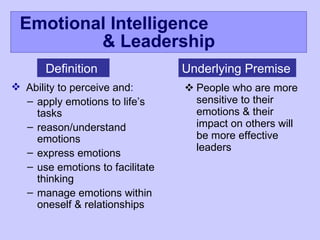
Emotional Intelligence  & Leadership People who are more sensitive to their emotions & their impact on others will be more effective leaders Underlying Premise  Definition  Ability to perceive and :   apply emotions to life’s tasks reason/understand emotions express emotions use emotions to facilitate thinking manage emotions within oneself & relationships
Is leadership more of a well developed skill set?
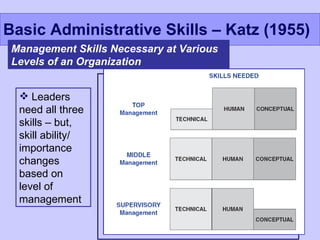
Basic Administrative Skills – Katz (1955) Management Skills Necessary at Various Levels of an Organization Leaders need all three skills – but, skill ability/ importance changes based on level of management
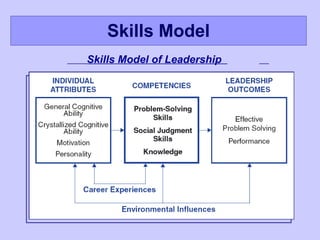
Skills Model Skills Model of Leadership
Maybe leadership is a matter of interactive style?
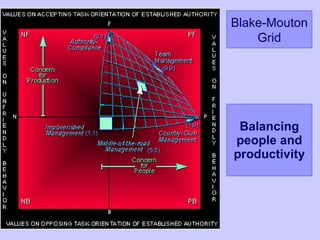
Balancing people and productivity Blake-Mouton Grid
Ok, maybe leadership is just the flexibility to adapt to a given situation?
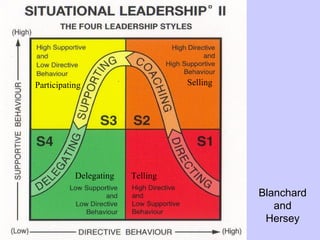
Blanchard and Hersey Telling Participating Delegating Selling
 
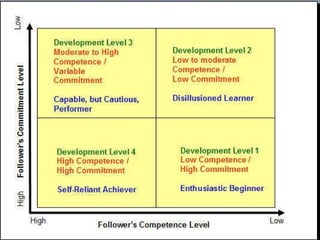
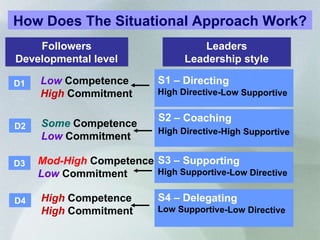
How Does The Situational Approach Work? Followers Developmental level D1 Low   Competence High  Commitment D2 Some  Competence Low  Commitment D3 Mod-High  Competence Low  Commitment D4 High  Competence High  Commitment Leaders Leadership style S1 – Directing High Directive-Low Supportive S2 – Coaching High Directive-High Supportive S3 – Supporting High Supportive-Low Directive S4 – Delegating Low Supportive-Low Directive How Does The Situational Approach Work?
Perhaps leadership is just staying out of the way and letting people do their jobs?
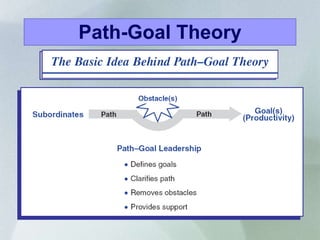
Path-Goal Theory
Is leadership more than just getting the job done?
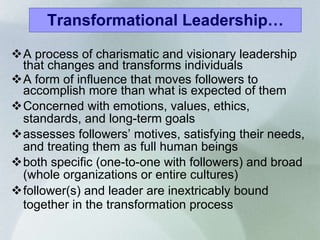
Transformational Leadership… A process of charismatic and visionary leadership that changes and transforms individuals A form of influence that moves followers to accomplish more than what is expected of them Concerned with emotions, values, ethics, standards, and long-term goals  assesses followers’ motives, satisfying their needs, and treating them as full human beings both specific (one-to-one with followers) and broad (whole organizations or entire cultures) follower(s) and leader are inextricably bound together in the transformation process
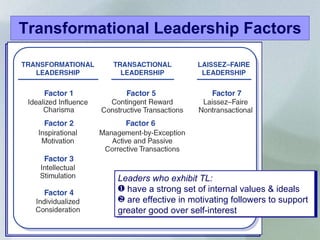
Transformational Leadership Factors Leaders who exhibit TL: have a strong set of internal values & ideals are effective in motivating followers to support greater good over self-interest
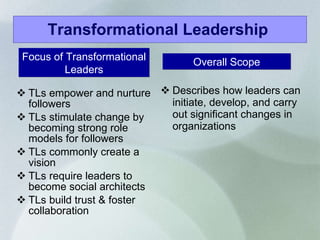
Transformational Leadership  TLs empower and nurture followers TLs stimulate change by becoming strong role models for followers TLs commonly create a vision TLs require leaders to become social architects TLs build trust & foster collaboration  Describes how leaders can initiate, develop, and carry out significant changes in organizations Focus of Transformational Leaders Overall Scope
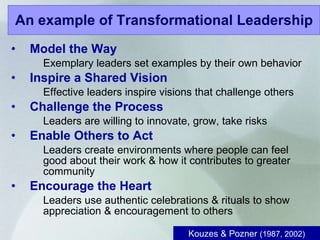
An example of Transformational Leadership Model the Way Exemplary leaders set examples by their own behavior Inspire a Shared Vision Effective leaders inspire visions that challenge others  Challenge the Process Leaders are willing to innovate, grow, take risks Enable Others to Act Leaders create environments where people can feel good about their work & how it contributes to greater community Encourage the Heart Leaders use authentic celebrations & rituals to show appreciation & encouragement to others Kouzes & Pozner  (1987, 2002)
Wait, maybe it’s not about the leader at all – it’s about the team that’s being led
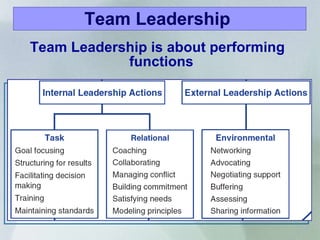
Team Leadership  Team Leadership is about performing functions
Wait – we’ve gotten too far from the focus on the leader and the complexity of the kinds of people we really are
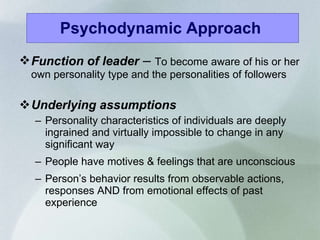
Psychodynamic Approach  Function of leader   –  To become aware of his or her own personality type and the personalities of followers Underlying assumptions Personality characteristics of individuals are deeply ingrained and virtually impossible to change in any significant way People have motives & feelings that are unconscious Person’s behavior results from observable actions, responses AND from emotional effects of past experience
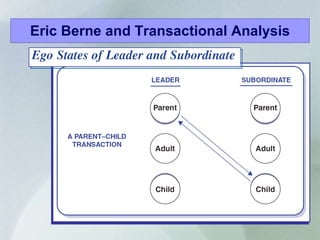
Eric Berne and Transactional Analysis
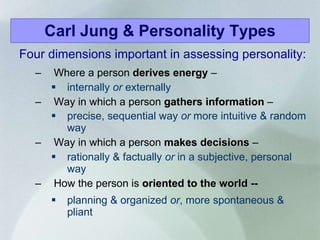
Four dimensions important in assessing personality: Where a person  derives energy  –  internally  or  externally Way in which a person  gathers information  –  precise, sequential way  or  more intuitive & random way   Way in which a person  makes decisions  –  rationally & factually  or  in a subjective, personal way How the person is  oriented to the world -- planning & organized  or , more spontaneous & pliant   Carl Jung & Personality Types
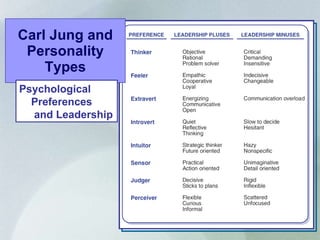
Carl Jung and Personality Types Psychological Preferences  and Leadership
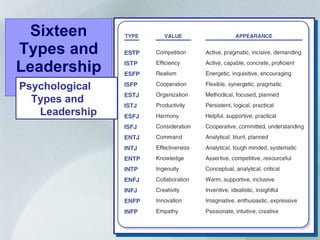
Sixteen Types and Leadership Psychological Types and Leadership
Maybe it’s all about gender – do men or women make better leaders?
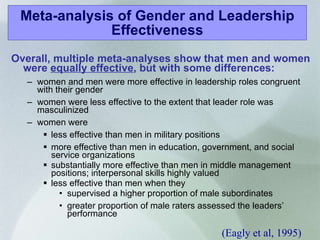
Overall, multiple meta-analyses show that men and women were  equally effective , but with some differences: women and men were more effective in leadership roles congruent with their gender women were less effective to the extent that leader role was masculinized women were  less effective than men in military positions more effective than men in education, government, and social service organizations substantially more effective than men in middle management positions; interpersonal skills highly valued less effective than men when they  supervised a higher proportion of male subordinates greater proportion of male raters assessed the leaders’ performance Meta-analysis of Gender and Leadership Effectiveness (Eagly et al, 1995)
What about culture? Does that make a difference?
Dimensions of Culture House et al’s (2004) research on the relationship between culture and leadership resulted in the  GLOBE research program Initiated in 1991 – this program involved more than 160 investigators Used quantitative methods to study the responses of 17,000 managers in more than 950 organizations, 62 different cultures Developed a classification of cultural dimensions – identified  nine cultural dimensions Research
Dimensions of Culture GLOBE research program –  nine cultural dimensions Uncertainty Avoidance:  extent to which a society, organization, or group relies on established social norms, rituals, and procedures to avoid uncertainty Power Distance: degree to which members of a group expect and agree that power should be shared unequally Institutional Collectivism: degree to which an organization or society encourages institutional or societal collective action.  Research
Dimensions of Culture GLOBE research program –  nine cultural dimensions In-Group Collectivism: degree to which people express pride, loyalty, and cohesiveness in their organizations or families Gender Egalitarianism: degree to which an organization or society minimizes gender role differences and promotes gender equality Assertiveness: degree to which people in a culture are determined, assertive, confrontational, and aggressive in their social relationships Research
Dimensions of Culture GLOBE research program –  nine cultural dimensions Future Orientation: extent to which people engage in future-oriented behaviors such as planning, investing in the future, and delaying gratification Performance Orientation: extent to which an organization or society encourages and rewards group members for improved performance and excellence  Humane Orientation: degree to which a culture encourages and rewards people for being fair, altruistic, generous, caring, and kind to others. Research
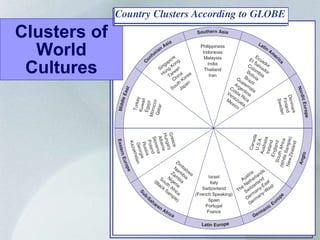
GLOBE researchers divided the data from 62 countries into regional clusters Clusters provide a convenient way to Analyze similarities & differences between cultural groups Make meaningful generalizations about culture & leadership Clusters were found to be unique Regional clusters represent 10 distinct groups   Clusters of World Cultures
Clusters of World Cultures
Characteristics include -  Anglo  – competitive and result-oriented Confucian Asia  – result-driven, encourage group working together over individual goals Eastern Europe  – forceful, supportive of co-workers, treat women with equality Germanic Europe  – value competition & aggressiveness and are more result-oriented Latin America  – loyal & devoted to their families and similar groups Characteristics of Clusters Observations
Characteristics include -  Latin Europe  – value individual autonomy Middle East  – devoted & loyal to their own people, women afforded less status Nordic Europe  – high priority on long-term success, women treated with greater equality Southern Asia  – strong family & deep concern for their communities Sub-Sahara Africa  – concerned & sensitive to others, demonstrate strong family loyalty Characteristics of Clusters Observations
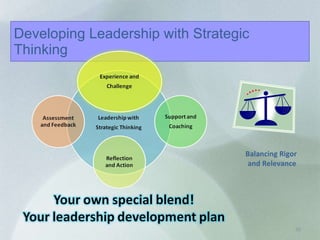
Developing Leadership with Strategic Thinking Balancing Rigor  and Relevance
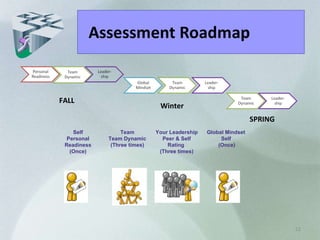
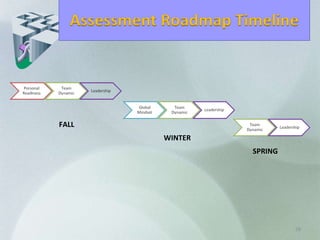
FALL Winter SPRING Self Personal Readiness (Once) Team Team Dynamic (Three times) Your Leadership Peer & Self Rating  (Three times) Global Mindset Self (Once)
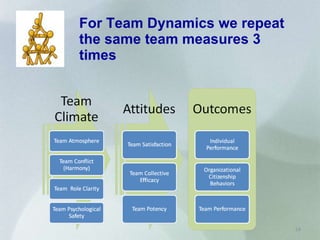
For Team Dynamics we repeat the same team measures 3 times
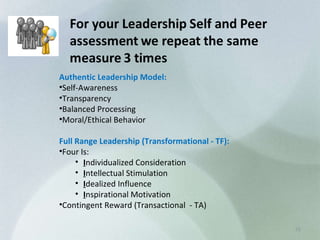
Authentic Leadership Model: Self-Awareness Transparency Balanced Processing Moral/Ethical Behavior Full Range Leadership (Transformational - TF): Four Is:  I ndividualized Consideration I ntellectual Stimulation I dealized Influence I nspirational Motivation Contingent Reward (Transactional  - TA)
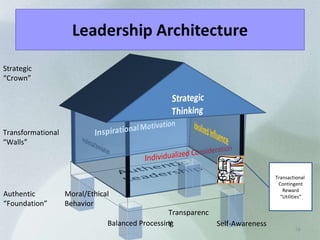
Transactional  Contingent Reward “ Utilities” Self-Awareness Transparency Balanced Processing Moral/Ethical Behavior Transformational “ Walls” Authentic “ Foundation” Strategic “ Crown”
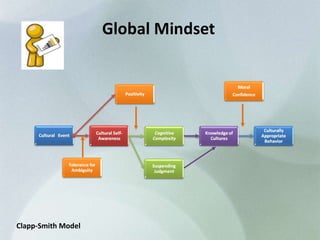
Clapp-Smith Model
Focus on state-like attributes (not traits) Leverage experience (trigger moments) Increase self-awareness Develop reflective learning capabilities (e.g., journaling, after action reviews, etc.) Provide challenge, feedback and support
FALL WINTER SPRING
A leader trained in an evidence-based system of development … Knows his or her  strengths  and is always  self-aware Continuously reflects  by thinking about  how he or she thinks Has a clear  self concept  and  goal orientation Is  motivated to learn  and  motivated to lead Maintains   and appreciates  perspective  and is  morally grounded Is  adaptable ,  tolerant of ambiguity  and is  self efficacious  in the face of adversity Is  socially and culturally aware Balances  individual and team effectiveness Becomes an  authentic leader: self aware, balanced processing, moral perspective, transparent Demonstrates   psychological capital:  self-efficacy, hope, optimism and resiliency
So what have we learned?

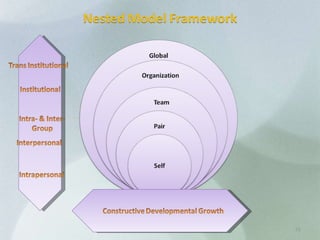
Leadership models, UW EMHA

  • 1.
    Leadership: an introductionEd Walker MD, MHA Director, UW Healthcare Leadership Development Alliance
  • 2.
    What is yourdefinition of leadership? Pick a word or phrase that best describes what you think leadership is
  • 3.
    Four important componentsof a definition of leadership Leadership is a 1) process whereby an 2) individual influences a 3) group of individuals to 4) achieve a common goal .
  • 4.
    But what exactlyis it? Trait of the leader? Skill set? Situational moment? Stylistic process A set of transactions? Ability to influence or manipulate? A transformational experience of inspiration? Knowledge of people and their motivations? Clear understanding of goals and paths?
  • 5.
    Trait vs. ProcessLeadership Certain individuals have special innate or inborn characteristics or qualities that differentiate them from nonleaders. Resides in select people Restricted to those with inborn talent Trait definition of leadership: LEADER FOLLOWERS Leadership Height Intelligence Extroversion Fluency Other Traits
  • 6.
    Trait vs. ProcessLeadership Leadership is a property or set of properties possessed in varying degrees by different people (Jago, 1982). Observed in leadership behaviors Can be learned Process definition of Leadership: LEADER Leadership (Interaction) FOLLOWERS
  • 7.
    Assigned vs. EmergentLeadership Leadership based on occupying a position within an organization CEO Chief of Staff Director of HR Department heads An individual perceived by others as the most influential member of a group or organization regardless of the individual’s title Emerges over time through communication behaviors The virtual org chart Assigned Emergent
  • 8.
    Leadership & PowerFive Bases of Power
  • 9.
    Leadership & Management Kotter (1990) Major activities of management and leadership are played out differently; BUT, both are essential for an organization to prosper.
  • 10.
    My gender? Myskills and learned behaviors? My ability to capitalize on circumstance? My personal style? My ability to influence and negotiate? My group’s ability to form a team? The culture of my organization? My flexibility to adapt? My genes? What makes me a good leader? Who I am Who I lead How I lead
  • 11.
  • 12.
    Historical Shifts inTrait Perspective Great Man Theories Early 1900s Research focused on individual characteristics that universally differentiated leaders from nonleaders Traits Interacting With Situational Demands on Leaders 1930-50s Landmark Stogdill (1948) study - analyzed and synthesized 124 trait studies - Leadership reconceptualized as a relationship between people in a social situation Mann (1959) reviewed 1,400 findings of personality and leadership in small groups - Less emphasis on situations - Suggested personality traits could be used to discriminate leaders from nonleaders Revival of Critical Role of Traits in Leader Effectiveness Stogdill (1974) - Analyzed 163 new studies with 1948 study findings - Validated original study - 10 characteristics positively identified with leadership Lord, DeVader, & Alliger (1986) meta-analysis - Personality traits can be used to differentiate leaders/nonleaders Kirkpatrick & Locke (1991) - 6 traits make up the “ Right Stuff” for leaders 1970’s - Early 90s Innate Qualities Situations Personality / Behaviors Today Intelligence Self-Confidence Determination Integrity Sociability 5 Major Leadership Traits
  • 13.
    5-Factor Personality Model& Leadership Big Five Personality Factors
  • 14.
    Emotional Intelligence & Leadership People who are more sensitive to their emotions & their impact on others will be more effective leaders Underlying Premise Definition Ability to perceive and : apply emotions to life’s tasks reason/understand emotions express emotions use emotions to facilitate thinking manage emotions within oneself & relationships
  • 15.
    Is leadership moreof a well developed skill set?
  • 16.
    Basic Administrative Skills– Katz (1955) Management Skills Necessary at Various Levels of an Organization Leaders need all three skills – but, skill ability/ importance changes based on level of management
  • 17.
    Skills Model SkillsModel of Leadership
  • 18.
    Maybe leadership isa matter of interactive style?
  • 19.
    Balancing people andproductivity Blake-Mouton Grid
  • 20.
    Ok, maybe leadershipis just the flexibility to adapt to a given situation?
  • 21.
    Blanchard and HerseyTelling Participating Delegating Selling
  • 22.
  • 23.
    How Does TheSituational Approach Work? Followers Developmental level D1 Low Competence High Commitment D2 Some Competence Low Commitment D3 Mod-High Competence Low Commitment D4 High Competence High Commitment Leaders Leadership style S1 – Directing High Directive-Low Supportive S2 – Coaching High Directive-High Supportive S3 – Supporting High Supportive-Low Directive S4 – Delegating Low Supportive-Low Directive How Does The Situational Approach Work?
  • 24.
    Perhaps leadership isjust staying out of the way and letting people do their jobs?
  • 25.
  • 26.
    Is leadership morethan just getting the job done?
  • 27.
    Transformational Leadership… Aprocess of charismatic and visionary leadership that changes and transforms individuals A form of influence that moves followers to accomplish more than what is expected of them Concerned with emotions, values, ethics, standards, and long-term goals assesses followers’ motives, satisfying their needs, and treating them as full human beings both specific (one-to-one with followers) and broad (whole organizations or entire cultures) follower(s) and leader are inextricably bound together in the transformation process
  • 28.
    Transformational Leadership FactorsLeaders who exhibit TL: have a strong set of internal values & ideals are effective in motivating followers to support greater good over self-interest
  • 29.
    Transformational Leadership TLs empower and nurture followers TLs stimulate change by becoming strong role models for followers TLs commonly create a vision TLs require leaders to become social architects TLs build trust & foster collaboration Describes how leaders can initiate, develop, and carry out significant changes in organizations Focus of Transformational Leaders Overall Scope
  • 30.
    An example ofTransformational Leadership Model the Way Exemplary leaders set examples by their own behavior Inspire a Shared Vision Effective leaders inspire visions that challenge others Challenge the Process Leaders are willing to innovate, grow, take risks Enable Others to Act Leaders create environments where people can feel good about their work & how it contributes to greater community Encourage the Heart Leaders use authentic celebrations & rituals to show appreciation & encouragement to others Kouzes & Pozner (1987, 2002)
  • 31.
    Wait, maybe it’snot about the leader at all – it’s about the team that’s being led
  • 32.
    Team Leadership Team Leadership is about performing functions
  • 33.
    Wait – we’vegotten too far from the focus on the leader and the complexity of the kinds of people we really are
  • 34.
    Psychodynamic Approach Function of leader – To become aware of his or her own personality type and the personalities of followers Underlying assumptions Personality characteristics of individuals are deeply ingrained and virtually impossible to change in any significant way People have motives & feelings that are unconscious Person’s behavior results from observable actions, responses AND from emotional effects of past experience
  • 35.
    Eric Berne andTransactional Analysis
  • 36.
    Four dimensions importantin assessing personality: Where a person derives energy – internally or externally Way in which a person gathers information – precise, sequential way or more intuitive & random way Way in which a person makes decisions – rationally & factually or in a subjective, personal way How the person is oriented to the world -- planning & organized or , more spontaneous & pliant Carl Jung & Personality Types
  • 37.
    Carl Jung andPersonality Types Psychological Preferences and Leadership
  • 38.
    Sixteen Types andLeadership Psychological Types and Leadership
  • 39.
    Maybe it’s allabout gender – do men or women make better leaders?
  • 40.
    Overall, multiple meta-analysesshow that men and women were equally effective , but with some differences: women and men were more effective in leadership roles congruent with their gender women were less effective to the extent that leader role was masculinized women were less effective than men in military positions more effective than men in education, government, and social service organizations substantially more effective than men in middle management positions; interpersonal skills highly valued less effective than men when they supervised a higher proportion of male subordinates greater proportion of male raters assessed the leaders’ performance Meta-analysis of Gender and Leadership Effectiveness (Eagly et al, 1995)
  • 41.
    What about culture?Does that make a difference?
  • 42.
    Dimensions of CultureHouse et al’s (2004) research on the relationship between culture and leadership resulted in the GLOBE research program Initiated in 1991 – this program involved more than 160 investigators Used quantitative methods to study the responses of 17,000 managers in more than 950 organizations, 62 different cultures Developed a classification of cultural dimensions – identified nine cultural dimensions Research
  • 43.
    Dimensions of CultureGLOBE research program – nine cultural dimensions Uncertainty Avoidance: extent to which a society, organization, or group relies on established social norms, rituals, and procedures to avoid uncertainty Power Distance: degree to which members of a group expect and agree that power should be shared unequally Institutional Collectivism: degree to which an organization or society encourages institutional or societal collective action. Research
  • 44.
    Dimensions of CultureGLOBE research program – nine cultural dimensions In-Group Collectivism: degree to which people express pride, loyalty, and cohesiveness in their organizations or families Gender Egalitarianism: degree to which an organization or society minimizes gender role differences and promotes gender equality Assertiveness: degree to which people in a culture are determined, assertive, confrontational, and aggressive in their social relationships Research
  • 45.
    Dimensions of CultureGLOBE research program – nine cultural dimensions Future Orientation: extent to which people engage in future-oriented behaviors such as planning, investing in the future, and delaying gratification Performance Orientation: extent to which an organization or society encourages and rewards group members for improved performance and excellence Humane Orientation: degree to which a culture encourages and rewards people for being fair, altruistic, generous, caring, and kind to others. Research
  • 46.
    GLOBE researchers dividedthe data from 62 countries into regional clusters Clusters provide a convenient way to Analyze similarities & differences between cultural groups Make meaningful generalizations about culture & leadership Clusters were found to be unique Regional clusters represent 10 distinct groups Clusters of World Cultures
  • 47.
  • 48.
    Characteristics include - Anglo – competitive and result-oriented Confucian Asia – result-driven, encourage group working together over individual goals Eastern Europe – forceful, supportive of co-workers, treat women with equality Germanic Europe – value competition & aggressiveness and are more result-oriented Latin America – loyal & devoted to their families and similar groups Characteristics of Clusters Observations
  • 49.
    Characteristics include - Latin Europe – value individual autonomy Middle East – devoted & loyal to their own people, women afforded less status Nordic Europe – high priority on long-term success, women treated with greater equality Southern Asia – strong family & deep concern for their communities Sub-Sahara Africa – concerned & sensitive to others, demonstrate strong family loyalty Characteristics of Clusters Observations
  • 50.
    Developing Leadership withStrategic Thinking Balancing Rigor and Relevance
  • 52.
    FALL Winter SPRINGSelf Personal Readiness (Once) Team Team Dynamic (Three times) Your Leadership Peer & Self Rating (Three times) Global Mindset Self (Once)
  • 54.
    For Team Dynamicswe repeat the same team measures 3 times
  • 55.
    Authentic Leadership Model:Self-Awareness Transparency Balanced Processing Moral/Ethical Behavior Full Range Leadership (Transformational - TF): Four Is: I ndividualized Consideration I ntellectual Stimulation I dealized Influence I nspirational Motivation Contingent Reward (Transactional - TA)
  • 56.
    Transactional ContingentReward “ Utilities” Self-Awareness Transparency Balanced Processing Moral/Ethical Behavior Transformational “ Walls” Authentic “ Foundation” Strategic “ Crown”
  • 57.
  • 58.
    Focus on state-likeattributes (not traits) Leverage experience (trigger moments) Increase self-awareness Develop reflective learning capabilities (e.g., journaling, after action reviews, etc.) Provide challenge, feedback and support
  • 59.
  • 60.
    A leader trainedin an evidence-based system of development … Knows his or her strengths and is always self-aware Continuously reflects by thinking about how he or she thinks Has a clear self concept and goal orientation Is motivated to learn and motivated to lead Maintains and appreciates perspective and is morally grounded Is adaptable , tolerant of ambiguity and is self efficacious in the face of adversity Is socially and culturally aware Balances individual and team effectiveness Becomes an authentic leader: self aware, balanced processing, moral perspective, transparent Demonstrates psychological capital: self-efficacy, hope, optimism and resiliency
  • 61.
    So what havewe learned?

Editor's Notes
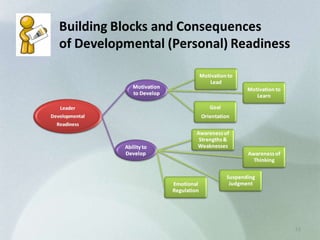
  • #54 Flow of Events: Leadership development opportunities abound in everyday life (work, family, community). Some are big and lasting, some are short and fleeting. No two people will interpret and respond to a particular “trigger event” in exactly the same way in terms of whether and how much the event contributes to leadership development. One of the key explanations for this variation is a construct called Developmental Readiness. Developmental Readiness : both the ability and motivation to attend to, seek performance feedback, make sense of it and incorporate it effectively and positively into one’s self-concept; the ability to access and effectively process self-knowledge, and ultimately apply that knowledge during self-evaluation and the formation of efficacy beliefs. Self Concept Clarity – self-beliefs are clearly and confidently defined, internally consistent and stable
  • #55 After reviewing the second team survey, your team might want to huddle and discuss what’s working and what could be done to improve team effectiveness. You can do this face-to-face and/or use the LSTDeveloper portal to start a team discussion thread on how team climate, how that’s impacting attitudes and behavioral outcomes.
  • #56 Methodology: T4, T7 and T11 assess the same aspects of leadership (authentic [ALQ], transactional, transformational & communication) using the same method (self report and peer ratings) T8 assesses self reported agentic leadership efficacy with a 22-item measure. This measure was also rolled into T3, but made that survey too long and so the second administration is a stand-alone. T9 is an optional 360° assessment using the MLQ. This is a future component of our assessment protocol.