LEAD DEPOSITS OF IND
CONTENTS
• Introduction
• Lead
• Properties of lead
• Chief ores of lead
• Distribution of lead in India
• Uses of lead
• Conclusion
• References
INTRODUCTION
•Lead was probably one of the first metals to be produced by man because it is
highly malleable, easy to smelt and work with.
INTRODUCTION
•Lead was probably one of the first metals to be produced by man because it is
highly malleable, easy to smelt and work with.
•. Romans used it for making iron pins to hold large stone blocks for buildings.
INTRODUCTION
•Lead was probably one of the first metals to be produced by man because it is
highly malleable, easy to smelt and work with.
•. Romans used it for making iron pins to hold large stone blocks for buildings.
•Ancient Indians possessed the knowledge of mining, metals and alloys; the
literary evidence of which is evidenced in Kautilya's ‘Arthsastra’, a treatise on
mining and metals written in about 400 BC.
INTRODUCTION
•Lead was probably one of the first metals to be produced by man because it is
highly malleable, easy to smelt and work with.
•. Romans used it for making iron pins to hold large stone blocks for buildings.
•Ancient Indians possessed the knowledge of mining, metals and alloys; the
literary evidence of which is evidenced in Kautilya's ‘Arthsastra’, a treatise on
mining and metals written in about 400 BC.
• India’s present need for lead is met mostly by imports from foreign countries.
.
INTRODUCTION
•Lead was probably one of the first metals to be produced by man because it is
highly malleable, easy to smelt and work with.
•. Romans used it for making iron pins to hold large stone blocks for buildings.
•Ancient Indians possessed the knowledge of mining, metals and alloys; the
literary evidence of which is evidenced in Kautilya's ‘Arthsastra’, a treatise on
mining and metals written in about 400 BC.
• India’s present need for lead is met mostly by imports from foreign countries.
• The total world productions of lead metal in 1990 were about 5.7 million
tonnes, to which India’s contributions were about 0.7%(0.040 m.tonnes) lead.
INTRODUCTION
•Lead was probably one of the first metals to be produced by man because it is
highly malleable, easy to smelt and work with.
•. Romans used it for making iron pins to hold large stone blocks for buildings.
•Ancient Indians possessed the knowledge of mining, metals and alloys; the
literary evidence of which is evidenced in Kautilya's ‘Arthsastra’, a treatise on
mining and metals written in about 400 BC.
• India’s present need for lead is met mostly by imports from foreign countries.
• The total world productions of lead metal in 1990 were about 5.7 million
tonnes, to which India’s contributions were about 0.7%(0.040 m.tonnes) lead.
•USA, Russia, Japan, Germany, UK, Canada, France, Australia, Belgium, and
China together produce majority of the world production of refined lead
INTRODUCTION
•Lead was probably one of the first metals to be produced by man because it is
highly malleable, easy to smelt and work with.
•. Romans used it for making iron pins to hold large stone blocks for buildings.
•Ancient Indians possessed the knowledge of mining, metals and alloys; the
literary evidence of which is evidenced in Kautilya's ‘Arthsastra’, a treatise on
mining and metals written in about 400 BC.
• India’s present need for lead is met mostly by imports from foreign countries.
• The total world productions of lead metal in 1990 were about 5.7 million
tonnes, to which India’s contributions were about 0.7%(0.040 m.tonnes) lead.
•USA, Russia, Japan, Germany, UK, Canada, France, Australia, Belgium, and
China together produce majority of the world production of refined lead
LEAD
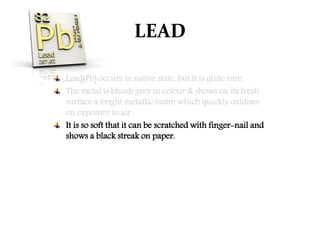
Lead(Pb) occurs in native state, but it is quite rare.
LEAD
Lead(Pb) occurs in native state, but it is quite rare.
The metal is bluish grey in colour & shows on its fresh
surface a bright metallic lustre which quickly oxidises
on exposure to air.
LEAD
Lead(Pb) occurs in native state, but it is quite rare.
The metal is bluish grey in colour & shows on its fresh
surface a bright metallic lustre which quickly oxidises
on exposure to air.
It is so soft that it can be scratched with finger-nail and
shows a black streak on paper.
LEAD
Lead(Pb) occurs in native state, but it is quite rare.
The metal is bluish grey in colour & shows on its fresh
surface a bright metallic lustre which quickly oxidises
on exposure to air.
It is so soft that it can be scratched with finger-nail and
shows a black streak on paper.
Its high Sp.Gr of 11.34 makes it heavy.
LEAD
Lead(Pb) occurs in native state, but it is quite rare.
The metal is bluish grey in colour & shows on its fresh
surface a bright metallic lustre which quickly oxidises
on exposure to air.
It is so soft that it can be scratched with finger-nail and
shows a black streak on paper.
Its high Sp.Gr of 11.34 makes it heavy.
It is highly resistant to corrosion, hence is used for
storage of acids
LEAD
Lead(Pb) occurs in native state, but it is quite rare.
The metal is bluish grey in colour & shows on its fresh
surface a bright metallic lustre which quickly oxidises
on exposure to air.
It is so soft that it can be scratched with finger-nail and
shows a black streak on paper.
Its high Sp.Gr of 11.34 makes it heavy.
It is highly resistant to corrosion, hence is used for
storage of acids.
Deposits of lead are either of hydrothermal (cavity –
filling and replacement) or of sedimentary origin.
LEAD
Lead(Pb) occurs in native state, but it is quite rare.
The metal is bluish grey in colour & shows on its fresh
surface a bright metallic lustre which quickly oxidises
on exposure to air.
It is so soft that it can be scratched with finger-nail and
shows a black streak on paper.
Its high Sp.Gr of 11.34 makes it heavy.
It is highly resistant to corrosion, hence is used for
storage of acids
Deposits of lead are either of hydrothermal (cavity –
filling and replacement) or of sedimentary origin.
PROPERTIES OF LEAD
• Colour -metallic gray
• Streak -lead gray
• Luster -Metallic
• Diaphaneity -opaque
• Cleavage -None
• Hardness -2 to 2.5
• Specific Gravity -11.34
• Diagnostic Properties -Luster, streak
• Chemical Composition -Pb
• Crystal System -Isometric
CHIEF ORES OF LEAD
• Galena(PbS)
• Cerussite(PbCO3)
• Anglesite(PbSO4)
DISTRIBUTION OF LEAD IN
INDIA
85% of the lead deposits if India
occur in Rajasthan.
The important lead deposits of India
include Rampura-Agucha
(Bhilwara district), Rajpura-Dariba
and Sindesar (Rajsamand district),
Zawar (Udaipur), Sawar
and Kayar-Ghugra (Ajmer district),
Basantgarh and Deri (Sirohi district)
in Rajasthan;
Mineralisation occurs along several
belts in rocks of
the Aravalli and Delhi Supergroups
and in
pre-Aravalli rocks.
RAJASTHAN
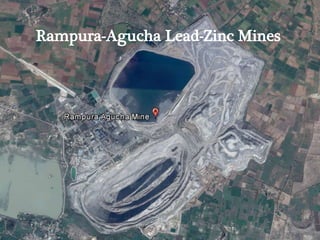
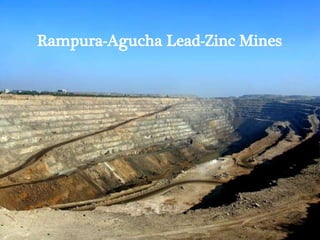
Rampura-Agucha Lead-Zinc Mines
ANDHRA PRADESH
Galena occurs at Chityala and
Chelima in Kurnool district,
Karempudi in Guntur district and
Zangamrajupalle in Cuddapah
district. Galena is also reported to
occur near Chintakunta in
Nalgonda district and Jestaipalli
in Khamam district.
These deposits and occurrences
are mostly hosted in rocks of the
Cuddapah Supergroup and to a
lesser extent in rocks of the
Kurnool Group, Pakhal
supergroup
JHARKHAND
Occurrences of argentiferous
lead ore had been located in
Hazaribagh district. Galena is
found in parts of Singhbhum,
Ranchi, Hazaribagh and Palamau
districts but with little chance of
success in their working. The GSI
has taken up investigation in
some parts of the State
MADHYA PRADESH
Lead-ores, often argentiferous, are
on a fairly large scale. Mahanadi
River near Padampur, Bilaspur
district. Occurrences have been
reported at Ranitalao near Chicholi,
Thelkadand Karamatara in Durg
district, Bhelaunda and Chiraikhurd
in Sarguja district, Andar in Shivpuri
district and near Kurol in Gwalior
district.
In Madhya Pradesh, basemetal
deposits and occurrences have been
recorded from Malanjkhand
granitoid belt, Bhundelkhand granite
complex and the Mahakhosal and
Vindhyan Groups of rocks.
KARNATAKA
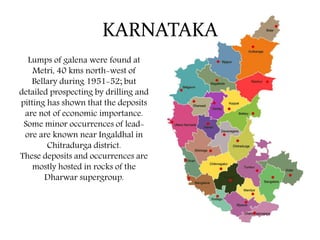
Lumps of galena were found at
Metri, 40 kms north-west of
Bellary during 1951-52; but
detailed prospecting by drilling and
pitting has shown that the deposits
are not of economic importance.
Some minor occurrences of lead-
ore are known near Ingaldhal in
Chitradurga district.
These deposits and occurrences are
mostly hosted in rocks of the
Dharwar supergroup.
ODISHA
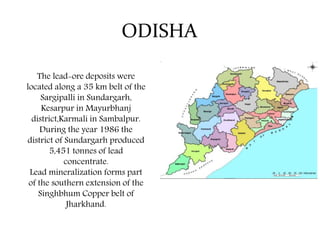
The lead-ore deposits were
located along a 35 km belt of the
Sargipalli in Sundargarh,
Kesarpur in Mayurbhanj
district,Karmali in Sambalpur.
During the year 1986 the
district of Sundargarh produced
5,451 tonnes of lead
concentrate.
Lead mineralization forms part
of the southern extension of the
Singhbhum Copper belt of
Jharkhand.
GUJARAT
Lead ores are found in
Ambamata-Chitrasani
in Banasakantha
District , Khandia in
Vadodara district
WEST BENGAL
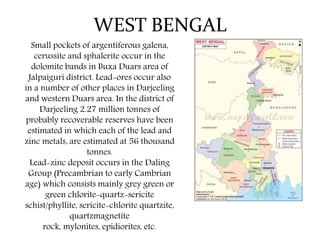
Small pockets of argentiferous galena,
cerussite and sphalerite occur in the
dolomite bands in Buxa Duars area of
Jalpaiguri district. Lead-ores occur also
in a number of other places in Darjeeling
and western Duars area. In the district of
Darjeeling 2.27 million tonnes of
probably recoverable reserves have been
estimated in which each of the lead and
zinc metals, are estimated at 56 thousand
tonnes.
Lead-zinc deposit occurs in the Daling
Group (Precambrian to early Cambrian
age) which consists mainly grey green or
green chlorite-quartz-sericite
schist/phyllite, sericite-chlorite quartzite,
quartzmagnetite
rock, mylonites, epidiorites, etc.
USES OF LEAD
• Lead is the main constituent of lead-acid batteries
USES OF LEAD
• Lead is the main constituent of lead-acid batteries
• It is widely used as a coloring agent in stained glasses for reducing the
radiation transmission.
USES OF LEAD
• Lead is the main constituent of lead-acid batteries
• It is widely used as a coloring agent in stained glasses for reducing the
radiation transmission.
• Due to its high specific gravity it is used as fishing sinkers and in balancing
wheels of vehicles.
USES OF LEAD
• Lead is the main constituent of lead-acid batteries
• It is widely used as a coloring agent in stained glasses for reducing the
radiation transmission.
• Due to its high specific gravity it is used as fishing sinkers and in
balancing wheels of vehicles.
• It is also used in polyvinyl chloride (PVC) plastic for coating the electrical
metal wires, and for shielding from radiation in x-ray laboratories.
USES OF LEAD
• Lead is the main constituent of lead-acid batteries
• It is widely used as a coloring agent in stained glasses for reducing the
radiation transmission.
• Due to its high specific gravity it is used as fishing sinkers and in
balancing whee.ls of vehicles.
• It is also used in polyvinyl chloride (PVC) plastic for coating the electrical
metal wires, and for shielding from radiation in x-ray laboratories.
• In electronics its use as soldering agent is well known.
USES OF LEAD
• Lead is the main constituent of lead-acid batteries
• It is widely used as a coloring agent in stained glasses for reducing the
radiation transmission.
• Due to its high specific gravity it is used as fishing sinkers and in
balancing whee.ls of vehicles.
• It is also used in polyvinyl chloride (PVC) plastic for coating the electrical
metal wires, and for shielding from radiation in x-ray laboratories.
• In electronics its use as soldering agent is well known.
• Molten lead is used as a coolant in lead cooled fast reactors.
USES OF LEAD
• Lead is the main constituent of lead-acid batteries
• It is widely used as a coloring agent in stained glasses for reducing the
radiation transmission.
• Due to its high specific gravity it is used as fishing sinkers and in
balancing whee.ls of vehicles.
• It is also used in polyvinyl chloride (PVC) plastic for coating the electrical
metal wires, and for shielding from radiation in x-ray laboratories.
• In electronics its use as soldering agent is well known.
• Molten lead is used as a coolant in lead cooled fast reactors.
• Lead has many applications in building constructions e.g. sheets as
architectural metals in roofing, cladding, flashings, gutters and joints, etc.
CONCLUSION
• Occurrence of metallic or native lead is very rare.
CONCLUSION
• Occurrence of metallic or native lead is very rare.
• It occurs as ore minerals mostly associated with zinc-cadmium-silver, and
some copper ores in varied geological environments and different rock
formations.
.
CONCLUSION
• Occurrence of metallic or native lead is very rare.
• It occurs as ore minerals mostly associated with zinc-cadmium-silver, and
some copper ores in varied geological environments and different rock
formations.
• A total of 59 ore minerals of lead are known but the most common are
galena (PbS ), cerussite (PbCO3), anglesite(PbSO4) and minium (Pb3O4).
CONCLUSION
• Occurrence of metallic or native lead is very rare.
• It occurs as ore minerals mostly associated with zinc-cadmium-silver, and
some copper ores in varied geological environments and different rock
formations.
• A total of 59 ore minerals of lead are known but the most common are
galena (PbS ), cerussite (PbCO3), anglesite(PbSO4) and minium (Pb3O4).
• India has 176.8 Mt recoverable reserves of lead-zinc ore as on April 2000.
CONCLUSION
• Occurrence of metallic or native lead is very rare.
• It occurs as ore minerals mostly associated with zinc-cadmium-silver, and
some copper ores in varied geological environments and different rock
formations.
• A total of 59 ore minerals of lead are known but the most common are
galena (PbS ), cerussite (PbCO3), anglesite(PbSO4) and minium (Pb3O4).
• India has 176.8 Mt recoverable reserves of lead-zinc ore as on April 2000.
• The important deposits of lead are in the states of Rajasthan, Andhra
Pradesh, Gujarat, Bihar, Orissa and West Bengal.
CONCLUSION
• Occurrence of metallic or native lead is very rare.
• It occurs as ore minerals mostly associated with zinc-cadmium-silver, and
some copper ores in varied geological environments and different rock
formations.
• A total of 59 ore minerals of lead are known but the most common are
galena (PbS ), cerussite (PbCO3), anglesite(PbSO4) and minium (Pb3O4).
• India has 176.8 Mt recoverable reserves of lead-zinc ore as on April 2000.
• The important deposits of lead-zinc are in the states of Rajasthan, Andhra
Pradesh, Gujarat, Bihar, Orissa and West Bengal.
REFERENCES
• Umeshwar Prasad;2014, Economic Geology-Economic Mineral
Deposits. CBS Publications, pp. 109-114
• K.M Bangar;2014, Principles of Engineering Geology, Standard
Publishers, pp. 349-351
• K.V.G.K. Gokhale & T.C Rao;1973, Ore Deposits of India, Thomson
Press Ltd, pp.86-88
Digital Resources:
• http://www.portal.gsi.gov.in/portal/page?_pageid=127,771815&_dad=p
ortal&_schema=PORTAL
• http://en.wikipedia.org/wiki/Lead
T
H
A
N
K
Y
O
UUse unleaded Petrol

Lead deposits in India

  • 1.
  • 2.
    CONTENTS • Introduction • Lead •Properties of lead • Chief ores of lead • Distribution of lead in India • Uses of lead • Conclusion • References
  • 3.
    INTRODUCTION •Lead was probablyone of the first metals to be produced by man because it is highly malleable, easy to smelt and work with.
  • 4.
    INTRODUCTION •Lead was probablyone of the first metals to be produced by man because it is highly malleable, easy to smelt and work with. •. Romans used it for making iron pins to hold large stone blocks for buildings.
  • 5.
    INTRODUCTION •Lead was probablyone of the first metals to be produced by man because it is highly malleable, easy to smelt and work with. •. Romans used it for making iron pins to hold large stone blocks for buildings. •Ancient Indians possessed the knowledge of mining, metals and alloys; the literary evidence of which is evidenced in Kautilya's ‘Arthsastra’, a treatise on mining and metals written in about 400 BC.
  • 6.
    INTRODUCTION •Lead was probablyone of the first metals to be produced by man because it is highly malleable, easy to smelt and work with. •. Romans used it for making iron pins to hold large stone blocks for buildings. •Ancient Indians possessed the knowledge of mining, metals and alloys; the literary evidence of which is evidenced in Kautilya's ‘Arthsastra’, a treatise on mining and metals written in about 400 BC. • India’s present need for lead is met mostly by imports from foreign countries. .
  • 7.
    INTRODUCTION •Lead was probablyone of the first metals to be produced by man because it is highly malleable, easy to smelt and work with. •. Romans used it for making iron pins to hold large stone blocks for buildings. •Ancient Indians possessed the knowledge of mining, metals and alloys; the literary evidence of which is evidenced in Kautilya's ‘Arthsastra’, a treatise on mining and metals written in about 400 BC. • India’s present need for lead is met mostly by imports from foreign countries. • The total world productions of lead metal in 1990 were about 5.7 million tonnes, to which India’s contributions were about 0.7%(0.040 m.tonnes) lead.
  • 8.
    INTRODUCTION •Lead was probablyone of the first metals to be produced by man because it is highly malleable, easy to smelt and work with. •. Romans used it for making iron pins to hold large stone blocks for buildings. •Ancient Indians possessed the knowledge of mining, metals and alloys; the literary evidence of which is evidenced in Kautilya's ‘Arthsastra’, a treatise on mining and metals written in about 400 BC. • India’s present need for lead is met mostly by imports from foreign countries. • The total world productions of lead metal in 1990 were about 5.7 million tonnes, to which India’s contributions were about 0.7%(0.040 m.tonnes) lead. •USA, Russia, Japan, Germany, UK, Canada, France, Australia, Belgium, and China together produce majority of the world production of refined lead
  • 9.
    INTRODUCTION •Lead was probablyone of the first metals to be produced by man because it is highly malleable, easy to smelt and work with. •. Romans used it for making iron pins to hold large stone blocks for buildings. •Ancient Indians possessed the knowledge of mining, metals and alloys; the literary evidence of which is evidenced in Kautilya's ‘Arthsastra’, a treatise on mining and metals written in about 400 BC. • India’s present need for lead is met mostly by imports from foreign countries. • The total world productions of lead metal in 1990 were about 5.7 million tonnes, to which India’s contributions were about 0.7%(0.040 m.tonnes) lead. •USA, Russia, Japan, Germany, UK, Canada, France, Australia, Belgium, and China together produce majority of the world production of refined lead
  • 10.
    LEAD Lead(Pb) occurs innative state, but it is quite rare.
  • 11.
    LEAD Lead(Pb) occurs innative state, but it is quite rare. The metal is bluish grey in colour & shows on its fresh surface a bright metallic lustre which quickly oxidises on exposure to air.
  • 12.
    LEAD Lead(Pb) occurs innative state, but it is quite rare. The metal is bluish grey in colour & shows on its fresh surface a bright metallic lustre which quickly oxidises on exposure to air. It is so soft that it can be scratched with finger-nail and shows a black streak on paper.
  • 13.
    LEAD Lead(Pb) occurs innative state, but it is quite rare. The metal is bluish grey in colour & shows on its fresh surface a bright metallic lustre which quickly oxidises on exposure to air. It is so soft that it can be scratched with finger-nail and shows a black streak on paper. Its high Sp.Gr of 11.34 makes it heavy.
  • 14.
    LEAD Lead(Pb) occurs innative state, but it is quite rare. The metal is bluish grey in colour & shows on its fresh surface a bright metallic lustre which quickly oxidises on exposure to air. It is so soft that it can be scratched with finger-nail and shows a black streak on paper. Its high Sp.Gr of 11.34 makes it heavy. It is highly resistant to corrosion, hence is used for storage of acids
  • 15.
    LEAD Lead(Pb) occurs innative state, but it is quite rare. The metal is bluish grey in colour & shows on its fresh surface a bright metallic lustre which quickly oxidises on exposure to air. It is so soft that it can be scratched with finger-nail and shows a black streak on paper. Its high Sp.Gr of 11.34 makes it heavy. It is highly resistant to corrosion, hence is used for storage of acids. Deposits of lead are either of hydrothermal (cavity – filling and replacement) or of sedimentary origin.
  • 16.
    LEAD Lead(Pb) occurs innative state, but it is quite rare. The metal is bluish grey in colour & shows on its fresh surface a bright metallic lustre which quickly oxidises on exposure to air. It is so soft that it can be scratched with finger-nail and shows a black streak on paper. Its high Sp.Gr of 11.34 makes it heavy. It is highly resistant to corrosion, hence is used for storage of acids Deposits of lead are either of hydrothermal (cavity – filling and replacement) or of sedimentary origin.
  • 17.
    PROPERTIES OF LEAD •Colour -metallic gray • Streak -lead gray • Luster -Metallic • Diaphaneity -opaque • Cleavage -None • Hardness -2 to 2.5 • Specific Gravity -11.34 • Diagnostic Properties -Luster, streak • Chemical Composition -Pb • Crystal System -Isometric
  • 18.
    CHIEF ORES OFLEAD • Galena(PbS) • Cerussite(PbCO3) • Anglesite(PbSO4)
  • 19.
  • 20.
    85% of thelead deposits if India occur in Rajasthan. The important lead deposits of India include Rampura-Agucha (Bhilwara district), Rajpura-Dariba and Sindesar (Rajsamand district), Zawar (Udaipur), Sawar and Kayar-Ghugra (Ajmer district), Basantgarh and Deri (Sirohi district) in Rajasthan; Mineralisation occurs along several belts in rocks of the Aravalli and Delhi Supergroups and in pre-Aravalli rocks. RAJASTHAN
  • 21.
  • 22.
  • 23.
    ANDHRA PRADESH Galena occursat Chityala and Chelima in Kurnool district, Karempudi in Guntur district and Zangamrajupalle in Cuddapah district. Galena is also reported to occur near Chintakunta in Nalgonda district and Jestaipalli in Khamam district. These deposits and occurrences are mostly hosted in rocks of the Cuddapah Supergroup and to a lesser extent in rocks of the Kurnool Group, Pakhal supergroup
  • 24.
    JHARKHAND Occurrences of argentiferous leadore had been located in Hazaribagh district. Galena is found in parts of Singhbhum, Ranchi, Hazaribagh and Palamau districts but with little chance of success in their working. The GSI has taken up investigation in some parts of the State
  • 25.
    MADHYA PRADESH Lead-ores, oftenargentiferous, are on a fairly large scale. Mahanadi River near Padampur, Bilaspur district. Occurrences have been reported at Ranitalao near Chicholi, Thelkadand Karamatara in Durg district, Bhelaunda and Chiraikhurd in Sarguja district, Andar in Shivpuri district and near Kurol in Gwalior district. In Madhya Pradesh, basemetal deposits and occurrences have been recorded from Malanjkhand granitoid belt, Bhundelkhand granite complex and the Mahakhosal and Vindhyan Groups of rocks.
  • 26.
    KARNATAKA Lumps of galenawere found at Metri, 40 kms north-west of Bellary during 1951-52; but detailed prospecting by drilling and pitting has shown that the deposits are not of economic importance. Some minor occurrences of lead- ore are known near Ingaldhal in Chitradurga district. These deposits and occurrences are mostly hosted in rocks of the Dharwar supergroup.
  • 27.
    ODISHA The lead-ore depositswere located along a 35 km belt of the Sargipalli in Sundargarh, Kesarpur in Mayurbhanj district,Karmali in Sambalpur. During the year 1986 the district of Sundargarh produced 5,451 tonnes of lead concentrate. Lead mineralization forms part of the southern extension of the Singhbhum Copper belt of Jharkhand.
  • 28.
    GUJARAT Lead ores arefound in Ambamata-Chitrasani in Banasakantha District , Khandia in Vadodara district
  • 29.
    WEST BENGAL Small pocketsof argentiferous galena, cerussite and sphalerite occur in the dolomite bands in Buxa Duars area of Jalpaiguri district. Lead-ores occur also in a number of other places in Darjeeling and western Duars area. In the district of Darjeeling 2.27 million tonnes of probably recoverable reserves have been estimated in which each of the lead and zinc metals, are estimated at 56 thousand tonnes. Lead-zinc deposit occurs in the Daling Group (Precambrian to early Cambrian age) which consists mainly grey green or green chlorite-quartz-sericite schist/phyllite, sericite-chlorite quartzite, quartzmagnetite rock, mylonites, epidiorites, etc.
  • 31.
    USES OF LEAD •Lead is the main constituent of lead-acid batteries
  • 32.
    USES OF LEAD •Lead is the main constituent of lead-acid batteries • It is widely used as a coloring agent in stained glasses for reducing the radiation transmission.
  • 33.
    USES OF LEAD •Lead is the main constituent of lead-acid batteries • It is widely used as a coloring agent in stained glasses for reducing the radiation transmission. • Due to its high specific gravity it is used as fishing sinkers and in balancing wheels of vehicles.
  • 34.
    USES OF LEAD •Lead is the main constituent of lead-acid batteries • It is widely used as a coloring agent in stained glasses for reducing the radiation transmission. • Due to its high specific gravity it is used as fishing sinkers and in balancing wheels of vehicles. • It is also used in polyvinyl chloride (PVC) plastic for coating the electrical metal wires, and for shielding from radiation in x-ray laboratories.
  • 35.
    USES OF LEAD •Lead is the main constituent of lead-acid batteries • It is widely used as a coloring agent in stained glasses for reducing the radiation transmission. • Due to its high specific gravity it is used as fishing sinkers and in balancing whee.ls of vehicles. • It is also used in polyvinyl chloride (PVC) plastic for coating the electrical metal wires, and for shielding from radiation in x-ray laboratories. • In electronics its use as soldering agent is well known.
  • 36.
    USES OF LEAD •Lead is the main constituent of lead-acid batteries • It is widely used as a coloring agent in stained glasses for reducing the radiation transmission. • Due to its high specific gravity it is used as fishing sinkers and in balancing whee.ls of vehicles. • It is also used in polyvinyl chloride (PVC) plastic for coating the electrical metal wires, and for shielding from radiation in x-ray laboratories. • In electronics its use as soldering agent is well known. • Molten lead is used as a coolant in lead cooled fast reactors.
  • 37.
    USES OF LEAD •Lead is the main constituent of lead-acid batteries • It is widely used as a coloring agent in stained glasses for reducing the radiation transmission. • Due to its high specific gravity it is used as fishing sinkers and in balancing whee.ls of vehicles. • It is also used in polyvinyl chloride (PVC) plastic for coating the electrical metal wires, and for shielding from radiation in x-ray laboratories. • In electronics its use as soldering agent is well known. • Molten lead is used as a coolant in lead cooled fast reactors. • Lead has many applications in building constructions e.g. sheets as architectural metals in roofing, cladding, flashings, gutters and joints, etc.
  • 38.
    CONCLUSION • Occurrence ofmetallic or native lead is very rare.
  • 39.
    CONCLUSION • Occurrence ofmetallic or native lead is very rare. • It occurs as ore minerals mostly associated with zinc-cadmium-silver, and some copper ores in varied geological environments and different rock formations. .
  • 40.
    CONCLUSION • Occurrence ofmetallic or native lead is very rare. • It occurs as ore minerals mostly associated with zinc-cadmium-silver, and some copper ores in varied geological environments and different rock formations. • A total of 59 ore minerals of lead are known but the most common are galena (PbS ), cerussite (PbCO3), anglesite(PbSO4) and minium (Pb3O4).
  • 41.
    CONCLUSION • Occurrence ofmetallic or native lead is very rare. • It occurs as ore minerals mostly associated with zinc-cadmium-silver, and some copper ores in varied geological environments and different rock formations. • A total of 59 ore minerals of lead are known but the most common are galena (PbS ), cerussite (PbCO3), anglesite(PbSO4) and minium (Pb3O4). • India has 176.8 Mt recoverable reserves of lead-zinc ore as on April 2000.
  • 42.
    CONCLUSION • Occurrence ofmetallic or native lead is very rare. • It occurs as ore minerals mostly associated with zinc-cadmium-silver, and some copper ores in varied geological environments and different rock formations. • A total of 59 ore minerals of lead are known but the most common are galena (PbS ), cerussite (PbCO3), anglesite(PbSO4) and minium (Pb3O4). • India has 176.8 Mt recoverable reserves of lead-zinc ore as on April 2000. • The important deposits of lead are in the states of Rajasthan, Andhra Pradesh, Gujarat, Bihar, Orissa and West Bengal.
  • 43.
    CONCLUSION • Occurrence ofmetallic or native lead is very rare. • It occurs as ore minerals mostly associated with zinc-cadmium-silver, and some copper ores in varied geological environments and different rock formations. • A total of 59 ore minerals of lead are known but the most common are galena (PbS ), cerussite (PbCO3), anglesite(PbSO4) and minium (Pb3O4). • India has 176.8 Mt recoverable reserves of lead-zinc ore as on April 2000. • The important deposits of lead-zinc are in the states of Rajasthan, Andhra Pradesh, Gujarat, Bihar, Orissa and West Bengal.
  • 44.
    REFERENCES • Umeshwar Prasad;2014,Economic Geology-Economic Mineral Deposits. CBS Publications, pp. 109-114 • K.M Bangar;2014, Principles of Engineering Geology, Standard Publishers, pp. 349-351 • K.V.G.K. Gokhale & T.C Rao;1973, Ore Deposits of India, Thomson Press Ltd, pp.86-88 Digital Resources: • http://www.portal.gsi.gov.in/portal/page?_pageid=127,771815&_dad=p ortal&_schema=PORTAL • http://en.wikipedia.org/wiki/Lead
  • 45.