MINERALS
SUBMITTED BY HIMA MOHAMMED
SUBMITTED TO KAVITHA MA’AM
THE BUILDING BLOCKS OF ROCKS
CONTENTS
INTRODUCTION
MINERAL
RESERVES IN
INDIA
BAUXITE
CHROMITE
COPPER
GOLD
TUNGSTEN
IRON ORE
LEAD-ZINC
MANGANESE
DIAMOND
GYPSUM
GRAPHITE
MICA
SIGNIFICENCE
OF MINERALS
EXPORT OF
MINERALS
FROM INDIA
REFERENCES
INTRODUCTION
A homogenous naturally occurring substance with a
definable internal structure
They are non-
living, solid, and,
like all matter,
are made of
atoms of
elements.
There are many
different types
of minerals and
each type is
made of
particular groups
of atoms.
The atoms are
arranged in a
network called a
crystal lattice.
The lattice of
atoms is what
gives a mineral
its crystal shape.
Different types
of minerals have
different crystal
shapes.
MINERAL RESERVES OF INDIA
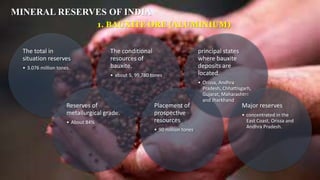
1. BAUXITE ORE (ALUMINIUM)
The total in
situation reserves
• 3.076 million tones.
Reserves of
metallurgical grade.
• About 84%
The conditional
resources of
bauxite.
• about 5, 99,780 tones.
Placement of
prospective
resources
• 90 million tones.
principal states
where bauxite
deposits are
located.
• Orissa, Andhra
Pradesh, Chhattisgarh,
Gujarat, Maharashtra
and Jharkhand
Major reserves
• concentrated in the
East Coast, Orissa and
Andhra Pradesh.
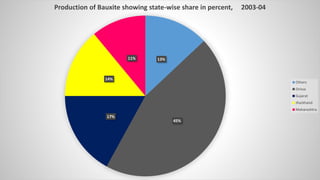
13%
45%
17%
14%
11%
Production of Bauxite showing state-wise share in percent, 2003-04
Others
Orissa
Gujarat
Jharkhand
Maharashtra
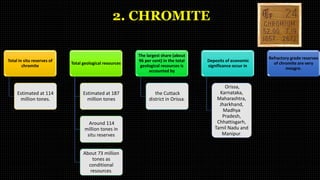
2. CHROMITE
Total in situ reserves of
chromite
Estimated at 114
million tones.
Total geological resources
Estimated at 187
million tones
Around 114
million tones in
situ reserves
About 73 million
tones as
conditional
resources.
The largest share (about
96 per cent) in the total
geological resources is
accounted by
the Cuttack
district in Orissa.
Deposits of economic
significance occur in
Orissa,
Karnataka,
Maharashtra,
Jharkhand,
Madhya
Pradesh,
Chhattisgarh,
Tamil Nadu and
Manipur.
Refractory grade reserves
of chromite are very
meagre.
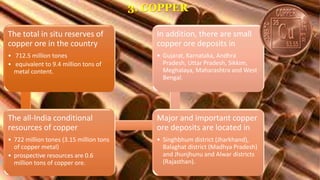
3. COPPER
The total in situ reserves of
copper ore in the country
• 712.5 million tones
• equivalent to 9.4 million tons of
metal content.
The all-India conditional
resources of copper
• 722 million tones (3.15 million tons
of copper metal)
• prospective resources are 0.6
million tons of copper ore.
Major and important copper
ore deposits are located in
• Singhbhum district (Jharkhand),
Balaghat district (Madhya Pradesh)
and Jhunjhunu and Alwar districts
(Rajasthan).
In addition, there are small
copper ore deposits in
• Gujarat, Karnataka, Andhra
Pradesh, Uttar Pradesh, Sikkim,
Meghalaya, Maharashtra and West
Bengal.
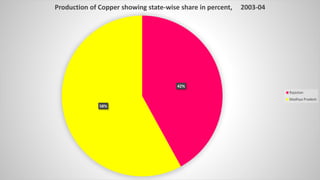
42%
58%
Production of Copper showing state-wise share in percent, 2003-04
Rajastan
Madhya Pradesh
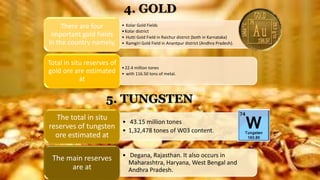
4. GOLD
• Kolar Gold Fields
•Kolar district
• Hutti Gold Field in Raichur district (both in Karnataka)
• Ramgiri Gold Field in Anantpur district (Andhra Pradesh).
There are four
important gold fields
in the country namely,
•22.4 million tones
• with 116.50 tons of metal.
Total in situ reserves of
gold ore are estimated
at
• 43.15 million tones
• 1,32,478 tones of W03 content.
The total in situ
reserves of tungsten
ore estimated at
• Degana, Rajasthan. It also occurs in
Maharashtra, Haryana, West Bengal and
Andhra Pradesh.
The main reserves
are at
5. TUNGSTEN
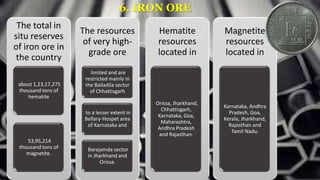
6. IRON ORE
The total in
situ reserves
of iron ore in
the country
about 1,23,17,275
thousand tons of
hematite
53,95,214
thousand tons of
magnetite.
The resources
of very high-
grade ore
limited and are
restricted mainly in
the Bailadila sector
of Chhattisgarh
to a lesser extent in
Bellary-Hospet area
of Karnataka and
Barajamda sector
in Jharkhand and
Orissa.
Hematite
resources
located in
Orissa, Jharkhand,
Chhattisgarh,
Karnataka, Goa,
Maharashtra,
Andhra Pradesh
and Rajasthan.
Magnetite
resources
located in
Karnataka, Andhra
Pradesh, Goa,
Kerala, Jharkhand,
Rajasthan and
Tamil Nadu.
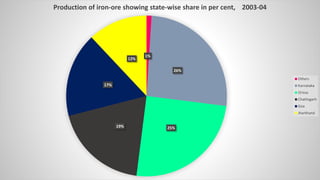
1%
26%
25%19%
17%
12%
Production of iron-ore showing state-wise share in per cent, 2003-04
Others
Karnataka
Orissa
Chattisgarh
Goa
Jharkhand
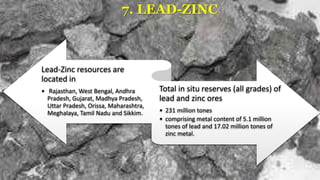
7. LEAD-ZINC
Lead-Zinc resources are
located in
• Rajasthan, West Bengal, Andhra
Pradesh, Gujarat, Madhya Pradesh,
Uttar Pradesh, Orissa, Maharashtra,
Meghalaya, Tamil Nadu and Sikkim.
Total in situ reserves (all grades) of
lead and zinc ores
• 231 million tones
• comprising metal content of 5.1 million
tones of lead and 17.02 million tones of
zinc metal.
8. MANGANESE
• 406 million tones out of which
• 104 million tones are proved,
• 135 million tones are in probable
• 167 million tones are in possible categories.
The total in situ
resources of
manganese ore
• Karnataka, followed by Orissa, Madhya Pradesh,
Maharashtra and Goa.
Main reserves
fall in
• Andhra Pradesh, Jharkhand, Gujarat, Rajasthan and
West Bengal.
Minor
occurrences of
manganese are
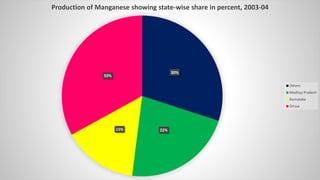
30%
22%15%
33%
Production of Manganese showing state-wise share in percent, 2003-04
Others
Madhya Pradesh
Karnataka
Orissa
9. DIAMOND
Diamond deposits occur in
three types of geological
settings
Kimberlite pipes
Conglomerate
beds
Alluvial gravels
The main diamond bearing
areas in India are
the Panna belt
in Madhya
Pradesh,
Munimadugu-
Banganapalle
conglomerate in
Kurnool district,
Wajrakarur
Kimberlite pipe
in Anantapur
district and the
gravels of
Krishna river
basin in Andhra
Pradesh
Reserves have been
estimated only in the Panna
belt and Krishna Gravels in
Andhra Pradesh.
The total in situ
reserves are
about
26, 43,824
carats
There are conditional
resources of 19, 36,512
carat.
The new kimberlite fields
are discovered recently in
Raichur-Gulbarga districts
of Karnataka.
10. GYPSUM
The in situ reserves of
gypsum are estimated at
383 million tonnes. Out of this,
two millions are of surgical/plaster grade.
92 million tones of fertilizer/pottery grade
76 million tones of cement/ paint grade
13 million tones of soil reclamation grade
the rest is unclassified.
The production of
gypsum is confined to
Rajasthan, Tamil Nadu, Jammu and
Kashmir, and Gujarat.
Rajasthan is the main producer of gypsum
followed by Jammu and Kashmir.
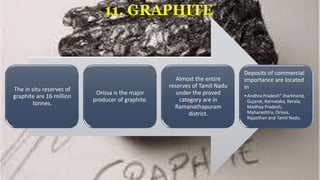
11. GRAPHITE
The in situ reserves of
graphite are 16 million
tonnes.
Orissa is the major
producer of graphite.
Almost the entire
reserves of Tamil Nadu
under the proved
category are in
Ramanathapuram
district.
Deposits of commercial
importance are located
in
•Andhra Pradesh” Jharkhand,
Gujarat, Karnataka, Kerala,
Madhya Pradesh,
Maharashtra, Orissa,
Rajasthan and Tamil Nadu.
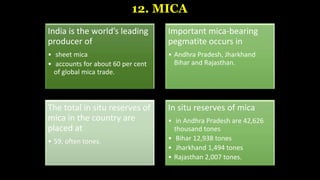
12. MICA
India is the world’s leading
producer of
• sheet mica
• accounts for about 60 per cent
of global mica trade.
Important mica-bearing
pegmatite occurs in
• Andhra Pradesh, Jharkhand
Bihar and Rajasthan.
The total in situ reserves of
mica in the country are
placed at
• 59, often tones.
In situ reserves of mica
• in Andhra Pradesh are 42,626
thousand tones
• Bihar 12,938 tones
• Jharkhand 1,494 tones
• Rajasthan 2,007 tones.
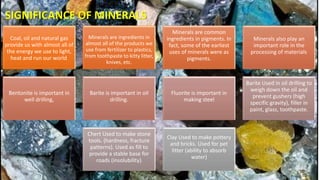
SIGNIFICANCE OF MINERALS
Coal, oil and natural gas
provide us with almost all of
the energy we use to light,
heat and run our world.
Minerals are ingredients in
almost all of the products we
use from fertilizer to plastics,
from toothpaste to kitty litter,
knives, etc.
Minerals are common
ingredients in pigments. In
fact, some of the earliest
uses of minerals were as
pigments.
Minerals also play an
important role in the
processing of materials.
Bentonite is important in
well drilling,
Barite is important in oil
drilling.
Fluorite is important in
making steel
Barite Used in oil drilling to
weigh down the oil and
prevent gushers (high
specific gravity), filler in
paint, glass, toothpaste.
Chert Used to make stone
tools. (hardness, fracture
patterns). Used as fill to
provide a stable base for
roads (insolubility))
Clay Used to make pottery
and bricks. Used for pet
litter (ability to absorb
water)
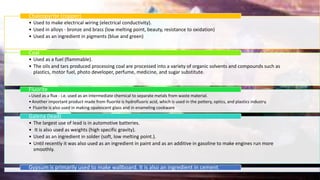
• Used to make electrical wiring (electrical conductivity).
• Used in alloys - bronze and brass (low melting point, beauty, resistance to oxidation)
• Used as an ingredient in pigments (blue and green)
Chalcopyrite (copper)
• Used as a fuel (flammable).
• The oils and tars produced processing coal are processed into a variety of organic solvents and compounds such as
plastics, motor fuel, photo developer, perfume, medicine, and sugar substitute.
Coal
• Used as a flux - i.e. used as an intermediate chemical to separate metals from waste material.
•Another important product made from fluorite is hydrofluoric acid, which is used in the pottery, optics, and plastics industry.
• Fluorite is also used in making opalescent glass and in enameling cookware
Fluorite
• The largest use of lead is in automotive batteries.
• It is also used as weights (high specific gravity).
• Used as an ingredient in solder (soft, low melting point.).
• Until recently it was also used as an ingredient in paint and as an additive in gasoline to make engines run more
smoothly.
Galena (lead)
Gypsum is primarily used to make wallboard. It is also an ingredient in cement.
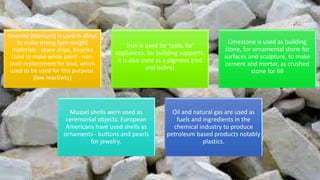
Ilmenite (titanium) is used in alloys
to make strong light-weight
materials - space ships, bicycles
Used to make white paint - non-
toxic replacement for lead, which
used to be used for this purpose.
(low reactivity)
Iron is used for tools, for
appliances, for building supports.
It is also used as a pigment (red
and ochre)
Limestone is used as building
stone, for ornamental stone for
surfaces and sculpture, to make
cement and mortar, as crushed
stone for fill
Mussel shells were used as
ceremonial objects. European
Americans have used shells as
ornaments - buttons and pearls
for jewelry.
Oil and natural gas are used as
fuels and ingredients in the
chemical industry to produce
petroleum based products notably
plastics.
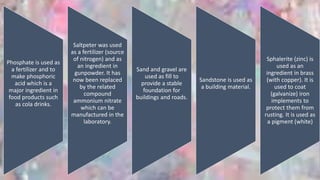
Phosphate is used as
a fertilizer and to
make phosphoric
acid which is a
major ingredient in
food products such
as cola drinks.
Saltpeter was used
as a fertilizer (source
of nitrogen) and as
an ingredient in
gunpowder. It has
now been replaced
by the related
compound
ammonium nitrate
which can be
manufactured in the
laboratory.
Sand and gravel are
used as fill to
provide a stable
foundation for
buildings and roads.
Sandstone is used as
a building material.
Sphalerite (zinc) is
used as an
ingredient in brass
(with copper). It is
used to coat
(galvanize) iron
implements to
protect them from
rusting. It is used as
a pigment (white)
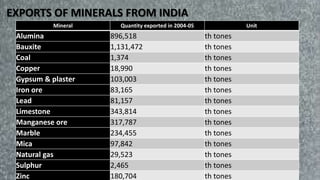
Mineral Quantity exported in 2004-05 Unit
Alumina 896,518 th tones
Bauxite 1,131,472 th tones
Coal 1,374 th tones
Copper 18,990 th tones
Gypsum & plaster 103,003 th tones
Iron ore 83,165 th tones
Lead 81,157 th tones
Limestone 343,814 th tones
Manganese ore 317,787 th tones
Marble 234,455 th tones
Mica 97,842 th tones
Natural gas 29,523 th tones
Sulphur 2,465 th tones
Zinc 180,704 th tones
EXPORTS OF MINERALS FROM INDIA
https://en.wikipedia.org
www.tradingeconomics.com
https://data.gov.in
www.oakton.edu
www.windows2universe.org
www.dave.ucsc.edu
www.hometrainingtools.com
www.open.edu
www.ted.com
www.mgwater.com
www.mtnhigh.com
www.myhdiet.com
www.webmd.com
www.westernsydney.edu.au
REFERENCES
www.academicjournals.org
https://en.wikipedia.org
www.geology.com
https://medlineplus.gov
www.tradingeconomics.com
www.indiatoday.intoday.in
www.ibm.nic.in
www.fedmin.com
www.livemint.com
www.chinamining.org
www.natural-salt-lamps.com
www.sp.lyellcollection.org/content
www.sciencedirect.com
www.eatbalanced.com
https://answers.yahoo.com
www.mgwater.com

Social ppt on minerals

  • 1.
    MINERALS SUBMITTED BY HIMAMOHAMMED SUBMITTED TO KAVITHA MA’AM THE BUILDING BLOCKS OF ROCKS
  • 2.
  • 3.
    INTRODUCTION A homogenous naturallyoccurring substance with a definable internal structure They are non- living, solid, and, like all matter, are made of atoms of elements. There are many different types of minerals and each type is made of particular groups of atoms. The atoms are arranged in a network called a crystal lattice. The lattice of atoms is what gives a mineral its crystal shape. Different types of minerals have different crystal shapes.
  • 4.
    MINERAL RESERVES OFINDIA 1. BAUXITE ORE (ALUMINIUM) The total in situation reserves • 3.076 million tones. Reserves of metallurgical grade. • About 84% The conditional resources of bauxite. • about 5, 99,780 tones. Placement of prospective resources • 90 million tones. principal states where bauxite deposits are located. • Orissa, Andhra Pradesh, Chhattisgarh, Gujarat, Maharashtra and Jharkhand Major reserves • concentrated in the East Coast, Orissa and Andhra Pradesh.
  • 5.
    13% 45% 17% 14% 11% Production of Bauxiteshowing state-wise share in percent, 2003-04 Others Orissa Gujarat Jharkhand Maharashtra
  • 6.
    2. CHROMITE Total insitu reserves of chromite Estimated at 114 million tones. Total geological resources Estimated at 187 million tones Around 114 million tones in situ reserves About 73 million tones as conditional resources. The largest share (about 96 per cent) in the total geological resources is accounted by the Cuttack district in Orissa. Deposits of economic significance occur in Orissa, Karnataka, Maharashtra, Jharkhand, Madhya Pradesh, Chhattisgarh, Tamil Nadu and Manipur. Refractory grade reserves of chromite are very meagre.
  • 7.
    3. COPPER The totalin situ reserves of copper ore in the country • 712.5 million tones • equivalent to 9.4 million tons of metal content. The all-India conditional resources of copper • 722 million tones (3.15 million tons of copper metal) • prospective resources are 0.6 million tons of copper ore. Major and important copper ore deposits are located in • Singhbhum district (Jharkhand), Balaghat district (Madhya Pradesh) and Jhunjhunu and Alwar districts (Rajasthan). In addition, there are small copper ore deposits in • Gujarat, Karnataka, Andhra Pradesh, Uttar Pradesh, Sikkim, Meghalaya, Maharashtra and West Bengal.
  • 8.
    42% 58% Production of Coppershowing state-wise share in percent, 2003-04 Rajastan Madhya Pradesh
  • 9.
    4. GOLD • KolarGold Fields •Kolar district • Hutti Gold Field in Raichur district (both in Karnataka) • Ramgiri Gold Field in Anantpur district (Andhra Pradesh). There are four important gold fields in the country namely, •22.4 million tones • with 116.50 tons of metal. Total in situ reserves of gold ore are estimated at • 43.15 million tones • 1,32,478 tones of W03 content. The total in situ reserves of tungsten ore estimated at • Degana, Rajasthan. It also occurs in Maharashtra, Haryana, West Bengal and Andhra Pradesh. The main reserves are at 5. TUNGSTEN
  • 10.
    6. IRON ORE Thetotal in situ reserves of iron ore in the country about 1,23,17,275 thousand tons of hematite 53,95,214 thousand tons of magnetite. The resources of very high- grade ore limited and are restricted mainly in the Bailadila sector of Chhattisgarh to a lesser extent in Bellary-Hospet area of Karnataka and Barajamda sector in Jharkhand and Orissa. Hematite resources located in Orissa, Jharkhand, Chhattisgarh, Karnataka, Goa, Maharashtra, Andhra Pradesh and Rajasthan. Magnetite resources located in Karnataka, Andhra Pradesh, Goa, Kerala, Jharkhand, Rajasthan and Tamil Nadu.
  • 11.
    1% 26% 25%19% 17% 12% Production of iron-oreshowing state-wise share in per cent, 2003-04 Others Karnataka Orissa Chattisgarh Goa Jharkhand
  • 12.
    7. LEAD-ZINC Lead-Zinc resourcesare located in • Rajasthan, West Bengal, Andhra Pradesh, Gujarat, Madhya Pradesh, Uttar Pradesh, Orissa, Maharashtra, Meghalaya, Tamil Nadu and Sikkim. Total in situ reserves (all grades) of lead and zinc ores • 231 million tones • comprising metal content of 5.1 million tones of lead and 17.02 million tones of zinc metal.
  • 13.
    8. MANGANESE • 406million tones out of which • 104 million tones are proved, • 135 million tones are in probable • 167 million tones are in possible categories. The total in situ resources of manganese ore • Karnataka, followed by Orissa, Madhya Pradesh, Maharashtra and Goa. Main reserves fall in • Andhra Pradesh, Jharkhand, Gujarat, Rajasthan and West Bengal. Minor occurrences of manganese are
  • 14.
    30% 22%15% 33% Production of Manganeseshowing state-wise share in percent, 2003-04 Others Madhya Pradesh Karnataka Orissa
  • 15.
    9. DIAMOND Diamond depositsoccur in three types of geological settings Kimberlite pipes Conglomerate beds Alluvial gravels The main diamond bearing areas in India are the Panna belt in Madhya Pradesh, Munimadugu- Banganapalle conglomerate in Kurnool district, Wajrakarur Kimberlite pipe in Anantapur district and the gravels of Krishna river basin in Andhra Pradesh Reserves have been estimated only in the Panna belt and Krishna Gravels in Andhra Pradesh. The total in situ reserves are about 26, 43,824 carats There are conditional resources of 19, 36,512 carat. The new kimberlite fields are discovered recently in Raichur-Gulbarga districts of Karnataka.
  • 16.
    10. GYPSUM The insitu reserves of gypsum are estimated at 383 million tonnes. Out of this, two millions are of surgical/plaster grade. 92 million tones of fertilizer/pottery grade 76 million tones of cement/ paint grade 13 million tones of soil reclamation grade the rest is unclassified. The production of gypsum is confined to Rajasthan, Tamil Nadu, Jammu and Kashmir, and Gujarat. Rajasthan is the main producer of gypsum followed by Jammu and Kashmir.
  • 17.
    11. GRAPHITE The insitu reserves of graphite are 16 million tonnes. Orissa is the major producer of graphite. Almost the entire reserves of Tamil Nadu under the proved category are in Ramanathapuram district. Deposits of commercial importance are located in •Andhra Pradesh” Jharkhand, Gujarat, Karnataka, Kerala, Madhya Pradesh, Maharashtra, Orissa, Rajasthan and Tamil Nadu.
  • 18.
    12. MICA India isthe world’s leading producer of • sheet mica • accounts for about 60 per cent of global mica trade. Important mica-bearing pegmatite occurs in • Andhra Pradesh, Jharkhand Bihar and Rajasthan. The total in situ reserves of mica in the country are placed at • 59, often tones. In situ reserves of mica • in Andhra Pradesh are 42,626 thousand tones • Bihar 12,938 tones • Jharkhand 1,494 tones • Rajasthan 2,007 tones.
  • 19.
    SIGNIFICANCE OF MINERALS Coal,oil and natural gas provide us with almost all of the energy we use to light, heat and run our world. Minerals are ingredients in almost all of the products we use from fertilizer to plastics, from toothpaste to kitty litter, knives, etc. Minerals are common ingredients in pigments. In fact, some of the earliest uses of minerals were as pigments. Minerals also play an important role in the processing of materials. Bentonite is important in well drilling, Barite is important in oil drilling. Fluorite is important in making steel Barite Used in oil drilling to weigh down the oil and prevent gushers (high specific gravity), filler in paint, glass, toothpaste. Chert Used to make stone tools. (hardness, fracture patterns). Used as fill to provide a stable base for roads (insolubility)) Clay Used to make pottery and bricks. Used for pet litter (ability to absorb water)
  • 20.
    • Used tomake electrical wiring (electrical conductivity). • Used in alloys - bronze and brass (low melting point, beauty, resistance to oxidation) • Used as an ingredient in pigments (blue and green) Chalcopyrite (copper) • Used as a fuel (flammable). • The oils and tars produced processing coal are processed into a variety of organic solvents and compounds such as plastics, motor fuel, photo developer, perfume, medicine, and sugar substitute. Coal • Used as a flux - i.e. used as an intermediate chemical to separate metals from waste material. •Another important product made from fluorite is hydrofluoric acid, which is used in the pottery, optics, and plastics industry. • Fluorite is also used in making opalescent glass and in enameling cookware Fluorite • The largest use of lead is in automotive batteries. • It is also used as weights (high specific gravity). • Used as an ingredient in solder (soft, low melting point.). • Until recently it was also used as an ingredient in paint and as an additive in gasoline to make engines run more smoothly. Galena (lead) Gypsum is primarily used to make wallboard. It is also an ingredient in cement.
  • 21.
    Ilmenite (titanium) isused in alloys to make strong light-weight materials - space ships, bicycles Used to make white paint - non- toxic replacement for lead, which used to be used for this purpose. (low reactivity) Iron is used for tools, for appliances, for building supports. It is also used as a pigment (red and ochre) Limestone is used as building stone, for ornamental stone for surfaces and sculpture, to make cement and mortar, as crushed stone for fill Mussel shells were used as ceremonial objects. European Americans have used shells as ornaments - buttons and pearls for jewelry. Oil and natural gas are used as fuels and ingredients in the chemical industry to produce petroleum based products notably plastics.
  • 22.
    Phosphate is usedas a fertilizer and to make phosphoric acid which is a major ingredient in food products such as cola drinks. Saltpeter was used as a fertilizer (source of nitrogen) and as an ingredient in gunpowder. It has now been replaced by the related compound ammonium nitrate which can be manufactured in the laboratory. Sand and gravel are used as fill to provide a stable foundation for buildings and roads. Sandstone is used as a building material. Sphalerite (zinc) is used as an ingredient in brass (with copper). It is used to coat (galvanize) iron implements to protect them from rusting. It is used as a pigment (white)
  • 23.
    Mineral Quantity exportedin 2004-05 Unit Alumina 896,518 th tones Bauxite 1,131,472 th tones Coal 1,374 th tones Copper 18,990 th tones Gypsum & plaster 103,003 th tones Iron ore 83,165 th tones Lead 81,157 th tones Limestone 343,814 th tones Manganese ore 317,787 th tones Marble 234,455 th tones Mica 97,842 th tones Natural gas 29,523 th tones Sulphur 2,465 th tones Zinc 180,704 th tones EXPORTS OF MINERALS FROM INDIA
  • 24.
  • 25.