INTRODUCTION
• Copper isan important industrial metal that has been used by human civilizations for
thousands of years due to its excellent electrical and thermal conductivity, high
ductility, and resistance to corrosion.
• Copper is widely used in various applications, including electrical wiring, plumbing,
construction, transportation, and electronics, making it a critical component of
modern society.
COPPER AS AN ELEMENT
Periodic symbol: Cu.
Density: 8930kg/m3.
Melting point: 1083˚C.
Thermal expansion: 0.0168mm/m/˚C (20-100˚).
Tensile strength: 210 - 240 N/mm2
Geological Settings &Distribution
Jharkhand
• A. Singhbhum Cu belt: Archean quartz-chlorite-biotite schist, Metamorphosed
basin Rocks, Soda granite.
• ore mineralization within the Singhbhum Copper Belt has taken place in more
than one rock type
• The belt extend for 120 km in length and width ranges up to 5 km.
• Prominent areas: Mosabani, Surda, Rakha, Jaduguda, Pathargora
5.
Geological Settings &Distribution
• B. Hesatu-Belbhatan belt: Tremolite, Actinolite, Schist, Calcareous granulite
and amphibolite
• Mineralization occurs as lenses and pockets within Chota Nagpur granite gneiss.
• The belt extend for 250 km in length and width ranges up to 50 km.
• Prominent areas: Gaganpur, Tulsinath etc.
6.
Geological Settings &Distribution
Rajasthan
• A. Khetri Cu belt: Pre-Aravalli and Aravalli rocks of Delhi supergroup
• Mineralization is along structural zones related to different orogenic belts
• The belt extend for 80 km in length
• Prominent areas: Khetri, Kolihan, Madan-Khudan, Chandmari etc.
• B. Pur-Banera Bhander: Dariba, Distt Alwar
7.
Geological Settings &Distribution
Madhya Pradesh
• A. Malanjkhand Cu deposit: Balaghat distt.
• Quartz reef in Bundelkhand granite complex overlain by the Pre-Cambrian
meta-sediments of Chilpi ghat formations with an erosional unconformity.
• The mineralization in steep dipping in liner bodies of quartz reefs is controlled
structurally(shear & fracture plains)
8.
Geological Settings &Distribution
Karnataka
• Cu deposit: Chitradurga, Hassan in Karnataka
• Dharwar schist belt occasionally associated with basic dykes and other
intrusions in Peninsular Gnessic Basement.
• Mineralization along shear through fracture in quartz veins.
9.
Geological Settings &Distribution
Andhra Pradesh
• A. Cu deposit: Khammam, Kurnool,
• (Archean schist and gneiss)
• Mineralization in quartz reefs
• A. Cu deposit: Agnigundala, Guntur distt.,
• Cuddappah Supergroup(Calcareous quartzite and dolomite) of Cumbum
formation
INTRODUCTION
• First minednear about 6000 years ago.
• Gold is a transitional metal. In its purest form have reddish yellow color, soft,
malleable, and ductile metal.
• Atomic no. 79
• Atomic mass 196.9 u
• Density 19.32 g/cm3
• Melting point 1,064 °C
• Boiling point 2,700 °C
• Most of the gold occur in native state.
12.
Mineralogy
Mineral Composition %
ClaveriteAuTe2 Small amount of Ag
Sylvanite AgAuTe2
Ag 13.4-Au 24.4-Te
62.1
Krennerite AuTe2
Petzite Ag3AuTe2 Ag-Au 3:1
Nagyazite AuPb(Sb,Bi)Te2-3S6
The minerals of gold
called as Gold
Tellurides.
Gangue mineral:
Quartz, carbonate,
tourmaline, Fluorite,
Non-metallic
Association: Ag, Cu, Bi,
Hg
13.
Geological Settings &Distribution
• Lode Deposits in India(Primary in Nature)
• The primary Au deposits occur in intrusive rocks(Dyke) having composition of
Diorite, Granite and their metamorphic equivalent.
• Placer Deposits in India:
• It deposits in association with sand, gravel and conglomerate.
14.
Geological Settings &Distribution
In India, gold mineralization of economic importance is mainly restricted to Archean
greenstone terranes of the Dharwar Craton (DC).
The eastern block of the DC has a high favorability for hosting major gold deposits such as
Kolar, Hutti, and Ramagiri, whereas the western block hosts only a few smaller deposits
such as Gadag, Kempinkote and Ajjahanahalli.
Gold also discovered by GSI in the Singbhum Craton, Aravalli Craton, Bastar Craton and
Southern Granulite Terrain (SGT).
15.
Geological Settings &Distribution
DHARWAR Age(Karnataka)
• Kolar Gold Fields: Lode Deposit- Principal Deposit
• is second deepest mines in the world after Mponeng is south
Africa (3.9 km).
• two types of gold mineralization i.e. gold- quartz and gold-sulphide-quartz lode
have been identified from this belt.
• Control of mineralization is structural control (shear zones)
16.
Geological Settings &Distribution
DHARWAR Age(Karnataka)
• Hutti Gold Fields: Principal Deposits
• The host rocks are amphibolite and gneiss with quartz vein and quartz lode
sulphide.
• One of the major gold producer mine in India,
17.
DHARWAR Age(Karnataka)
• Ramgiri-Anantpur:Potential Deposits
• Schistose rocks
• Gadag deposits
• Quartz veins
Kerala
• The gold prospects in SGTSouthern Granulite Terrain (SGT) can be broadly grouped into three
provinces
• Wynad-Nilgiri
• Malappuram
• Attappadi
• Gold mineralization is associated with primary quartz veins, placerand
laterite.
Bihar
• Kundrakocha:
• Quartz reef with in cherty phyllite and Fe-ore formations.
18.
Geological Settings &Distribution
Minor Occurrence(Dharwar Age)
• These include numerous occurrence in Anantpur, Kurnool(A.P.)
• Nalanda, Sonapet (Ranchi)
• Singhbhum (Jharkhand)
• Jamnagar (Gujrat)
• Kenoor (Kerala)
19.
Geological Settings &Distribution
Placer Deposits(Pliestocene & Recent Age)
• Placer deposits are found in alluvial and gravel beds of many river in parts of
Assam, Bihar, Jharkhand and H.P. etc.
• The river as Subansiri, Lohit, Poni of Assam and Arunachal Pradesh.
• Sona river, Subarnarekha of Singhbhum(Jharkhand) and many others streams
in different parts of the country have yielded gold.
20.
Geological Settings &Distribution
Rajasthan
• The occurrence of gold, has been postulated in the Paleoproterozoic belt
extending from Nathdwara in the North to Jhabua in Madhya Pradesh in the
South, related to greenstone belts.
INTRODUCTION
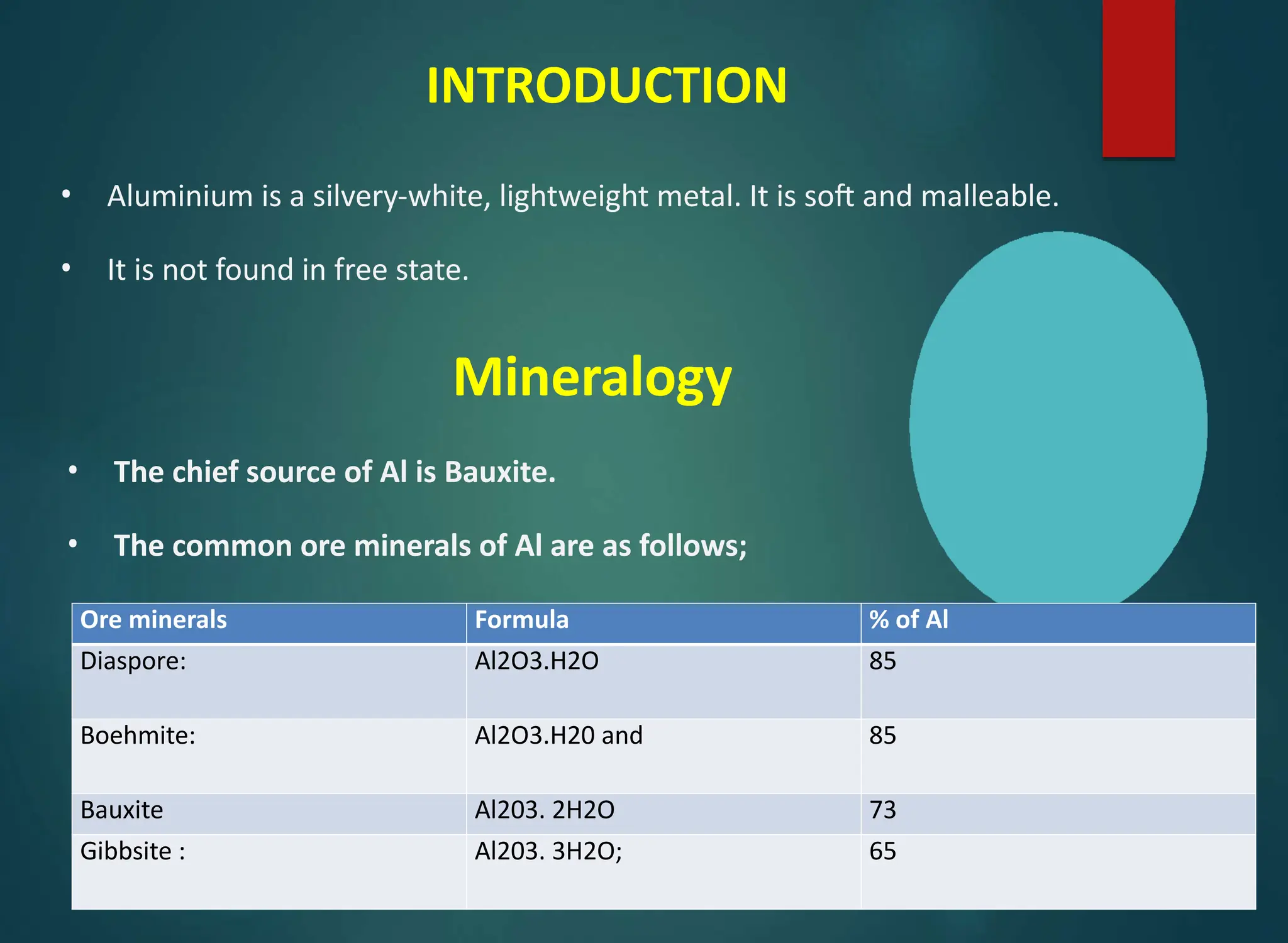
• Aluminium isa silvery-white, lightweight metal. It is soft and malleable.
• It is not found in free state.
Mineralogy
• The chief source of Al is Bauxite.
• The common ore minerals of Al are as follows;
Ore minerals Formula % of Al
Diaspore: Al2O3.H2O 85
Boehmite: Al2O3.H20 and 85
Bauxite Al203. 2H2O 73
Gibbsite : Al203. 3H2O; 65
23.
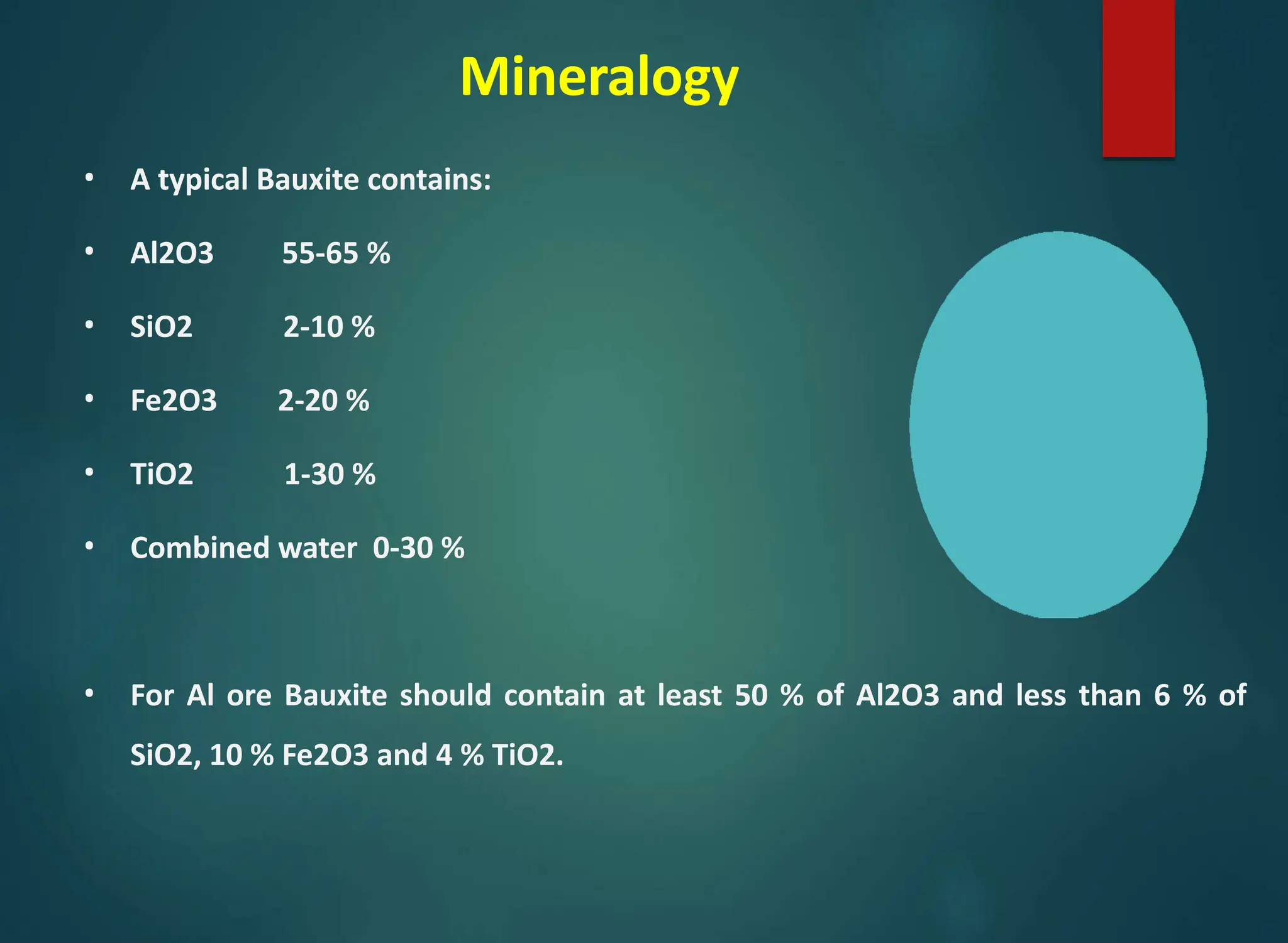
Mineralogy
• A typicalBauxite contains:
• Al2O3 55-65 %
• SiO2 2-10 %
• Fe2O3 2-20 %
• TiO2 1-30 %
• Combined water 0-30 %
• For Al ore Bauxite should contain at least 50 % of Al2O3 and less than 6 % of
SiO2, 10 % Fe2O3 and 4 % TiO2.
24.
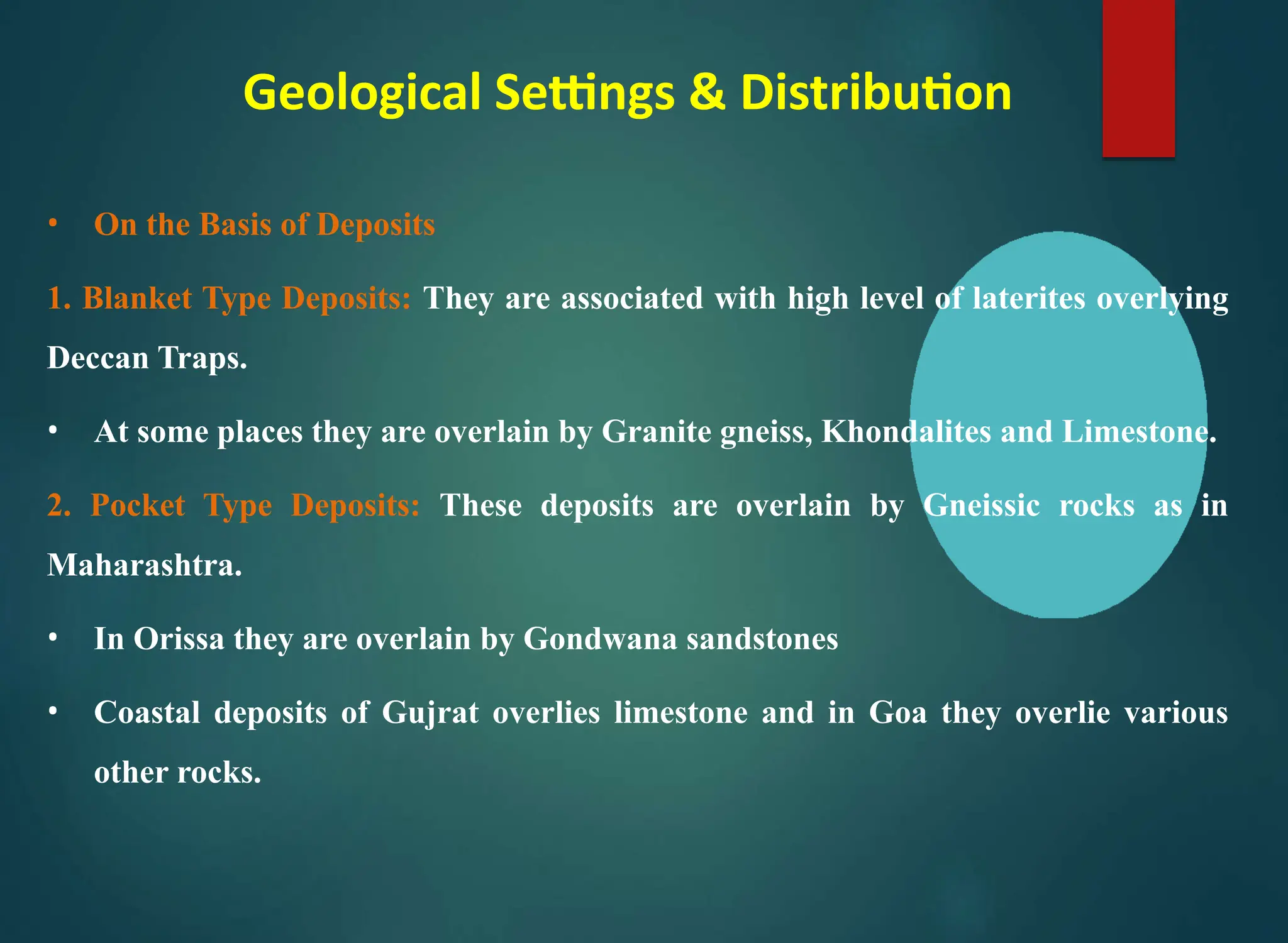
Geological Settings &Distribution
• On the Basis of Deposits
1. Blanket Type Deposits: They are associated with high level of laterites overlying
Deccan Traps.
• At some places they are overlain by Granite gneiss, Khondalites and Limestone.
2. Pocket Type Deposits: These deposits are overlain by Gneissic rocks as in
Maharashtra.
• In Orissa they are overlain by Gondwana sandstones
• Coastal deposits of Gujrat overlies limestone and in Goa they overlie various
other rocks.
25.
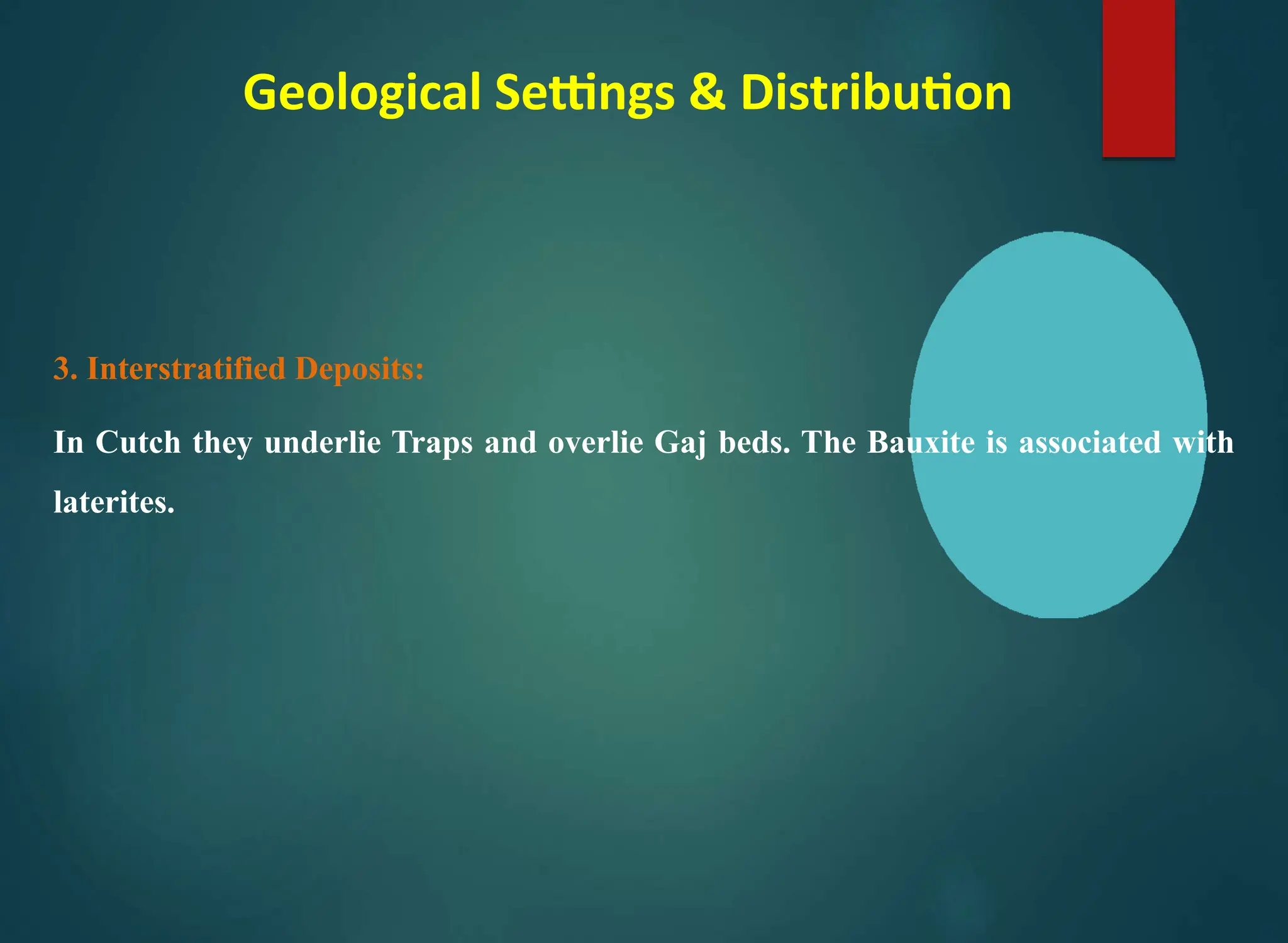
Geological Settings &Distribution
3. Interstratified Deposits:
In Cutch they underlie Traps and overlie Gaj beds. The Bauxite is associated with
laterites.
26.
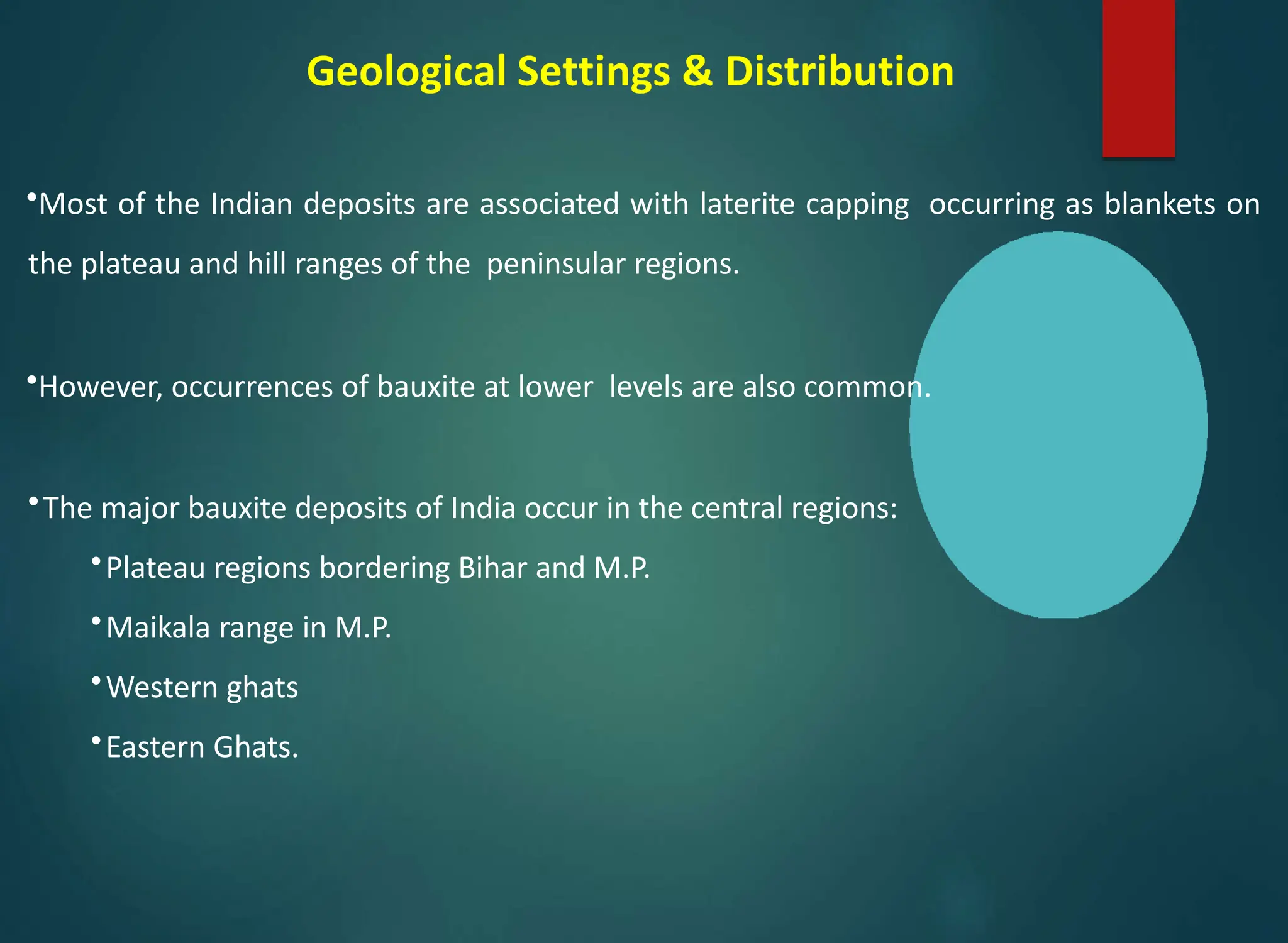
•Most of theIndian deposits are associated with laterite capping occurring as blankets on
the plateau and hill ranges of the peninsular regions.
•However, occurrences of bauxite at lower levels are also common.
•The major bauxite deposits of India occur in the central regions:
•Plateau regions bordering Bihar and M.P.
•Maikala range in M.P.
•Western ghats
•Eastern Ghats.
27.
Geological Settings &Distribution
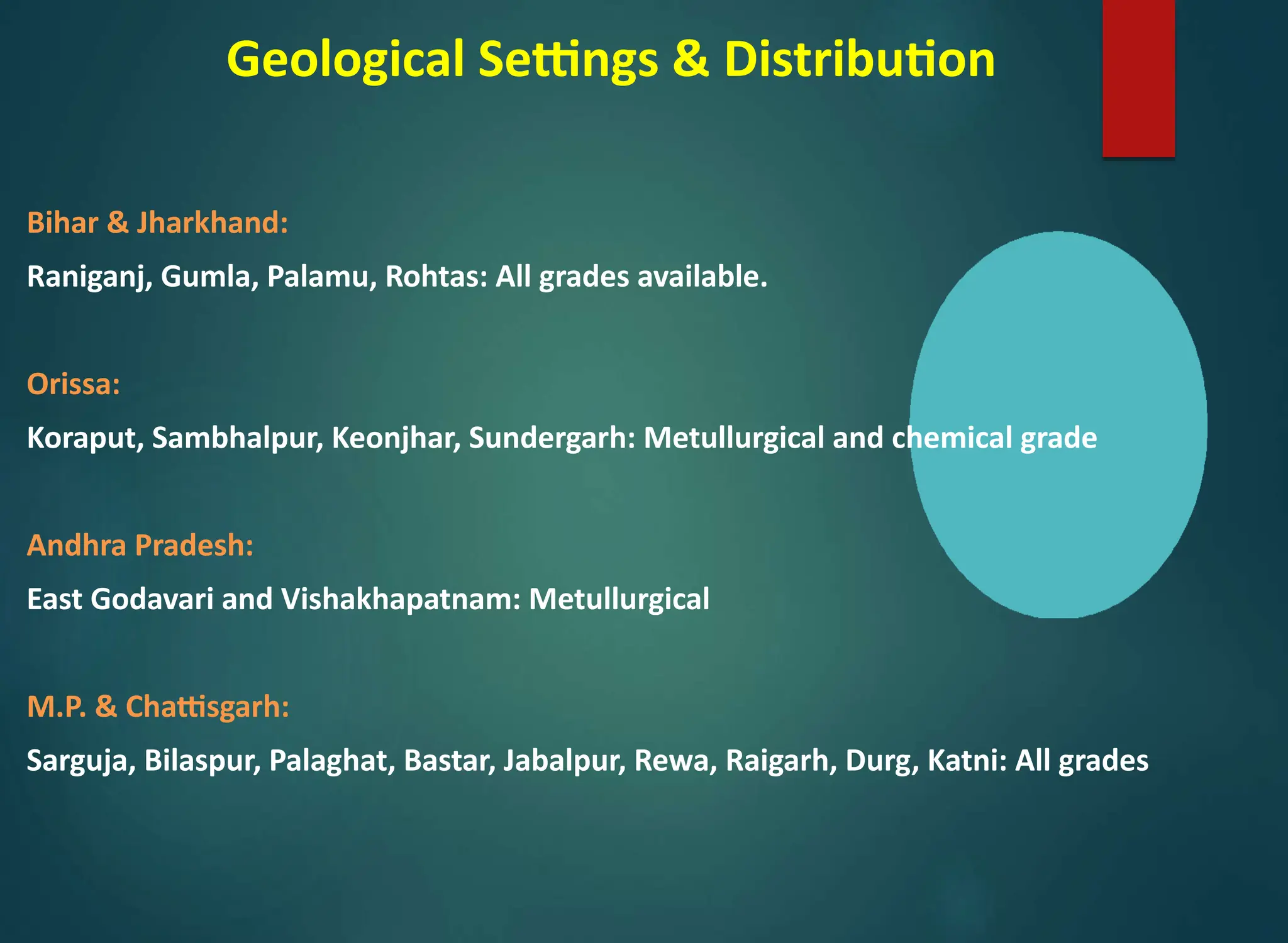
Bihar & Jharkhand:
Raniganj, Gumla, Palamu, Rohtas: All grades available.
Orissa:
Koraput, Sambhalpur, Keonjhar, Sundergarh: Metullurgical and chemical grade
Andhra Pradesh:
East Godavari and Vishakhapatnam: Metullurgical
M.P. & Chattisgarh:
Sarguja, Bilaspur, Palaghat, Bastar, Jabalpur, Rewa, Raigarh, Durg, Katni: All grades
28.
Geological Settings &Distribution
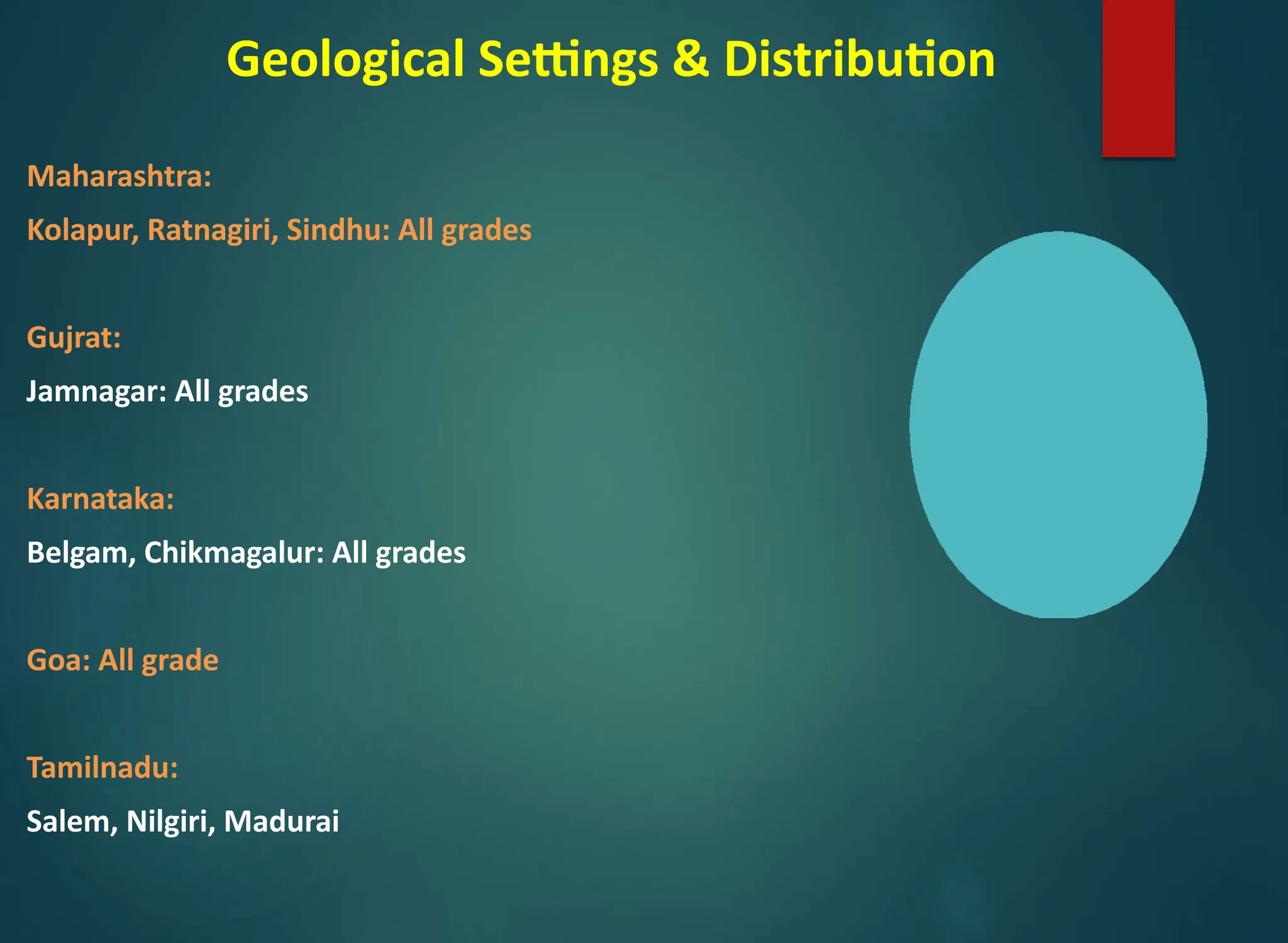
Maharashtra:
Kolapur, Ratnagiri, Sindhu: All grades
Gujrat:
Jamnagar: All grades
Karnataka:
Belgam, Chikmagalur: All grades
Goa: All grade
Tamilnadu:
Salem, Nilgiri, Madurai
29.
Geological Settings &Distribution
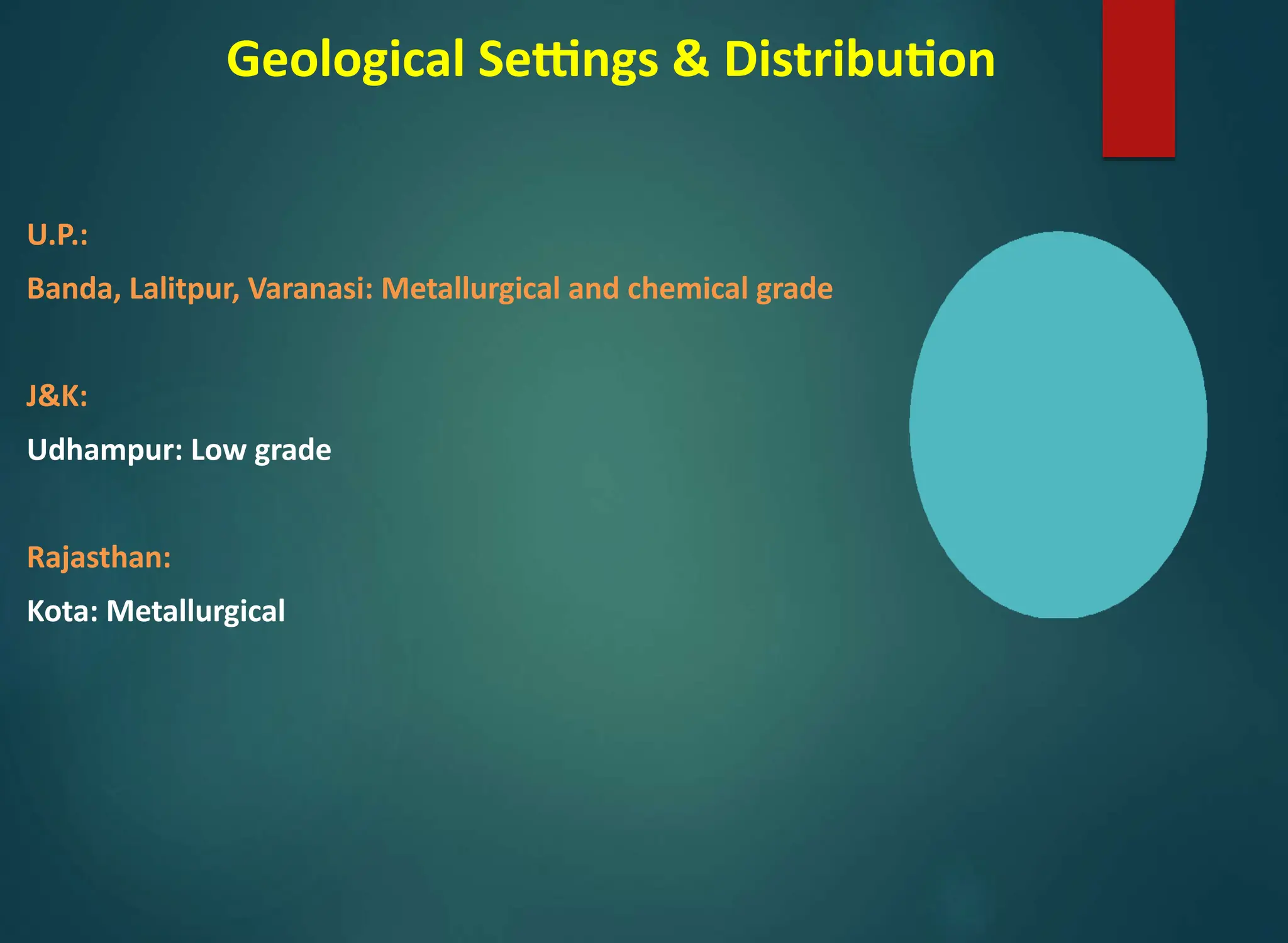
U.P.:
Banda, Lalitpur, Varanasi: Metallurgical and chemical grade
J&K:
Udhampur: Low grade
Rajasthan:
Kota: Metallurgical
INTRODUCTION
• Lead isa soft, malleable poor metal, It is also counted
asone of the heavymetals.
• zinc is one of the most important metal for commercial
use.
• In the base metal category, Pb-Zn ores occur together in close association.
32.
Mineralogy
LEAD
• Lead(Pb) doesnot occur in native state but at some places there are rare
occurrences of native lead.
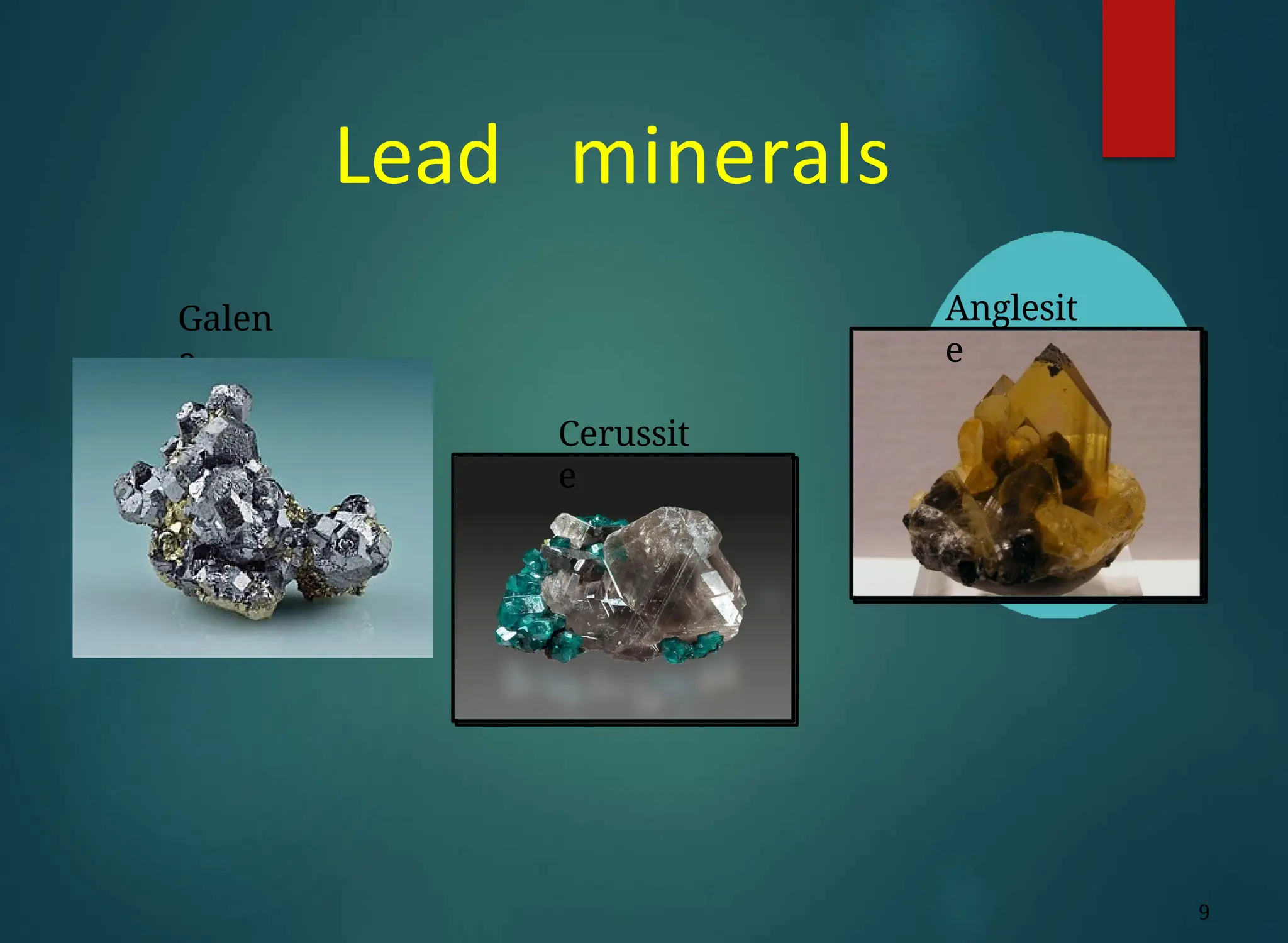
• The common ore minerals of lead are as follows;
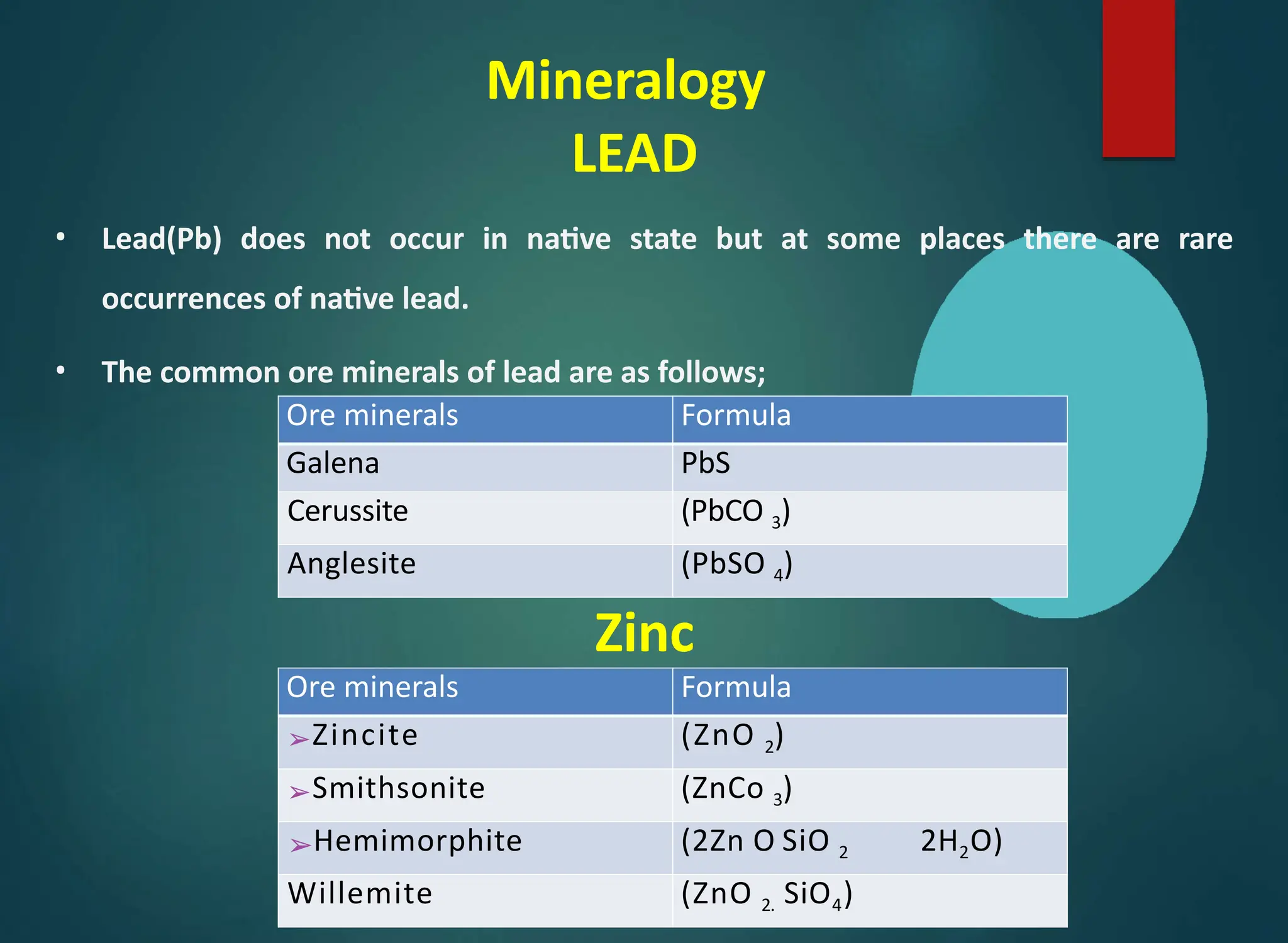
Ore minerals Formula
Galena PbS
Cerussite (PbCO 3)
Anglesite (PbSO 4)
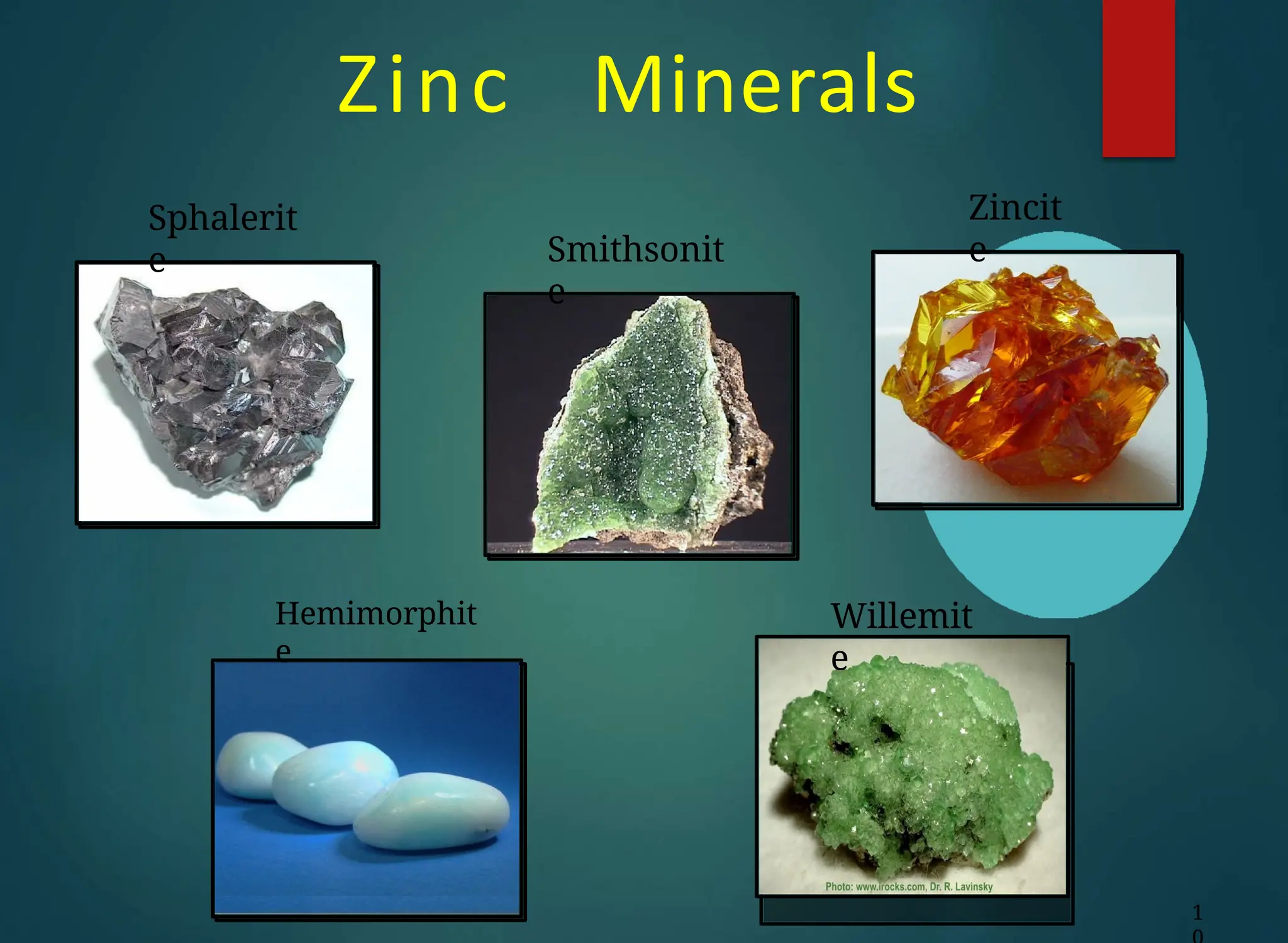
Zinc
Ore minerals Formula
➢Zincite (ZnO 2)
➢Smithsonite (ZnCo 3)
➢Hemimorphite (2Zn O SiO 2 2H2O)
Willemite (ZnO 2. SiO4)
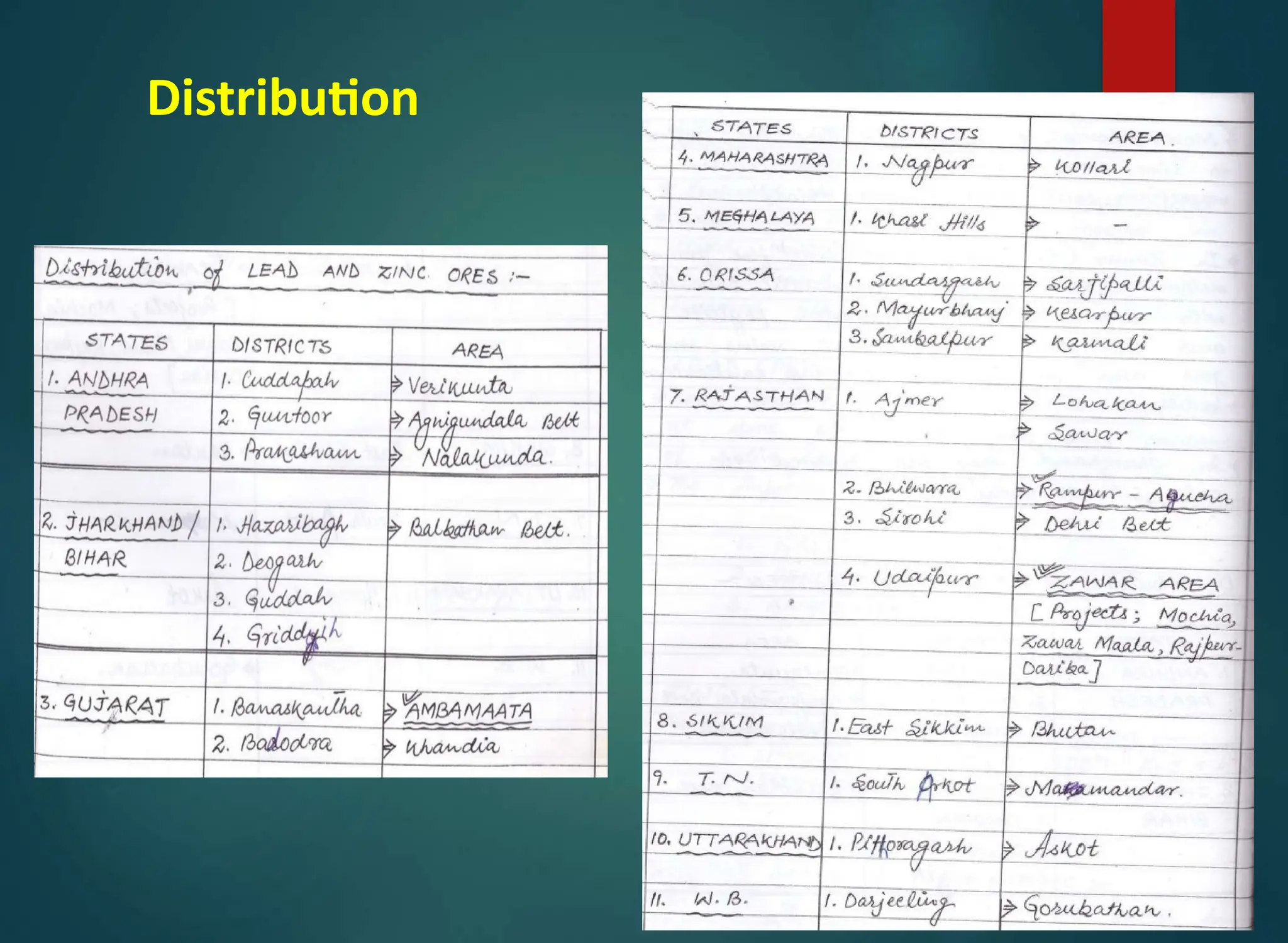
Geological Settings &Distribution
• As Pb-Zn ores found in close association and are oxidized in the upper part into oxysalt.
• Most deposits of Pb-Zn are confined to limestone, dolomite and other calc-magnesium rich rocks.
(Zawar mine)
• Cavity filling deposits – formed from the solution of minerals in rock openings, include fissure vein,
shear zone, fold crack or solution cavity deposits
• Eg: Zawar Lead-Zinc deposits in Rajasthan
• The deposits occurs in the dolomite rock of mochia member of Tiri
series, which belongs to Aravalli systemof Precambrian in age.
• The other rocks of the area are mainly phyllite, greywacke, quartzite and rarely
conglomerate.
• In Jharkhand they are limited to calc-silicate rocks.