Long Island University | April 6th, 2018
LC-MS/MS Basics
Ben Kuzma
Long Island University | April 6th, 2018
Objectives
• Introduce basic MS concepts
• Explain the fundamentals of MS
• Demonstrate the benefits of different systems
• Method Development using concepts
Long Island University | April 6th, 2018
Key Terms
• Parent Ion (Precursor ion)
• Daughter Ion (fragment ion)
• MS/MS
• MRM
http://www.waters.com/webassets/cms/library/docs/720000807en.pdf
Long Island University | April 6th, 2018
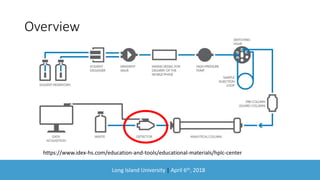
Overview
https://www.idex-hs.com/education-and-tools/educational-materials/hplc-center
Long Island University | April 6th, 2018
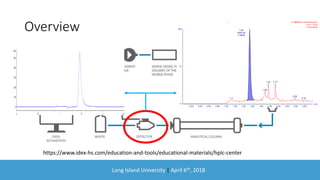
Overview
https://www.idex-hs.com/education-and-tools/educational-materials/hplc-center
min
0.20 0.40 0.60 0.80 1.00 1.20 1.40 1.60 1.80 2.00 2.20 2.40 2.60 2.80
%
0
100
F1:MRM of 2 channels,ES+
172 > 127.9
Metronidazole_400pg_ml_Lot_1_2 Smooth(Mn,1x2)
Metronidazole 400pg/ml
1.221e+005Metronidazole
1.54
5460.39
116590
1.11
2.131.97
1.89
2.58
2.79
Long Island University | April 6th, 2018
Why use LCMS?
• Selectivity
• Lidocaine and Prilocaine
• Elute with 0.1 minutes of each other
• Speed (UHPLC)
• HPLC Run time – 5-20 minutes
• UHPLC Run time 3 minutes
• Sensitivity
• HPLC LLOQ - 10 ng/ml
• LCMS/MS – 400 pg/ml (0.4ng/ml)
• 25 fold difference
Long Island University | April 6th, 2018
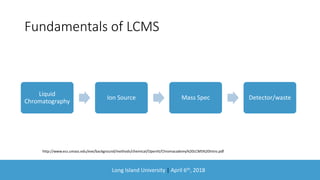
Fundamentals of LCMS
• How does it work?
• Mass to charge ratio (m/z)
• Ionization Methods
• Electrospray ionization (ESI)
• Atmospheric Pressure Chemical ionization (APCI)
• Atmospheric pressure photoionization (APPI)
Long Island University | April 6th, 2018
Fundamentals of LCMS
Liquid
Chromatography
Ion Source Mass Spec Detector/waste
http://www.ecs.umass.edu/eve/background/methods/chemical/Openlit/Chromacademy%20LCMS%20Intro.pdf
Long Island University | April 6th, 2018
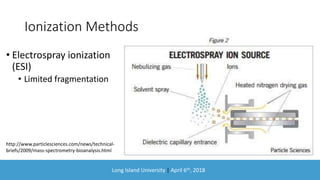
Ionization Methods
• Electrospray ionization
(ESI)
• Limited fragmentation
http://www.particlesciences.com/news/technical-
briefs/2009/mass-spectrometry-bioanalysis.html
Long Island University | April 6th, 2018
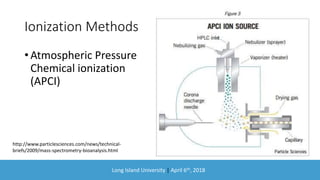
Ionization Methods
• Atmospheric Pressure
Chemical ionization
(APCI)
http://www.particlesciences.com/news/technical-
briefs/2009/mass-spectrometry-bioanalysis.html
Long Island University | April 6th, 2018
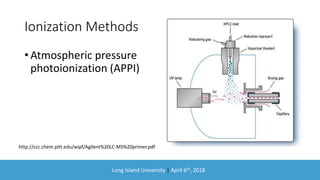
Ionization Methods
• Atmospheric pressure
photoionization (APPI)
http://ccc.chem.pitt.edu/wipf/Agilent%20LC-MS%20primer.pdf
Long Island University | April 6th, 2018
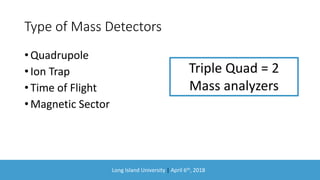
Type of Mass Detectors
• Quadrupole
• Ion Trap
• Time of Flight
• Magnetic Sector
Triple Quad = 2
Mass analyzers
Long Island University | April 6th, 2018
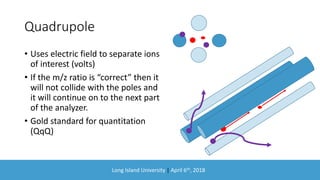
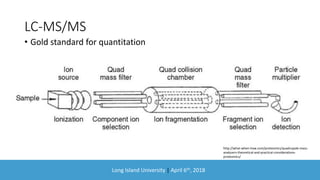
Quadrupole
• Uses electric field to separate ions
of interest (volts)
• If the m/z ratio is “correct” then it
will not collide with the poles and
it will continue on to the next part
of the analyzer.
• Gold standard for quantitation
(QqQ)
Long Island University | April 6th, 2018
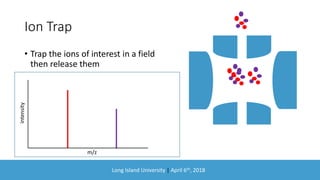
Ion Trap
• Trap the ions of interest in a field
then release them
m/z
intensity
Long Island University | April 6th, 2018
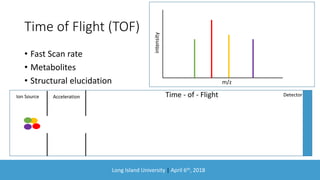
Time of Flight (TOF)
• Fast Scan rate
• Metabolites
• Structural elucidation m/z
intensity
F
Ion Source Acceleration Time - of - Flight Detector
Long Island University | April 6th, 2018
LC-MS/MS
• Gold standard for quantitation
http://what-when-how.com/proteomics/quadrupole-mass-
analyzers-theoretical-and-practical-considerations-
proteomics/
Long Island University | April 6th, 2018
Application of Fundamentals
Long Island University | April 6th, 2018
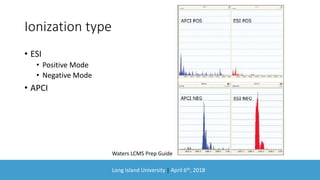
Ionization type
• ESI
• Positive Mode
• Negative Mode
• APCI
Waters LCMS Prep Guide
Long Island University | April 6th, 2018
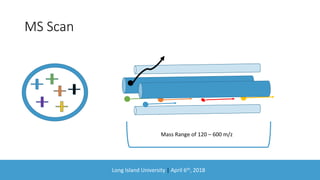
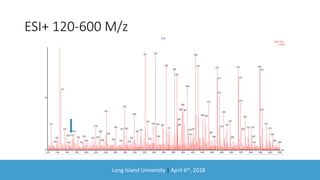
MS Scan
Mass Range of 120 – 600 m/z
Long Island University | April 6th, 2018
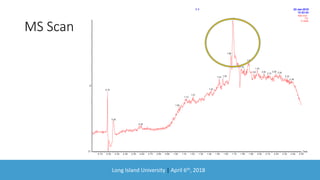
MS Scan
Long Island University | April 6th, 2018
ESI+ 120-600 M/z
Long Island University | April 6th, 2018
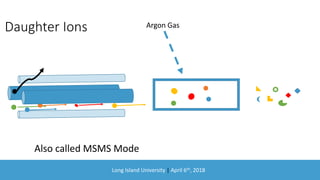
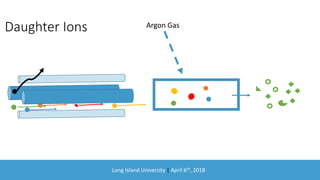
Daughter Ions Argon Gas
Also called MSMS Mode
Long Island University | April 6th, 2018
Daughter Ions
Long Island University | April 6th, 2018
Daughter Ions
Long Island University | April 6th, 2018
Daughter Ions Argon Gas
Long Island University | April 6th, 2018
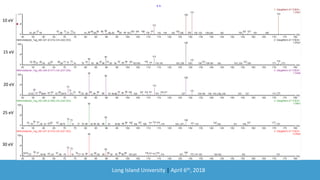
10 eV
15 eV
20 eV
25 eV
30 eV
Long Island University | April 6th, 2018
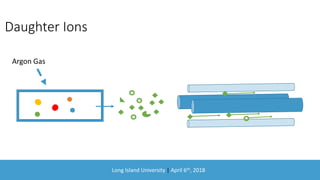
Daughter Ions
Argon Gas
Long Island University | April 6th, 2018
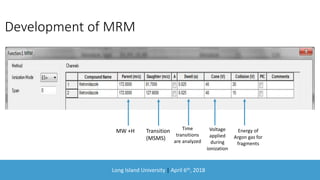
Development of MRM
MW +H Transition
(MSMS)
Time
transitions
are analyzed
Voltage
applied
during
ionization
Energy of
Argon gas for
fragments
Long Island University | April 6th, 2018
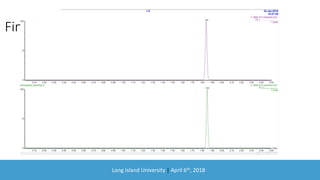
Final Product of MRM
Questions?
Resources
• http://ccc.chem.pitt.edu/wipf/Waters%20LC-MS%20primer.pdf
• http://www.ecs.umass.edu/eve/background/methods/chemical/Ope
nlit/Chromacademy%20LCMS%20Intro.pdf
• http://www.rsc.org/images/AMC%20LCMS%20Guide_tcm18-
240030.pdf

Lcms Basics

  • 1.
    Long Island University| April 6th, 2018 LC-MS/MS Basics Ben Kuzma
  • 2.
    Long Island University| April 6th, 2018 Objectives • Introduce basic MS concepts • Explain the fundamentals of MS • Demonstrate the benefits of different systems • Method Development using concepts
  • 3.
    Long Island University| April 6th, 2018 Key Terms • Parent Ion (Precursor ion) • Daughter Ion (fragment ion) • MS/MS • MRM http://www.waters.com/webassets/cms/library/docs/720000807en.pdf
  • 4.
    Long Island University| April 6th, 2018 Overview https://www.idex-hs.com/education-and-tools/educational-materials/hplc-center
  • 5.
    Long Island University| April 6th, 2018 Overview https://www.idex-hs.com/education-and-tools/educational-materials/hplc-center min 0.20 0.40 0.60 0.80 1.00 1.20 1.40 1.60 1.80 2.00 2.20 2.40 2.60 2.80 % 0 100 F1:MRM of 2 channels,ES+ 172 > 127.9 Metronidazole_400pg_ml_Lot_1_2 Smooth(Mn,1x2) Metronidazole 400pg/ml 1.221e+005Metronidazole 1.54 5460.39 116590 1.11 2.131.97 1.89 2.58 2.79
  • 6.
    Long Island University| April 6th, 2018 Why use LCMS? • Selectivity • Lidocaine and Prilocaine • Elute with 0.1 minutes of each other • Speed (UHPLC) • HPLC Run time – 5-20 minutes • UHPLC Run time 3 minutes • Sensitivity • HPLC LLOQ - 10 ng/ml • LCMS/MS – 400 pg/ml (0.4ng/ml) • 25 fold difference
  • 7.
    Long Island University| April 6th, 2018 Fundamentals of LCMS • How does it work? • Mass to charge ratio (m/z) • Ionization Methods • Electrospray ionization (ESI) • Atmospheric Pressure Chemical ionization (APCI) • Atmospheric pressure photoionization (APPI)
  • 8.
    Long Island University| April 6th, 2018 Fundamentals of LCMS Liquid Chromatography Ion Source Mass Spec Detector/waste http://www.ecs.umass.edu/eve/background/methods/chemical/Openlit/Chromacademy%20LCMS%20Intro.pdf
  • 9.
    Long Island University| April 6th, 2018 Ionization Methods • Electrospray ionization (ESI) • Limited fragmentation http://www.particlesciences.com/news/technical- briefs/2009/mass-spectrometry-bioanalysis.html
  • 10.
    Long Island University| April 6th, 2018 Ionization Methods • Atmospheric Pressure Chemical ionization (APCI) http://www.particlesciences.com/news/technical- briefs/2009/mass-spectrometry-bioanalysis.html
  • 11.
    Long Island University| April 6th, 2018 Ionization Methods • Atmospheric pressure photoionization (APPI) http://ccc.chem.pitt.edu/wipf/Agilent%20LC-MS%20primer.pdf
  • 12.
    Long Island University| April 6th, 2018 Type of Mass Detectors • Quadrupole • Ion Trap • Time of Flight • Magnetic Sector Triple Quad = 2 Mass analyzers
  • 13.
    Long Island University| April 6th, 2018 Quadrupole • Uses electric field to separate ions of interest (volts) • If the m/z ratio is “correct” then it will not collide with the poles and it will continue on to the next part of the analyzer. • Gold standard for quantitation (QqQ)
  • 14.
    Long Island University| April 6th, 2018 Ion Trap • Trap the ions of interest in a field then release them m/z intensity
  • 15.
    Long Island University| April 6th, 2018 Time of Flight (TOF) • Fast Scan rate • Metabolites • Structural elucidation m/z intensity F Ion Source Acceleration Time - of - Flight Detector
  • 16.
    Long Island University| April 6th, 2018 LC-MS/MS • Gold standard for quantitation http://what-when-how.com/proteomics/quadrupole-mass- analyzers-theoretical-and-practical-considerations- proteomics/
  • 17.
    Long Island University| April 6th, 2018 Application of Fundamentals
  • 18.
    Long Island University| April 6th, 2018 Ionization type • ESI • Positive Mode • Negative Mode • APCI Waters LCMS Prep Guide
  • 19.
    Long Island University| April 6th, 2018 MS Scan Mass Range of 120 – 600 m/z
  • 20.
    Long Island University| April 6th, 2018 MS Scan
  • 21.
    Long Island University| April 6th, 2018 ESI+ 120-600 M/z
  • 22.
    Long Island University| April 6th, 2018 Daughter Ions Argon Gas Also called MSMS Mode
  • 23.
    Long Island University| April 6th, 2018 Daughter Ions
  • 24.
    Long Island University| April 6th, 2018 Daughter Ions
  • 25.
    Long Island University| April 6th, 2018 Daughter Ions Argon Gas
  • 26.
    Long Island University| April 6th, 2018 10 eV 15 eV 20 eV 25 eV 30 eV
  • 27.
    Long Island University| April 6th, 2018 Daughter Ions Argon Gas
  • 28.
    Long Island University| April 6th, 2018 Development of MRM MW +H Transition (MSMS) Time transitions are analyzed Voltage applied during ionization Energy of Argon gas for fragments
  • 29.
    Long Island University| April 6th, 2018 Final Product of MRM
  • 30.
  • 31.

Editor's Notes

  • #5 LC-MS/MS – What is it? Liquid Chromatography (HPLC) MS(/MS) – simply a different detector
  • #6 LC-MS/MS – What is it? Liquid Chromatography (HPLC) MS(/MS) – simply a different detector
  • #7 Disadvantages Complexity Cost Excesive selectivity
  • #8 Can be in positive mode (M+) or in negative mode (M-)
  • #9 Disadvantages Complexity Cost Excesive selectivity
  • #10 The LC eluent flows through a metal capillary contained within the probe.  Droplets are formed by nebulisation of the LC flow into a spray as it leaves the electrospray capillary.  A charge is transferred onto the droplets by applying a large (2-5 kV) potential difference between the electrospray capillary and counter electrode.  The droplet size reduces by evaporating the mobile phase by the use of a heated drying gas.  This desolvation increases charge density on the surface of the smaller droplets.  Electric repulsion due to the charge density results in droplet fission.  When this exceeds the surface tension of the droplet it results in coulombic fission.  Gas-phase ions are formed as the droplet “explodes” and are sampled typically through some form of orifice. Ionization occurs in the mobile phase
  • #11 The LC eluent flows through a silica capillary contained within the probe.  Droplets are produced by nebulisation of the LC flow into a spray.  Solvent is evaporated by the use of a heater in the probe to produce gas-phase molecules.  A corona discharge needle placed in the ion source generates electrons and ionises air and gaseous solvent molecules forming reactive species (N2+, H2O+, O2+), which quickly react to form H3O+(H2O)n.  Proton transfer from/to the ionised solvent results in chemical ionisation of analyte [M+H]+. Ionization takes place in the source
  • #12 Accomplished by exposing a spray of droplets to photoirradiation The ion is formed when the molecule absorbs a photon Not commonly used
  • #13 Quadrupole – 4 poles that guide the specified ion through Ion Trap – traps the ion of interest and multiplies it Time of flight – the heavy the molecule the less it will travel Magnetic sector – a magnetic beam guides the ions to the detector
  • #15 Ions are held by a certain frequency and then a ramp is applied so that ions of a m/z come out at a certain point and then the next set of ions are pushed out
  • #16 The ionize are accelerated and the ionzed that are lighter will reach the detector first and ones that are heavier will reach later (according to m/z)
  • #17 Collison gas is argon Atmospheric pressure ionization gas is nitrogen Two sets of quadrupoles
  • #19 Just an example of the ionization types and positive or negative mode
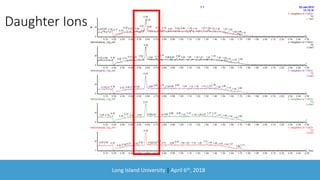
  • #23 Shows the ions of a certain mass range going through the first quad The ions are then hit with a collison gas – argon at different voltages
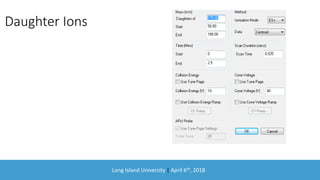
  • #25 Changed the gradient Centroid data is what I showed before with the peaks – zero width and an exact m/z Profile is the other option that you can have that gives you UV type peaks which makes it difficult to select a transition
  • #26 Shows the ions of a certain mass range going through the first quad The ions are then hit with a collison gas – argon at different voltages
  • #28 Shows the ions of a certain mass range going through the first quad The ions are then hit with a collision gas – argon at different voltages
  • #29 Shows the ions of a certain mass range going through the first quad The ions are then hit with a collision gas – argon at different voltages
  • #30 Shows the ions of a certain mass range going through the first quad The ions are then hit with a collision gas – argon at different voltages