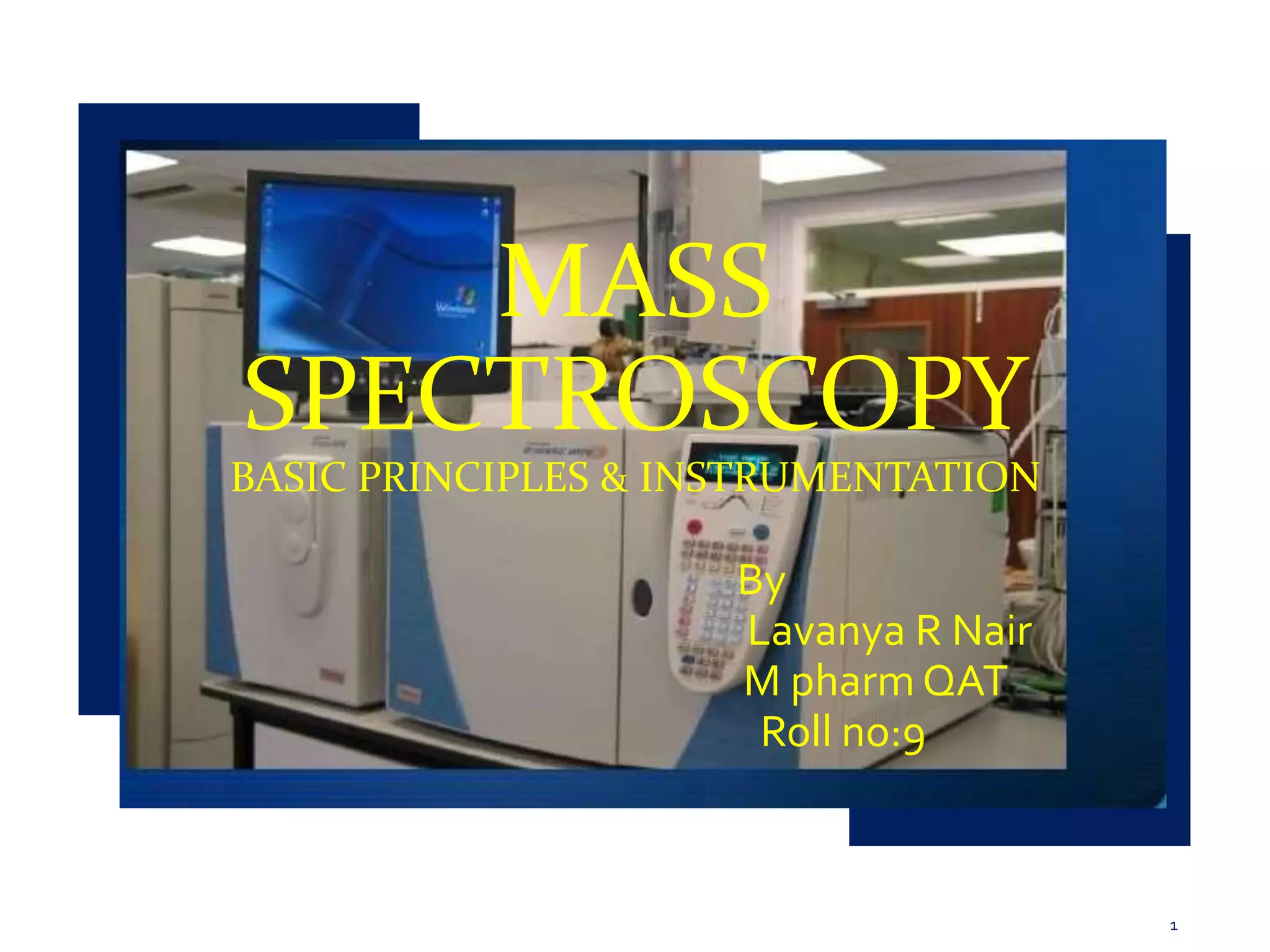
MASS
SPECTROSCOPY
BASIC PRINCIPLES & INSTRUMENTATION
By
Lavanya R Nair
M pharm QAT
Roll no:9
1
What is Mass Number?
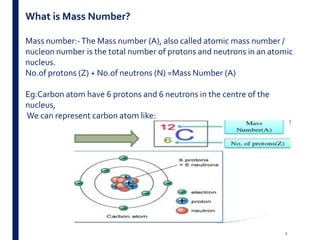
Mass number:-The Mass number (A), also called atomic mass number /
nucleon number is the total number of protons and neutrons in an atomic
nucleus.
No.of protons (Z) + No.of neutrons (N) =Mass Number (A)
Eg:Carbon atom have 6 protons and 6 neutrons in the centre of the
nucleus,
We can represent carbon atom like:
2
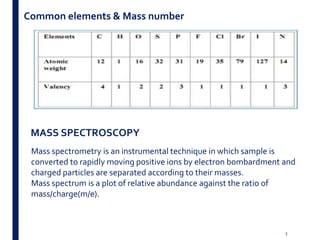
Common elements & Mass number
MASS SPECTROSCOPY
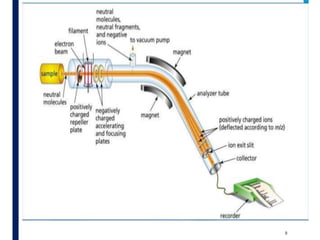
Mass spectrometry is an instrumental technique in which sample is
converted to rapidly moving positive ions by electron bombardment and
charged particles are separated according to their masses.
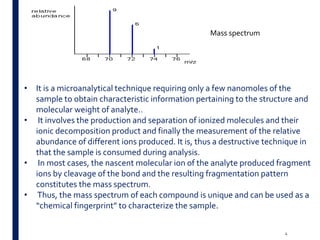
Mass spectrum is a plot of relative abundance against the ratio of
mass/charge(m/e).
3
Mass spectrum
• It is a microanalytical technique requiring only a few nanomoles of the
sample to obtain characteristic information pertaining to the structure and
molecular weight of analyte..
• It involves the production and separation of ionized molecules and their
ionic decomposition product and finally the measurement of the relative
abundance of different ions produced. It is, thus a destructive technique in
that the sample is consumed during analysis.
• In most cases, the nascent molecular ion of the analyte produced fragment
ions by cleavage of the bond and the resulting fragmentation pattern
constitutes the mass spectrum.
• Thus, the mass spectrum of each compound is unique and can be used as a
“chemical fingerprint” to characterize the sample.
4
BASIC PRINCIPLES
1.Organic molecules are bombarded with a beam of energetic electrons (70
eV) in gaseous state under pressure between 10ˉ7 to 10ˉ5 mm of Hg, using
tungsten or rhenium filament.
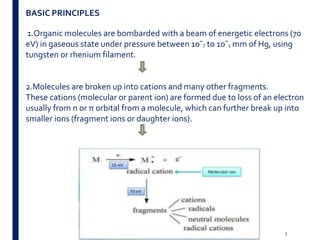
2.Molecules are broken up into cations and many other fragments.
These cations (molecular or parent ion) are formed due to loss of an electron
usually from n or π orbital from a molecule, which can further break up into
smaller ions (fragment ions or daughter ions).
5
3.All these ions are accelerated by an electric field, sorted out according to
their mass to charge ratio by deflection in variable magnetic field and recorded.
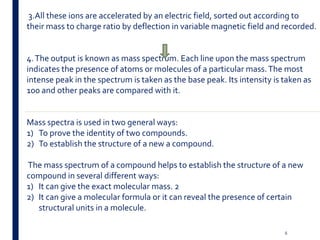
4.The output is known as mass spectrum. Each line upon the mass spectrum
indicates the presence of atoms or molecules of a particular mass.The most
intense peak in the spectrum is taken as the base peak. Its intensity is taken as
100 and other peaks are compared with it.
Mass spectra is used in two general ways:
1) To prove the identity of two compounds.
2) To establish the structure of a new a compound.
The mass spectrum of a compound helps to establish the structure of a new
compound in several different ways:
1) It can give the exact molecular mass. 2
2) It can give a molecular formula or it can reveal the presence of certain
structural units in a molecule.
6
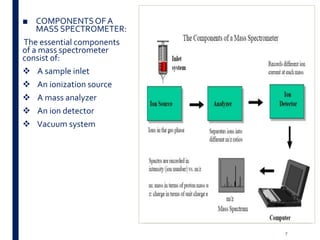
■ COMPONENTSOF A
MASS SPECTROMETER:
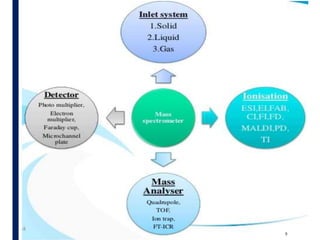
The essential components
of a mass spectrometer
consist of:
 A sample inlet
 An ionization source
 A mass analyzer
 An ion detector
 Vacuum system
7
8
9
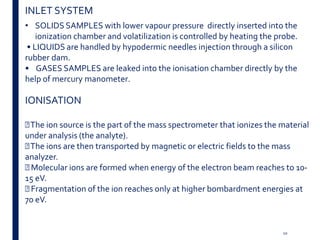
• SOLIDS SAMPLES with lower vapour pressure directly inserted into the
ionization chamber and volatilization is controlled by heating the probe.
• LIQUIDS are handled by hypodermic needles injection through a silicon
rubber dam.
• GASES SAMPLES are leaked into the ionisation chamber directly by the
help of mercury manometer.
IONISATION
The ion source is the part of the mass spectrometer that ionizes the material
under analysis (the analyte).
The ions are then transported by magnetic or electric fields to the mass
analyzer.
Molecular ions are formed when energy of the electron beam reaches to 10-
15 eV.
Fragmentation of the ion reaches only at higher bombardment energies at
70 eV.
INLET SYSTEM
10
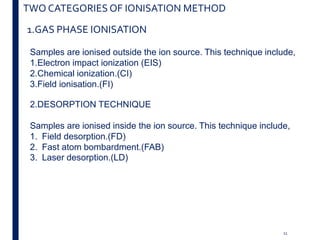
Samples are ionised outside the ion source. This technique include,
1.Electron impact ionization (EIS)
2.Chemical ionization.(CI)
3.Field ionisation.(FI)
2.DESORPTION TECHNIQUE
Samples are ionised inside the ion source. This technique include,
1. Field desorption.(FD)
2. Fast atom bombardment.(FAB)
3. Laser desorption.(LD)
TWO CATEGORIES OF IONISATION METHOD
1.GAS PHASE IONISATION
11
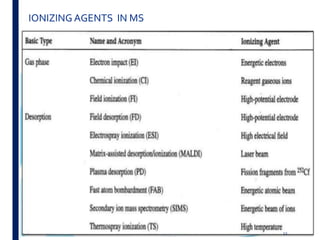
IONIZING AGENTS IN MS
12
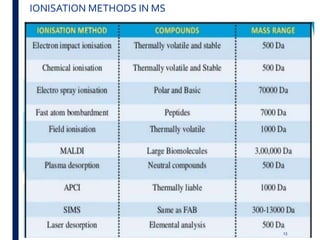
IONISATION METHODS IN MS
13
Spectroscopy;Donald L Pavia,George S Kriz
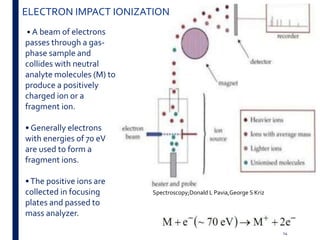
ELECTRON IMPACT IONIZATION
• A beam of electrons
passes through a gas-
phase sample and
collides with neutral
analyte molecules (M) to
produce a positively
charged ion or a
fragment ion.
• Generally electrons
with energies of 70 eV
are used to form a
fragment ions.
•The positive ions are
collected in focusing
plates and passed to
mass analyzer.
14
Advantage :
Fragmentation pattern are predictable due to large databases.
Disadvantages :
(a) Loss of the molecular ion peak.
(b) Sample must be volatile to come in contact with electron in chamber.
(c) High MW compounds cannot be analyzed.
15
Spectroscopy;Donald L Pavia,George S Kriz
CHEMICAL IONISATION
It is a soft ionization technique.
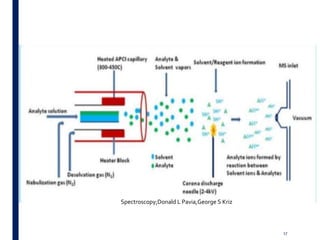
Sample molecules are combined with ionized reagent gas which is present in
excess than the sample. Commonly used reagent gases include
methane,ammonia,isobutane. • Oxygen and hydrogens are used in Negative
ion chemical ionisation in MS.
Due to collision, various molecules are ionized by different mechanisms like
proton transfer, electron transfer, adduct formation etc.
The vaporised sample is introduced into the mass spectrometer with an
excess of a reagent gas (methane) at pressure of about 1 torr.
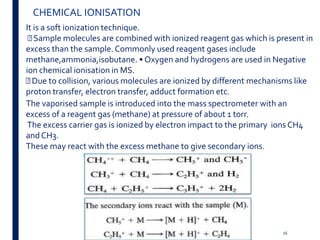
The excess carrier gas is ionized by electron impact to the primary ions CH4
and CH3.
These may react with the excess methane to give secondary ions.
16
17
Spectroscopy;Donald L Pavia,George S Kriz
18
DESORPTIONTECHNIQUE
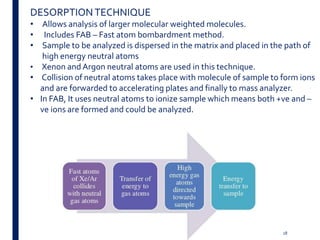
• Allows analysis of larger molecular weighted molecules.
• Includes FAB – Fast atom bombardment method.
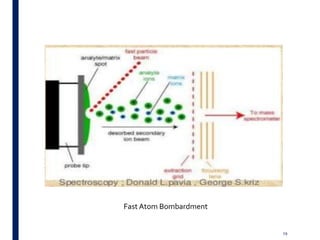
• Sample to be analyzed is dispersed in the matrix and placed in the path of
high energy neutral atoms
• Xenon and Argon neutral atoms are used in this technique.
• Collision of neutral atoms takes place with molecule of sample to form ions
and are forwarded to accelerating plates and finally to mass analyzer.
• In FAB, It uses neutral atoms to ionize sample which means both +ve and –
ve ions are formed and could be analyzed.
19
Fast Atom Bombardment
20
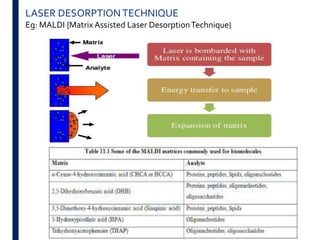
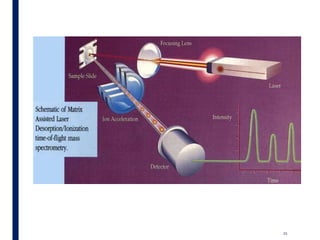
LASER DESORPTIONTECHNIQUE
Eg: MALDI {Matrix Assisted Laser DesorptionTechnique}
21
22
MASS ANALYSERS
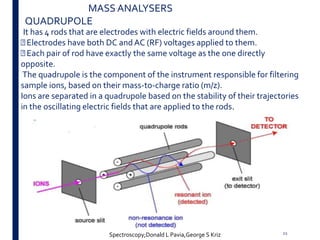
QUADRUPOLE
It has 4 rods that are electrodes with electric fields around them.
Electrodes have both DC andAC (RF) voltages applied to them.
Each pair of rod have exactly the same voltage as the one directly
opposite.
The quadrupole is the component of the instrument responsible for filtering
sample ions, based on their mass-to-charge ratio (m/z).
Ions are separated in a quadrupole based on the stability of their trajectories
in the oscillating electric fields that are applied to the rods.
Spectroscopy;Donald L Pavia,George S Kriz
23
TIME OF FLIGHT
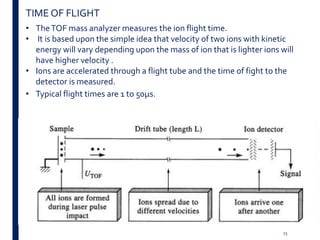
• TheTOF mass analyzer measures the ion flight time.
• It is based upon the simple idea that velocity of two ions with kinetic
energy will vary depending upon the mass of ion that is lighter ions will
have higher velocity .
• Ions are accelerated through a flight tube and the time of fight to the
detector is measured.
• Typical flight times are 1 to 50μs.
24
FOURIERTRANSFORM ION CYCLOTRON ANALYZER [FT-ICR]
A type of mass analyzer for determining the mass-to-charge ratio (m/z) of
ions based on the cyclotron frequency of the ions in a fixed magnetic field.
The ions are trapped in a Penning trap(a magnetic field with electric
trapping plates) where they are excited to a larger cyclotron radius by an
oscillating electric field perpendicular to the magnetic field.
25
DETECTORS
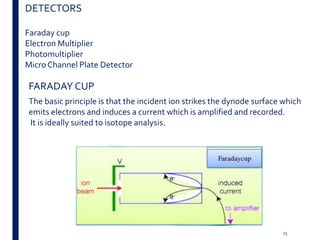
Faraday cup
Electron Multiplier
Photomultiplier
Micro Channel Plate Detector
FARADAY CUP
The basic principle is that the incident ion strikes the dynode surface which
emits electrons and induces a current which is amplified and recorded.
It is ideally suited to isotope analysis.
26
ELECTRON MULTIPLIER
Electron multipliers are the most common especially when positive and
negative ions need to be detected on the same instrument.
Dynodes made up of copper-beryllium which transduces the initial ion
current ,and electron emitted by first dynode are focused magnetically
from dynode to the next.
Final cascade current is amplified more than million times.
27
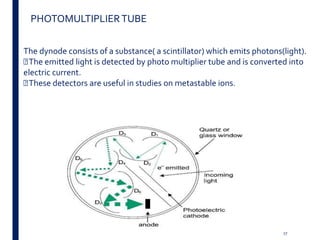
The dynode consists of a substance( a scintillator) which emits photons(light).
The emitted light is detected by photo multiplier tube and is converted into
electric current.
These detectors are useful in studies on metastable ions.
PHOTOMULTIPLIERTUBE
28
REFERENCES
1. Spectroscopic identification of organic compounds by Silverstein
2. Instrumental analysis by Skoog.
3. Introduction to Spectroscopy (Pavia, Donald; Lampman,Gary M.; Kriz,
George S., Jr.)
4. https://www.slideshare.net/solairajananant/mass-spectrometry-38534267
5. https://www.slideshare.net/akshukumarsharma/mass-spectroscopy-
55382941
6. Google Images
7. Wikipedia
29
THANKYOU!

Mass spectroscopy

  • 1.
    MASS SPECTROSCOPY BASIC PRINCIPLES &INSTRUMENTATION By Lavanya R Nair M pharm QAT Roll no:9 1
  • 2.
    What is MassNumber? Mass number:-The Mass number (A), also called atomic mass number / nucleon number is the total number of protons and neutrons in an atomic nucleus. No.of protons (Z) + No.of neutrons (N) =Mass Number (A) Eg:Carbon atom have 6 protons and 6 neutrons in the centre of the nucleus, We can represent carbon atom like: 2
  • 3.
    Common elements &Mass number MASS SPECTROSCOPY Mass spectrometry is an instrumental technique in which sample is converted to rapidly moving positive ions by electron bombardment and charged particles are separated according to their masses. Mass spectrum is a plot of relative abundance against the ratio of mass/charge(m/e). 3
  • 4.
    Mass spectrum • Itis a microanalytical technique requiring only a few nanomoles of the sample to obtain characteristic information pertaining to the structure and molecular weight of analyte.. • It involves the production and separation of ionized molecules and their ionic decomposition product and finally the measurement of the relative abundance of different ions produced. It is, thus a destructive technique in that the sample is consumed during analysis. • In most cases, the nascent molecular ion of the analyte produced fragment ions by cleavage of the bond and the resulting fragmentation pattern constitutes the mass spectrum. • Thus, the mass spectrum of each compound is unique and can be used as a “chemical fingerprint” to characterize the sample. 4
  • 5.
    BASIC PRINCIPLES 1.Organic moleculesare bombarded with a beam of energetic electrons (70 eV) in gaseous state under pressure between 10ˉ7 to 10ˉ5 mm of Hg, using tungsten or rhenium filament. 2.Molecules are broken up into cations and many other fragments. These cations (molecular or parent ion) are formed due to loss of an electron usually from n or π orbital from a molecule, which can further break up into smaller ions (fragment ions or daughter ions). 5
  • 6.
    3.All these ionsare accelerated by an electric field, sorted out according to their mass to charge ratio by deflection in variable magnetic field and recorded. 4.The output is known as mass spectrum. Each line upon the mass spectrum indicates the presence of atoms or molecules of a particular mass.The most intense peak in the spectrum is taken as the base peak. Its intensity is taken as 100 and other peaks are compared with it. Mass spectra is used in two general ways: 1) To prove the identity of two compounds. 2) To establish the structure of a new a compound. The mass spectrum of a compound helps to establish the structure of a new compound in several different ways: 1) It can give the exact molecular mass. 2 2) It can give a molecular formula or it can reveal the presence of certain structural units in a molecule. 6
  • 7.
    ■ COMPONENTSOF A MASSSPECTROMETER: The essential components of a mass spectrometer consist of:  A sample inlet  An ionization source  A mass analyzer  An ion detector  Vacuum system 7
  • 8.
  • 9.
  • 10.
    • SOLIDS SAMPLESwith lower vapour pressure directly inserted into the ionization chamber and volatilization is controlled by heating the probe. • LIQUIDS are handled by hypodermic needles injection through a silicon rubber dam. • GASES SAMPLES are leaked into the ionisation chamber directly by the help of mercury manometer. IONISATION The ion source is the part of the mass spectrometer that ionizes the material under analysis (the analyte). The ions are then transported by magnetic or electric fields to the mass analyzer. Molecular ions are formed when energy of the electron beam reaches to 10- 15 eV. Fragmentation of the ion reaches only at higher bombardment energies at 70 eV. INLET SYSTEM 10
  • 11.
    Samples are ionisedoutside the ion source. This technique include, 1.Electron impact ionization (EIS) 2.Chemical ionization.(CI) 3.Field ionisation.(FI) 2.DESORPTION TECHNIQUE Samples are ionised inside the ion source. This technique include, 1. Field desorption.(FD) 2. Fast atom bombardment.(FAB) 3. Laser desorption.(LD) TWO CATEGORIES OF IONISATION METHOD 1.GAS PHASE IONISATION 11
  • 12.
  • 13.
  • 14.
    Spectroscopy;Donald L Pavia,GeorgeS Kriz ELECTRON IMPACT IONIZATION • A beam of electrons passes through a gas- phase sample and collides with neutral analyte molecules (M) to produce a positively charged ion or a fragment ion. • Generally electrons with energies of 70 eV are used to form a fragment ions. •The positive ions are collected in focusing plates and passed to mass analyzer. 14
  • 15.
    Advantage : Fragmentation patternare predictable due to large databases. Disadvantages : (a) Loss of the molecular ion peak. (b) Sample must be volatile to come in contact with electron in chamber. (c) High MW compounds cannot be analyzed. 15
  • 16.
    Spectroscopy;Donald L Pavia,GeorgeS Kriz CHEMICAL IONISATION It is a soft ionization technique. Sample molecules are combined with ionized reagent gas which is present in excess than the sample. Commonly used reagent gases include methane,ammonia,isobutane. • Oxygen and hydrogens are used in Negative ion chemical ionisation in MS. Due to collision, various molecules are ionized by different mechanisms like proton transfer, electron transfer, adduct formation etc. The vaporised sample is introduced into the mass spectrometer with an excess of a reagent gas (methane) at pressure of about 1 torr. The excess carrier gas is ionized by electron impact to the primary ions CH4 and CH3. These may react with the excess methane to give secondary ions. 16
  • 17.
  • 18.
    18 DESORPTIONTECHNIQUE • Allows analysisof larger molecular weighted molecules. • Includes FAB – Fast atom bombardment method. • Sample to be analyzed is dispersed in the matrix and placed in the path of high energy neutral atoms • Xenon and Argon neutral atoms are used in this technique. • Collision of neutral atoms takes place with molecule of sample to form ions and are forwarded to accelerating plates and finally to mass analyzer. • In FAB, It uses neutral atoms to ionize sample which means both +ve and – ve ions are formed and could be analyzed.
  • 19.
  • 20.
    20 LASER DESORPTIONTECHNIQUE Eg: MALDI{Matrix Assisted Laser DesorptionTechnique}
  • 21.
  • 22.
    22 MASS ANALYSERS QUADRUPOLE It has4 rods that are electrodes with electric fields around them. Electrodes have both DC andAC (RF) voltages applied to them. Each pair of rod have exactly the same voltage as the one directly opposite. The quadrupole is the component of the instrument responsible for filtering sample ions, based on their mass-to-charge ratio (m/z). Ions are separated in a quadrupole based on the stability of their trajectories in the oscillating electric fields that are applied to the rods. Spectroscopy;Donald L Pavia,George S Kriz
  • 23.
    23 TIME OF FLIGHT •TheTOF mass analyzer measures the ion flight time. • It is based upon the simple idea that velocity of two ions with kinetic energy will vary depending upon the mass of ion that is lighter ions will have higher velocity . • Ions are accelerated through a flight tube and the time of fight to the detector is measured. • Typical flight times are 1 to 50μs.
  • 24.
    24 FOURIERTRANSFORM ION CYCLOTRONANALYZER [FT-ICR] A type of mass analyzer for determining the mass-to-charge ratio (m/z) of ions based on the cyclotron frequency of the ions in a fixed magnetic field. The ions are trapped in a Penning trap(a magnetic field with electric trapping plates) where they are excited to a larger cyclotron radius by an oscillating electric field perpendicular to the magnetic field.
  • 25.
    25 DETECTORS Faraday cup Electron Multiplier Photomultiplier MicroChannel Plate Detector FARADAY CUP The basic principle is that the incident ion strikes the dynode surface which emits electrons and induces a current which is amplified and recorded. It is ideally suited to isotope analysis.
  • 26.
    26 ELECTRON MULTIPLIER Electron multipliersare the most common especially when positive and negative ions need to be detected on the same instrument. Dynodes made up of copper-beryllium which transduces the initial ion current ,and electron emitted by first dynode are focused magnetically from dynode to the next. Final cascade current is amplified more than million times.
  • 27.
    27 The dynode consistsof a substance( a scintillator) which emits photons(light). The emitted light is detected by photo multiplier tube and is converted into electric current. These detectors are useful in studies on metastable ions. PHOTOMULTIPLIERTUBE
  • 28.
    28 REFERENCES 1. Spectroscopic identificationof organic compounds by Silverstein 2. Instrumental analysis by Skoog. 3. Introduction to Spectroscopy (Pavia, Donald; Lampman,Gary M.; Kriz, George S., Jr.) 4. https://www.slideshare.net/solairajananant/mass-spectrometry-38534267 5. https://www.slideshare.net/akshukumarsharma/mass-spectroscopy- 55382941 6. Google Images 7. Wikipedia
  • 29.