and


      present


  A Summary of
Leveraged Buyout
  (LBO) Models
About JobSearchDigest.com
   Every day our team researches all the online job
    sources (including the specialty niche sites)
   We capture every Hedge Fund, Private Equity,
    Venture Capital and Investment Banking job
   Daily email updates give you a competitive
    advantage in your job search


      www.JobSearchDigest.com


                          Copyright 2009
About The Investment Banking Institute
   Core financial, technical and modeling skills.
   Similar to the top firms.
   4 Weeks of training
    – 28 hours of live, in-class instruction,
    – Taught by current and former investment bankers.
 Wide range of topics.
 Classes monthly in major cities across the US,
  Canada and Europe.
 Visit www.ibtraining.com for additional details.


                            Copyright 2009
Table of Contents


 I. Uses for An LBO Model

II. Components of LBO Model

III. IRR Analysis

IV. Q&A


                    Copyright 2009
Uses for an LBO Model
 An LBO Model is an analysis used by private equity
  firms (financial sponsors) to evaluate an acquisition

 The goal of an LBO is to acquire a company by
  financing the purchase with as much debt as cash flow
  and debt markets will support

 The more debt available, the smaller an equity
  investment the financial sponsor has to make

 The higher the leverage, the higher the expected IRR
  for the financial sponsor or private equity firm


                         Copyright 2009
Uses for an LBO Model (cont’d)
 The goal of an LBO model is to establish expected
  internal rates of return (“IRR”) for the acquisition
  that reflects:
    Purchase price assumptions and the cash needed
    Capitalization assumptions: leverage, debt tranches, equity
     investments
    Base case financial projections for balance sheet, cash flow
     and income statement

 Model should include sensitivity functions for a
  range of:
      purchase prices,
      capitalization structures,
      operating assumptions


                               Copyright 2009
Uses for an LBO Model (cont’d)
 Private Equity Firms / Financial Sponsors usually have
  a required rate of return hurdle
    Expected transaction IRR must meet or exceed hurdle rate
    PE firms required rates of return usually range from 15% to
     30% (18% - 25% typical)


 The IRR analysis is strongly driven by the amount of
  leverage
    With higher leverage, less equity, and higher IRR
    Often the goal is to leverage up the Company based on cash
     flow and the debt markets
    More leverage increases risk, as cash flows will pay interest
     and debt service


                             Copyright 2009
Uses for an LBO Model (cont’d)
 Leverage is largely determined by the debt markets

 Until mid-2007, the debt markets were experiencing
  excess liquidity
    Lenders were allowing higher leverage
    In 2005-2007 leveraged at 4.0–6.0x recent EBITDA

 Higher levels allowed higher prices yet still attain
  the required IRR


                           Copyright 2009
Uses for an LBO Model (cont’d)
 Leverage is comprised of some combination
  of:
   Senior secured loans
   Junior loans/bonds
   Mezzanine debt, or “hybrid” securities


 Lenders may require the financial sponsor to
  have a minimum equity investment
   Minimum equity contribution is typically around
    20% - 25% of total capitalization


                       Copyright 2009
Uses for an LBO Model (cont’d)

 Not Just for Buyers
     The LBO Model is also used by lenders

     Lenders like to see expected leverage and debt
      service coverage ratios based upon Company’s
      projected:
      – income statement,
      – balance sheet,
      – cash flow


                            Copyright 2009
Pop Quiz

 The goal of an LBO model is to establish
  expected internal rates of return (“IRR”)
  using a financial model that reflects:
     a. Purchase price assumptions and uses of cash
     b. Capitalization assumptions and sources of cash
     c. Base case financial projections with
      assumptions
     d. All the above.


                         Copyright 2009
Pop Quiz

 The goal of an LBO model is to establish
  expected internal rates of return (“IRR”)
  using a financial model that reflects:
     a. Purchase price assumptions and uses of cash
     b. Capitalization assumptions and sources of cash
     c. Base case financial projections with
      assumptions
     d. All the above.


                         Copyright 2009
I. Uses for An LBO Model

II. Components of LBO Model

III. IRR Analysis

IV. Q&A


                    Copyright 2009
Components of LBO Model

 Typical LBO Model will contain, at a minimum, the
  following items:
      Purchase price assumptions
      Uses of Cash Schedule
      Sources of Cash Schedule
      Capital Structure Alternatives
      Pro Forma Balance Sheet
      Integrated Financial Model
      IRR Analyses


                              Copyright 2009
Purchase Price Calculation and Considerations

 Determination of the purchase price typically
  involves a full-scale valuation of the company:

      Comparable Companies Analysis
      Precedent Transactions Analysis
      Discounted Cash Flow Analysis


                             Copyright 2009
Sources and Uses of Cash

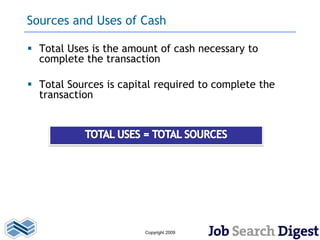
 Total Uses is the amount of cash necessary to
  complete the transaction

 Total Sources is capital required to complete the
  transaction


                        Copyright 2009
Sources and Uses of Cash (cont’d)
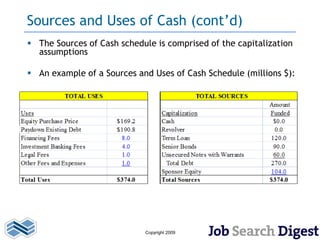
 The Sources of Cash schedule is comprised of the capitalization
  assumptions

 An example of a Sources and Uses of Cash Schedule (millions $):


                            Copyright 2009
Capital Structure Alternatives

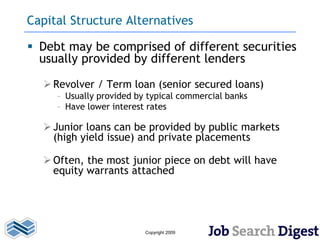
 Debt may be comprised of different securities
  usually provided by different lenders

   Revolver / Term loan (senior secured loans)
     – Usually provided by typical commercial banks
     – Have lower interest rates

   Junior loans can be provided by public markets
    (high yield issue) and private placements

   Often, the most junior piece on debt will have
    equity warrants attached


                          Copyright 2009
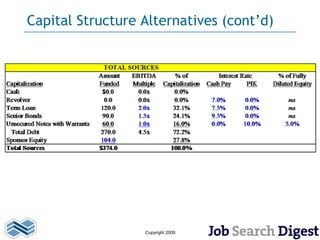
Capital Structure Alternatives (cont’d)


                  Copyright 2009
Proforma Balance Sheet
 Proforma balance sheet gives effect for the transaction

 Adjusts the historical balance sheet for the new sources
  of debt and equity as well as any transaction-related
  adjustments:
      Write-ups or write-downs
      All financing fees incurred can be capitalized and amortized
      Any Goodwill created by the transaction

 The buyer typically assumes all of the normal-course
  short term liabilities

 The “old debt” is typically eliminated


                              Copyright 2009
Proforma Balance Sheet (cont’d)
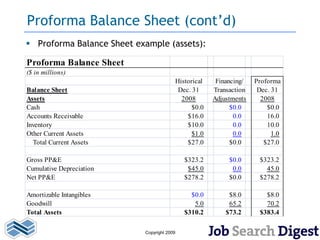
 Proforma Balance Sheet example (assets):

Proforma Balance Sheet
($ in millions)
                                        Historical    Financing/   Proforma
Balance Sheet                            Dec. 31     Transaction    Dec. 31
Assets                                    2008       Adjustments     2008
Cash                                          $0.0         $0.0        $0.0
Accounts Receivable                         $16.0           0.0        16.0
Inventory                                   $10.0           0.0        10.0
Other Current Assets                          $1.0          0.0          1.0
  Total Current Assets                      $27.0          $0.0       $27.0

Gross PP&E                                  $323.2        $0.0      $323.2
Cumulative Depreciation                      $45.0         0.0        45.0
Net PP&E                                    $278.2        $0.0      $278.2

Amortizable Intangibles                       $0.0        $8.0        $8.0
Goodwill                                       5.0        65.2        70.2
Total Assets                                $310.2       $73.2      $383.4

                           Copyright 2009
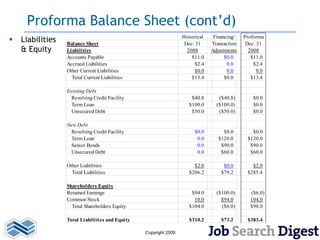
Proforma Balance Sheet (cont’d)
   Liabilities   Balance Sheet
                                                                  Historical
                                                                   Dec. 31
                                                                                Financing/
                                                                               Transaction
                                                                                             Proforma
                                                                                              Dec. 31
    & Equity      Liabilities                                       2008       Adjustments     2008
                  Accounts Payable                                    $11.0          $0.0       $11.0
                  Accrued Liabilities                                   $2.4          0.0        $2.4
                  Other Current Liabilities                             $0.0          0.0          0.0
                    Total Current Liabilities                         $13.4          $0.0       $13.4

                  Existing Debt
                    Revolving Credit Facility                         $40.8       ($40.8)        $0.0
                    Term Loan                                        $100.0      ($100.0)        $0.0
                    Unsecured Debt                                    $50.0       ($50.0)        $0.0

                  New Debt
                    Revolving Credit Facility                          $0.0         $0.0        $0.0
                    Term Loan                                           0.0       $120.0      $120.0
                    Senior Bonds                                        0.0        $90.0       $90.0
                    Unsecured Debt                                      0.0        $60.0       $60.0

                  Other Liabilities                                    $2.0         $0.0        $2.0
                    Total Liabilities                                $206.2        $79.2      $285.4

                  Shareholders Equity
                  Retained Earnings                                   $94.0      ($100.0)       ($6.0)
                  Common Stock                                         10.0        $94.0        104.0
                    Total Shareholders Equity                        $104.0        ($6.0)       $98.0

                  Total Liabilities and Equity                       $310.2        $73.2      $383.4

                                                 Copyright 2009
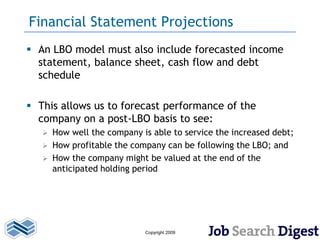
Financial Statement Projections
 An LBO model must also include forecasted income
  statement, balance sheet, cash flow and debt
  schedule

 This allows us to forecast performance of the
  company on a post-LBO basis to see:
      How well the company is able to service the increased debt;
      How profitable the company can be following the LBO; and
      How the company might be valued at the end of the
       anticipated holding period


                             Copyright 2009
Pop Quiz

 Which of the following is not included in total
  uses of cash?
     a. purchase price
     b. transaction fees
     c. debt service
     d. other required cash payments in the transaction
     e. none


                        Copyright 2009
Pop Quiz

 Which of the following is not included in total
  uses of cash?
     a. purchase price
     b. transaction fees
     c. debt service
     d. other required cash payments in the transaction
     e. none


                        Copyright 2009
I. Uses for An LBO Model

II. Components of LBO Model

III. IRR Analysis

IV. Q&A


                    Copyright 2009
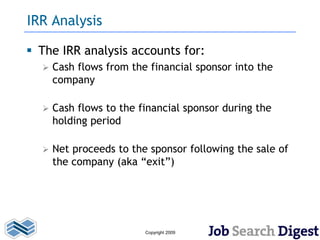
IRR Analysis

 The IRR analysis accounts for:
     Cash flows from the financial sponsor into the
      company

     Cash flows to the financial sponsor during the
      holding period

     Net proceeds to the sponsor following the sale of
      the company (aka “exit”)


                         Copyright 2009
IRR Analysis (cont’d)
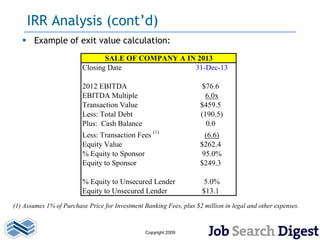
    Example of exit value calculation:
                                SALE OF COMPANY A IN 2013
                         Closing Date               31-Dec-13

                         2012 EBITDA                                  $76.6
                         EBITDA Multiple                               6.0x
                         Transaction Value                           $459.5
                         Less: Total Debt                            (190.5)
                         Plus: Cash Balance                            0.0
                         Less: Transaction Fees (1)                    (6.6)
                         Equity Value                                $262.4
                         % Equity to Sponsor                          95.0%
                         Equity to Sponsor                           $249.3

                         % Equity to Unsecured Lender                  5.0%
                         Equity to Unsecured Lender                   $13.1
(1) Assumes 1% of Purchase Price for Investment Banking Fees, plus $2 million in legal and other expenses.


                                                 Copyright 2009
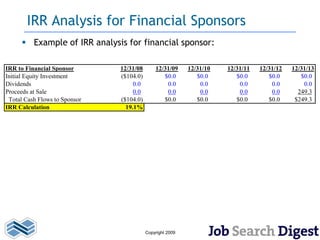
IRR Analysis for Financial Sponsors
       Example of IRR analysis for financial sponsor:

IRR to Financial Sponsor       12/31/08       12/31/09     12/31/10   12/31/11   12/31/12   12/31/13
Initial Equity Investment      ($104.0)          $0.0         $0.0       $0.0       $0.0       $0.0
Dividends                           0.0           0.0          0.0        0.0        0.0        0.0
Proceeds at Sale                    0.0           0.0          0.0        0.0        0.0      249.3
 Total Cash Flows to Sponsor   ($104.0)          $0.0         $0.0       $0.0       $0.0     $249.3
IRR Calculation                  19.1%


                                          Copyright 2009
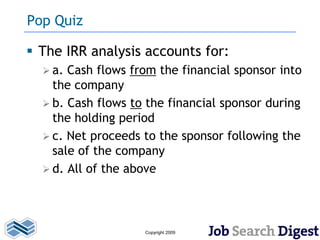
Pop Quiz

 The IRR analysis accounts for:
   a. Cash flows from the financial sponsor into
    the company
   b. Cash flows to the financial sponsor during
    the holding period
   c. Net proceeds to the sponsor following the
    sale of the company
   d. All of the above


                    Copyright 2009
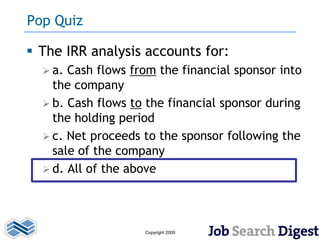
Pop Quiz

 The IRR analysis accounts for:
   a. Cash flows from the financial sponsor into
    the company
   b. Cash flows to the financial sponsor during
    the holding period
   c. Net proceeds to the sponsor following the
    sale of the company
   d. All of the above


                    Copyright 2009
I. Uses for An LBO Model

II. Construction of LBO Model

III. IRR Analysis

IV. Q&A


                    Copyright 2009
Q&A


Q: When is the LBO considered an
 appropriate method over other
 financing options?


               Copyright 2009
Q&A


Q: How have current market
   conditions affected the LBO
   model?


                Copyright 2009
Q&A


Q: Common pitfalls and how to avoid?


               Copyright 2009
Q&A


Q: Best tools and resources for LBO
   modeling?


                Copyright 2009
Q&A


Q: Is there a difference modeling an
   LBO for a private company vs.
   public company?


                Copyright 2009
and


Thank You.
About Investment Banking Institute
 The Investment Banking Institute (IBI), with offices in 14 cities
  throughout North America and Europe, conducts corporate as
  well as individual training for candidates ranging from
  Managing Directors to MBAs to College Undergrads and other
  professionals seeking to enter the industry. Since our inception
  in 2002, IBI has offered the most comprehensive course
  syllabus and longest running program available

 IBI conducts more individual based programs in more cities
  than any other firm. Last year alone (2008) we held over 700
  sessions worldwide for more than 2000 live training hours;
  moreover, our bankers/instructors possess a combined 129
  years of I-banking and/or PE experience


                              Copyright 2009
About Investment Banking Institute
 IBI is affiliated with the CFA Institute, NASBA (the national
  association of the state boards of accountancy –overseeing
  CPAs), and the CFP Board
 IBI has trained analysts and associates for hundreds of
  organizations (a partial list can be viewed on our website), the
  in-class training we provide our individual students is the same
  exact training provided to corporate clients
 Interview preparation, resume revision, and job contacts are
  available through our Human Resources division on a one-on-
  one basis with no set expiration date
 The training program can be repeated free of charge at any
  future date to ensure your skills are sharp when you need them
  to be
 Seasoned Investment Bankers are available for help outside of
  class whenever needed

                             Copyright 2009
Investment Banking Institute                                Student Testimonial

 I am so thankful for the class I took at the Investment Banking Institute. It was both
 an enriching knowledge vault and a confidence booster!

 Your walkthrough of the DCF calculations was an excellent refresher. While I still
 remember bits and pieces of how DCF works from my on-campus interviews back in
 college and work at JP Morgan, your presentation helped to consolidate everything
 in my mind. I also appreciate how you tied things back to an estimate of the
 company's stock price at the end -- I actually once got an interview question on that
 exact topic! The details and examples of the LBO modeling were extremely helpful,
 and the encouragement you gave students throughout the class was equally
 invaluable.

 A huge thank-you for your insight into current market conditions, and on how the
 subprime crisis actually unfolded. Although I manage to gain exposure to
 macroeconomic and market valuation issues at work every day at JP Morgan, it was
 your engaging, concise teaching method and holistic approach to the course that
 put everything in perspective for me.

 I will definitely recommend your course to my future classmates at Harvard Business
 School as I am sure they will benefit tremendously from it.
 Thank you very much.

 Anthony, Boston


                                     Copyright 2009
Investment Banking Institute
                 Please visit us at

              www.ibtraining.com
For company information, banker’s bios, and contact
       information for any of our local offices

                  Headquarters:
              The Helmsley Building
            230 Park Avenue, 10th Floor
               New York, NY 10169
                   212-380-7027

                      Copyright 2009
LBO Training Summary

  • 1.
    and present A Summary of Leveraged Buyout (LBO) Models
  • 2.
    About JobSearchDigest.com  Every day our team researches all the online job sources (including the specialty niche sites)  We capture every Hedge Fund, Private Equity, Venture Capital and Investment Banking job  Daily email updates give you a competitive advantage in your job search www.JobSearchDigest.com Copyright 2009
  • 3.
    About The InvestmentBanking Institute  Core financial, technical and modeling skills.  Similar to the top firms.  4 Weeks of training – 28 hours of live, in-class instruction, – Taught by current and former investment bankers.  Wide range of topics.  Classes monthly in major cities across the US, Canada and Europe.  Visit www.ibtraining.com for additional details. Copyright 2009
  • 4.
    Table of Contents I. Uses for An LBO Model II. Components of LBO Model III. IRR Analysis IV. Q&A Copyright 2009
  • 5.
    Uses for anLBO Model  An LBO Model is an analysis used by private equity firms (financial sponsors) to evaluate an acquisition  The goal of an LBO is to acquire a company by financing the purchase with as much debt as cash flow and debt markets will support  The more debt available, the smaller an equity investment the financial sponsor has to make  The higher the leverage, the higher the expected IRR for the financial sponsor or private equity firm Copyright 2009
  • 6.
    Uses for anLBO Model (cont’d)  The goal of an LBO model is to establish expected internal rates of return (“IRR”) for the acquisition that reflects:  Purchase price assumptions and the cash needed  Capitalization assumptions: leverage, debt tranches, equity investments  Base case financial projections for balance sheet, cash flow and income statement  Model should include sensitivity functions for a range of:  purchase prices,  capitalization structures,  operating assumptions Copyright 2009
  • 7.
    Uses for anLBO Model (cont’d)  Private Equity Firms / Financial Sponsors usually have a required rate of return hurdle  Expected transaction IRR must meet or exceed hurdle rate  PE firms required rates of return usually range from 15% to 30% (18% - 25% typical)  The IRR analysis is strongly driven by the amount of leverage  With higher leverage, less equity, and higher IRR  Often the goal is to leverage up the Company based on cash flow and the debt markets  More leverage increases risk, as cash flows will pay interest and debt service Copyright 2009
  • 8.
    Uses for anLBO Model (cont’d)  Leverage is largely determined by the debt markets  Until mid-2007, the debt markets were experiencing excess liquidity  Lenders were allowing higher leverage  In 2005-2007 leveraged at 4.0–6.0x recent EBITDA  Higher levels allowed higher prices yet still attain the required IRR Copyright 2009
  • 9.
    Uses for anLBO Model (cont’d)  Leverage is comprised of some combination of:  Senior secured loans  Junior loans/bonds  Mezzanine debt, or “hybrid” securities  Lenders may require the financial sponsor to have a minimum equity investment  Minimum equity contribution is typically around 20% - 25% of total capitalization Copyright 2009
  • 10.
    Uses for anLBO Model (cont’d)  Not Just for Buyers  The LBO Model is also used by lenders  Lenders like to see expected leverage and debt service coverage ratios based upon Company’s projected: – income statement, – balance sheet, – cash flow Copyright 2009
  • 11.
    Pop Quiz  Thegoal of an LBO model is to establish expected internal rates of return (“IRR”) using a financial model that reflects:  a. Purchase price assumptions and uses of cash  b. Capitalization assumptions and sources of cash  c. Base case financial projections with assumptions  d. All the above. Copyright 2009
  • 12.
    Pop Quiz  Thegoal of an LBO model is to establish expected internal rates of return (“IRR”) using a financial model that reflects:  a. Purchase price assumptions and uses of cash  b. Capitalization assumptions and sources of cash  c. Base case financial projections with assumptions  d. All the above. Copyright 2009
  • 13.
    I. Uses forAn LBO Model II. Components of LBO Model III. IRR Analysis IV. Q&A Copyright 2009
  • 14.
    Components of LBOModel  Typical LBO Model will contain, at a minimum, the following items:  Purchase price assumptions  Uses of Cash Schedule  Sources of Cash Schedule  Capital Structure Alternatives  Pro Forma Balance Sheet  Integrated Financial Model  IRR Analyses Copyright 2009
  • 15.
    Purchase Price Calculationand Considerations  Determination of the purchase price typically involves a full-scale valuation of the company:  Comparable Companies Analysis  Precedent Transactions Analysis  Discounted Cash Flow Analysis Copyright 2009
  • 16.
    Sources and Usesof Cash  Total Uses is the amount of cash necessary to complete the transaction  Total Sources is capital required to complete the transaction Copyright 2009

  • 17.
    Sources and Usesof Cash (cont’d)  The Sources of Cash schedule is comprised of the capitalization assumptions  An example of a Sources and Uses of Cash Schedule (millions $): Copyright 2009
  • 18.
    Capital Structure Alternatives Debt may be comprised of different securities usually provided by different lenders  Revolver / Term loan (senior secured loans) – Usually provided by typical commercial banks – Have lower interest rates  Junior loans can be provided by public markets (high yield issue) and private placements  Often, the most junior piece on debt will have equity warrants attached Copyright 2009
  • 19.
    Capital Structure Alternatives(cont’d) Copyright 2009
  • 20.
    Proforma Balance Sheet Proforma balance sheet gives effect for the transaction  Adjusts the historical balance sheet for the new sources of debt and equity as well as any transaction-related adjustments:  Write-ups or write-downs  All financing fees incurred can be capitalized and amortized  Any Goodwill created by the transaction  The buyer typically assumes all of the normal-course short term liabilities  The “old debt” is typically eliminated Copyright 2009
  • 21.
    Proforma Balance Sheet(cont’d)  Proforma Balance Sheet example (assets): Proforma Balance Sheet ($ in millions) Historical Financing/ Proforma Balance Sheet Dec. 31 Transaction Dec. 31 Assets 2008 Adjustments 2008 Cash $0.0 $0.0 $0.0 Accounts Receivable $16.0 0.0 16.0 Inventory $10.0 0.0 10.0 Other Current Assets $1.0 0.0 1.0 Total Current Assets $27.0 $0.0 $27.0 Gross PP&E $323.2 $0.0 $323.2 Cumulative Depreciation $45.0 0.0 45.0 Net PP&E $278.2 $0.0 $278.2 Amortizable Intangibles $0.0 $8.0 $8.0 Goodwill 5.0 65.2 70.2 Total Assets $310.2 $73.2 $383.4 Copyright 2009
  • 22.
    Proforma Balance Sheet(cont’d)  Liabilities Balance Sheet Historical Dec. 31 Financing/ Transaction Proforma Dec. 31 & Equity Liabilities 2008 Adjustments 2008 Accounts Payable $11.0 $0.0 $11.0 Accrued Liabilities $2.4 0.0 $2.4 Other Current Liabilities $0.0 0.0 0.0 Total Current Liabilities $13.4 $0.0 $13.4 Existing Debt Revolving Credit Facility $40.8 ($40.8) $0.0 Term Loan $100.0 ($100.0) $0.0 Unsecured Debt $50.0 ($50.0) $0.0 New Debt Revolving Credit Facility $0.0 $0.0 $0.0 Term Loan 0.0 $120.0 $120.0 Senior Bonds 0.0 $90.0 $90.0 Unsecured Debt 0.0 $60.0 $60.0 Other Liabilities $2.0 $0.0 $2.0 Total Liabilities $206.2 $79.2 $285.4 Shareholders Equity Retained Earnings $94.0 ($100.0) ($6.0) Common Stock 10.0 $94.0 104.0 Total Shareholders Equity $104.0 ($6.0) $98.0 Total Liabilities and Equity $310.2 $73.2 $383.4 Copyright 2009
  • 23.
    Financial Statement Projections An LBO model must also include forecasted income statement, balance sheet, cash flow and debt schedule  This allows us to forecast performance of the company on a post-LBO basis to see:  How well the company is able to service the increased debt;  How profitable the company can be following the LBO; and  How the company might be valued at the end of the anticipated holding period Copyright 2009
  • 24.
    Pop Quiz  Whichof the following is not included in total uses of cash?  a. purchase price  b. transaction fees  c. debt service  d. other required cash payments in the transaction  e. none Copyright 2009
  • 25.
    Pop Quiz  Whichof the following is not included in total uses of cash?  a. purchase price  b. transaction fees  c. debt service  d. other required cash payments in the transaction  e. none Copyright 2009
  • 26.
    I. Uses forAn LBO Model II. Components of LBO Model III. IRR Analysis IV. Q&A Copyright 2009
  • 27.
    IRR Analysis  TheIRR analysis accounts for:  Cash flows from the financial sponsor into the company  Cash flows to the financial sponsor during the holding period  Net proceeds to the sponsor following the sale of the company (aka “exit”) Copyright 2009
  • 28.
    IRR Analysis (cont’d)  Example of exit value calculation: SALE OF COMPANY A IN 2013 Closing Date 31-Dec-13 2012 EBITDA $76.6 EBITDA Multiple 6.0x Transaction Value $459.5 Less: Total Debt (190.5) Plus: Cash Balance 0.0 Less: Transaction Fees (1) (6.6) Equity Value $262.4 % Equity to Sponsor 95.0% Equity to Sponsor $249.3 % Equity to Unsecured Lender 5.0% Equity to Unsecured Lender $13.1 (1) Assumes 1% of Purchase Price for Investment Banking Fees, plus $2 million in legal and other expenses. Copyright 2009
  • 29.
    IRR Analysis forFinancial Sponsors  Example of IRR analysis for financial sponsor: IRR to Financial Sponsor 12/31/08 12/31/09 12/31/10 12/31/11 12/31/12 12/31/13 Initial Equity Investment ($104.0) $0.0 $0.0 $0.0 $0.0 $0.0 Dividends 0.0 0.0 0.0 0.0 0.0 0.0 Proceeds at Sale 0.0 0.0 0.0 0.0 0.0 249.3 Total Cash Flows to Sponsor ($104.0) $0.0 $0.0 $0.0 $0.0 $249.3 IRR Calculation 19.1% Copyright 2009
  • 30.
    Pop Quiz  TheIRR analysis accounts for:  a. Cash flows from the financial sponsor into the company  b. Cash flows to the financial sponsor during the holding period  c. Net proceeds to the sponsor following the sale of the company  d. All of the above Copyright 2009
  • 31.
    Pop Quiz  TheIRR analysis accounts for:  a. Cash flows from the financial sponsor into the company  b. Cash flows to the financial sponsor during the holding period  c. Net proceeds to the sponsor following the sale of the company  d. All of the above Copyright 2009
  • 32.
    I. Uses forAn LBO Model II. Construction of LBO Model III. IRR Analysis IV. Q&A Copyright 2009
  • 33.
    Q&A Q: When isthe LBO considered an appropriate method over other financing options? Copyright 2009
  • 34.
    Q&A Q: How havecurrent market conditions affected the LBO model? Copyright 2009
  • 35.
    Q&A Q: Common pitfallsand how to avoid? Copyright 2009
  • 36.
    Q&A Q: Best toolsand resources for LBO modeling? Copyright 2009
  • 37.
    Q&A Q: Is therea difference modeling an LBO for a private company vs. public company? Copyright 2009
  • 38.
  • 39.
    About Investment BankingInstitute  The Investment Banking Institute (IBI), with offices in 14 cities throughout North America and Europe, conducts corporate as well as individual training for candidates ranging from Managing Directors to MBAs to College Undergrads and other professionals seeking to enter the industry. Since our inception in 2002, IBI has offered the most comprehensive course syllabus and longest running program available  IBI conducts more individual based programs in more cities than any other firm. Last year alone (2008) we held over 700 sessions worldwide for more than 2000 live training hours; moreover, our bankers/instructors possess a combined 129 years of I-banking and/or PE experience Copyright 2009
  • 40.
    About Investment BankingInstitute  IBI is affiliated with the CFA Institute, NASBA (the national association of the state boards of accountancy –overseeing CPAs), and the CFP Board  IBI has trained analysts and associates for hundreds of organizations (a partial list can be viewed on our website), the in-class training we provide our individual students is the same exact training provided to corporate clients  Interview preparation, resume revision, and job contacts are available through our Human Resources division on a one-on- one basis with no set expiration date  The training program can be repeated free of charge at any future date to ensure your skills are sharp when you need them to be  Seasoned Investment Bankers are available for help outside of class whenever needed Copyright 2009
  • 41.
    Investment Banking Institute Student Testimonial I am so thankful for the class I took at the Investment Banking Institute. It was both an enriching knowledge vault and a confidence booster! Your walkthrough of the DCF calculations was an excellent refresher. While I still remember bits and pieces of how DCF works from my on-campus interviews back in college and work at JP Morgan, your presentation helped to consolidate everything in my mind. I also appreciate how you tied things back to an estimate of the company's stock price at the end -- I actually once got an interview question on that exact topic! The details and examples of the LBO modeling were extremely helpful, and the encouragement you gave students throughout the class was equally invaluable. A huge thank-you for your insight into current market conditions, and on how the subprime crisis actually unfolded. Although I manage to gain exposure to macroeconomic and market valuation issues at work every day at JP Morgan, it was your engaging, concise teaching method and holistic approach to the course that put everything in perspective for me. I will definitely recommend your course to my future classmates at Harvard Business School as I am sure they will benefit tremendously from it. Thank you very much. Anthony, Boston Copyright 2009
  • 42.
    Investment Banking Institute Please visit us at www.ibtraining.com For company information, banker’s bios, and contact information for any of our local offices Headquarters: The Helmsley Building 230 Park Avenue, 10th Floor New York, NY 10169 212-380-7027 Copyright 2009