CHAPTER 3

 Analysis of Financial Statements


                                    1
Topics in Chapter
   Ratio analysis
   Du Pont system
   Effects of improving ratios
   Limitations of ratio analysis
   Qualitative factors


                                    2
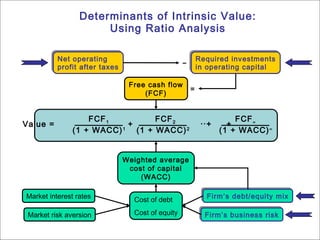
Determinants of Intrinsic Value:
                      Using Ratio Analysis

          Net operating
          Net operating                               Required investments
                                                       Required investments
          profit after taxes                      −   in operating capital
          profit after taxes                           in operating capital

                                Free cash flow
                                                      =
                                    (FCF)


                   FCF 1         FCF 2                    ...       FCF ∞
Value =                    +                                +     +
               (1 + WACC) 1 (1 + WACC) 2                        (1 + WACC) ∞


                               Weighted average
                                cost of capital
                                   (WACC)

Market interest rates                                      Firm’s debt/equity mix
                                                           Firm’s debt/equity mix
                                 Cost of debt

 Market risk aversion            Cost of equity           Firm’s business risk
                                                          Firm’s business risk
                                                                                    3
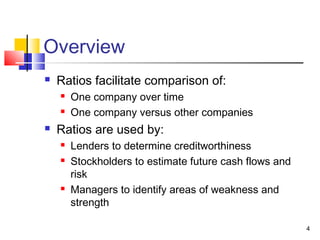
Overview
   Ratios facilitate comparison of:
       One company over time
       One company versus other companies
   Ratios are used by:
       Lenders to determine creditworthiness
       Stockholders to estimate future cash flows and
        risk
       Managers to identify areas of weakness and
        strength

                                                         4
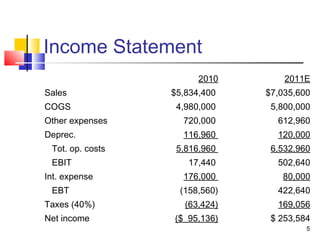
Income Statement
                        2010        2011E
Sales             $5,834,400    $7,035,600
COGS               4,980,000     5,800,000
Other expenses      720,000       612,960
Deprec.             116,960       120,000
 Tot. op. costs    5,816,960     6,532,960
 EBIT                17,440       502,640
Int. expense        176,000        80,000
 EBT               (158,560)      422,640
Taxes (40%)          (63,424)     169,056
Net income        ($ 95,136)     $ 253,584
                                         5
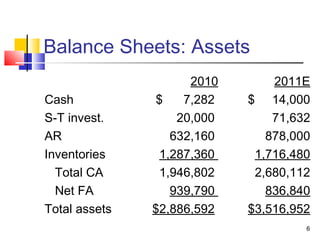
Balance Sheets: Assets
                      2010       2011E
Cash            $    7,282   $ 14,000
S-T invest.         20,000       71,632
AR                 632,160      878,000
Inventories      1,287,360    1,716,480
  Total CA       1,946,802    2,680,112
  Net FA           939,790      836,840
Total assets   $2,886,592    $3,516,952
                                      6
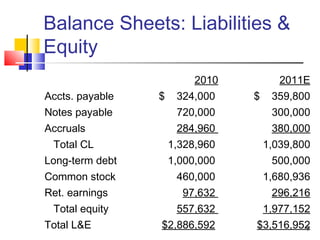
Balance Sheets: Liabilities &
Equity
                          2010          2011E
Accts. payable   $    324,000    $    359,800
Notes payable         720,000         300,000
Accruals              284,960         380,000
 Total CL            1,328,960       1,039,800
Long-term debt       1,000,000        500,000
Common stock          460,000        1,680,936
Ret. earnings          97,632         296,216
 Total equity         557,632        1,977,152
Total L&E        $2,886,592      $3,516,952
                                          7
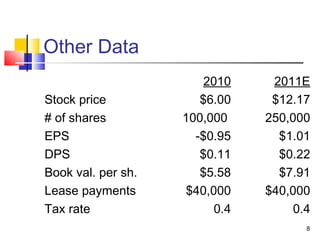
Other Data
                        2010     2011E
Stock price            $6.00     $12.17
# of shares         100,000     250,000
EPS                   -$0.95      $1.01
DPS                    $0.11      $0.22
Book val. per sh.      $5.58      $7.91
Lease payments       $40,000    $40,000
Tax rate                  0.4        0.4
                                       8
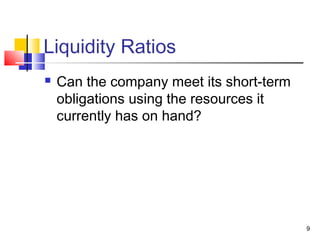
Liquidity Ratios
   Can the company meet its short-term
    obligations using the resources it
    currently has on hand?


                                          9
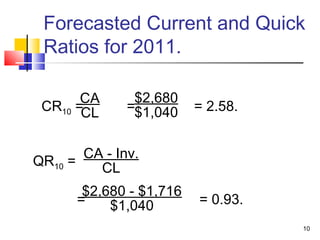
Forecasted Current and Quick
 Ratios for 2011.

       CA      $2,680
 CR10 =CL     =$1,040    = 2.58.


       CA - Inv.
QR10 =   CL
       $2,680 - $1,716
      =    $1,040        = 0.93.
                                   10
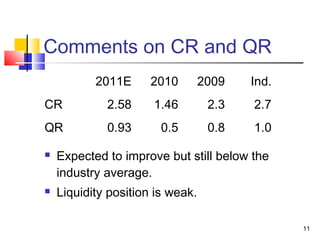
Comments on CR and QR
           2011E      2010        2009   Ind.
CR           2.58     1.46         2.3   2.7
QR           0.93       0.5        0.8   1.0

   Expected to improve but still below the
    industry average.
   Liquidity position is weak.

                                                11
Asset Management Ratios
   How efficiently does the firm use its
    assets?
   How much does the firm have tied up in
    assets for each dollar of sales?


                                         12
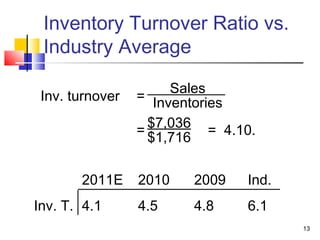
Inventory Turnover Ratio vs.
 Industry Average

                      Sales
 Inv. turnover   = Inventories
                   $7,036
                 =          = 4.10.
                   $1,716

       2011E     2010    2009    Ind.
Inv. T. 4.1      4.5     4.8     6.1
                                        13
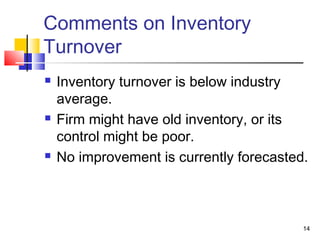
Comments on Inventory
Turnover
   Inventory turnover is below industry
    average.
   Firm might have old inventory, or its
    control might be poor.
   No improvement is currently forecasted.


                                          14
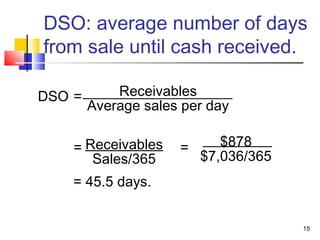
DSO: average number of days
from sale until cash received.

DSO =       Receivables
        Average sales per day

    = Receivables    =      $878
       Sales/365         $7,036/365
    = 45.5 days.


                                      15
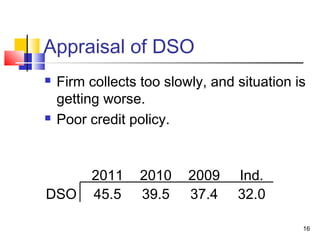
Appraisal of DSO
   Firm collects too slowly, and situation is
    getting worse.
   Poor credit policy.


         2011     2010    2009    Ind.
DSO      45.5     39.5    37.4    32.0

                                             16
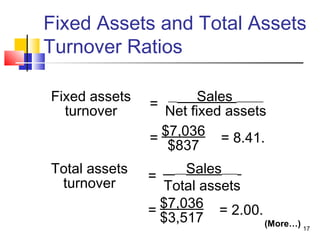
Fixed Assets and Total Assets
Turnover Ratios

Fixed assets             Sales             
               =
  turnover         Net fixed assets
                  

               =  $7,036 = 8.41.
                   $837
Total assets         Sales       
                          
               =
 turnover        Total assets
               = $7,036 = 2.00.
                 $3,517           (More…)     17
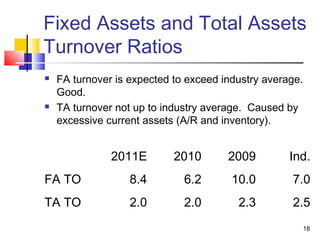
Fixed Assets and Total Assets
Turnover Ratios
   FA turnover is expected to exceed industry average.
    Good.
   TA turnover not up to industry average. Caused by
    excessive current assets (A/R and inventory).


               2011E        2010       2009         Ind.
FA TO              8.4        6.2       10.0        7.0
TA TO              2.0        2.0        2.3        2.5
                                                          18
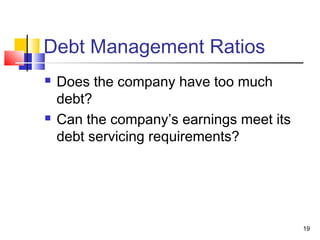
Debt Management Ratios
   Does the company have too much
    debt?
   Can the company’s earnings meet its
    debt servicing requirements?


                                          19
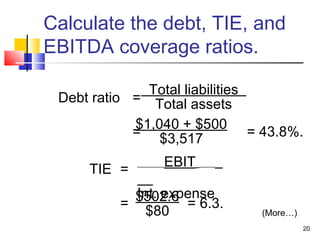
Calculate the debt, TIE, and
EBITDA coverage ratios.

              Total liabilities
 Debt ratio = Total assets
            $1,040 + $500
            = $3,517            = 43.8%.

                            EBIT        
     TIE =


            Int. expense
            $502.6 = 6.3.
          =
              $80                          (More…)
                                                     20
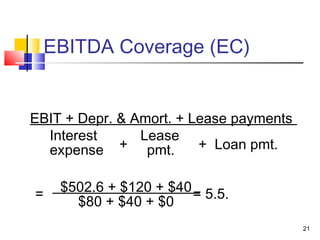
EBITDA Coverage (EC)


EBIT + Depr. & Amort. + Lease payments
  Interest      Lease
  expense    + pmt.      + Loan pmt.


=    $502.6 + $120 + $40 = 5.5.
       $80 + $40 + $0
                                         21
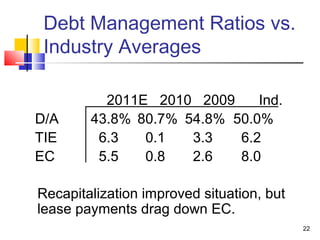
Debt Management Ratios vs.
 Industry Averages

          2011E 2010 2009     Ind.
D/A     43.8% 80.7% 54.8% 50.0%
TIE      6.3   0.1   3.3   6.2
EC       5.5   0.8   2.6   8.0

Recapitalization improved situation, but 
lease payments drag down EC.
                                            22
Profitability Ratios
   What is the company’s rate of return on:
       Sales?
       Assets?


                                           23
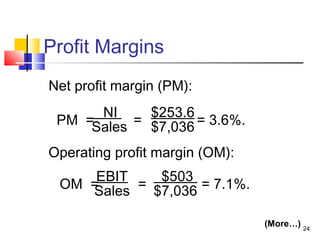
Profit Margins
Net profit margin (PM):
      NI     $253.6
 PM =Sales = $7,036 = 3.6%.

Operating profit margin (OM):
     EBIT    $503
 OM =
    Sales = $7,036 = 7.1%.

                                (More…) 24
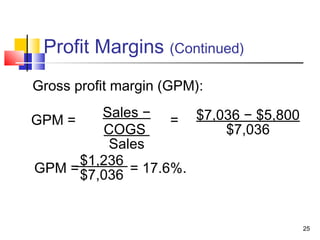
Profit Margins (Continued)
Gross profit margin (GPM):
         Sales −
GPM =              = $7,036 − $5,800
         COGS            $7,036
          Sales
      $1,236
GPM = $7,036 = 17.6%.


                                       25
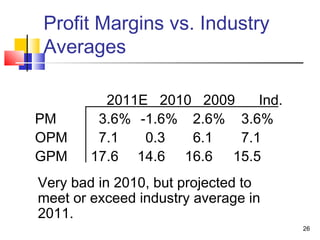
Profit Margins vs. Industry
Averages

          2011E 2010 2009    Ind.
PM       3.6% -1.6% 2.6% 3.6%
OPM      7.1   0.3  6.1   7.1
GPM     17.6 14.6 16.6 15.5
Very bad in 2010, but projected to
meet or exceed industry average in
2011.
                                     26
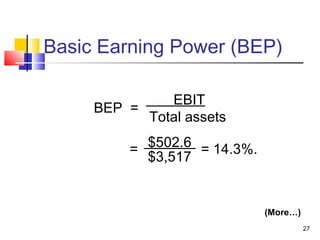
Basic Earning Power (BEP)

              EBIT
     BEP =
           Total assets

         = $502.6 = 14.3%.
           $3,517


                             (More…)
                                       27
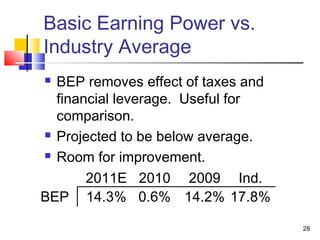
Basic Earning Power vs.
Industry Average
 BEP removes effect of taxes and
  financial leverage. Useful for
  comparison.
 Projected to be below average.

 Room for improvement.

       2011E 2010 2009 Ind.
BEP 14.3% 0.6% 14.2% 17.8%

                                    28
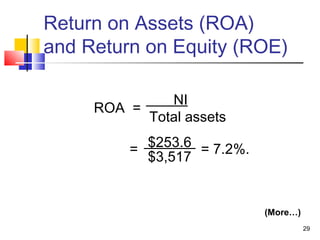
Return on Assets (ROA)
and Return on Equity (ROE)

              NI
     ROA =
           Total assets

         = $253.6 = 7.2%.
           $3,517


                            (More…)
                                      29
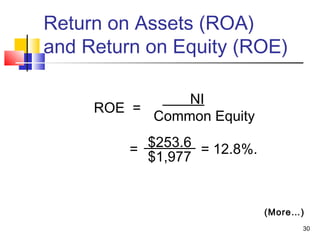
Return on Assets (ROA)
and Return on Equity (ROE)

               NI
     ROE =
           Common Equity

         = $253.6 = 12.8%.
           $1,977


                             (More…)
                                   30
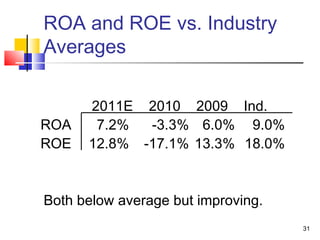
ROA and ROE vs. Industry
Averages

      2011E 2010 2009 Ind.
ROA    7.2%  -3.3% 6.0% 9.0%
ROE   12.8% -17.1% 13.3% 18.0%


Both below average but improving.
                                    31
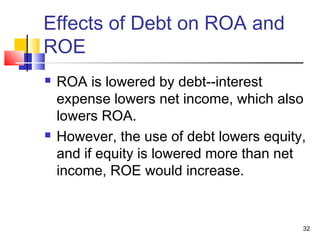
Effects of Debt on ROA and
ROE
   ROA is lowered by debt--interest
    expense lowers net income, which also
    lowers ROA.
   However, the use of debt lowers equity,
    and if equity is lowered more than net
    income, ROE would increase.


                                          32
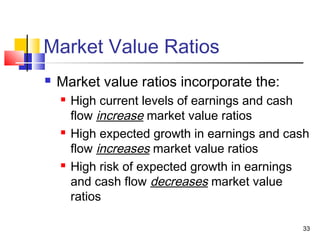
Market Value Ratios
   Market value ratios incorporate the:
       High current levels of earnings and cash
        flow increase market value ratios
       High expected growth in earnings and cash
        flow increases market value ratios
       High risk of expected growth in earnings
        and cash flow decreases market value
        ratios

                                               33
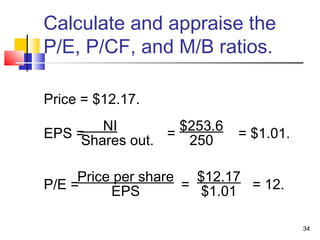
Calculate and appraise the
P/E, P/CF, and M/B ratios.

Price = $12.17.
        NI        $253.6
EPS =Shares out. = 250     = $1.01.


     Price per share   $12.17
P/E =     EPS        = $1.01 = 12.

                                      34
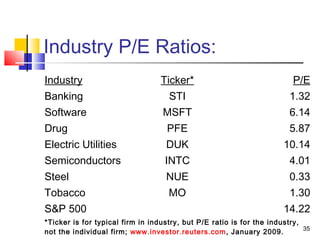
Industry P/E Ratios:
Industry                          Ticker*                                P/E
Banking                             STI                                1.32
Software                          MSFT                                 6.14
Drug                               PFE                                 5.87
Electric Utilities                 DUK                                10.14
Semiconductors                     INTC                                4.01
Steel                              NUE                                 0.33
Tobacco                             MO                                 1.30
S&P 500                                                               14.22
*Ticker is for typical firm in industry, but P/E ratio is for the industry,
                                                                            35
not the individual firm; www.investor.reuters.com, January 2009.
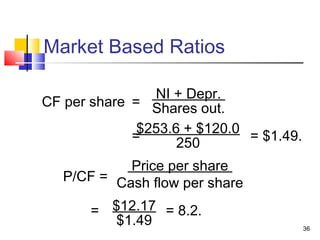
Market Based Ratios

                NI + Depr.
CF per share = Shares out.
              $253.6 + $120.0
             =      250       = $1.49.

            Price per share
   P/CF = Cash flow per share

       = $12.17 = 8.2.
          $1.49                          36
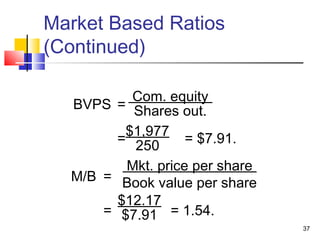
Market Based Ratios
(Continued)

          Com. equity
  BVPS = Shares out.
         $1,977
        = 250      = $7.91.
         Mkt. price per share
  M/B = Book value per share
        $12.17
      = $7.91 = 1.54.
                                37
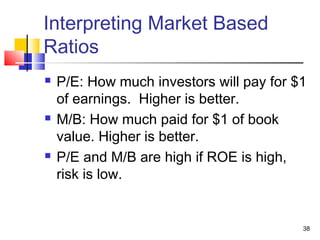
Interpreting Market Based
Ratios
   P/E: How much investors will pay for $1
    of earnings. Higher is better.
   M/B: How much paid for $1 of book
    value. Higher is better.
   P/E and M/B are high if ROE is high,
    risk is low.


                                          38
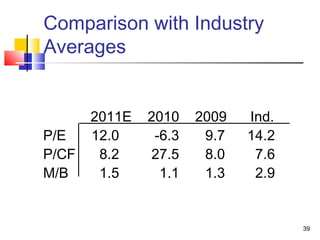
Comparison with Industry
Averages


       2011E   2010    2009   Ind.
P/E    12.0     -6.3    9.7   14.2
P/CF    8.2    27.5     8.0    7.6
M/B     1.5      1.1    1.3    2.9


                                     39
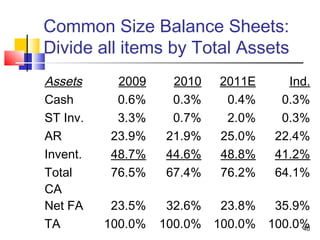
Common Size Balance Sheets:
Divide all items by Total Assets
Assets     2009     2010   2011E     Ind.
Cash       0.6%     0.3%    0.4%    0.3%
ST Inv.    3.3%     0.7%    2.0%    0.3%
AR        23.9%    21.9%   25.0%   22.4%
Invent.   48.7%    44.6%   48.8%   41.2%
Total     76.5%    67.4%   76.2%   64.1%
CA
Net FA     23.5%    32.6%  23.8%  35.9%
TA        100.0%   100.0% 100.0% 100.0%
                                      40
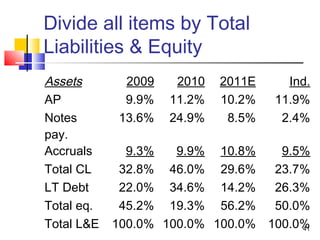
Divide all items by Total
Liabilities & Equity
Assets      2009   2010 2011E     Ind.
AP          9.9% 11.2% 10.2%    11.9%
Notes      13.6% 24.9%    8.5%   2.4%
pay.
Accruals    9.3%   9.9% 10.8%    9.5%
Total CL   32.8% 46.0% 29.6%    23.7%
LT Debt    22.0% 34.6% 14.2%    26.3%
Total eq.  45.2% 19.3% 56.2%    50.0%
Total L&E 100.0% 100.0% 100.0% 100.0%
                                    41
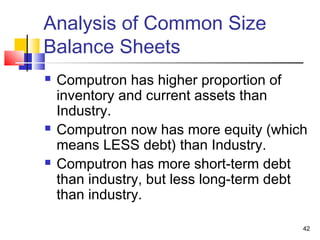
Analysis of Common Size
Balance Sheets
   Computron has higher proportion of
    inventory and current assets than
    Industry.
   Computron now has more equity (which
    means LESS debt) than Industry.
   Computron has more short-term debt
    than industry, but less long-term debt
    than industry.

                                         42
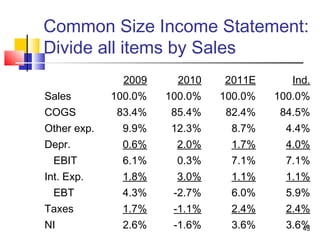
Common Size Income Statement:
Divide all items by Sales
               2009     2010   2011E       Ind.
Sales        100.0%   100.0%   100.0%   100.0%
COGS         83.4%    85.4%    82.4%    84.5%
Other exp.    9.9%    12.3%     8.7%     4.4%
Depr.         0.6%     2.0%     1.7%     4.0%
  EBIT        6.1%     0.3%     7.1%     7.1%
Int. Exp.     1.8%     3.0%     1.1%     1.1%
  EBT         4.3%     -2.7%    6.0%     5.9%
Taxes         1.7%     -1.1%    2.4%     2.4%
NI            2.6%     -1.6%    3.6%     3.6%
                                            43
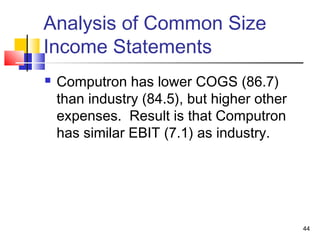
Analysis of Common Size
Income Statements
   Computron has lower COGS (86.7)
    than industry (84.5), but higher other
    expenses. Result is that Computron
    has similar EBIT (7.1) as industry.


                                             44
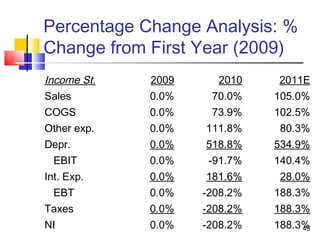
Percentage Change Analysis: %
Change from First Year (2009)
Income St.   2009     2010     2011E
Sales        0.0%    70.0%    105.0%
COGS         0.0%    73.9%    102.5%
Other exp.   0.0%   111.8%     80.3%
Depr.        0.0%   518.8%    534.9%
  EBIT       0.0%    -91.7%   140.4%
Int. Exp.    0.0%   181.6%     28.0%
  EBT        0.0%   -208.2%   188.3%
Taxes        0.0%   -208.2%   188.3%
NI           0.0%   -208.2%   188.3%
                                   45
Analysis of Percent Change
Income Statement
   We see that 2011 sales grew 105%
    from 2009, and that NI grew 188% from
    2009.
   So Computron has become more
    profitable.


                                        46
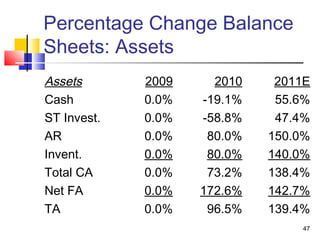
Percentage Change Balance
Sheets: Assets
Assets       2009     2010    2011E
Cash         0.0%   -19.1%    55.6%
ST Invest.   0.0%   -58.8%    47.4%
AR           0.0%    80.0%   150.0%
Invent.      0.0%    80.0%   140.0%
Total CA     0.0%    73.2%   138.4%
Net FA       0.0%   172.6%   142.7%
TA           0.0%    96.5%   139.4%
                                 47
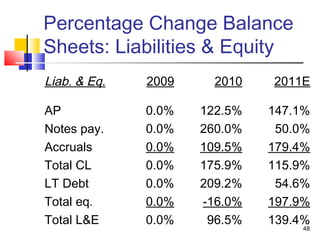
Percentage Change Balance
Sheets: Liabilities & Equity
Liab. & Eq.   2009     2010   2011E

AP            0.0%   122.5%   147.1%
Notes pay.    0.0%   260.0%    50.0%
Accruals      0.0%   109.5%   179.4%
Total CL      0.0%   175.9%   115.9%
LT Debt       0.0%   209.2%    54.6%
Total eq.     0.0%   -16.0%   197.9%
Total L&E     0.0%    96.5%   139.4%
                                  48
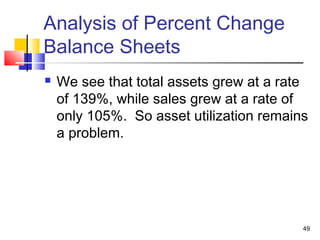
Analysis of Percent Change
Balance Sheets
   We see that total assets grew at a rate
    of 139%, while sales grew at a rate of
    only 105%. So asset utilization remains
    a problem.


                                          49
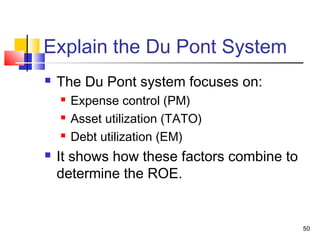
Explain the Du Pont System
   The Du Pont system focuses on:
       Expense control (PM)
       Asset utilization (TATO)
       Debt utilization (EM)
   It shows how these factors combine to
    determine the ROE.


                                            50
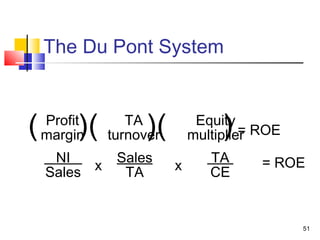
The Du Pont System


(        )(
    Profit
    margin
                 TA
                    )(
              turnover            )
                              Equity
                             multiplier ROE
                                      =
     NI        Sales            TA      = ROE
    Sales x     TA       x      CE


                                              51
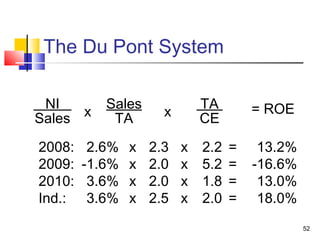
The Du Pont System

 NI        Sales              TA        = ROE
Sales x     TA        x       CE

2008:    2.6%   x   2.3   x   2.2   =    13.2%
2009:   -1.6%   x   2.0   x   5.2   =   -16.6%
2010:    3.6%   x   2.0   x   1.8   =    13.0%
Ind.:    3.6%   x   2.5   x   2.0   =    18.0%
                                                 52
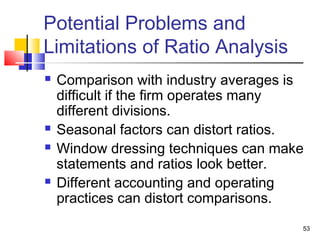
Potential Problems and
Limitations of Ratio Analysis
   Comparison with industry averages is
    difficult if the firm operates many
    different divisions.
   Seasonal factors can distort ratios.
   Window dressing techniques can make
    statements and ratios look better.
   Different accounting and operating
    practices can distort comparisons.
                                       53
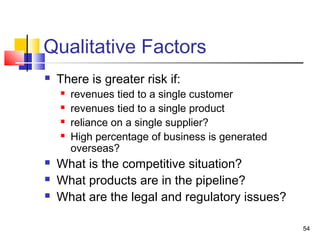
Qualitative Factors
   There is greater risk if:
       revenues tied to a single customer
       revenues tied to a single product
       reliance on a single supplier?
       High percentage of business is generated
        overseas?
   What is the competitive situation?
   What products are in the pipeline?
   What are the legal and regulatory issues?

                                                   54
Chapter 3 slide.ppt(1)

  • 1.
    CHAPTER 3 Analysisof Financial Statements 1
  • 2.
    Topics in Chapter  Ratio analysis  Du Pont system  Effects of improving ratios  Limitations of ratio analysis  Qualitative factors 2
  • 3.
    Determinants of IntrinsicValue: Using Ratio Analysis Net operating Net operating Required investments Required investments profit after taxes − in operating capital profit after taxes in operating capital Free cash flow = (FCF) FCF 1 FCF 2 ... FCF ∞ Value = + + + (1 + WACC) 1 (1 + WACC) 2 (1 + WACC) ∞ Weighted average cost of capital (WACC) Market interest rates Firm’s debt/equity mix Firm’s debt/equity mix Cost of debt Market risk aversion Cost of equity Firm’s business risk Firm’s business risk 3
  • 4.
    Overview  Ratios facilitate comparison of:  One company over time  One company versus other companies  Ratios are used by:  Lenders to determine creditworthiness  Stockholders to estimate future cash flows and risk  Managers to identify areas of weakness and strength 4
  • 5.
    Income Statement 2010 2011E Sales $5,834,400 $7,035,600 COGS 4,980,000 5,800,000 Other expenses 720,000 612,960 Deprec. 116,960 120,000 Tot. op. costs 5,816,960 6,532,960 EBIT 17,440 502,640 Int. expense 176,000 80,000 EBT (158,560) 422,640 Taxes (40%) (63,424) 169,056 Net income ($ 95,136) $ 253,584 5
  • 6.
    Balance Sheets: Assets 2010 2011E Cash $ 7,282 $ 14,000 S-T invest. 20,000 71,632 AR 632,160 878,000 Inventories 1,287,360 1,716,480 Total CA 1,946,802 2,680,112 Net FA 939,790 836,840 Total assets $2,886,592 $3,516,952 6
  • 7.
    Balance Sheets: Liabilities& Equity 2010 2011E Accts. payable $ 324,000 $ 359,800 Notes payable 720,000 300,000 Accruals 284,960 380,000 Total CL 1,328,960 1,039,800 Long-term debt 1,000,000 500,000 Common stock 460,000 1,680,936 Ret. earnings 97,632 296,216 Total equity 557,632 1,977,152 Total L&E $2,886,592 $3,516,952 7
  • 8.
    Other Data 2010 2011E Stock price $6.00 $12.17 # of shares 100,000 250,000 EPS -$0.95 $1.01 DPS $0.11 $0.22 Book val. per sh. $5.58 $7.91 Lease payments $40,000 $40,000 Tax rate 0.4 0.4 8
  • 9.
    Liquidity Ratios  Can the company meet its short-term obligations using the resources it currently has on hand? 9
  • 10.
    Forecasted Current andQuick Ratios for 2011. CA $2,680 CR10 =CL =$1,040 = 2.58. CA - Inv. QR10 = CL $2,680 - $1,716 = $1,040 = 0.93. 10
  • 11.
    Comments on CRand QR 2011E 2010 2009 Ind. CR 2.58 1.46 2.3 2.7 QR 0.93 0.5 0.8 1.0  Expected to improve but still below the industry average.  Liquidity position is weak. 11
  • 12.
    Asset Management Ratios  How efficiently does the firm use its assets?  How much does the firm have tied up in assets for each dollar of sales? 12
  • 13.
    Inventory Turnover Ratiovs. Industry Average Sales Inv. turnover = Inventories $7,036 = = 4.10. $1,716 2011E 2010 2009 Ind. Inv. T. 4.1 4.5 4.8 6.1 13
  • 14.
    Comments on Inventory Turnover  Inventory turnover is below industry average.  Firm might have old inventory, or its control might be poor.  No improvement is currently forecasted. 14
  • 15.
    DSO: average numberof days from sale until cash received. DSO = Receivables Average sales per day = Receivables = $878 Sales/365 $7,036/365 = 45.5 days. 15
  • 16.
    Appraisal of DSO  Firm collects too slowly, and situation is getting worse.  Poor credit policy. 2011 2010 2009 Ind. DSO 45.5 39.5 37.4 32.0 16
  • 17.
    Fixed Assets andTotal Assets Turnover Ratios Fixed assets      Sales              = turnover Net fixed assets    = $7,036 = 8.41. $837 Total assets Sales              = turnover Total assets = $7,036 = 2.00. $3,517 (More…) 17
  • 18.
    Fixed Assets andTotal Assets Turnover Ratios  FA turnover is expected to exceed industry average. Good.  TA turnover not up to industry average. Caused by excessive current assets (A/R and inventory). 2011E 2010 2009 Ind. FA TO 8.4 6.2 10.0 7.0 TA TO 2.0 2.0 2.3 2.5 18
  • 19.
    Debt Management Ratios  Does the company have too much debt?  Can the company’s earnings meet its debt servicing requirements? 19
  • 20.
    Calculate the debt,TIE, and EBITDA coverage ratios. Total liabilities Debt ratio = Total assets $1,040 + $500 = $3,517 = 43.8%. EBIT         TIE =              Int. expense $502.6 = 6.3. = $80 (More…) 20
  • 21.
    EBITDA Coverage (EC) EBIT+ Depr. & Amort. + Lease payments Interest Lease expense + pmt. + Loan pmt. = $502.6 + $120 + $40 = 5.5. $80 + $40 + $0 21
  • 22.
    Debt Management Ratiosvs. Industry Averages 2011E 2010 2009 Ind. D/A 43.8% 80.7% 54.8% 50.0% TIE 6.3 0.1 3.3 6.2 EC 5.5 0.8 2.6 8.0 Recapitalization improved situation, but  lease payments drag down EC. 22
  • 23.
    Profitability Ratios  What is the company’s rate of return on:  Sales?  Assets? 23
  • 24.
    Profit Margins Net profitmargin (PM): NI $253.6 PM =Sales = $7,036 = 3.6%. Operating profit margin (OM): EBIT $503 OM = Sales = $7,036 = 7.1%. (More…) 24
  • 25.
    Profit Margins (Continued) Grossprofit margin (GPM): Sales − GPM = = $7,036 − $5,800 COGS $7,036 Sales $1,236 GPM = $7,036 = 17.6%. 25
  • 26.
    Profit Margins vs.Industry Averages 2011E 2010 2009 Ind. PM 3.6% -1.6% 2.6% 3.6% OPM 7.1 0.3 6.1 7.1 GPM 17.6 14.6 16.6 15.5 Very bad in 2010, but projected to meet or exceed industry average in 2011. 26
  • 27.
    Basic Earning Power(BEP) EBIT BEP = Total assets = $502.6 = 14.3%. $3,517 (More…) 27
  • 28.
    Basic Earning Powervs. Industry Average  BEP removes effect of taxes and financial leverage. Useful for comparison.  Projected to be below average.  Room for improvement. 2011E 2010 2009 Ind. BEP 14.3% 0.6% 14.2% 17.8% 28
  • 29.
    Return on Assets(ROA) and Return on Equity (ROE) NI ROA = Total assets = $253.6 = 7.2%. $3,517 (More…) 29
  • 30.
    Return on Assets(ROA) and Return on Equity (ROE) NI ROE = Common Equity = $253.6 = 12.8%. $1,977 (More…) 30
  • 31.
    ROA and ROEvs. Industry Averages 2011E 2010 2009 Ind. ROA 7.2% -3.3% 6.0% 9.0% ROE 12.8% -17.1% 13.3% 18.0% Both below average but improving. 31
  • 32.
    Effects of Debton ROA and ROE  ROA is lowered by debt--interest expense lowers net income, which also lowers ROA.  However, the use of debt lowers equity, and if equity is lowered more than net income, ROE would increase. 32
  • 33.
    Market Value Ratios  Market value ratios incorporate the:  High current levels of earnings and cash flow increase market value ratios  High expected growth in earnings and cash flow increases market value ratios  High risk of expected growth in earnings and cash flow decreases market value ratios 33
  • 34.
    Calculate and appraisethe P/E, P/CF, and M/B ratios. Price = $12.17. NI $253.6 EPS =Shares out. = 250 = $1.01. Price per share $12.17 P/E = EPS = $1.01 = 12. 34
  • 35.
    Industry P/E Ratios: Industry Ticker* P/E Banking STI 1.32 Software MSFT 6.14 Drug PFE 5.87 Electric Utilities DUK 10.14 Semiconductors INTC 4.01 Steel NUE 0.33 Tobacco MO 1.30 S&P 500 14.22 *Ticker is for typical firm in industry, but P/E ratio is for the industry, 35 not the individual firm; www.investor.reuters.com, January 2009.
  • 36.
    Market Based Ratios NI + Depr. CF per share = Shares out. $253.6 + $120.0 = 250 = $1.49. Price per share P/CF = Cash flow per share = $12.17 = 8.2. $1.49 36
  • 37.
    Market Based Ratios (Continued) Com. equity BVPS = Shares out. $1,977 = 250 = $7.91. Mkt. price per share M/B = Book value per share $12.17 = $7.91 = 1.54. 37
  • 38.
    Interpreting Market Based Ratios  P/E: How much investors will pay for $1 of earnings. Higher is better.  M/B: How much paid for $1 of book value. Higher is better.  P/E and M/B are high if ROE is high, risk is low. 38
  • 39.
    Comparison with Industry Averages 2011E 2010 2009 Ind. P/E 12.0 -6.3 9.7 14.2 P/CF 8.2 27.5 8.0 7.6 M/B 1.5 1.1 1.3 2.9 39
  • 40.
    Common Size BalanceSheets: Divide all items by Total Assets Assets 2009 2010 2011E Ind. Cash 0.6% 0.3% 0.4% 0.3% ST Inv. 3.3% 0.7% 2.0% 0.3% AR 23.9% 21.9% 25.0% 22.4% Invent. 48.7% 44.6% 48.8% 41.2% Total 76.5% 67.4% 76.2% 64.1% CA Net FA 23.5% 32.6% 23.8% 35.9% TA 100.0% 100.0% 100.0% 100.0% 40
  • 41.
    Divide all itemsby Total Liabilities & Equity Assets 2009 2010 2011E Ind. AP 9.9% 11.2% 10.2% 11.9% Notes 13.6% 24.9% 8.5% 2.4% pay. Accruals 9.3% 9.9% 10.8% 9.5% Total CL 32.8% 46.0% 29.6% 23.7% LT Debt 22.0% 34.6% 14.2% 26.3% Total eq. 45.2% 19.3% 56.2% 50.0% Total L&E 100.0% 100.0% 100.0% 100.0% 41
  • 42.
    Analysis of CommonSize Balance Sheets  Computron has higher proportion of inventory and current assets than Industry.  Computron now has more equity (which means LESS debt) than Industry.  Computron has more short-term debt than industry, but less long-term debt than industry. 42
  • 43.
    Common Size IncomeStatement: Divide all items by Sales 2009 2010 2011E Ind. Sales 100.0% 100.0% 100.0% 100.0% COGS 83.4% 85.4% 82.4% 84.5% Other exp. 9.9% 12.3% 8.7% 4.4% Depr. 0.6% 2.0% 1.7% 4.0% EBIT 6.1% 0.3% 7.1% 7.1% Int. Exp. 1.8% 3.0% 1.1% 1.1% EBT 4.3% -2.7% 6.0% 5.9% Taxes 1.7% -1.1% 2.4% 2.4% NI 2.6% -1.6% 3.6% 3.6% 43
  • 44.
    Analysis of CommonSize Income Statements  Computron has lower COGS (86.7) than industry (84.5), but higher other expenses. Result is that Computron has similar EBIT (7.1) as industry. 44
  • 45.
    Percentage Change Analysis:% Change from First Year (2009) Income St. 2009 2010 2011E Sales 0.0% 70.0% 105.0% COGS 0.0% 73.9% 102.5% Other exp. 0.0% 111.8% 80.3% Depr. 0.0% 518.8% 534.9% EBIT 0.0% -91.7% 140.4% Int. Exp. 0.0% 181.6% 28.0% EBT 0.0% -208.2% 188.3% Taxes 0.0% -208.2% 188.3% NI 0.0% -208.2% 188.3% 45
  • 46.
    Analysis of PercentChange Income Statement  We see that 2011 sales grew 105% from 2009, and that NI grew 188% from 2009.  So Computron has become more profitable. 46
  • 47.
    Percentage Change Balance Sheets:Assets Assets 2009 2010 2011E Cash 0.0% -19.1% 55.6% ST Invest. 0.0% -58.8% 47.4% AR 0.0% 80.0% 150.0% Invent. 0.0% 80.0% 140.0% Total CA 0.0% 73.2% 138.4% Net FA 0.0% 172.6% 142.7% TA 0.0% 96.5% 139.4% 47
  • 48.
    Percentage Change Balance Sheets:Liabilities & Equity Liab. & Eq. 2009 2010 2011E AP 0.0% 122.5% 147.1% Notes pay. 0.0% 260.0% 50.0% Accruals 0.0% 109.5% 179.4% Total CL 0.0% 175.9% 115.9% LT Debt 0.0% 209.2% 54.6% Total eq. 0.0% -16.0% 197.9% Total L&E 0.0% 96.5% 139.4% 48
  • 49.
    Analysis of PercentChange Balance Sheets  We see that total assets grew at a rate of 139%, while sales grew at a rate of only 105%. So asset utilization remains a problem. 49
  • 50.
    Explain the DuPont System  The Du Pont system focuses on:  Expense control (PM)  Asset utilization (TATO)  Debt utilization (EM)  It shows how these factors combine to determine the ROE. 50
  • 51.
    The Du PontSystem ( )( Profit margin TA )( turnover ) Equity multiplier ROE = NI Sales TA = ROE Sales x TA x CE 51
  • 52.
    The Du PontSystem NI Sales TA = ROE Sales x TA x CE 2008: 2.6% x 2.3 x 2.2 = 13.2% 2009: -1.6% x 2.0 x 5.2 = -16.6% 2010: 3.6% x 2.0 x 1.8 = 13.0% Ind.: 3.6% x 2.5 x 2.0 = 18.0% 52
  • 53.
    Potential Problems and Limitationsof Ratio Analysis  Comparison with industry averages is difficult if the firm operates many different divisions.  Seasonal factors can distort ratios.  Window dressing techniques can make statements and ratios look better.  Different accounting and operating practices can distort comparisons. 53
  • 54.
    Qualitative Factors  There is greater risk if:  revenues tied to a single customer  revenues tied to a single product  reliance on a single supplier?  High percentage of business is generated overseas?  What is the competitive situation?  What products are in the pipeline?  What are the legal and regulatory issues? 54
Editor's Notes

  • #4 For value box in Ch 3 ratios FM13.