Colgate Palmolive
The Precision Toothbrush
CP was a global leader in household and
personal care products.
With sales of $6.06 Billion and gross profit of
$2.76 billion.
Colgate Palmolive (CP), a market leader in
the development and delivery of oral care
products
Problem Statement
Outlining the
Marketing strategy
(Positioning,
Branding and
Communications) to
the new toothbrush :
Colgate Precision
Colgate- Palmolive’s Oral
Care Business
CP offered two lines of toothbrushes in 1991—
the Colgate Classic and the Colgate Plus.
• Colgate Classic positioned in the “value”
segment and was CP’s original entry in the
toothbrush market
• Colgate Plus positioned as a higher-quality
product in the “professional” segment.
• CP’s International sales, account for
64% of sales and 67% of profits in
1991, showcase their brand Image.
• Precision Toothbrush launched by
CP is a Technical Innovation .
• Precision toothbrush prevent gum
diseases motivated the greatest
purchase intent among consumers.
STRENGTHS
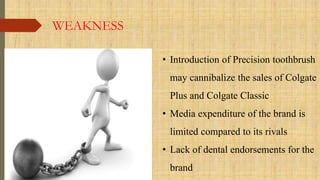
• Introduction of Precision toothbrush
may cannibalize the sales of Colgate
Plus and Colgate Classic
• Media expenditure of the brand is
limited compared to its rivals
• Lack of dental endorsements for the
brand
WEAKNESS
• CP’s consumer research revealed that
46% of adult consumers are concerned
about the health of their gums and are
willing to pay premium for
new products addressing the issue.
• Super-premium category can help
increase market share
• Precision brushes could be channeled
through Dental Professionals to
increase their Brand Image.
OPPURTUNITIES
• Positioning Precision as a
mainstream toothbrush raised
concerns about the possible
cannibalization of Colgate
Plus.
• Because of the recent market
saturation, the various
producers of oral health care
products have rushed to offer
promotional incentives
including two-for-one, buy-
one-get-one-free and mail-
in refund coupon deals.
THREATS
Product Segments
Toothbrush Industry divided the three main segments on the basis
of price: value, professional and super-premium.
In 1992, three players dominated the U.S. toothbrush market
overall: Colgate-Palmolive and Johnson & Johnson, whose
brushes were positioned in the professional segment; and Oral-B,
whose brushes were positioned in the super-premium segment.
New Entrants :Procter & Gamble, Smithkline Beecham both
had positioned their new product launches in the super-premium
segment
Values
Retail Prices:
• Super-Premium Brushes, between $2.29 and $2.89, accounted
for 35% of unit volume and 46% of dollar sales.
• Professional brushes, priced between $1.59 and $2.09,
accounted for a corresponding 41% and 42%,
• Value brushes, priced on average at $1.29, accounted for 24%
and 12%.
Consumer Behavior
CP estimated that 82% of toothbrush purchases were unplanned, and research
showed that
consumers were relatively unfamiliar with toothbrush prices. Although
consumers were willing to
experiment with new toothbrushes
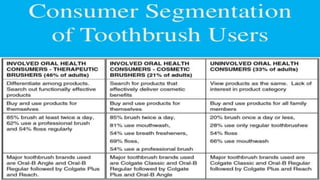
Buying Behavior of three groups:
1. Therapeutic brushers aimed to avoid oral care problems,
2. While cosmetic brushers emphasized preventing bad breath and/or ensuring
white teeth.
3. Uninvolved consumers were not motivated by oral care benefits and adjusted
their behavior only when
confronted by oral hygiene problems.
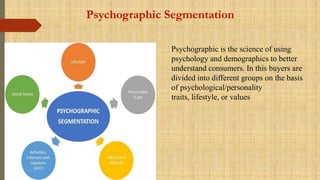
Psychographic Segmentation
Psychographic is the science of using
psychology and demographics to better
understand consumers. In this buyers are
divided into different groups on the basis
of psychological/personality
traits, lifestyle, or values
Major competitor brands in the super-premium segment included Oral-B,
Reach Advanced Design, Crest Complete, and Aquafresh Flex
• Oral-B relied heavily on professional endorsements and was known as “the
dentist’s toothbrush.”
• Johnson & Johnson (J&J) entered the U.S. toothbrush market in the 1970s
with the Reach brand
• Procter & Gamble (P&G) was the most recent entrant in the toothbrush
market with Crest Complete, an extension of the company’s toothpaste
brand name, Crest.
• Smithkline Beecham entered the U.S. toothbrush market, Aquafresh Flex
toothbrushes had flexible handles that allowed for gentle brushing.
Company Volume share(%) Value share(%) SKU's
Oral-B 23.1 30.7 27
Johnson & Johnson 19.4 21.8 18
Smithkline Beecham 0.9 1.1 6
Lever 7.2 6.6 5
Companies with their Volume share,
Value Share and SKU’S
Advertising and Promotion
• Increased advertising and promotion enhanced the
toothbrush category’s visibility which in turn fueled
consumer demand. Through a series a cleverly designed
promotions such as; giving away a free toothbrush with a
toothpaste purchase, mail-in premiums, buy-1 get-1 free,
coupons, etc.
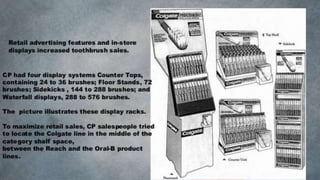
• Colgate was able to successfully market their products.
One of their most accomplished advertisements was in-
store displays. By utilizing in-store displays sales
increased 90%, and when combining toothbrushes and
toothpastes within a display sales increased 170%.
Precision Marketing Mix
CP had established a task force comprising executives from R&D and
Marketing, dental professionals, and outside consultants.
Its mission was to “develop a superior, technical, plaque removing device.”
The task force had five goals:
• Understanding the varying techniques consumers used
when brushing their teeth
• Testing the between-teeth access of different toothbrush
designs
• Establishing an index to score clinical plaque-removal
efficacy at the gum line and between teeth.
• Creating a bristle configuration and handle design offering
maximum plaque- removing efficacy.
• Determining, through clinical and consumer research, the
efficacy and acceptance of the new toothbrush design.
Positioning
Niche Positioning Strategy:
• Targeted at consumers concerned about gum disease.
• As a Niche product, Precision would capture 3 % of toothbrush Market by End
of the year.
• CP could command a 15% price positioning. premium over Oral-B.
• Precision, positioned as Niche Product would be primarily carried by food and
Drug stores.
• Precision as a niche product would not only give Colgate enough time to build
up a stock of the product but would also be able to avoid taking the Children’s
Plus model off store shelves.
Mainstream Positioning Strategy:
• Had a Broader appeal
• As a Mainstream product, Precision would capture 10 % of toothbrush
Market by End of the year.
• This volume share was expected to increase to 14.7% in the second year
• Precision, positioned as Mainstream Product would be primarily occur
through mass merchandisers and club stores.
Income Pro forma:
Analysis of the Pro forma income statements shows the mainstream
positioning strategy will lose almost $6.7MM in year one, but earn
$16MM in year two whereas a niche strategy loses less money in year
one ($1.4MM) and makes $7.4MM in year two. Hence mainstream
positioning strategy will help CP in long term profits.
Branding
• CP was estimated, both under the mainstream and niche positioning
scenarios, that cannibalization figures for Colgate Plus would
increase by 20% if the Colgate brand name was stressed but remain
unchanged if the Precision brand name was stressed.
• On the other hand, CP’s stated corporate strategy was to build on the
Colgate brand equity.
Arguments for launching precision as (a) a niche product and (b) a
mainstream brand
• CP had the option of either launching Colgate Precision as a niche
product or as a mainstream product. Both these options had
advantages and disadvantages and hence, this made it difficult for
the management to decide which route to choose
• The Colgate Plus product manager, John Phillips, argued that Plus
was the bread-and-butter of CP’s toothbrush line and claimed that
his mainstream brand should receive more rather than less support
if Precision was launched.
Communication and Promotions
Once the basic product design was established, four
concept tests conducted, tests revealed that 55% of test
consumers found Precision to be very different from
their current toothbrushes, and 77% claimed that
Precision was much more effective than their current
toothbrush
RECOMMENDATION
1. Position Precision toothbrush as a niche product
2. Appeal to therapeutic consumers
3. Market the product as providing superior and distinctive
oral care
FUTURE SCOPE
1. Can expand the toothbrush into mainstream market later
2. Can replace Oral-B as the leading brand in Super-
Premium range
3. Can expand into other oral care products for therapeutic
consumers
Disclaimer
MBA MARKETING INTERNSHIP
Created by ANSH BHARDWAJ, HBTU KANPUR under
the guidance of Prof. SAMEER MATHUR, IIM-
LUCKNOW

Colgate case study

  • 2.
    Colgate Palmolive The PrecisionToothbrush CP was a global leader in household and personal care products. With sales of $6.06 Billion and gross profit of $2.76 billion. Colgate Palmolive (CP), a market leader in the development and delivery of oral care products
  • 3.
    Problem Statement Outlining the Marketingstrategy (Positioning, Branding and Communications) to the new toothbrush : Colgate Precision
  • 4.
    Colgate- Palmolive’s Oral CareBusiness CP offered two lines of toothbrushes in 1991— the Colgate Classic and the Colgate Plus. • Colgate Classic positioned in the “value” segment and was CP’s original entry in the toothbrush market • Colgate Plus positioned as a higher-quality product in the “professional” segment.
  • 6.
    • CP’s Internationalsales, account for 64% of sales and 67% of profits in 1991, showcase their brand Image. • Precision Toothbrush launched by CP is a Technical Innovation . • Precision toothbrush prevent gum diseases motivated the greatest purchase intent among consumers. STRENGTHS
  • 7.
    • Introduction ofPrecision toothbrush may cannibalize the sales of Colgate Plus and Colgate Classic • Media expenditure of the brand is limited compared to its rivals • Lack of dental endorsements for the brand WEAKNESS
  • 8.
    • CP’s consumerresearch revealed that 46% of adult consumers are concerned about the health of their gums and are willing to pay premium for new products addressing the issue. • Super-premium category can help increase market share • Precision brushes could be channeled through Dental Professionals to increase their Brand Image. OPPURTUNITIES
  • 9.
    • Positioning Precisionas a mainstream toothbrush raised concerns about the possible cannibalization of Colgate Plus. • Because of the recent market saturation, the various producers of oral health care products have rushed to offer promotional incentives including two-for-one, buy- one-get-one-free and mail- in refund coupon deals. THREATS
  • 11.
    Product Segments Toothbrush Industrydivided the three main segments on the basis of price: value, professional and super-premium. In 1992, three players dominated the U.S. toothbrush market overall: Colgate-Palmolive and Johnson & Johnson, whose brushes were positioned in the professional segment; and Oral-B, whose brushes were positioned in the super-premium segment. New Entrants :Procter & Gamble, Smithkline Beecham both had positioned their new product launches in the super-premium segment
  • 12.
    Values Retail Prices: • Super-PremiumBrushes, between $2.29 and $2.89, accounted for 35% of unit volume and 46% of dollar sales. • Professional brushes, priced between $1.59 and $2.09, accounted for a corresponding 41% and 42%, • Value brushes, priced on average at $1.29, accounted for 24% and 12%.
  • 13.
    Consumer Behavior CP estimatedthat 82% of toothbrush purchases were unplanned, and research showed that consumers were relatively unfamiliar with toothbrush prices. Although consumers were willing to experiment with new toothbrushes Buying Behavior of three groups: 1. Therapeutic brushers aimed to avoid oral care problems, 2. While cosmetic brushers emphasized preventing bad breath and/or ensuring white teeth. 3. Uninvolved consumers were not motivated by oral care benefits and adjusted their behavior only when confronted by oral hygiene problems.
  • 14.
    Psychographic Segmentation Psychographic isthe science of using psychology and demographics to better understand consumers. In this buyers are divided into different groups on the basis of psychological/personality traits, lifestyle, or values
  • 17.
    Major competitor brandsin the super-premium segment included Oral-B, Reach Advanced Design, Crest Complete, and Aquafresh Flex • Oral-B relied heavily on professional endorsements and was known as “the dentist’s toothbrush.” • Johnson & Johnson (J&J) entered the U.S. toothbrush market in the 1970s with the Reach brand • Procter & Gamble (P&G) was the most recent entrant in the toothbrush market with Crest Complete, an extension of the company’s toothpaste brand name, Crest. • Smithkline Beecham entered the U.S. toothbrush market, Aquafresh Flex toothbrushes had flexible handles that allowed for gentle brushing.
  • 18.
    Company Volume share(%)Value share(%) SKU's Oral-B 23.1 30.7 27 Johnson & Johnson 19.4 21.8 18 Smithkline Beecham 0.9 1.1 6 Lever 7.2 6.6 5 Companies with their Volume share, Value Share and SKU’S
  • 19.
    Advertising and Promotion •Increased advertising and promotion enhanced the toothbrush category’s visibility which in turn fueled consumer demand. Through a series a cleverly designed promotions such as; giving away a free toothbrush with a toothpaste purchase, mail-in premiums, buy-1 get-1 free, coupons, etc. • Colgate was able to successfully market their products. One of their most accomplished advertisements was in- store displays. By utilizing in-store displays sales increased 90%, and when combining toothbrushes and toothpastes within a display sales increased 170%.
  • 21.
    Precision Marketing Mix CPhad established a task force comprising executives from R&D and Marketing, dental professionals, and outside consultants. Its mission was to “develop a superior, technical, plaque removing device.” The task force had five goals:
  • 22.
    • Understanding thevarying techniques consumers used when brushing their teeth • Testing the between-teeth access of different toothbrush designs • Establishing an index to score clinical plaque-removal efficacy at the gum line and between teeth. • Creating a bristle configuration and handle design offering maximum plaque- removing efficacy. • Determining, through clinical and consumer research, the efficacy and acceptance of the new toothbrush design.
  • 23.
    Positioning Niche Positioning Strategy: •Targeted at consumers concerned about gum disease. • As a Niche product, Precision would capture 3 % of toothbrush Market by End of the year. • CP could command a 15% price positioning. premium over Oral-B. • Precision, positioned as Niche Product would be primarily carried by food and Drug stores. • Precision as a niche product would not only give Colgate enough time to build up a stock of the product but would also be able to avoid taking the Children’s Plus model off store shelves.
  • 24.
    Mainstream Positioning Strategy: •Had a Broader appeal • As a Mainstream product, Precision would capture 10 % of toothbrush Market by End of the year. • This volume share was expected to increase to 14.7% in the second year • Precision, positioned as Mainstream Product would be primarily occur through mass merchandisers and club stores.
  • 27.
    Income Pro forma: Analysisof the Pro forma income statements shows the mainstream positioning strategy will lose almost $6.7MM in year one, but earn $16MM in year two whereas a niche strategy loses less money in year one ($1.4MM) and makes $7.4MM in year two. Hence mainstream positioning strategy will help CP in long term profits.
  • 29.
    Branding • CP wasestimated, both under the mainstream and niche positioning scenarios, that cannibalization figures for Colgate Plus would increase by 20% if the Colgate brand name was stressed but remain unchanged if the Precision brand name was stressed. • On the other hand, CP’s stated corporate strategy was to build on the Colgate brand equity.
  • 30.
    Arguments for launchingprecision as (a) a niche product and (b) a mainstream brand • CP had the option of either launching Colgate Precision as a niche product or as a mainstream product. Both these options had advantages and disadvantages and hence, this made it difficult for the management to decide which route to choose • The Colgate Plus product manager, John Phillips, argued that Plus was the bread-and-butter of CP’s toothbrush line and claimed that his mainstream brand should receive more rather than less support if Precision was launched.
  • 31.
    Communication and Promotions Oncethe basic product design was established, four concept tests conducted, tests revealed that 55% of test consumers found Precision to be very different from their current toothbrushes, and 77% claimed that Precision was much more effective than their current toothbrush
  • 32.
    RECOMMENDATION 1. Position Precisiontoothbrush as a niche product 2. Appeal to therapeutic consumers 3. Market the product as providing superior and distinctive oral care FUTURE SCOPE 1. Can expand the toothbrush into mainstream market later 2. Can replace Oral-B as the leading brand in Super- Premium range 3. Can expand into other oral care products for therapeutic consumers
  • 33.
    Disclaimer MBA MARKETING INTERNSHIP Createdby ANSH BHARDWAJ, HBTU KANPUR under the guidance of Prof. SAMEER MATHUR, IIM- LUCKNOW