Fiscal Policy

 Submitted to:       Submitted by:
Ms. Mudita Singh        Monica
                      Manoj Bheel
                     Naman Bansal
                    Namrata Dhadse
                     Neha Khanuja
Definition
O Fiscal Policy is defined as government policy
  concerned with raising expenditure and revenue
  collection (taxation) to influence the economy.
O A policy under which government uses its
  expenditure and revenue program to produce
  desirable effects and avoid undesirable effects
  in the national income, production and
  employment.
                                   - Arthur Smith.
Meaning & Comprehension
 O Fiscal Policy is a vital instrument in modern
   times.
 O Fiscal Policy means relating to taxation and
   public expenditure. When these policies are
   used to achieve balanced economic
   development of any country it’s called as fiscal
   policy.
 O In developing economy, goals of the Fiscal Policy
   are to accelerate the rate of the economic
   growth, social justice and price stability.
Stances of Fiscal Policy
O The three main stances of fiscal policy are:


     O Neutral Fiscal Policy
     O Expansionary Fiscal Policy
     O Contractionary Fiscal Policy
Objectives of Fiscal Policy
O   Development by effective mobilization of
    resources

O   Taxation : Direct and Indirect Taxes

O   Public savings : Public sector enterprise

O   Private savings : Treasury bills
    ,      government bonds, loan from domestic
    and foreign parties
O     Efficient allocation of financial resources

    O For development activities
    O Production of desirable goods


O     Reduction in inequalities in income and
      wealth

    O Direct taxes on rich people
    O Indirect taxes on semi luxury and luxury items
O    Balanced Regional Development

    O Cash Subsidies
    O Tax Holidays


O    Reducing Deficit in the Balance of Payment

    O Exemption of income tax on export
    O Exemption of central excise duties and customs
    O Custom duties on Imports
O    Capital formation

    O Encourage saving
    O Reduce spending


O    Increasing national income

O    Development of Infrastructure

O    Foreign exchange earnings
Trends in
Indian Fiscal Policy
Trends in Indian Fiscal Policy
O Revenue
   O Tax Revenue
     O Direct Taxes
     O Indirect Taxes
   O Non Tax Revenue
   O Capital Receipts
O Expenditure
   O Plan Expenditure
   O Non - Plan Expenditure
O Fiscal Deficit
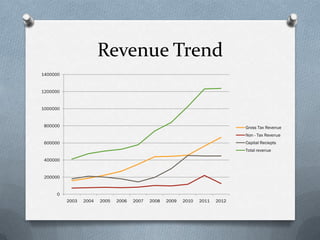
Revenue Trend
1400000


1200000


1000000


 800000                                                                         Gross Tax Revenue
                                                                                Non - Tax Revenue
 600000                                                                         Capital Reciepts
                                                                                Total revenue

 400000


 200000


      0
          2003   2004   2005   2006   2007   2008   2009   2010   2011   2012
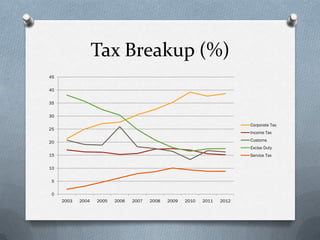
Tax Breakup (%)
45

40

35

30

                                                                           Corporate Tax
25
                                                                           Income Tax

20                                                                         Customs
                                                                           Excise Duty
15                                                                         Service Tax

10

5

0
     2003   2004   2005   2006   2007   2008   2009   2010   2011   2012
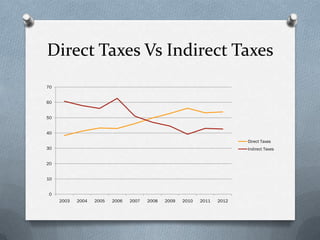
Direct Taxes Vs Indirect Taxes
70


60


50


40
                                                                           Direct Taxes
30                                                                         Indirect Taxes


20


10


0
     2003   2004   2005   2006   2007   2008   2009   2010   2011   2012
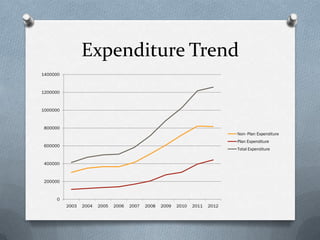
Expenditure Trend
1400000


1200000


1000000


 800000
                                                                                Non- Plan Expenditure
                                                                                Plan Expenditure
 600000
                                                                                Total Expenditure


 400000


 200000


      0
          2003   2004   2005   2006   2007   2008   2009   2010   2011   2012
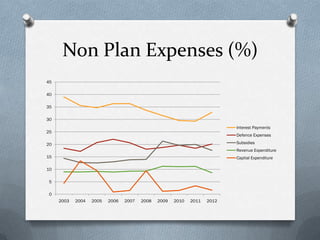
Non Plan Expenses (%)
45

40

35

30
                                                                           Interest Payments
25
                                                                           Defence Expenses

20                                                                         Subsidies
                                                                           Revenue Expenditure
15                                                                         Capital Expenditure

10

 5

 0
     2003   2004   2005   2006   2007   2008   2009   2010   2011   2012
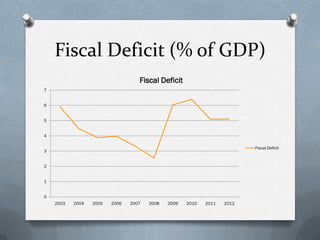
Fiscal Deficit (% of GDP)
                                   Fiscal Deficit
7


6


5


4

                                                                          Fiscal Deficit
3


2


1


0
    2003   2004   2005   2006   2007   2008   2009   2010   2011   2012
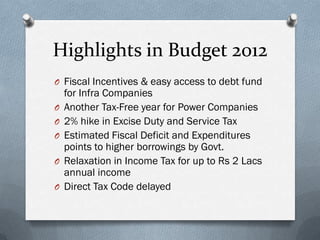
Highlights in Budget 2012
O Fiscal Incentives & easy access to debt fund
    for Infra Companies
O   Another Tax-Free year for Power Companies
O   2% hike in Excise Duty and Service Tax
O   Estimated Fiscal Deficit and Expenditures
    points to higher borrowings by Govt.
O   Relaxation in Income Tax for up to Rs 2 Lacs
    annual income
O   Direct Tax Code delayed
Features of Fiscal Policy
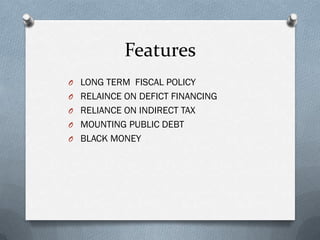
Features
O LONG TERM FISCAL POLICY
O RELAINCE ON DEFICT FINANCING
O RELIANCE ON INDIRECT TAX
O MOUNTING PUBLIC DEBT
O BLACK MONEY
Conclusion
O
  The objectives of fiscal policy such as economic
  development, price stability, social justice, etc. can be
  achieved only if the tools of policy like Public
  Expenditure, Taxation, Borrowing and deficit
  financing are effectively used.
O Though there are gaps in India's fiscal policy, there is
  also an urgent need for making India's fiscal policy a
  rationalized and growth oriented one.
O The success of fiscal policy depends upon taking
  timely measures and their effective administration
  during implementation.

Fiscal Policy

  • 1.
    Fiscal Policy Submittedto: Submitted by: Ms. Mudita Singh Monica Manoj Bheel Naman Bansal Namrata Dhadse Neha Khanuja
  • 2.
    Definition O Fiscal Policyis defined as government policy concerned with raising expenditure and revenue collection (taxation) to influence the economy. O A policy under which government uses its expenditure and revenue program to produce desirable effects and avoid undesirable effects in the national income, production and employment. - Arthur Smith.
  • 3.
    Meaning & Comprehension O Fiscal Policy is a vital instrument in modern times. O Fiscal Policy means relating to taxation and public expenditure. When these policies are used to achieve balanced economic development of any country it’s called as fiscal policy. O In developing economy, goals of the Fiscal Policy are to accelerate the rate of the economic growth, social justice and price stability.
  • 4.
    Stances of FiscalPolicy O The three main stances of fiscal policy are: O Neutral Fiscal Policy O Expansionary Fiscal Policy O Contractionary Fiscal Policy
  • 5.
  • 6.
    O Development by effective mobilization of resources O Taxation : Direct and Indirect Taxes O Public savings : Public sector enterprise O Private savings : Treasury bills , government bonds, loan from domestic and foreign parties
  • 7.
    O Efficient allocation of financial resources O For development activities O Production of desirable goods O Reduction in inequalities in income and wealth O Direct taxes on rich people O Indirect taxes on semi luxury and luxury items
  • 8.
    O Balanced Regional Development O Cash Subsidies O Tax Holidays O Reducing Deficit in the Balance of Payment O Exemption of income tax on export O Exemption of central excise duties and customs O Custom duties on Imports
  • 9.
    O Capital formation O Encourage saving O Reduce spending O Increasing national income O Development of Infrastructure O Foreign exchange earnings
  • 10.
  • 11.
    Trends in IndianFiscal Policy O Revenue O Tax Revenue O Direct Taxes O Indirect Taxes O Non Tax Revenue O Capital Receipts O Expenditure O Plan Expenditure O Non - Plan Expenditure O Fiscal Deficit
  • 12.
    Revenue Trend 1400000 1200000 1000000 800000 Gross Tax Revenue Non - Tax Revenue 600000 Capital Reciepts Total revenue 400000 200000 0 2003 2004 2005 2006 2007 2008 2009 2010 2011 2012
  • 13.
    Tax Breakup (%) 45 40 35 30 Corporate Tax 25 Income Tax 20 Customs Excise Duty 15 Service Tax 10 5 0 2003 2004 2005 2006 2007 2008 2009 2010 2011 2012
  • 14.
    Direct Taxes VsIndirect Taxes 70 60 50 40 Direct Taxes 30 Indirect Taxes 20 10 0 2003 2004 2005 2006 2007 2008 2009 2010 2011 2012
  • 15.
    Expenditure Trend 1400000 1200000 1000000 800000 Non- Plan Expenditure Plan Expenditure 600000 Total Expenditure 400000 200000 0 2003 2004 2005 2006 2007 2008 2009 2010 2011 2012
  • 16.
    Non Plan Expenses(%) 45 40 35 30 Interest Payments 25 Defence Expenses 20 Subsidies Revenue Expenditure 15 Capital Expenditure 10 5 0 2003 2004 2005 2006 2007 2008 2009 2010 2011 2012
  • 17.
    Fiscal Deficit (%of GDP) Fiscal Deficit 7 6 5 4 Fiscal Deficit 3 2 1 0 2003 2004 2005 2006 2007 2008 2009 2010 2011 2012
  • 18.
    Highlights in Budget2012 O Fiscal Incentives & easy access to debt fund for Infra Companies O Another Tax-Free year for Power Companies O 2% hike in Excise Duty and Service Tax O Estimated Fiscal Deficit and Expenditures points to higher borrowings by Govt. O Relaxation in Income Tax for up to Rs 2 Lacs annual income O Direct Tax Code delayed
  • 19.
  • 20.
    Features O LONG TERMFISCAL POLICY O RELAINCE ON DEFICT FINANCING O RELIANCE ON INDIRECT TAX O MOUNTING PUBLIC DEBT O BLACK MONEY
  • 21.
    Conclusion O Theobjectives of fiscal policy such as economic development, price stability, social justice, etc. can be achieved only if the tools of policy like Public Expenditure, Taxation, Borrowing and deficit financing are effectively used. O Though there are gaps in India's fiscal policy, there is also an urgent need for making India's fiscal policy a rationalized and growth oriented one. O The success of fiscal policy depends upon taking timely measures and their effective administration during implementation.