LaTeX tutorial
How to setup and write in LaTeX
1
Hossein Babashah
November 22th, 2015
2
1 minute break
Compiling &
Output Files
51
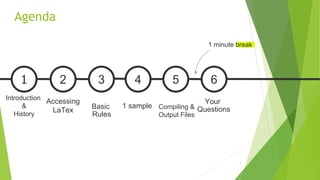
Introduction
&
History
Accessing
LaTex
2
Basic
Rules
3
1 sample
4
Your
Questions
6
Agenda
3
What is LaTeX?
 LaTeX
 a document markup language and document preparation system for the TeX
typesetting program
 to create a document in LaTeX, a .tex file must be created using some form of
text editor.
 is widely used in academia, because of the high quality of typesetting
achievable by TeX
 The version numbers of TeX are converging toward pi, with a current version
number of 3.1415926
 e for pen size
History: TeX and LaTeX
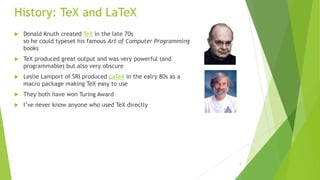
 Donald Knuth created TeX in the late 70s
so he could typeset his famous Art of Computer Programming
books
 TeX produced great output and was very powerful (and
programmable) but also very obscure
 Leslie Lamport of SRI produced LaTeX in the ealry 80s as a
macro package making TeX easy to use
 They both have won Turing Award
 I’ve never know anyone who used TeX directly
4
Why not MS Word?
[8]http://www.jaftalks.com/wp/index.php/latex-or-
microsoft-word-in-it-organization/
5
6
Why LaTeX
 It’s good for complex documents
like a dissertation
 It’s the standard for Computer Science, Mathematics and many other STEM fields
 Many conferences have their own LaTex document
 Elsevier uses LaTeX to typeset all their journals
 LaTeX’s bibliography system, BibTex, is the best
 LaTex is programmable!
 LaTeX is open source software, has a large community of users and developers
and a good infrastructure (e.g., CTAN.org , latex-projgect.org)
[1] Leslie Lamport. LATEX: A Document Preparation System.
7
Accessing LaTeX
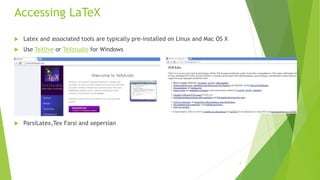
 Latex and associated tools are typically pre-installed on Linux and Mac OS X
 Use TeXlive or TeXstudio for Windows
 ParsiLatex,Tex Farsi and xepersian
8
LaTeX Files
 The input for LaTeX is a plain ASCII text file.
 You can create it with any text editor.
 It contains
 the text of the document
 commands which tell LaTeX how to typeset the text.
 Spaces
 Special Characters
 LaTeX Commands
 Comments
 Files containing structure and layout definitions (.sty)
 Tex formatted output file (.dvi)
 Others:
lof (list of figures), .lot (list of tables), .bib (bibliography)
Special Characters
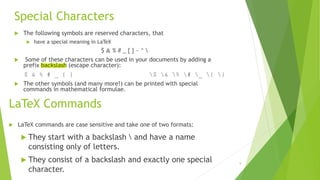
 The following symbols are reserved characters, that
 have a special meaning in LaTeX
$ & % # _ { } ~ ^ 
 Some of these characters can be used in your documents by adding a
prefix backslash (escape character):
$ & % # _ { } $ & % # _ { }
 The other symbols (and many more!) can be printed with special
commands in mathematical formulae.
LaTeX Commands
 LaTeX commands are case sensitive and take one of two formats:
 They start with a backslash  and have a name
consisting only of letters.
 They consist of a backslash and exactly one special
character.
9
Input File Structure (1)
 When LaTeX2e processes an input file it expects it
to follow a certain structure. Every input file starts
with the command:
documentclass[options]{class}
 documentclass[11pt,twoside,a4paper]{article}
 This specifies what sort of document you intend to write
(article, letter, book,thesis, etc.)
 After that, you can include global style commands
or you can load packages which add new features
to the LaTeX system. To load a package you use the
command:
usepackage[options]{package}
10
Input File Structure (2)
 When all the setup work is done, you start the body of the text with the
command:
begin{document}
 Now you enter the text mixed with some useful LaTeX commands.
 At the end of the document you use the
end{document}
command, which tells LaTeX to finish. Anything which follows this command
will be ignored by LaTeX
sample.tex
documentclass[12pt]{article}
usepackage{ifthen}
begin{document}
title{Hello World in LaTeX}
author{My Name Goes Here}
maketitle
Hello, world!
{em Hello, world!}
{bf Hello, world!}
{Large bf Hello, world!!!}
end{document}
Start by declaring the document class (article)
and use the 12pt option setting the font size
Loads required packages defining commands
or setting parameters
LaTex uses begin|end commands for
blocks. Every document must have a
document block
The title and author command set
document variables and the maketitle
command generates the output text
Latex comands start with a backslash,
required args are in {}, options in []s
Paragraphs are separated by blank lines
{}s introduce un-named blocks and
control scope. em for italics, bf for
bold, Large to increase font size
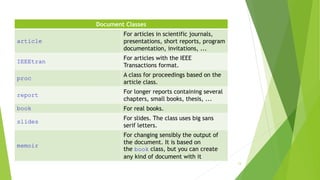
Document Classes
article
For articles in scientific journals,
presentations, short reports, program
documentation, invitations, ...
IEEEtran
For articles with the IEEE
Transactions format.
proc
A class for proceedings based on the
article class.
report
For longer reports containing several
chapters, small books, thesis, ...
book For real books.
slides
For slides. The class uses big sans
serif letters.
memoir
For changing sensibly the output of
the document. It is based on
the book class, but you can create
any kind of document with it
13
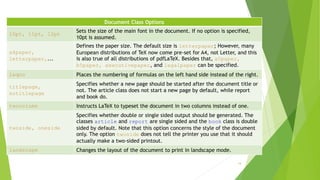
Document Class Options
10pt, 11pt, 12pt
Sets the size of the main font in the document. If no option is specified,
10pt is assumed.
a4paper,
letterpaper,...
Defines the paper size. The default size is letterpaper; However, many
European distributions of TeX now come pre-set for A4, not Letter, and this
is also true of all distributions of pdfLaTeX. Besides that, a5paper,
b5paper, executivepaper, and legalpaper can be specified.
leqno Places the numbering of formulas on the left hand side instead of the right.
titlepage,
notitlepage
Specifies whether a new page should be started after the document title or
not. The article class does not start a new page by default, while report
and book do.
twocolumn Instructs LaTeX to typeset the document in two columns instead of one.
twoside, oneside
Specifies whether double or single sided output should be generated. The
classes article and report are single sided and the book class is double
sided by default. Note that this option concerns the style of the document
only. The option twoside does not tell the printer you use that it should
actually make a two-sided printout.
landscape Changes the layout of the document to print in landscape mode.
14
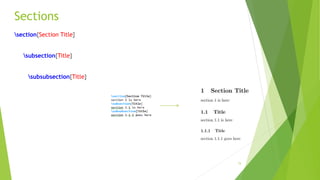
Sections
section{Section Title}
subsection{Title}
subsubsection{Title}
15
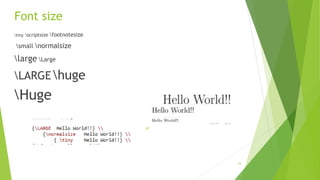
Font size
tiny scriptsize footnotesize
small normalsize
large Large
LARGE huge
Huge
16
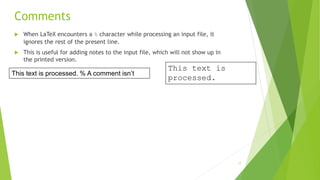
Comments
 When LaTeX encounters a % character while processing an input file, it
ignores the rest of the present line.
 This is useful for adding notes to the input file, which will not show up in
the printed version.
This text is
processed.
This text is processed. % A comment isn’t
17
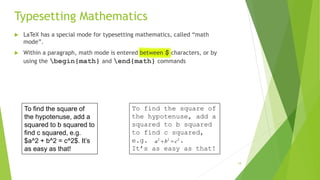
To find the square of
the hypotenuse, add a
squared to b squared
to find c squared,
e.g. .
It’s as easy as that!
Typesetting Mathematics
 LaTeX has a special mode for typesetting mathematics, called “math
mode”.
 Within a paragraph, math mode is entered between $ characters, or by
using the begin{math} and end{math} commands
To find the square of
the hypotenuse, add a
squared to b squared to
find c squared, e.g.
$a^2 + b^2 = c^2$. It’s
as easy as that!
222
cba 
18
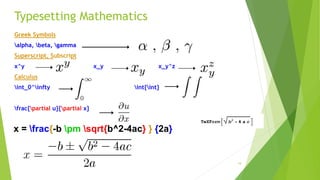
Typesetting Mathematics
Greek Symbols
alpha, beta, gamma
Superscript, Subscript
x^y x_y x_y^z
Calculus
int_0^infty int{int}
frac{partial u}{partial x}
x = frac{-b pm sqrt{b^2-4ac} } {2a}
19
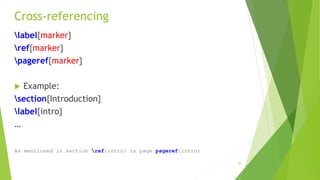
Cross-referencing
label{marker}
ref{marker}
pageref{marker}
 Example:
section{Introduction}
label{intro}
…
As mentioned in section ref{intro} in page pageref{intro}
20
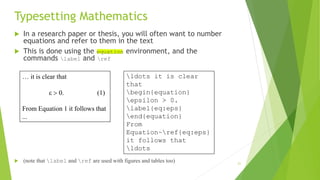
Typesetting Mathematics
 In a research paper or thesis, you will often want to number
equations and refer to them in the text
 This is done using the equation environment, and the
commands label and ref
 (note that label and ref are used with figures and tables too)
… it is clear that
e > 0. (1)
From Equation 1 it follows that
...
ldots it is clear
that
begin{equation}
epsilon > 0.
label{eq:eps}
end{equation}
From
Equation~ref{eq:eps}
it follows that
ldots
21
Typesetting Mathematics
 Matrices are produced using the textbf{array}
environment. Example:
The emph{characteristic polynomial} $chi(lambda)$ of the
$3 times 3$ matrix
[ left( begin{array}{ccc}
a & b & c 
d & e & f 
g & h & i end{array} right)]
is given by the formula
[ chi(lambda) = left| begin{array}{ccc}
lambda - a & -b & -c 
-d & lambda - e & -f 
-g & -h & lambda - i end{array} right|.] 22
TeXForm[
𝑎11 𝑎12 𝑎13
𝑎21 𝑎22 𝑎23
𝑎31 𝑎32 𝑎33
Including Graphics
 LaTeX2e includes a standard package for including PostScript graphics in
your document. Load it using
usepackage{graphics}
 A figure can be included using, for example,
begin{figure}[h]
centering
includegraphics[width=0.6linewidth]{"mypic"}
caption{Friends for $2.1<T_{c}<2.6$}
label{fig:magnetforsometc}
end{figure}
23
begin{figure}[placement specifier]
usepackage{caption}
raggedleft
Figures and Tables
 Figures & Tables cannot be broken between pages
 They are “floated”
begin{figure}
includegraphics[option]{sample}
caption{A sample figure.}
end{figure}
24
usepackage{caption}
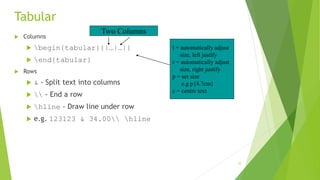
 Columns
 begin{tabular}{|…|…|}
 end{tabular}
 Rows
 & - Split text into columns
  - End a row
 hline - Draw line under row
 e.g. 123123 & 34.00 hline
Two Columns
l = automatically adjust
size, left justify
r = automatically adjust
size, right justify
p = set size
e.g p{4.7cm}
c = centre text
Tabular
25
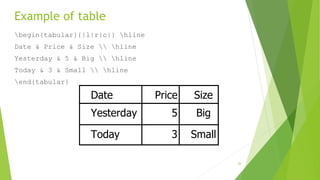
Example of table
begin{tabular}{|l|r|c|} hline
Date & Price & Size  hline
Yesterday & 5 & Big  hline
Today & 3 & Small  hline
end{tabular}
Date Price Size
Yesterday 5 Big
Today 3 Small
26
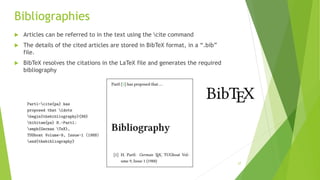
Bibliographies
 Articles can be referred to in the text using the cite command
 The details of the cited articles are stored in BibTeX format, in a “.bib”
file.
 BibTeX resolves the citations in the LaTeX file and generates the required
bibliography
27
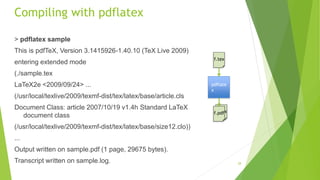
f.aux
Compiling with pdflatex
> pdflatex sample
This is pdfTeX, Version 3.1415926-1.40.10 (TeX Live 2009)
entering extended mode
(./sample.tex
LaTeX2e <2009/09/24> ...
(/usr/local/texlive/2009/texmf-dist/tex/latex/base/article.cls
Document Class: article 2007/10/19 v1.4h Standard LaTeX
document class
(/usr/local/texlive/2009/texmf-dist/tex/latex/base/size12.clo))
...
Output written on sample.pdf (1 page, 29675 bytes).
Transcript written on sample.log.
f.tex
pdflate
x
f.pdf
28
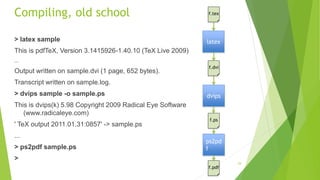
Compiling, old school
> latex sample
This is pdfTeX, Version 3.1415926-1.40.10 (TeX Live 2009)
...
Output written on sample.dvi (1 page, 652 bytes).
Transcript written on sample.log.
> dvips sample -o sample.ps
This is dvips(k) 5.98 Copyright 2009 Radical Eye Software
(www.radicaleye.com)
' TeX output 2011.01.31:0857' -> sample.ps
...
> ps2pdf sample.ps
>
f.tex
latex
dvips
f.dvi
f.ps
ps2pd
f
f.pdf
29
Output Formats
 .dvi Device Independent
 .ps Post Script
 .pdf PDF
 .rtf Rich Text Format
 .html HTML
 .xmlXML
1
30
References
31
[1] Leslie Lamport. LATEX: A Document Preparation System. Addison-Wesley,
Reading, Massachuse s, second edition, 1994, ISBN 0-201-52983-1.
[2] Donald E. Knuth. e TEXbook, Volume A of Computers and Typese ing,
Addison-Wesley, Reading, Massachuse s, second edition, 1984, ISBN 0-201-
13448-9.
[3] Frank Mi elbach, Michel Goossens, Johannes Braams, David Carlisle, Chris
Rowley. e LATEX Companion, (2nd Edition). Addison-Wesley, Reading, Mas-
sachuse s, 2004, ISBN 0-201-36299-6.
[4] Michel Goossens, Sebastian Rahtz and Frank Mi elbach. e LATEX Graphics
Companion. Addison-Wesley, Reading, Massachuse s, 1997, ISBN 0-201-
85469-4.
[5] Each LATEX installation should provide a so-called LATEX Local Guide, which
explains the things that are special to the local system. It should be contained
in a file called local.tex. Unfortunately, some lazy sysops do not provide
such a document. In this case, go and ask your local LATEX guru for help.
[6] LATEX3 Project Team. LATEX 2ε for authors. Comes with the LATEX 2ε distribu-
tion as usrguide.tex.
[7] www.wikipedia.com
[8]http://www.jaftalks.com/wp/index.php/latex-or-microsoft-word-in-it-
organization/
32
?
Your Questions

LaTex tutorial with Texstudio

  • 1.
    LaTeX tutorial How tosetup and write in LaTeX 1 Hossein Babashah November 22th, 2015
  • 2.
    2 1 minute break Compiling& Output Files 51 Introduction & History Accessing LaTex 2 Basic Rules 3 1 sample 4 Your Questions 6 Agenda
  • 3.
    3 What is LaTeX? LaTeX  a document markup language and document preparation system for the TeX typesetting program  to create a document in LaTeX, a .tex file must be created using some form of text editor.  is widely used in academia, because of the high quality of typesetting achievable by TeX  The version numbers of TeX are converging toward pi, with a current version number of 3.1415926  e for pen size
  • 4.
    History: TeX andLaTeX  Donald Knuth created TeX in the late 70s so he could typeset his famous Art of Computer Programming books  TeX produced great output and was very powerful (and programmable) but also very obscure  Leslie Lamport of SRI produced LaTeX in the ealry 80s as a macro package making TeX easy to use  They both have won Turing Award  I’ve never know anyone who used TeX directly 4
  • 5.
    Why not MSWord? [8]http://www.jaftalks.com/wp/index.php/latex-or- microsoft-word-in-it-organization/ 5
  • 6.
    6 Why LaTeX  It’sgood for complex documents like a dissertation  It’s the standard for Computer Science, Mathematics and many other STEM fields  Many conferences have their own LaTex document  Elsevier uses LaTeX to typeset all their journals  LaTeX’s bibliography system, BibTex, is the best  LaTex is programmable!  LaTeX is open source software, has a large community of users and developers and a good infrastructure (e.g., CTAN.org , latex-projgect.org) [1] Leslie Lamport. LATEX: A Document Preparation System.
  • 7.
    7 Accessing LaTeX  Latexand associated tools are typically pre-installed on Linux and Mac OS X  Use TeXlive or TeXstudio for Windows  ParsiLatex,Tex Farsi and xepersian
  • 8.
    8 LaTeX Files  Theinput for LaTeX is a plain ASCII text file.  You can create it with any text editor.  It contains  the text of the document  commands which tell LaTeX how to typeset the text.  Spaces  Special Characters  LaTeX Commands  Comments  Files containing structure and layout definitions (.sty)  Tex formatted output file (.dvi)  Others: lof (list of figures), .lot (list of tables), .bib (bibliography)
  • 9.
    Special Characters  Thefollowing symbols are reserved characters, that  have a special meaning in LaTeX $ & % # _ { } ~ ^  Some of these characters can be used in your documents by adding a prefix backslash (escape character): $ & % # _ { } $ & % # _ { }  The other symbols (and many more!) can be printed with special commands in mathematical formulae. LaTeX Commands  LaTeX commands are case sensitive and take one of two formats:  They start with a backslash and have a name consisting only of letters.  They consist of a backslash and exactly one special character. 9
  • 10.
    Input File Structure(1)  When LaTeX2e processes an input file it expects it to follow a certain structure. Every input file starts with the command: documentclass[options]{class}  documentclass[11pt,twoside,a4paper]{article}  This specifies what sort of document you intend to write (article, letter, book,thesis, etc.)  After that, you can include global style commands or you can load packages which add new features to the LaTeX system. To load a package you use the command: usepackage[options]{package} 10
  • 11.
    Input File Structure(2)  When all the setup work is done, you start the body of the text with the command: begin{document}  Now you enter the text mixed with some useful LaTeX commands.  At the end of the document you use the end{document} command, which tells LaTeX to finish. Anything which follows this command will be ignored by LaTeX
  • 12.
    sample.tex documentclass[12pt]{article} usepackage{ifthen} begin{document} title{Hello World inLaTeX} author{My Name Goes Here} maketitle Hello, world! {em Hello, world!} {bf Hello, world!} {Large bf Hello, world!!!} end{document} Start by declaring the document class (article) and use the 12pt option setting the font size Loads required packages defining commands or setting parameters LaTex uses begin|end commands for blocks. Every document must have a document block The title and author command set document variables and the maketitle command generates the output text Latex comands start with a backslash, required args are in {}, options in []s Paragraphs are separated by blank lines {}s introduce un-named blocks and control scope. em for italics, bf for bold, Large to increase font size
  • 13.
    Document Classes article For articlesin scientific journals, presentations, short reports, program documentation, invitations, ... IEEEtran For articles with the IEEE Transactions format. proc A class for proceedings based on the article class. report For longer reports containing several chapters, small books, thesis, ... book For real books. slides For slides. The class uses big sans serif letters. memoir For changing sensibly the output of the document. It is based on the book class, but you can create any kind of document with it 13
  • 14.
    Document Class Options 10pt,11pt, 12pt Sets the size of the main font in the document. If no option is specified, 10pt is assumed. a4paper, letterpaper,... Defines the paper size. The default size is letterpaper; However, many European distributions of TeX now come pre-set for A4, not Letter, and this is also true of all distributions of pdfLaTeX. Besides that, a5paper, b5paper, executivepaper, and legalpaper can be specified. leqno Places the numbering of formulas on the left hand side instead of the right. titlepage, notitlepage Specifies whether a new page should be started after the document title or not. The article class does not start a new page by default, while report and book do. twocolumn Instructs LaTeX to typeset the document in two columns instead of one. twoside, oneside Specifies whether double or single sided output should be generated. The classes article and report are single sided and the book class is double sided by default. Note that this option concerns the style of the document only. The option twoside does not tell the printer you use that it should actually make a two-sided printout. landscape Changes the layout of the document to print in landscape mode. 14
  • 15.
  • 16.
    Font size tiny scriptsizefootnotesize small normalsize large Large LARGE huge Huge 16
  • 17.
    Comments  When LaTeXencounters a % character while processing an input file, it ignores the rest of the present line.  This is useful for adding notes to the input file, which will not show up in the printed version. This text is processed. This text is processed. % A comment isn’t 17
  • 18.
    To find thesquare of the hypotenuse, add a squared to b squared to find c squared, e.g. . It’s as easy as that! Typesetting Mathematics  LaTeX has a special mode for typesetting mathematics, called “math mode”.  Within a paragraph, math mode is entered between $ characters, or by using the begin{math} and end{math} commands To find the square of the hypotenuse, add a squared to b squared to find c squared, e.g. $a^2 + b^2 = c^2$. It’s as easy as that! 222 cba  18
  • 19.
    Typesetting Mathematics Greek Symbols alpha,beta, gamma Superscript, Subscript x^y x_y x_y^z Calculus int_0^infty int{int} frac{partial u}{partial x} x = frac{-b pm sqrt{b^2-4ac} } {2a} 19
  • 20.
  • 21.
    Typesetting Mathematics  Ina research paper or thesis, you will often want to number equations and refer to them in the text  This is done using the equation environment, and the commands label and ref  (note that label and ref are used with figures and tables too) … it is clear that e > 0. (1) From Equation 1 it follows that ... ldots it is clear that begin{equation} epsilon > 0. label{eq:eps} end{equation} From Equation~ref{eq:eps} it follows that ldots 21
  • 22.
    Typesetting Mathematics  Matricesare produced using the textbf{array} environment. Example: The emph{characteristic polynomial} $chi(lambda)$ of the $3 times 3$ matrix [ left( begin{array}{ccc} a & b & c d & e & f g & h & i end{array} right)] is given by the formula [ chi(lambda) = left| begin{array}{ccc} lambda - a & -b & -c -d & lambda - e & -f -g & -h & lambda - i end{array} right|.] 22 TeXForm[ 𝑎11 𝑎12 𝑎13 𝑎21 𝑎22 𝑎23 𝑎31 𝑎32 𝑎33
  • 23.
    Including Graphics  LaTeX2eincludes a standard package for including PostScript graphics in your document. Load it using usepackage{graphics}  A figure can be included using, for example, begin{figure}[h] centering includegraphics[width=0.6linewidth]{"mypic"} caption{Friends for $2.1<T_{c}<2.6$} label{fig:magnetforsometc} end{figure} 23 begin{figure}[placement specifier] usepackage{caption} raggedleft
  • 24.
    Figures and Tables Figures & Tables cannot be broken between pages  They are “floated” begin{figure} includegraphics[option]{sample} caption{A sample figure.} end{figure} 24 usepackage{caption}
  • 25.
     Columns  begin{tabular}{|…|…|} end{tabular}  Rows  & - Split text into columns  - End a row  hline - Draw line under row  e.g. 123123 & 34.00 hline Two Columns l = automatically adjust size, left justify r = automatically adjust size, right justify p = set size e.g p{4.7cm} c = centre text Tabular 25
  • 26.
    Example of table begin{tabular}{|l|r|c|}hline Date & Price & Size hline Yesterday & 5 & Big hline Today & 3 & Small hline end{tabular} Date Price Size Yesterday 5 Big Today 3 Small 26
  • 27.
    Bibliographies  Articles canbe referred to in the text using the cite command  The details of the cited articles are stored in BibTeX format, in a “.bib” file.  BibTeX resolves the citations in the LaTeX file and generates the required bibliography 27
  • 28.
    f.aux Compiling with pdflatex >pdflatex sample This is pdfTeX, Version 3.1415926-1.40.10 (TeX Live 2009) entering extended mode (./sample.tex LaTeX2e <2009/09/24> ... (/usr/local/texlive/2009/texmf-dist/tex/latex/base/article.cls Document Class: article 2007/10/19 v1.4h Standard LaTeX document class (/usr/local/texlive/2009/texmf-dist/tex/latex/base/size12.clo)) ... Output written on sample.pdf (1 page, 29675 bytes). Transcript written on sample.log. f.tex pdflate x f.pdf 28
  • 29.
    Compiling, old school >latex sample This is pdfTeX, Version 3.1415926-1.40.10 (TeX Live 2009) ... Output written on sample.dvi (1 page, 652 bytes). Transcript written on sample.log. > dvips sample -o sample.ps This is dvips(k) 5.98 Copyright 2009 Radical Eye Software (www.radicaleye.com) ' TeX output 2011.01.31:0857' -> sample.ps ... > ps2pdf sample.ps > f.tex latex dvips f.dvi f.ps ps2pd f f.pdf 29
  • 30.
    Output Formats  .dviDevice Independent  .ps Post Script  .pdf PDF  .rtf Rich Text Format  .html HTML  .xmlXML 1 30
  • 31.
    References 31 [1] Leslie Lamport.LATEX: A Document Preparation System. Addison-Wesley, Reading, Massachuse s, second edition, 1994, ISBN 0-201-52983-1. [2] Donald E. Knuth. e TEXbook, Volume A of Computers and Typese ing, Addison-Wesley, Reading, Massachuse s, second edition, 1984, ISBN 0-201- 13448-9. [3] Frank Mi elbach, Michel Goossens, Johannes Braams, David Carlisle, Chris Rowley. e LATEX Companion, (2nd Edition). Addison-Wesley, Reading, Mas- sachuse s, 2004, ISBN 0-201-36299-6. [4] Michel Goossens, Sebastian Rahtz and Frank Mi elbach. e LATEX Graphics Companion. Addison-Wesley, Reading, Massachuse s, 1997, ISBN 0-201- 85469-4. [5] Each LATEX installation should provide a so-called LATEX Local Guide, which explains the things that are special to the local system. It should be contained in a file called local.tex. Unfortunately, some lazy sysops do not provide such a document. In this case, go and ask your local LATEX guru for help. [6] LATEX3 Project Team. LATEX 2ε for authors. Comes with the LATEX 2ε distribu- tion as usrguide.tex. [7] www.wikipedia.com [8]http://www.jaftalks.com/wp/index.php/latex-or-microsoft-word-in-it- organization/
  • 32.