Optical Volume Holograms and
Their Applications
1
Presented By:Hossein Babashah
Optoelectronic Course
Professor: Dr.Kavehvash
25 Ordibehesht 1395
Applications &
Simulation
51
History
Concept
2
Volume
Hologram
3
Recording
Medium
4
Conclusion
6
Outline
/352
History
 information about both the amplitude and phase
of the diffracted
 Virtually all recording devices for light respond
to light intensity.
Concept
Conventional
Holograms
RecordingMedium
VolumeHologram
Applications
&Simulation
Conclusion
3
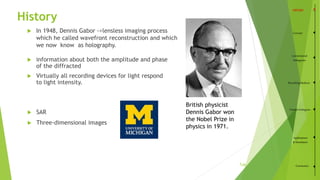
 In 1948, Dennis Gabor ->lensless imaging process
which he called wavefront reconstruction and which
we now know as holography.
 SAR
 Three-dimensional images
British physicist
Dennis Gabor won
the Nobel Prize in
physics in 1971.
/35
Concept: Challenge
4
 Problem: How to record, and then later reconstruct
both the amplitude and phase of an optical wave?
Conventional
Holograms
RecordingMedium
VolumeHologram
Applications
&Simulation
Conclusion/35
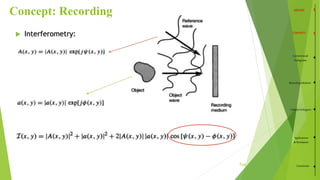
Concept: Recording
4
 Interferometry:
Conventional
Holograms
RecordingMedium
VolumeHologram
Applications
&Simulation
Conclusion/35
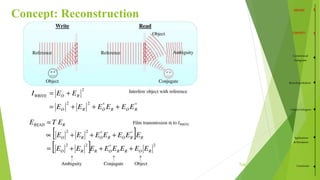
Concept: Reconstruction
6
/35
Conventional
Holograms
RecordingMedium
VolumeHologram
Applications
&Simulation
Conclusion
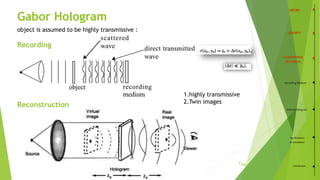
Gabor Hologram
Recording
Reconstruction
object is assumed to be highly transmissive :
RecordingMedium
VolumeHologram
Applications
&Simulation
Conclusion
1.highly transmissive
2.Twin images
/35
7
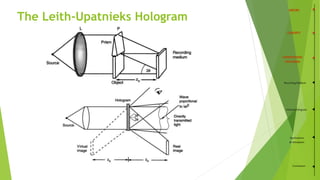
The Leith-Upatnieks Hologram
RecordingMedium
VolumeHologram
Applications
&Simulation
Conclusion
The Recording Medium
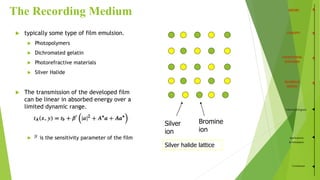
 typically some type of film emulsion.
 Photopolymers
 Dichromated gelatin
 Photorefractive materials
 Silver Halide
 The transmission of the developed film
can be linear in absorbed energy over a
limited dynamic range.
 is the sensitivity parameter of the film
VolumeHologram
Applications
&Simulation
Conclusion
Silver
ion
Bromine
ion
Silver halide lattice
Silver Halide
10
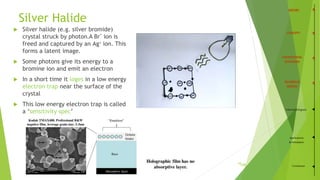
 Silver halide (e.g. silver bromide)
crystal struck by photon.A Br- ion is
freed and captured by an Ag+ ion. This
forms a latent image.
 Some photons give its energy to a
bromine ion and emit an electron
 In a short time it loges in a low energy
electron trap near the surface of the
crystal
 This low energy electron trap is called
a ‘sensitivity spec’
/35
VolumeHologram
Applications
&Simulation
Conclusion
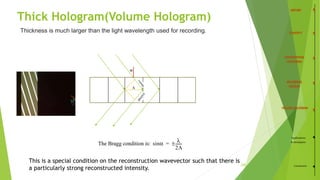
Thick Hologram(Volume Hologram)
This is a special condition on the reconstruction wavevector such that there is
a particularly strong reconstructed intensity.
Applications
&Simulation
Conclusion
Thickness is much larger than the light wavelength used for recording.
/35
12
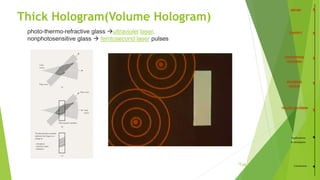
Thick Hologram(Volume Hologram)
photo-thermo-refractive glass ultraviolet laser.
nonphotosensitive glass  femtosecond laser pulses
/35
Applications
&Simulation
Conclusion
13
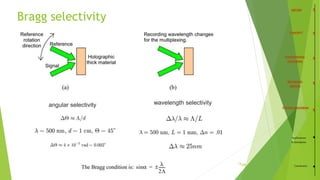
Bragg selectivity
Applications
&Simulation
Conclusion
wavelength selectivityangular selectivity
/35
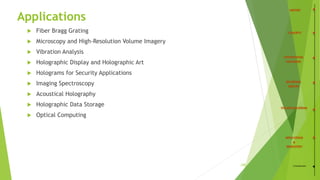
Applications
 Fiber Bragg Grating
 Microscopy and High-Resolution Volume Imagery
 Vibration Analysis
 Holographic Display and Holographic Art
 Holograms for Security Applications
 Imaging Spectroscopy
 Acoustical Holography
 Holographic Data Storage
 Optical Computing
/35 Conclusion
15
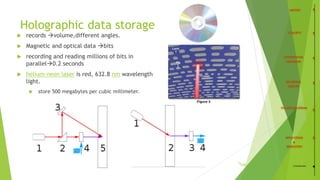
 records volume,different angles.
 Magnetic and optical data bits
 recording and reading millions of bits in
parallel0.2 seconds
 helium–neon laser is red, 632.8 nm wavelength
light.
 store 500 megabytes per cubic millimeter.
Holographic data storage
/35 Conclusion
16
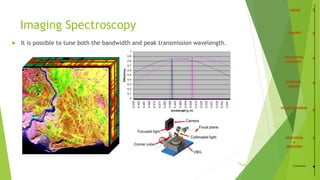
Imaging Spectroscopy
 It is possible to tune both the bandwidth and peak transmission wavelength.
/35 Conclusion
17
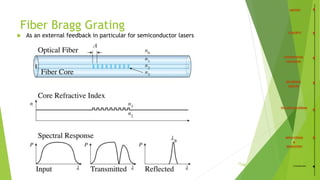
Fiber Bragg Grating
 As an external feedback in particular for semiconductor lasers
/35 Conclusion
18
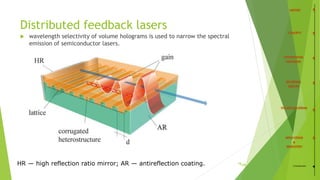
 wavelength selectivity of volume holograms is used to narrow the spectral
emission of semiconductor lasers.
Distributed feedback lasers
HR — high reflection ratio mirror; AR — antireflection coating. /35 Conclusion
19
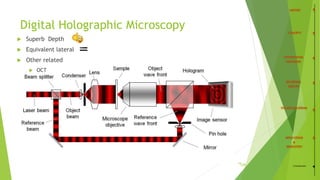
Digital Holographic Microscopy
 Superb Depth
 Equivalent lateral
 Other related
 OCT
/35 Conclusion
20
Optical Computing
/35 Conclusion
21
 1. The Matched Filter
 2. Optical Neural Network
 3. The Joint Transform Correlator
Optical Computing
/35 Conclusion
22
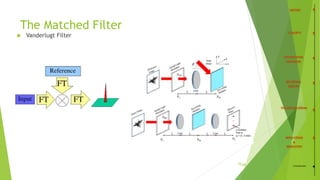
 1.Matched Filter (MF)
 Vanderlugt Filter
The Matched Filter
 Vanderlugt Filter
/35 Conclusion
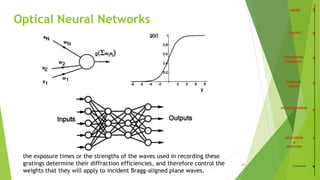
Optical Neural Networks
the exposure times or the strengths of the waves used in recording these
gratings determine their diffraction efficiencies, and therefore control the
weights that they will apply to incident Bragg-aligned plane waves.
/35 Conclusion
24
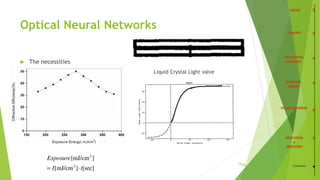
 The necessities
 Liquid Crystal Light valve
 Exposure Time
Optical Neural Networks
/35 Conclusion
25
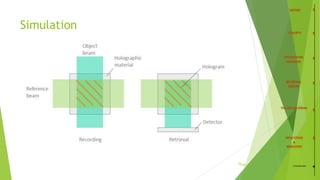
 Design
Simulation
/35 Conclusion
26
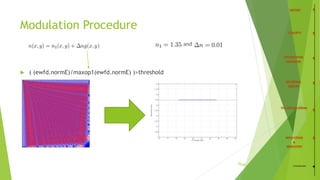
Modulation Procedure
 ( (ewfd.normE)/maxop1(ewfd.normE) )>threshold
/35 Conclusion
27
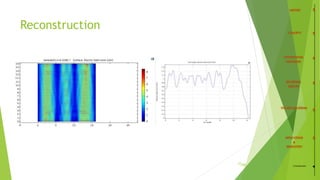
Reconstruction
/35 Conclusion
28
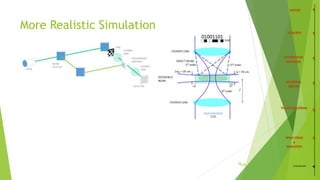
More Realistic Simulation
/35 Conclusion
29
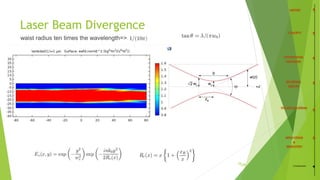
Laser Beam Divergence
waist radius ten times the wavelength=>
/35 Conclusion
30
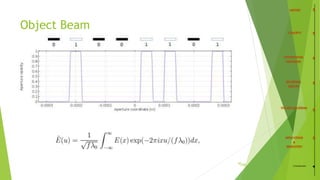
Object Beam
/35 Conclusion
31
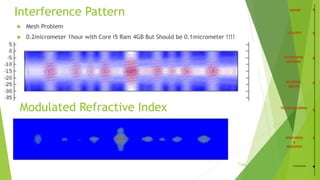
Interference Pattern
Modulated Refractive Index
 Mesh Problem
 0.2micrometer 1hour with Core i5 Ram 4GB But Should be 0.1micrometer !!!!
/35 Conclusion
32
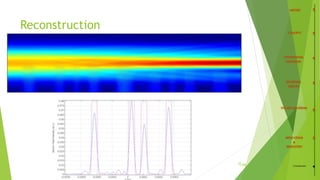
Reconstruction
/35 Conclusion
Conclusion
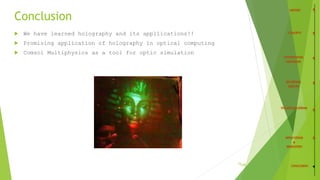
 We have learned holography and its appllications!!
 Promising application of holography in optical computing
 Comsol Multiphysics as a tool for optic simulation
33
/35
References
34
(1) Joseph W. Goodman-Introduction to Fourier optics-Roberts and Co. (2005)
(2) All Optical Three Dimensional Spatio-Temporal Correlator for Automatic
Event Recognition Using a Multiphoton Atomic System Mehjabin S. Monjur, 1,*
Mohamed F. Fouda, 1 and Selim M.
[3] C. Zhang, A.K. Wong, A genetic algorithm for multiple molecular sequence
alignment, Comput. Appl. Biosci. 13 (1997) 565–581.
[4] W. Choe, O.K. Ersoy, M. Bina, Neural network schemes for detecting rare
events in human genomic DNA, Bioinformatics 16 (2000) 1062–1072.
[5] L. Hirschman, J.C. Park, J. Tsujii, L. Wong, C.H. Wu, Accomplishments
and challenges in literature data mining for biology, Bioinformatics 18 (2002)
1553–1561.
[6] DNA sequencing using optical joint Fourier transform A.K. Alqallaf ∗ , A.K.
Cherri Kuwait University, College of Engineering and Petroleum, Electrical
Engineering Department, PO Box 5969, Safat 13060, Kuwait
(7)Comsol Blog website
(8)Wikipedia website
(9)Optalsys website
/35
?
Your Questions
Thanks forYour Attention
35
/35

Optical volume holograms and their applications

Editor's Notes

  • #16 Sensitivity refers to the extent of refractive index modulation produced per unit of exposure. Diffraction efficiency is proportional to the square of the index modulation times the effective thickness. The dynamic range determines how many holograms may be multiplexed in a single volume data. Spatial light modulators (SLM) are pixelated input devices (liquid crystal panels), used to imprint the data to be stored on the object beam.
  • #17 Imaging spectroscopy can be achieved by selecting a single wavelength for each pixel in a full camera field.Volume holograms are used as tunable optical filters to produce monochromatic images, also known as hyperspectral imaging.
  • #20 Commonly, a microscope objective is used to collect the object wave front. 
  • #23  strict alignment criteria and long optical train.  high space­bandwidth product and extremely fast process time. The process involves taking the individual Fourier Transforms of the “Input” and “reference” images, taking their product and then Fourier Transforming the result.