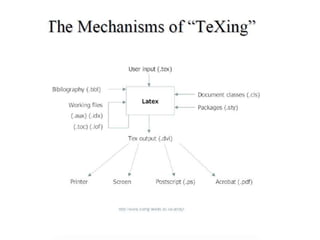
What is LaTeX?
• LaTeX is pronounced “lay-tech” or “lah-tech,”
not “la-teks.”
What is LaTeX?
• LaTeX is a document markup language used to
create documents in TeX.
• LATEX is the standard mathematical
typesetting program
• A computer language that consists of easily
understood keywords, names, or tags that
help format the overall view of a page and the
data it contains.
• Some examples of a markup
language are HTML and XML.
Typesetting can be defined as the process
of preparing and arranging text and
images for printing
Latex was created by the American computer scientist named
Leslie Lamport in 1983
Why Use LaTeX?
• Mathematical symbols and equations are easily integrated.
• Even complex structures such as footnotes, references, table
of contents, and bibliographies can be generated easily.
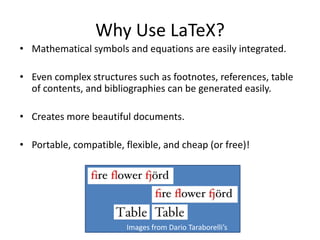
• Creates more beautiful documents.
• Portable, compatible, flexible, and cheap (or free)!
Images from Dario Taraborelli’s
Blog
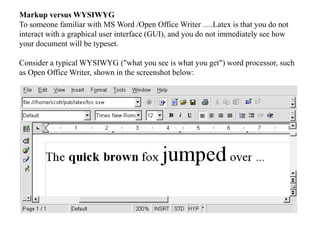
Markup versus WYSIWYG
To someone familiar with MS Word /Open Office Writer ….Latex is that you do not
interact with a graphical user interface (GUI), and you do not immediately see how
your document will be typeset.
Consider a typical WYSIWYG ("what you see is what you get") word processor, such
as Open Office Writer, shown in the screenshot below:
• https://www.ieee.org/conferences/publishing
/templates.html
Installing LaTeX
• In Windows
• MiKTeX
– MiKTeX is a typesetting system for the Windows.
– Download from www.miktex.org for free
– It is generally recommended to install MiKTeX first,
then WinEdt.
• WinEdt
– WinEdt is a text editor.
– WinEdt creates the source file (.tex and others).
– Download from www.winedt.com for free for 30 days.
– WinEdt costs $30.
Installing LaTeX
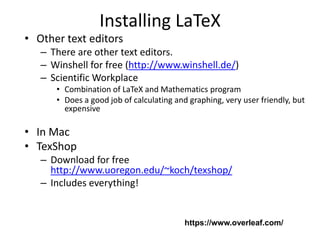
• Other text editors
– There are other text editors.
– Winshell for free (http://www.winshell.de/)
– Scientific Workplace
• Combination of LaTeX and Mathematics program
• Does a good job of calculating and graphing, very user friendly, but
expensive
• In Mac
• TexShop
– Download for free
http://www.uoregon.edu/~koch/texshop/
– Includes everything!
https://www.overleaf.com/
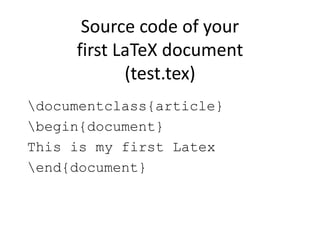
Source code of your
first LaTeX document
(test.tex)
documentclass{article}
begin{document}
This is my first Latex
end{document}
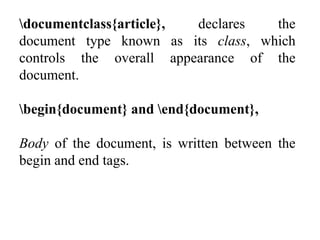
documentclass{article}, declares the
document type known as its class, which
controls the overall appearance of the
document.
begin{document} and end{document},
Body of the document, is written between the
begin and end tags.
Font Size: The point size can be described in the way [10pt]. The
other font sizes are 8pt, 9pt, 10pt, 11pt, 12pt, 14pt, 17pt, 20pt.
The default font size for Latex is 10pt.
The paper types with their dimensions are given below:
o letterpaper (11 x 8.5 in)
o legalpaper (14 x 8.5 in)
o a5paper (5.8 x 8.3 in)
o a4paper (8.3 x 11.7 in)
o executivepaper (10.5 x 7.25 in)
o b5paper (25 x 17.6 cm)
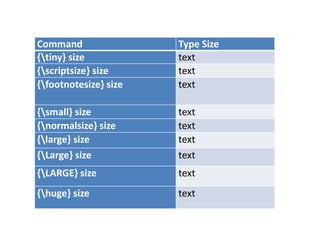
Command Type Size
{tiny} size text
{scriptsize} size text
{footnotesize} size text
{small} size text
{normalsize} size text
{large} size text
{Large} size text
{LARGE} size text
{huge} size text
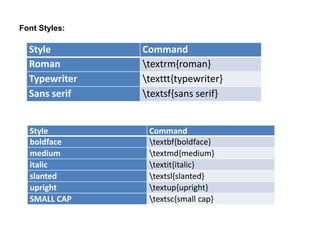
Font Styles:
Style Command
Roman textrm{roman}
Typewriter texttt{typewriter}
Sans serif textsf{sans serif}
Style Command
boldface textbf{boldface}
medium textmd{medium}
italic textit{italic}
slanted textsl{slanted}
upright textup{upright}
SMALL CAP textsc{small cap}
documentclass[12pt]{article}
begin{document}
textit{textbf{ Latex}}
textrm{textsl{ IT Workshop}}
end{document}
The basic requirements to insert an image are:
o Including the graphicx package. The command will be written
as usepackage{graphicx}.
o You need to download the particular image from the browser and save that image
in the same folder where the Latex files are present.
o Example:
documentclass[12pt]{article}
usepackage{graphicx}
begin{document}
includegraphics{computer.jpg}
end{document}
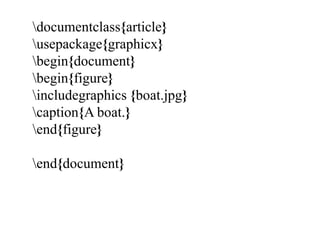
documentclass{article}
usepackage{graphicx}
begin{document}
begin{figure}
includegraphics {boat.jpg}
caption{A boat.}
end{figure}
end{document}
documentclass[12pt]{article}
usepackage{mathtools}
begin{document}
begin{equation}
x + y = 4 % there should be no gap between any of the two
rows
end{equation}
end{document}
documentclass[12pt]{article}
usepackage{mathtools}
begin{document}
begin{equation}
x^2 +2x+ 6 = 0
end{equation}
end{document}
documentclass[12pt]{article}
usepackage{mathtools}
begin{document}
begin{equation}
1, 2, 3, 4, 5, 6........... infty
end{equation}
end{document}
documentclass[12pt]{standalone}
usepackage{pgfplots}
pgfplotsset{width=6.6cm,compat=1.7}
begin{document}
begin{tikzpicture}
begin{axis}
[
ybar,
enlargelimits=0.15,
ylabel={#Average Marks}, % the ylabel must precede a # symbol.
xlabel={ Students Name},
symbolic x coords={Tom, Jack, Hary, Liza, Henry}, % these are the specification of
coordinates on the x-axis.
xtick=data,
nodes near coords, % this command is used to mention the y-axis points on the top
of the particular bar.
nodes near coords align={vertical},
]
addplot coordinates {(Tom,50) (Jack,90) (Hary,70) (Liza,80) (Henry,60) };
end{axis}
end{tikzpicture}
end{document}
Three Ways to Insert CSS
•External CSS
•Internal CSS
•Inline CSS
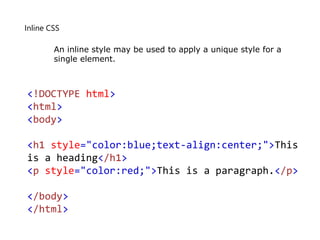
Inline CSS
<!DOCTYPE html>
<html>
<body>
<h1 style="color:blue;text-align:center;">This
is a heading</h1>
<p style="color:red;">This is a paragraph.</p>
</body>
</html>
An inline style may be used to apply a unique style for a
single element.
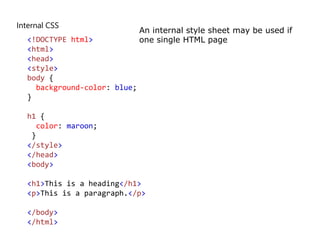
Internal CSS
<!DOCTYPE html>
<html>
<head>
<style>
body {
background-color: blue;
}
h1 {
color: maroon;
}
</style>
</head>
<body>
<h1>This is a heading</h1>
<p>This is a paragraph.</p>
</body>
</html>
An internal style sheet may be used if
one single HTML page
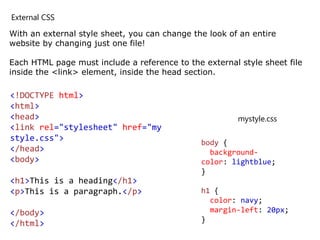
External CSS
<!DOCTYPE html>
<html>
<head>
<link rel="stylesheet" href="my
style.css">
</head>
<body>
<h1>This is a heading</h1>
<p>This is a paragraph.</p>
</body>
</html>
mystyle.css
body {
background-
color: lightblue;
}
h1 {
color: navy;
margin-left: 20px;
}
With an external style sheet, you can change the look of an entire
website by changing just one file!
Each HTML page must include a reference to the external style sheet file
inside the <link> element, inside the head section.

latex document for IT workshop Lab . B.Tech

  • 1.
    What is LaTeX? •LaTeX is pronounced “lay-tech” or “lah-tech,” not “la-teks.”
  • 2.
    What is LaTeX? •LaTeX is a document markup language used to create documents in TeX. • LATEX is the standard mathematical typesetting program
  • 3.
    • A computerlanguage that consists of easily understood keywords, names, or tags that help format the overall view of a page and the data it contains. • Some examples of a markup language are HTML and XML. Typesetting can be defined as the process of preparing and arranging text and images for printing
  • 4.
    Latex was createdby the American computer scientist named Leslie Lamport in 1983
  • 5.
    Why Use LaTeX? •Mathematical symbols and equations are easily integrated. • Even complex structures such as footnotes, references, table of contents, and bibliographies can be generated easily. • Creates more beautiful documents. • Portable, compatible, flexible, and cheap (or free)! Images from Dario Taraborelli’s Blog
  • 7.
    Markup versus WYSIWYG Tosomeone familiar with MS Word /Open Office Writer ….Latex is that you do not interact with a graphical user interface (GUI), and you do not immediately see how your document will be typeset. Consider a typical WYSIWYG ("what you see is what you get") word processor, such as Open Office Writer, shown in the screenshot below:
  • 8.
  • 9.
    Installing LaTeX • InWindows • MiKTeX – MiKTeX is a typesetting system for the Windows. – Download from www.miktex.org for free – It is generally recommended to install MiKTeX first, then WinEdt. • WinEdt – WinEdt is a text editor. – WinEdt creates the source file (.tex and others). – Download from www.winedt.com for free for 30 days. – WinEdt costs $30.
  • 10.
    Installing LaTeX • Othertext editors – There are other text editors. – Winshell for free (http://www.winshell.de/) – Scientific Workplace • Combination of LaTeX and Mathematics program • Does a good job of calculating and graphing, very user friendly, but expensive • In Mac • TexShop – Download for free http://www.uoregon.edu/~koch/texshop/ – Includes everything! https://www.overleaf.com/
  • 11.
    Source code ofyour first LaTeX document (test.tex) documentclass{article} begin{document} This is my first Latex end{document}
  • 12.
    documentclass{article}, declares the documenttype known as its class, which controls the overall appearance of the document. begin{document} and end{document}, Body of the document, is written between the begin and end tags.
  • 13.
    Font Size: Thepoint size can be described in the way [10pt]. The other font sizes are 8pt, 9pt, 10pt, 11pt, 12pt, 14pt, 17pt, 20pt. The default font size for Latex is 10pt. The paper types with their dimensions are given below: o letterpaper (11 x 8.5 in) o legalpaper (14 x 8.5 in) o a5paper (5.8 x 8.3 in) o a4paper (8.3 x 11.7 in) o executivepaper (10.5 x 7.25 in) o b5paper (25 x 17.6 cm)
  • 14.
    Command Type Size {tiny}size text {scriptsize} size text {footnotesize} size text {small} size text {normalsize} size text {large} size text {Large} size text {LARGE} size text {huge} size text
  • 15.
    Font Styles: Style Command Romantextrm{roman} Typewriter texttt{typewriter} Sans serif textsf{sans serif} Style Command boldface textbf{boldface} medium textmd{medium} italic textit{italic} slanted textsl{slanted} upright textup{upright} SMALL CAP textsc{small cap}
  • 17.
  • 22.
    The basic requirementsto insert an image are: o Including the graphicx package. The command will be written as usepackage{graphicx}. o You need to download the particular image from the browser and save that image in the same folder where the Latex files are present. o Example: documentclass[12pt]{article} usepackage{graphicx} begin{document} includegraphics{computer.jpg} end{document}
  • 23.
  • 24.
    documentclass[12pt]{article} usepackage{mathtools} begin{document} begin{equation} x + y= 4 % there should be no gap between any of the two rows end{equation} end{document}
  • 25.
  • 26.
  • 27.
    documentclass[12pt]{standalone} usepackage{pgfplots} pgfplotsset{width=6.6cm,compat=1.7} begin{document} begin{tikzpicture} begin{axis} [ ybar, enlargelimits=0.15, ylabel={#Average Marks}, %the ylabel must precede a # symbol. xlabel={ Students Name}, symbolic x coords={Tom, Jack, Hary, Liza, Henry}, % these are the specification of coordinates on the x-axis. xtick=data, nodes near coords, % this command is used to mention the y-axis points on the top of the particular bar. nodes near coords align={vertical}, ] addplot coordinates {(Tom,50) (Jack,90) (Hary,70) (Liza,80) (Henry,60) }; end{axis} end{tikzpicture} end{document}
  • 28.
    Three Ways toInsert CSS •External CSS •Internal CSS •Inline CSS
  • 29.
    Inline CSS <!DOCTYPE html> <html> <body> <h1style="color:blue;text-align:center;">This is a heading</h1> <p style="color:red;">This is a paragraph.</p> </body> </html> An inline style may be used to apply a unique style for a single element.
  • 30.
    Internal CSS <!DOCTYPE html> <html> <head> <style> body{ background-color: blue; } h1 { color: maroon; } </style> </head> <body> <h1>This is a heading</h1> <p>This is a paragraph.</p> </body> </html> An internal style sheet may be used if one single HTML page
  • 31.
    External CSS <!DOCTYPE html> <html> <head> <linkrel="stylesheet" href="my style.css"> </head> <body> <h1>This is a heading</h1> <p>This is a paragraph.</p> </body> </html> mystyle.css body { background- color: lightblue; } h1 { color: navy; margin-left: 20px; } With an external style sheet, you can change the look of an entire website by changing just one file! Each HTML page must include a reference to the external style sheet file inside the <link> element, inside the head section.