STUDY OF MICRO
COMBINED HEAT & POWER
1
ABSTRACT
Micro Combined Heat and Power (CHP) have been
identified as a key element of the Energy Strategy offers
environmental, economic and social benefits & fulfils the
joint objectives of security of supply.
However, in order to achieve the full potential for this
technology, a number of regulatory and structural changes
are required. This Presentation summarizes the potential,
current status of micro CHP & how to implementing it into
India.
Introduction
• Micro CHP (combined heat and power) is the
simultaneous production of heat and power in a single
building based on small energy conversion units.
• It generates electricity & heat at the same time. So, some
of which you will use in your own home, the remainder it
exported to the grid to be used by others. The heat
produced is used for space and water heating.
• Micro-CHP, a cost-effective and flexible low carbon
solution that generates heat and electricity on-site.
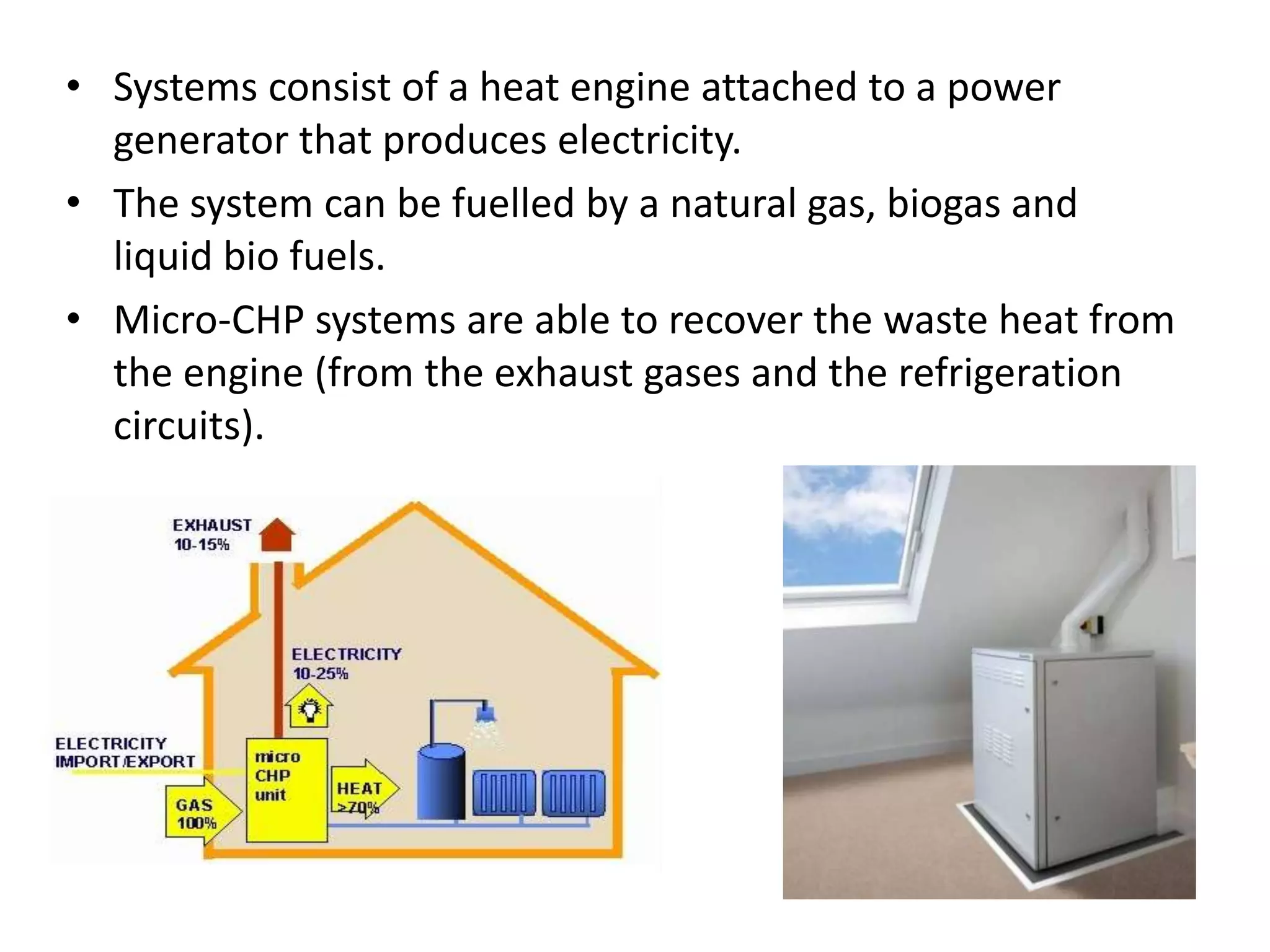
• Systems consist of a heat engine attached to a power
generator that produces electricity.
• The system can be fuelled by a natural gas, biogas and
liquid bio fuels.
• Micro-CHP systems are able to recover the waste heat from
the engine (from the exhaust gases and the refrigeration
circuits).
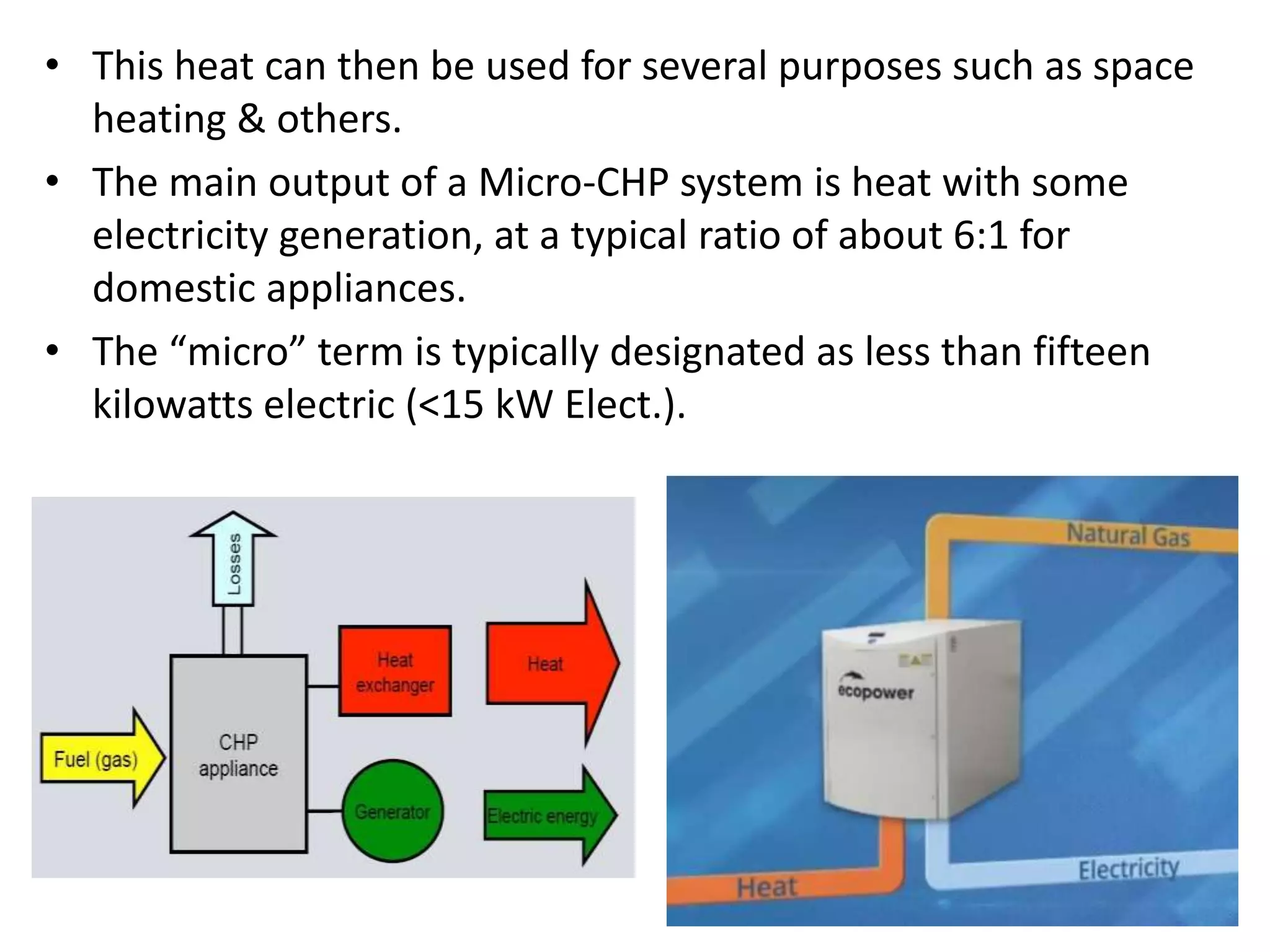
• This heat can then be used for several purposes such as space
heating & others.
• The main output of a Micro-CHP system is heat with some
electricity generation, at a typical ratio of about 6:1 for
domestic appliances.
• The “micro” term is typically designated as less than fifteen
kilowatts electric (<15 kW Elect.).
Advantages
1. Costs, Savings, Earnings:
• Save on electricity and fuels costs due to higher efficiencies.
• Investment costs of micro-CHP are higher than those of a
conventional set-up, i.e. a boiler for heat and a grid
connection for electricity.
• Operating costs can be lower, depending mainly on electricity
tariffs and grid charges.
• Local generation of electricity is in some countries cheaper
than buying it off the grid.
2. Environmental Impacts:
• Usually lower to those of conventional and condensing
heating boilers.
• Environmental impacts are reduced in proportion to the
efficiency gain and the reduction of fuel use.
• Micro CHP systems can lead to GHG emission reductions by
avoiding generation of electricity in conventional power
plants.
• The result depends on the energy 'mix' (the share of
different types of power plants e.g. nuclear, coal, gas,
renewable) of the country or region where the system is
installed.
3. Efficiency:
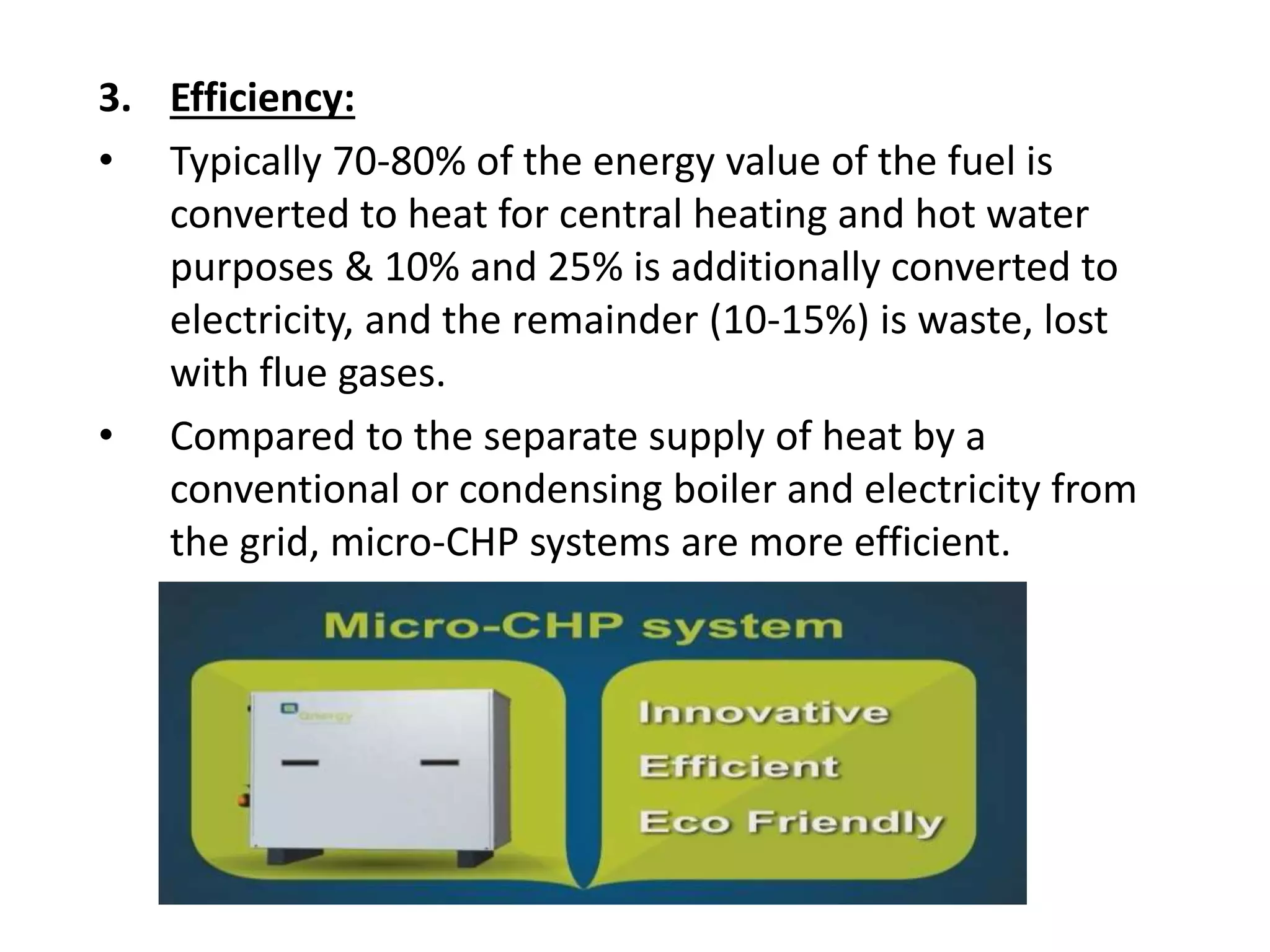
• Typically 70-80% of the energy value of the fuel is
converted to heat for central heating and hot water
purposes & 10% and 25% is additionally converted to
electricity, and the remainder (10-15%) is waste, lost
with flue gases.
• Compared to the separate supply of heat by a
conventional or condensing boiler and electricity from
the grid, micro-CHP systems are more efficient.
Applications
1. Organic Rankine Cycle mCHP
2. Stirling Engine mCHP
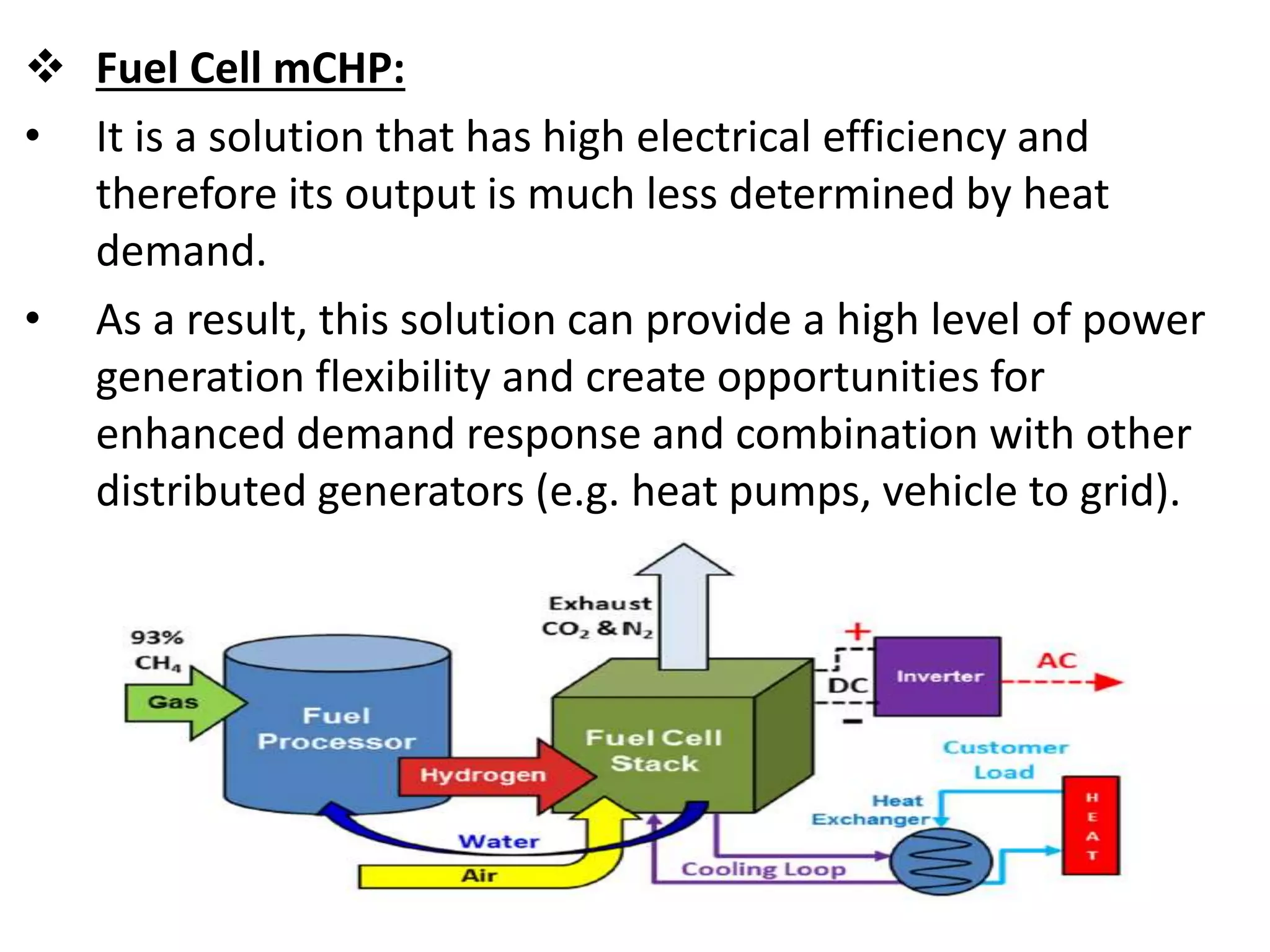
3. Fuel Cell mCHP
4. Internal combustion engine (ICE) mCHP
5. Micro turbines
 Fuel Cell mCHP:
• It is a solution that has high electrical efficiency and
therefore its output is much less determined by heat
demand.
• As a result, this solution can provide a high level of power
generation flexibility and create opportunities for
enhanced demand response and combination with other
distributed generators (e.g. heat pumps, vehicle to grid).
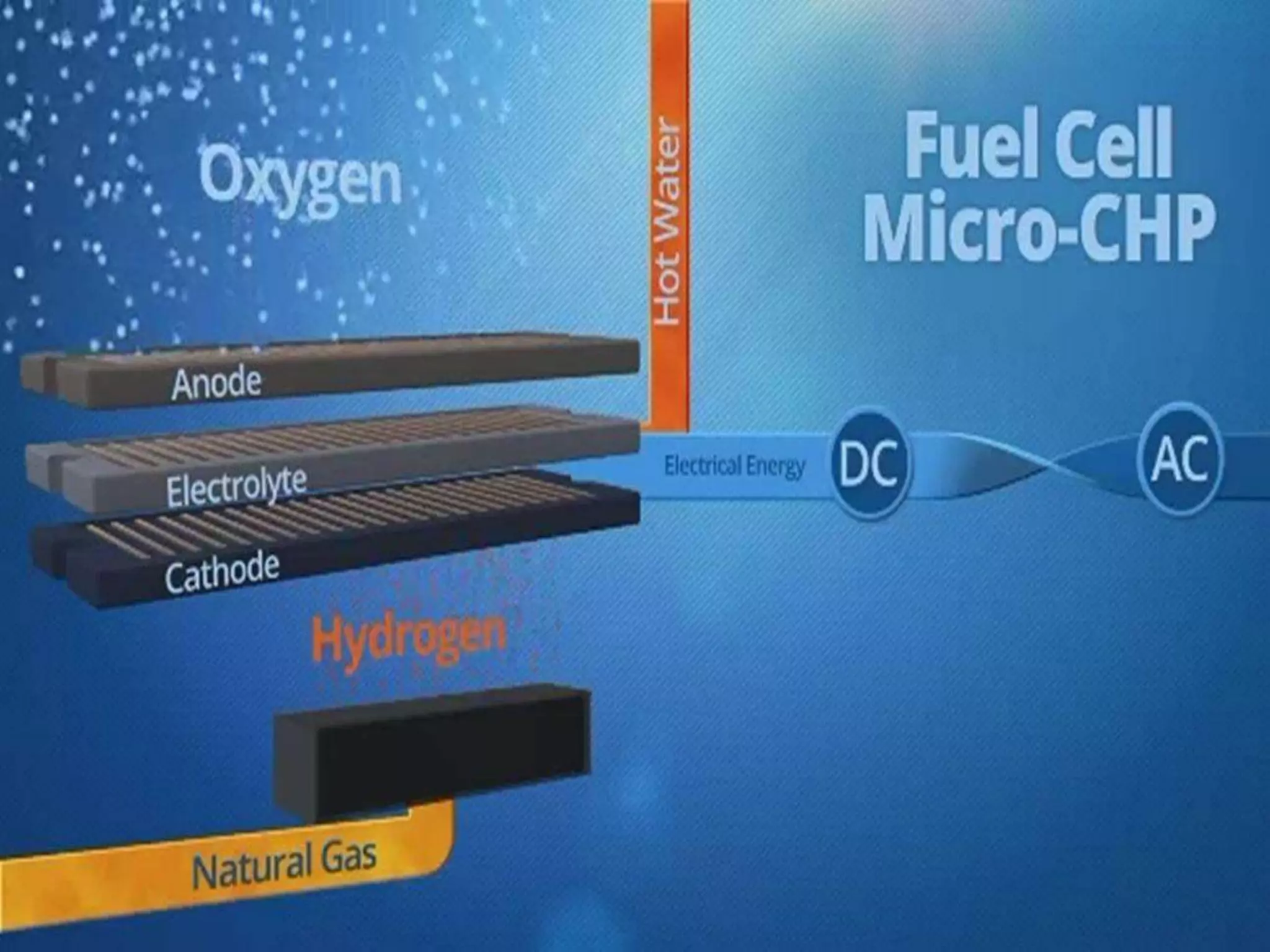
• In general terms, fuels cells combine a hydrogen based fuel
input and gaseous stream containing oxygen.
• The products of this reaction vary for each type of fuel cell
but typically are electrical power, heat, and water. In some
instances, other product gases such as carbon dioxide are
formed.
• PEMFC & SOFC have the Advantage to Utilize Natural gas
directly into electricity & Continuous Heat output so use as a
Micro CHP.
• Electrical Efficiency: 30-35%
• Low Emissions
• Low Temperature and Fast Startup
• Mostly for continuous running apps
• Some under development
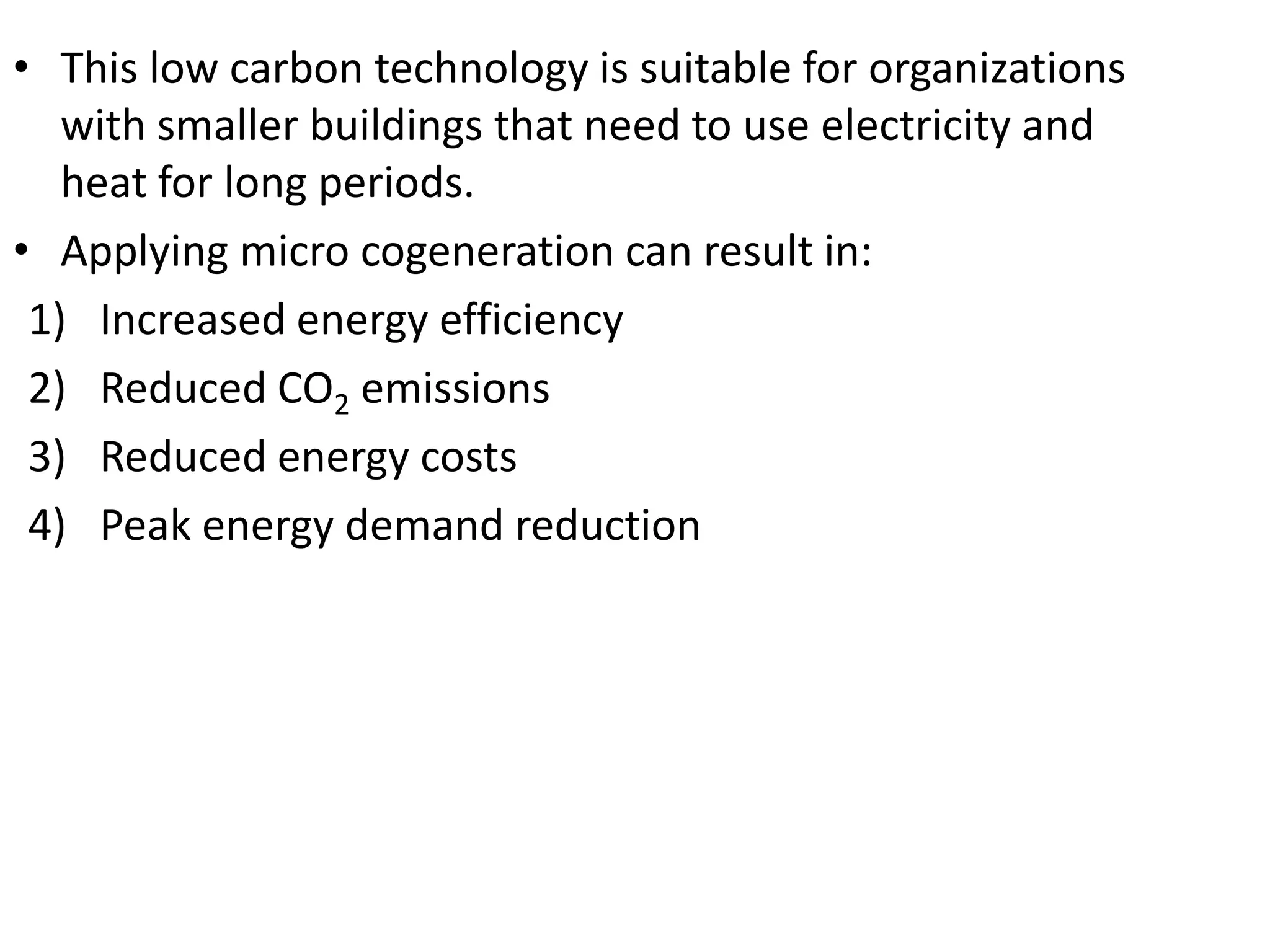
• This low carbon technology is suitable for organizations
with smaller buildings that need to use electricity and
heat for long periods.
• Applying micro cogeneration can result in:
1) Increased energy efficiency
2) Reduced CO2 emissions
3) Reduced energy costs
4) Peak energy demand reduction
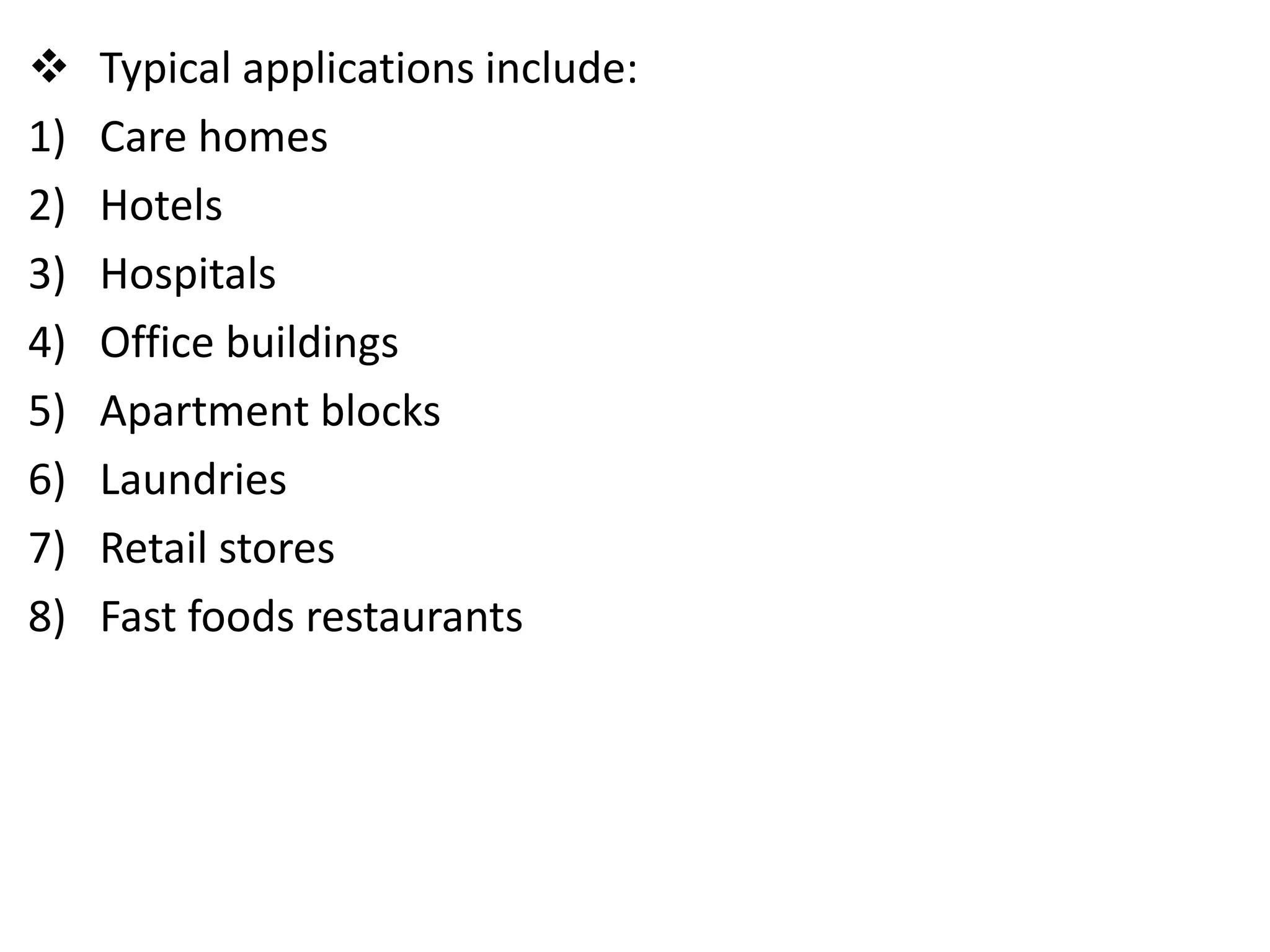
 Typical applications include:
1) Care homes
2) Hotels
3) Hospitals
4) Office buildings
5) Apartment blocks
6) Laundries
7) Retail stores
8) Fast foods restaurants
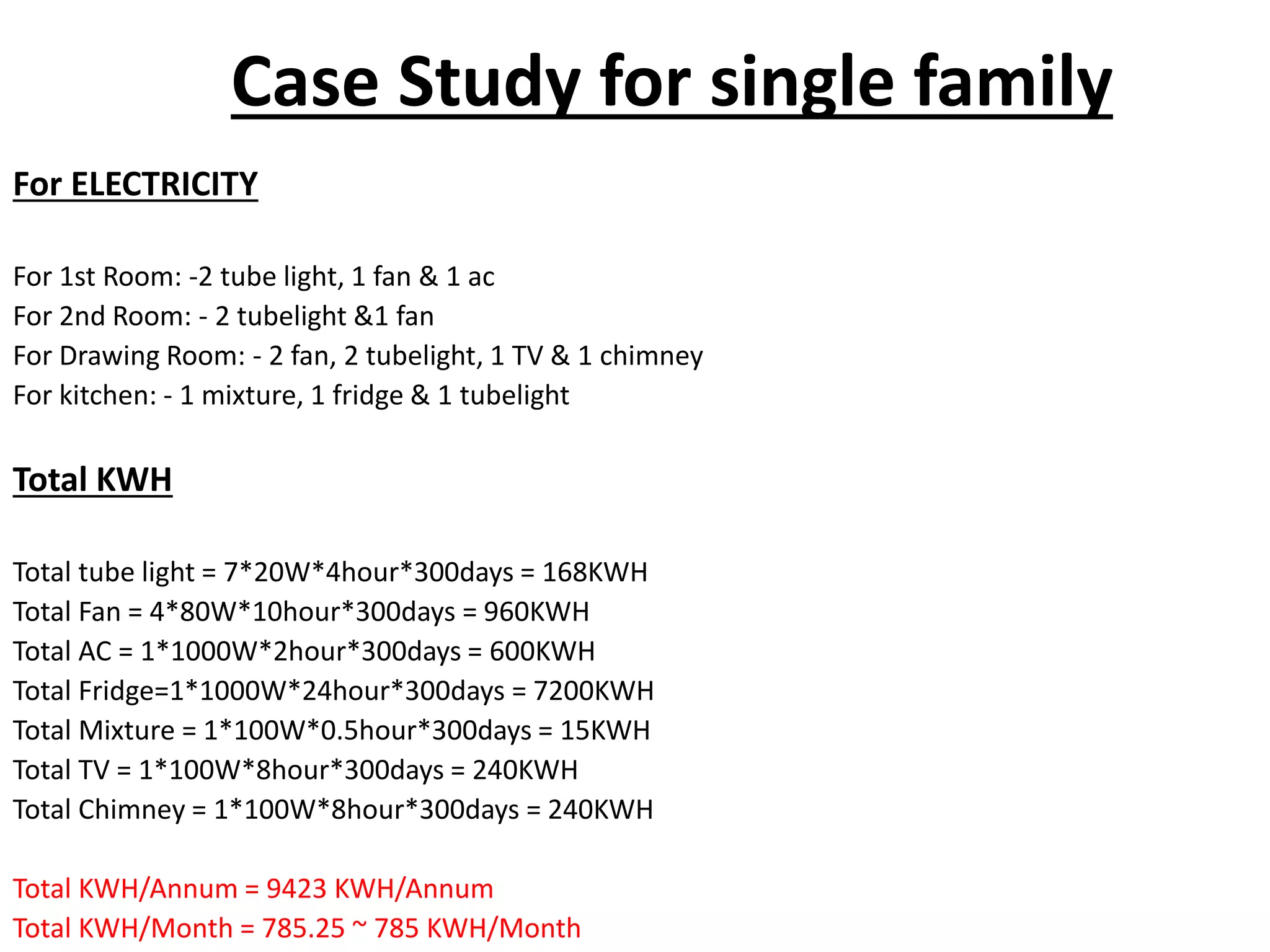
Case Study for single family
For ELECTRICITY
For 1st Room: -2 tube light, 1 fan & 1 ac
For 2nd Room: - 2 tubelight &1 fan
For Drawing Room: - 2 fan, 2 tubelight, 1 TV & 1 chimney
For kitchen: - 1 mixture, 1 fridge & 1 tubelight
Total KWH
Total tube light = 7*20W*4hour*300days = 168KWH
Total Fan = 4*80W*10hour*300days = 960KWH
Total AC = 1*1000W*2hour*300days = 600KWH
Total Fridge=1*1000W*24hour*300days = 7200KWH
Total Mixture = 1*100W*0.5hour*300days = 15KWH
Total TV = 1*100W*8hour*300days = 240KWH
Total Chimney = 1*100W*8hour*300days = 240KWH
Total KWH/Annum = 9423 KWH/Annum
Total KWH/Month = 785.25 ~ 785 KWH/Month
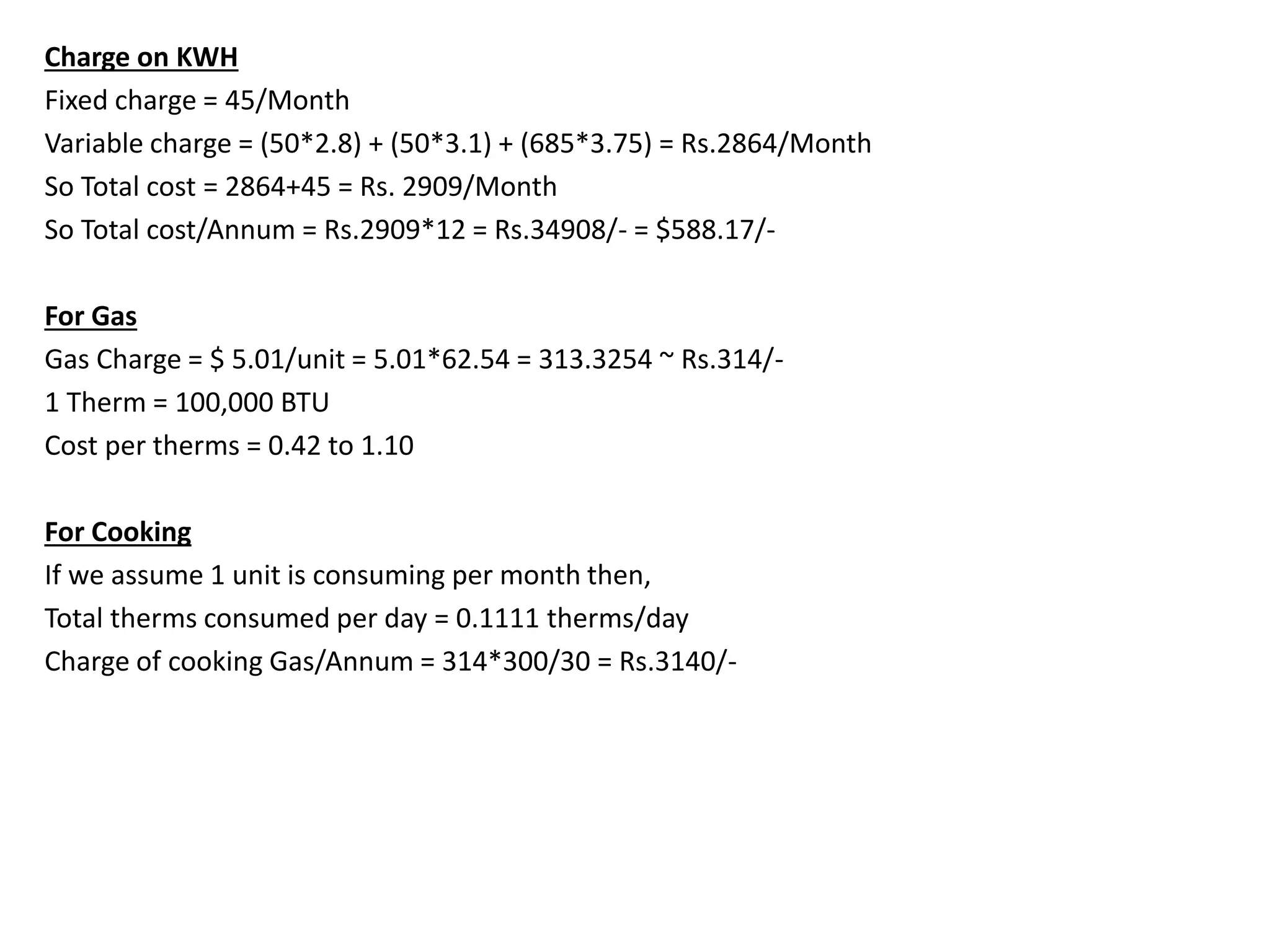
Charge on KWH
Fixed charge = 45/Month
Variable charge = (50*2.8) + (50*3.1) + (685*3.75) = Rs.2864/Month
So Total cost = 2864+45 = Rs. 2909/Month
So Total cost/Annum = Rs.2909*12 = Rs.34908/- = $588.17/-
For Gas
Gas Charge = $ 5.01/unit = 5.01*62.54 = 313.3254 ~ Rs.314/-
1 Therm = 100,000 BTU
Cost per therms = 0.42 to 1.10
For Cooking
If we assume 1 unit is consuming per month then,
Total therms consumed per day = 0.1111 therms/day
Charge of cooking Gas/Annum = 314*300/30 = Rs.3140/-
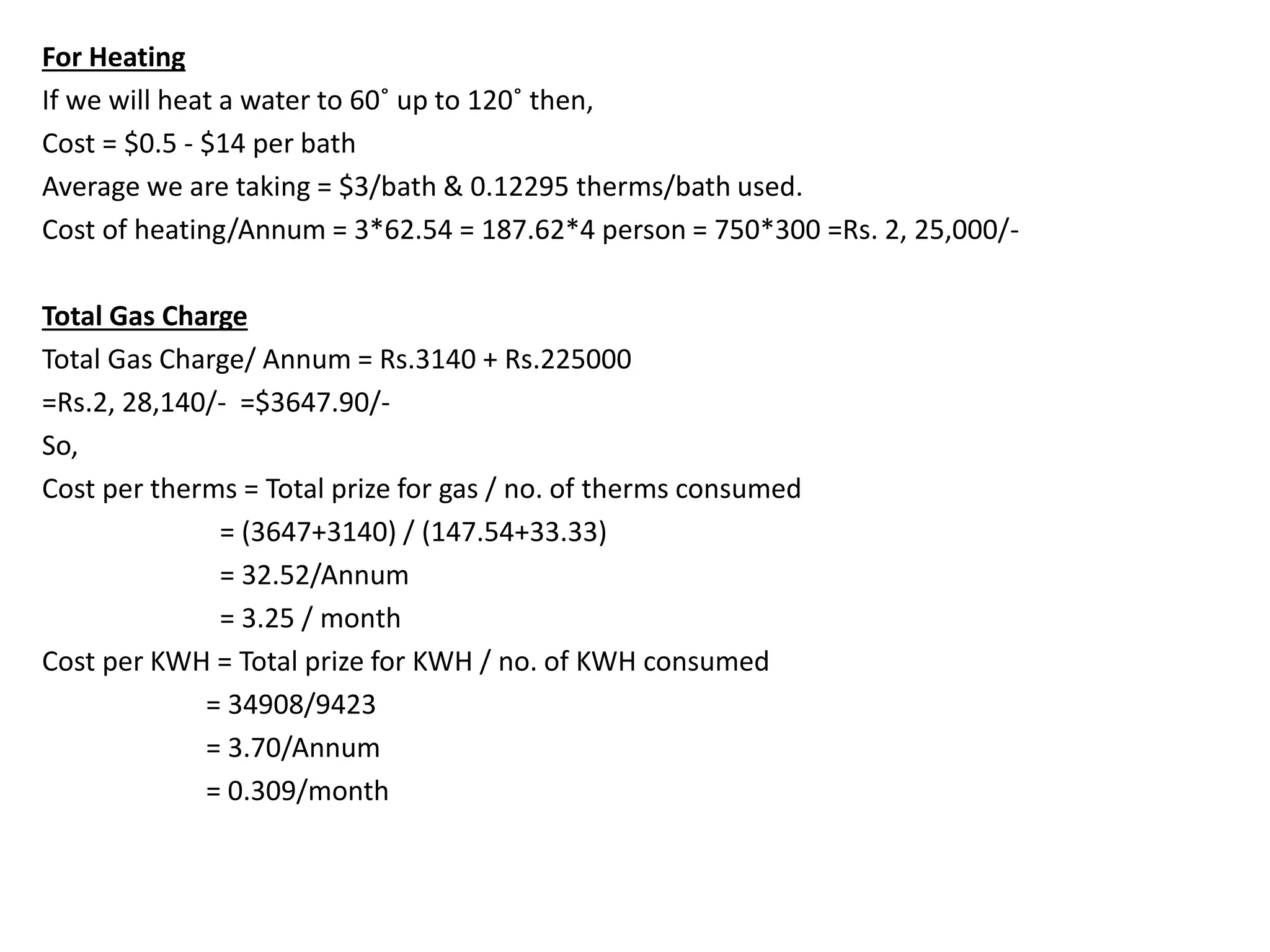
For Heating
If we will heat a water to 60˚ up to 120˚ then,
Cost = $0.5 - $14 per bath
Average we are taking = $3/bath & 0.12295 therms/bath used.
Cost of heating/Annum = 3*62.54 = 187.62*4 person = 750*300 =Rs. 2, 25,000/-
Total Gas Charge
Total Gas Charge/ Annum = Rs.3140 + Rs.225000
=Rs.2, 28,140/- =$3647.90/-
So,
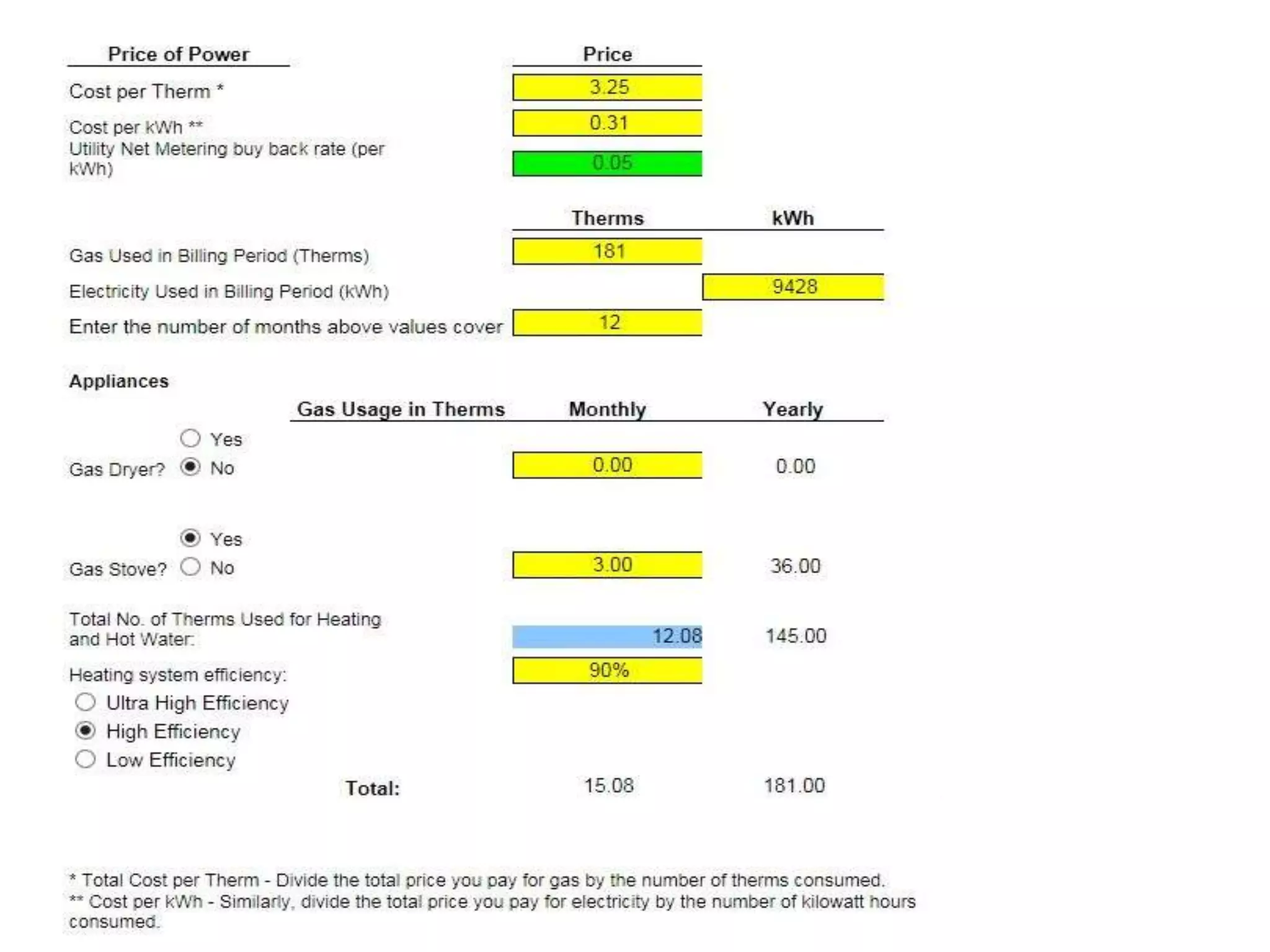
Cost per therms = Total prize for gas / no. of therms consumed
= (3647+3140) / (147.54+33.33)
= 32.52/Annum
= 3.25 / month
Cost per KWH = Total prize for KWH / no. of KWH consumed
= 34908/9423
= 3.70/Annum
= 0.309/month
Conclusion
Fuel Cell Micro CHP offers a unique combination of heat
and electricity generation which is perfectly adapted in
household energy use. It is also used in isolated application
on small scale. Micro CHP is likely to have a positive
environmental impact with CO2 saving in the region of 20%
of house hold emissions. Micro CHP has finally reached
commercial reality, having faced and overcome significant
technical, administrative and regulatory obstacles.
References
• http://www.rural-energy.eu/solutions/8/366/Micro-
combined-heat-and-power-micro-CHP#.VNjpgz_nWCF
• http://www.qnergy.com/-micro-chp-system
• http://www.cogeneurope.eu/micro-chp_269.html
• http://www.energ-group.com/ener-g-combined-
power/energy-services/micro-
cogeneration/applications/
• http://www.baxi.co.uk/renewables/combined-heat-
and-power.htm
• http://www.energystar.gov/ia/partners/pt_awards/doc
uments/Marathon_Case_Study.pdf?20e3-8422
• http://www.b-es.org/sustainability/sustainable-
technology-briefing-sheets/micro-chp-guidance/
• http://en.wikipedia.org/wiki/Micro_combined_heat_a
nd_power
• http://www.marathonengine.com/cogeneration.html
• http://www.ecuity.com/wp-
content/uploads/2013/03/The-role-of-micro-CHP-in-a-
smart-energy-world.pdf
• http://www.microchap.info/benefits.pdf
• http://www.energysavingtrust.org.uk/domestic/conten
t/micro-chp
• http://www.yougen.co.uk/renewable-
energy/Combined+Heat+'26+Power/
• http://www.marathonengine.com/energy_savings.htm
l

Latest energy efficient technology - MICRO CHP

  • 1.
  • 2.
    ABSTRACT Micro Combined Heatand Power (CHP) have been identified as a key element of the Energy Strategy offers environmental, economic and social benefits & fulfils the joint objectives of security of supply. However, in order to achieve the full potential for this technology, a number of regulatory and structural changes are required. This Presentation summarizes the potential, current status of micro CHP & how to implementing it into India.
  • 3.
    Introduction • Micro CHP(combined heat and power) is the simultaneous production of heat and power in a single building based on small energy conversion units. • It generates electricity & heat at the same time. So, some of which you will use in your own home, the remainder it exported to the grid to be used by others. The heat produced is used for space and water heating. • Micro-CHP, a cost-effective and flexible low carbon solution that generates heat and electricity on-site.
  • 4.
    • Systems consistof a heat engine attached to a power generator that produces electricity. • The system can be fuelled by a natural gas, biogas and liquid bio fuels. • Micro-CHP systems are able to recover the waste heat from the engine (from the exhaust gases and the refrigeration circuits).
  • 5.
    • This heatcan then be used for several purposes such as space heating & others. • The main output of a Micro-CHP system is heat with some electricity generation, at a typical ratio of about 6:1 for domestic appliances. • The “micro” term is typically designated as less than fifteen kilowatts electric (<15 kW Elect.).
  • 6.
    Advantages 1. Costs, Savings,Earnings: • Save on electricity and fuels costs due to higher efficiencies. • Investment costs of micro-CHP are higher than those of a conventional set-up, i.e. a boiler for heat and a grid connection for electricity. • Operating costs can be lower, depending mainly on electricity tariffs and grid charges. • Local generation of electricity is in some countries cheaper than buying it off the grid.
  • 7.
    2. Environmental Impacts: •Usually lower to those of conventional and condensing heating boilers. • Environmental impacts are reduced in proportion to the efficiency gain and the reduction of fuel use. • Micro CHP systems can lead to GHG emission reductions by avoiding generation of electricity in conventional power plants. • The result depends on the energy 'mix' (the share of different types of power plants e.g. nuclear, coal, gas, renewable) of the country or region where the system is installed.
  • 8.
    3. Efficiency: • Typically70-80% of the energy value of the fuel is converted to heat for central heating and hot water purposes & 10% and 25% is additionally converted to electricity, and the remainder (10-15%) is waste, lost with flue gases. • Compared to the separate supply of heat by a conventional or condensing boiler and electricity from the grid, micro-CHP systems are more efficient.
  • 9.
    Applications 1. Organic RankineCycle mCHP 2. Stirling Engine mCHP 3. Fuel Cell mCHP 4. Internal combustion engine (ICE) mCHP 5. Micro turbines
  • 10.
     Fuel CellmCHP: • It is a solution that has high electrical efficiency and therefore its output is much less determined by heat demand. • As a result, this solution can provide a high level of power generation flexibility and create opportunities for enhanced demand response and combination with other distributed generators (e.g. heat pumps, vehicle to grid).
  • 12.
    • In generalterms, fuels cells combine a hydrogen based fuel input and gaseous stream containing oxygen. • The products of this reaction vary for each type of fuel cell but typically are electrical power, heat, and water. In some instances, other product gases such as carbon dioxide are formed. • PEMFC & SOFC have the Advantage to Utilize Natural gas directly into electricity & Continuous Heat output so use as a Micro CHP. • Electrical Efficiency: 30-35% • Low Emissions • Low Temperature and Fast Startup • Mostly for continuous running apps • Some under development
  • 13.
    • This lowcarbon technology is suitable for organizations with smaller buildings that need to use electricity and heat for long periods. • Applying micro cogeneration can result in: 1) Increased energy efficiency 2) Reduced CO2 emissions 3) Reduced energy costs 4) Peak energy demand reduction
  • 14.
     Typical applicationsinclude: 1) Care homes 2) Hotels 3) Hospitals 4) Office buildings 5) Apartment blocks 6) Laundries 7) Retail stores 8) Fast foods restaurants
  • 15.
    Case Study forsingle family For ELECTRICITY For 1st Room: -2 tube light, 1 fan & 1 ac For 2nd Room: - 2 tubelight &1 fan For Drawing Room: - 2 fan, 2 tubelight, 1 TV & 1 chimney For kitchen: - 1 mixture, 1 fridge & 1 tubelight Total KWH Total tube light = 7*20W*4hour*300days = 168KWH Total Fan = 4*80W*10hour*300days = 960KWH Total AC = 1*1000W*2hour*300days = 600KWH Total Fridge=1*1000W*24hour*300days = 7200KWH Total Mixture = 1*100W*0.5hour*300days = 15KWH Total TV = 1*100W*8hour*300days = 240KWH Total Chimney = 1*100W*8hour*300days = 240KWH Total KWH/Annum = 9423 KWH/Annum Total KWH/Month = 785.25 ~ 785 KWH/Month
  • 16.
    Charge on KWH Fixedcharge = 45/Month Variable charge = (50*2.8) + (50*3.1) + (685*3.75) = Rs.2864/Month So Total cost = 2864+45 = Rs. 2909/Month So Total cost/Annum = Rs.2909*12 = Rs.34908/- = $588.17/- For Gas Gas Charge = $ 5.01/unit = 5.01*62.54 = 313.3254 ~ Rs.314/- 1 Therm = 100,000 BTU Cost per therms = 0.42 to 1.10 For Cooking If we assume 1 unit is consuming per month then, Total therms consumed per day = 0.1111 therms/day Charge of cooking Gas/Annum = 314*300/30 = Rs.3140/-
  • 17.
    For Heating If wewill heat a water to 60˚ up to 120˚ then, Cost = $0.5 - $14 per bath Average we are taking = $3/bath & 0.12295 therms/bath used. Cost of heating/Annum = 3*62.54 = 187.62*4 person = 750*300 =Rs. 2, 25,000/- Total Gas Charge Total Gas Charge/ Annum = Rs.3140 + Rs.225000 =Rs.2, 28,140/- =$3647.90/- So, Cost per therms = Total prize for gas / no. of therms consumed = (3647+3140) / (147.54+33.33) = 32.52/Annum = 3.25 / month Cost per KWH = Total prize for KWH / no. of KWH consumed = 34908/9423 = 3.70/Annum = 0.309/month
  • 21.
    Conclusion Fuel Cell MicroCHP offers a unique combination of heat and electricity generation which is perfectly adapted in household energy use. It is also used in isolated application on small scale. Micro CHP is likely to have a positive environmental impact with CO2 saving in the region of 20% of house hold emissions. Micro CHP has finally reached commercial reality, having faced and overcome significant technical, administrative and regulatory obstacles.
  • 22.
    References • http://www.rural-energy.eu/solutions/8/366/Micro- combined-heat-and-power-micro-CHP#.VNjpgz_nWCF • http://www.qnergy.com/-micro-chp-system •http://www.cogeneurope.eu/micro-chp_269.html • http://www.energ-group.com/ener-g-combined- power/energy-services/micro- cogeneration/applications/ • http://www.baxi.co.uk/renewables/combined-heat- and-power.htm • http://www.energystar.gov/ia/partners/pt_awards/doc uments/Marathon_Case_Study.pdf?20e3-8422 • http://www.b-es.org/sustainability/sustainable- technology-briefing-sheets/micro-chp-guidance/
  • 23.
    • http://en.wikipedia.org/wiki/Micro_combined_heat_a nd_power • http://www.marathonengine.com/cogeneration.html •http://www.ecuity.com/wp- content/uploads/2013/03/The-role-of-micro-CHP-in-a- smart-energy-world.pdf • http://www.microchap.info/benefits.pdf • http://www.energysavingtrust.org.uk/domestic/conten t/micro-chp • http://www.yougen.co.uk/renewable- energy/Combined+Heat+'26+Power/ • http://www.marathonengine.com/energy_savings.htm l