AN EMERGING MATTERIAL FOR
FUTURE TECHNOLOGY
BY:
Sakti Prasanna Muduli
1
OVERVIEW
1) What is GRAPHENE?
2) Different properties of Graphene
3) Preparation processes
4) Special about it...!!!
5) Applications
6) Drawbacks
7) Conclusion
2
INTRODUCTION TO GRAPHENE
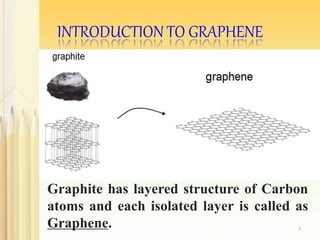
Graphite has layered structure of Carbon
atoms and each isolated layer is called as
Graphene. 3
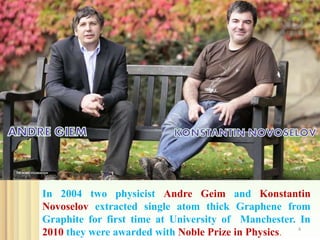
In 2004 two physicist Andre Geim and Konstantin
Novoselov extracted single atom thick Graphene from
Graphite for first time at University of Manchester. In
2010 they were awarded with Noble Prize in Physics. 4
PROPERTIES OF GRAPHENE
Structural
Chemical
Electronic
Optical
Thermal
Mechanical
5
STRUCTURE
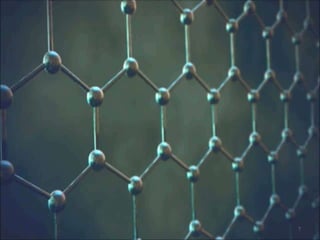
Graphene is a one-atom-thick planar sheet of
sp2-bonded carbon atoms that are densely
packed in a honeycomb crystal lattice.
C-C bond length is about 0.142nm, and
graphene sheets stack to form graphite with
inter planner spacing of 0.335nm.
It is considered as a two dimensional object.
6
7
CHEMICAL
Graphene is the most reactive form of the carbon
as it has the highest surface area among other
forms of Carbon.
It burns at 350 ˚C.
OPTICAL
Monolayer Graphene absorbes 2.3% of
white light; i.e it is almost TRANSPARENT.
8
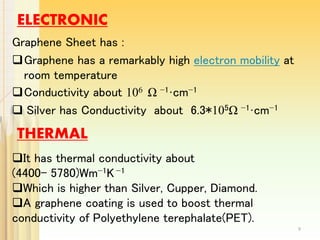
ELECTRONIC
Graphene Sheet has :
Graphene has a remarkably high electron mobility at
room temperature
Conductivity about 106 Ω −1·cm−1
 Silver has Conductivity about 6.3*105Ω −1·cm−1
THERMAL
It has thermal conductivity about
(4400- 5780)Wm−1K −1
Which is higher than Silver, Cupper, Diamond.
A graphene coating is used to boost thermal
conductivity of Polyethylene terephalate(PET).
9
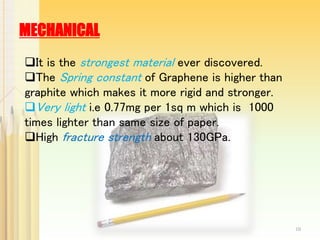
MECHANICAL
It is the strongest material ever discovered.
The Spring constant of Graphene is higher than
graphite which makes it more rigid and stronger.
Very light i.e 0.77mg per 1sq m which is 1000
times lighter than same size of paper.
High fracture strength about 130GPa.
10
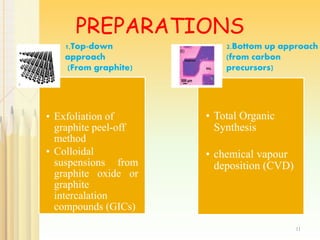
PREPARATIONS
• Exfoliation of
graphite peel-off
method
• Colloidal
suspensions from
graphite oxide or
graphite
intercalation
compounds (GICs)
• Total Organic
Synthesis
• chemical vapour
deposition (CVD)
1,Top-down
approach
(From graphite)
2.Bottom up approach
(from carbon
precursors)
11
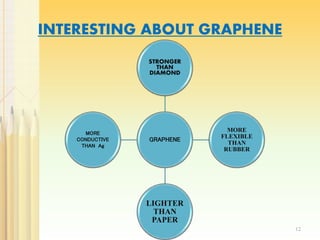
INTERESTING ABOUT GRAPHENE
GRAPHENE
STRONGER
THAN
DIAMOND
MORE
FLEXIBLE
THAN
RUBBER
LIGHTER
THAN
PAPER
MORE
CONDUCTIVE
THAN Ag
12
13
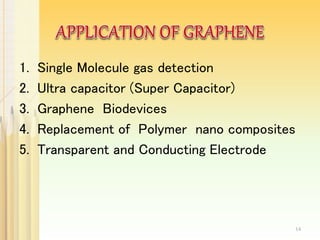
1. Single Molecule gas detection
2. Ultra capacitor (Super Capacitor)
3. Graphene Biodevices
4. Replacement of Polymer nano composites
5. Transparent and Conducting Electrode
14
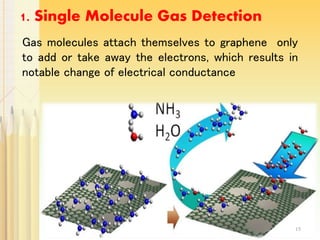
1. Single Molecule Gas Detection
Gas molecules attach themselves to graphene only
to add or take away the electrons, which results in
notable change of electrical conductance
15
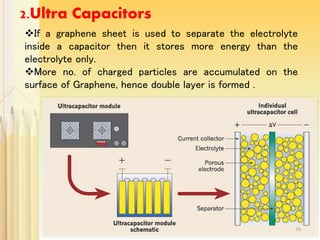
2.Ultra Capacitors
If a graphene sheet is used to separate the electrolyte
inside a capacitor then it stores more energy than the
electrolyte only.
More no. of charged particles are accumulated on the
surface of Graphene, hence double layer is formed .
16
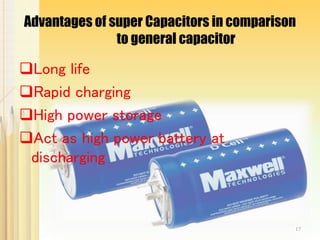
Advantages of super Capacitors in comparison
to general capacitor
Long life
Rapid charging
High power storage
Act as high power battery at
discharging
17
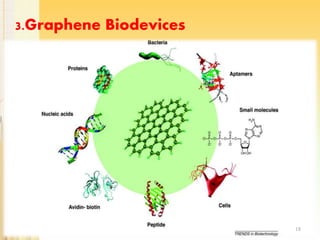
3.Graphene Biodevices
18
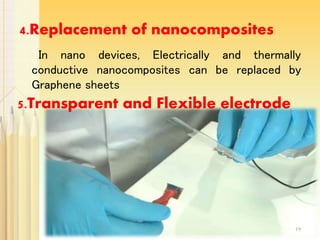
4.Replacement of nanocomposites
In nano devices, Electrically and thermally
conductive nanocomposites can be replaced by
Graphene sheets
5.Transparent and Flexible electrode
19
DRAWBACKS IN USING GREPHENE
1. There is no such industrial method for synthesis
of Graphene which prevents its commercialisation.
2. Its catalytic effect defects the metal in battery; it
needs some chemical modification.
3. Graphene sheet needs to have a substrate for use
e.g: Cellophane coating is required for use as a
transparent electrode.
4. It has cytotoxic effect.
20
CONCLUSION
1. The quality and availability of “Synthetic graphene”
will continue to improve.
2. Science must have ample access to improve
graphene material & integrate it to the present day
gadgets.
3. As synthetic routs improve the prospects of
replacing ITO in touch screens and “Si” for
Semiconductor Industries, seems feasible.
4. Graphene is Biodegradable.
21
REFERENCES
1. www.graphenia.com
2. www.wikipedia.org/wiki/Graphene
3. www.graphene.manchester.ac.uk
4. www.graphenelabs.com
22
23

Graphene, a matter for future technology

  • 1.
    AN EMERGING MATTERIALFOR FUTURE TECHNOLOGY BY: Sakti Prasanna Muduli 1
  • 2.
    OVERVIEW 1) What isGRAPHENE? 2) Different properties of Graphene 3) Preparation processes 4) Special about it...!!! 5) Applications 6) Drawbacks 7) Conclusion 2
  • 3.
    INTRODUCTION TO GRAPHENE Graphitehas layered structure of Carbon atoms and each isolated layer is called as Graphene. 3
  • 4.
    In 2004 twophysicist Andre Geim and Konstantin Novoselov extracted single atom thick Graphene from Graphite for first time at University of Manchester. In 2010 they were awarded with Noble Prize in Physics. 4
  • 5.
  • 6.
    STRUCTURE Graphene is aone-atom-thick planar sheet of sp2-bonded carbon atoms that are densely packed in a honeycomb crystal lattice. C-C bond length is about 0.142nm, and graphene sheets stack to form graphite with inter planner spacing of 0.335nm. It is considered as a two dimensional object. 6
  • 7.
  • 8.
    CHEMICAL Graphene is themost reactive form of the carbon as it has the highest surface area among other forms of Carbon. It burns at 350 ˚C. OPTICAL Monolayer Graphene absorbes 2.3% of white light; i.e it is almost TRANSPARENT. 8
  • 9.
    ELECTRONIC Graphene Sheet has: Graphene has a remarkably high electron mobility at room temperature Conductivity about 106 Ω −1·cm−1  Silver has Conductivity about 6.3*105Ω −1·cm−1 THERMAL It has thermal conductivity about (4400- 5780)Wm−1K −1 Which is higher than Silver, Cupper, Diamond. A graphene coating is used to boost thermal conductivity of Polyethylene terephalate(PET). 9
  • 10.
    MECHANICAL It is thestrongest material ever discovered. The Spring constant of Graphene is higher than graphite which makes it more rigid and stronger. Very light i.e 0.77mg per 1sq m which is 1000 times lighter than same size of paper. High fracture strength about 130GPa. 10
  • 11.
    PREPARATIONS • Exfoliation of graphitepeel-off method • Colloidal suspensions from graphite oxide or graphite intercalation compounds (GICs) • Total Organic Synthesis • chemical vapour deposition (CVD) 1,Top-down approach (From graphite) 2.Bottom up approach (from carbon precursors) 11
  • 12.
  • 13.
  • 14.
    1. Single Moleculegas detection 2. Ultra capacitor (Super Capacitor) 3. Graphene Biodevices 4. Replacement of Polymer nano composites 5. Transparent and Conducting Electrode 14
  • 15.
    1. Single MoleculeGas Detection Gas molecules attach themselves to graphene only to add or take away the electrons, which results in notable change of electrical conductance 15
  • 16.
    2.Ultra Capacitors If agraphene sheet is used to separate the electrolyte inside a capacitor then it stores more energy than the electrolyte only. More no. of charged particles are accumulated on the surface of Graphene, hence double layer is formed . 16
  • 17.
    Advantages of superCapacitors in comparison to general capacitor Long life Rapid charging High power storage Act as high power battery at discharging 17
  • 18.
  • 19.
    4.Replacement of nanocomposites Innano devices, Electrically and thermally conductive nanocomposites can be replaced by Graphene sheets 5.Transparent and Flexible electrode 19
  • 20.
    DRAWBACKS IN USINGGREPHENE 1. There is no such industrial method for synthesis of Graphene which prevents its commercialisation. 2. Its catalytic effect defects the metal in battery; it needs some chemical modification. 3. Graphene sheet needs to have a substrate for use e.g: Cellophane coating is required for use as a transparent electrode. 4. It has cytotoxic effect. 20
  • 21.
    CONCLUSION 1. The qualityand availability of “Synthetic graphene” will continue to improve. 2. Science must have ample access to improve graphene material & integrate it to the present day gadgets. 3. As synthetic routs improve the prospects of replacing ITO in touch screens and “Si” for Semiconductor Industries, seems feasible. 4. Graphene is Biodegradable. 21
  • 22.
    REFERENCES 1. www.graphenia.com 2. www.wikipedia.org/wiki/Graphene 3.www.graphene.manchester.ac.uk 4. www.graphenelabs.com 22
  • 23.

Editor's Notes

  • #3 We r going 2 explain the above points
  • #4 Graphite is one of the 3 naturally occurring allotropes of Carbon. The word “Graphene” is derived from its mother material “Graphite”. So Graphene is pure carbon in the form of a very thin, nearly transparent sheet, one atom thick.
  • #5 Theory of Graphene was first explored by P R Wallance in 1947.Sir A Geim and K Novoselov, two Russian scientists, extracted Graphene from bulk Graphite by micromechanical cleavage process. They explained the commercial extraction process from graphite.  
  • #10 It is the best electrical conductor among any known material. Diamond is electrically insulator but very good conductor for heat even better than Cu, Ag, Al, Pb, Steel. Graphene is even better conductor of heat than diamond.
  • #11 If we take same thickness of steel then graphene will be 100 times stronger. It is also Flexible
  • #16 Graphene based nano sensors for toxic gases. Graphene is extremely sensitive to the presence of minute amount of gases such as alcohol vapour or Carbon mono oxide.
  • #19 Graphene can be used to detect smallbiomolecules such as bacteria, proteins, Cells, Nucleic acids
  • #20 In touch Screen there is a Indium tin oxide coating which can be replaced by Graphene