In-Situ TiC-Fe Deposition on Mild Steel Using Laser Cladding Process Ali Emamian Department of Mechanical and Mechatronics Engineering November 18, 2009
Contents Introduction   Motivation Objectives Experimental Approach and Procedure Results and Discussion Summary Future Work
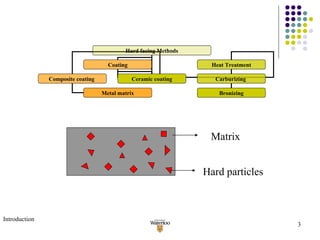
Matrix Hard particles Introduction Hard facing Methods Coating Heat Treatment Carburizing  Composite coating  Metal matrix Bronizing Ceramic coating
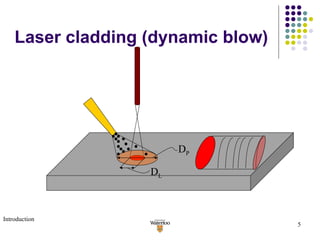
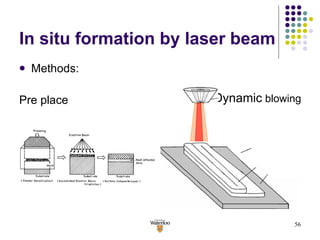
Laser cladding is a method that can be used to form metal matrix composite  Creates a small heat affected zone Melts the powder and substrate  Mixture of powder can be pre-place (pre-place method) or fed by nozzle into the melt pool (dynamic blow method) Introduction
Laser cladding (dynamic blow) D P D L Introduction
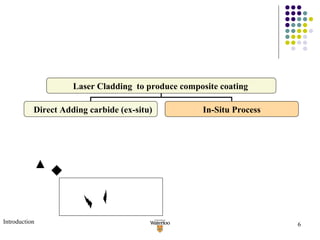
Introduction Laser   Cladding  to produce composite coating   In-Situ Process Direct Adding carbide (ex-situ)
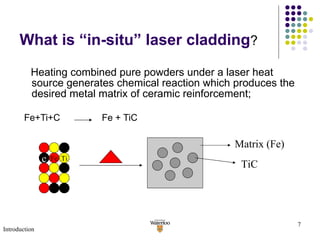
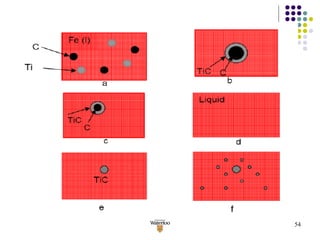
What is “in-situ” laser cladding ? Heating combined pure powders under a laser heat source generates chemical reaction which produces the desired metal matrix of ceramic reinforcement;   Fe+Ti+C  Fe + TiC c Fe Ti Matrix (Fe) TiC Introduction
In-situ process advantages Particles are thermodynamically stable in the metal matrix Reinforcing’ size can be controlled Rapid solidification can produce finely dispersed ceramic particles  High metal/ceramic bond strength (i.e. matrix can transfer the applied stress, easily) Introduction
Why TiC? TiC has : High melting point (3067 º  C) High Young Modules High specific strength High hardness (3000 HVN) 30% greater than WC Low density (WC is almost 3 times heavier) Introduction
Literature review (ex-situ) Ariely, Laser surface alloying of steel with TiC (1991). Tassin, Carbide-reinforced coatings on AISI 316 L stainless steel by laser surface alloying (1995). Axén, Abrasive wear of TiC-steel composite clad layers on tool steel (1992). Jiang, Laser deposited TiC/H13 tool steel composite coatings and their erosion resistance (2007). Li, Micro structural characterization of laser-clad TiCp-reinforced Ni-Cr-B-Si-C composite coatings on steel (1999). Wanliang, Microstructure of TiC dendrites reinforced titanium matrix composite layer by laser cladding (2003). Hidouci, Microstructural and mechanical characteristics of laser coatings (2000). Wu, Microstructure and mechanical properties at TiCp/Ni-alloy interfaces in laser-synthesized coatings (2001). Literature review
Literature review (In-situ) Cui, In situ TiC particles reinforced grey cast iron composite fabricated by laser cladding of Ni–Ti–C system (2007). Wang,  Microstructure and wear properties of TiC/FeCrBSi surface composite coating prepared by laser cladding (2008). Yang, In-situ TiC reinforced composite coating produced by powder feeding laser cladding (2006). Yan, In situ laser surface coating of TiC metal-matrix composite layer (1996). Yang, S. Fabrication of in-situ synthesized TiC particles reinforced composite coating by powder feeding laser cladding  (2005). Wu, X. In situ formation by laser cladding of a TiC composite coating with a gradient distribution (1999). Yang1, In-situ TiC reinforced composite coating produced by powder feeding laser cladding (2006). Wang, In situ synthesized TiC particles reinforced Fe based composite coating produced by laser cladding (2009). Literature review
Have mostly focused on pre-place method Mainly used Ni or Co alloys as a binder Did not explain TiC formation mechanism  Did not investigate the relationship between clad microstructure and laser processing condition Produced carbides which are combination of Ni, Fe, Co, Cr, B or Si.  Variety of carbides other than TiC are produced in a complex solidification process Motivation Motivation
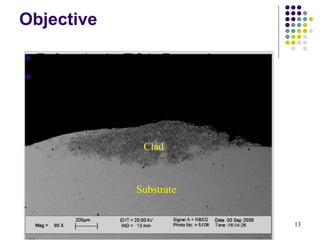
Objective To form in-situ TiC in Fe matrix  To form high quality clad (complete metallurgical bonding between clad and substrate without porosity and crack) Substrate Clad
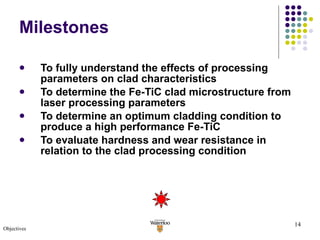
Milestones To fully understand the effects of processing parameters on clad characteristics To determine the Fe-TiC clad microstructure from laser processing parameters To determine an optimum cladding condition to produce a high performance Fe-TiC  To evaluate hardness and wear resistance in relation to the clad processing condition Objectives
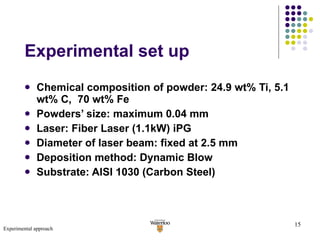
Experimental set up Chemical composition of powder: 24.9 wt% Ti, 5.1 wt% C,  70 wt% Fe Powders’ size: maximum 0.04 mm Laser: Fiber Laser (1.1kW) iPG Diameter of laser beam: fixed at 2.5 mm Deposition method: Dynamic Blow  Substrate: AISI 1030 (Carbon Steel) Experimental approach
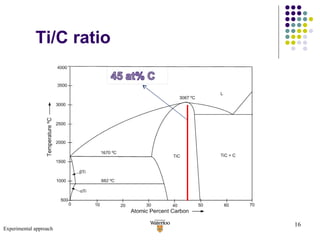
Ti/C ratio Experimental approach
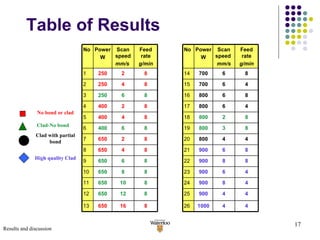
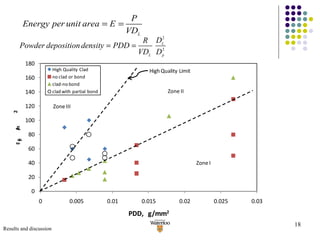
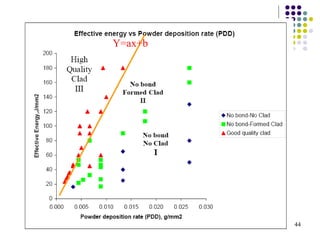
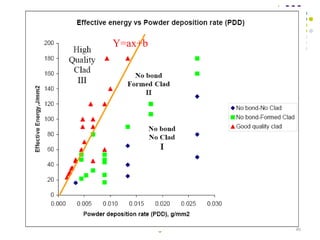
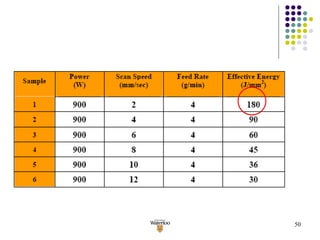
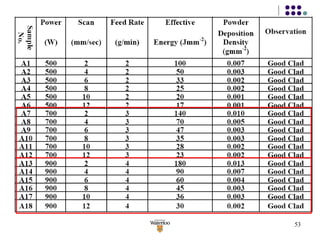
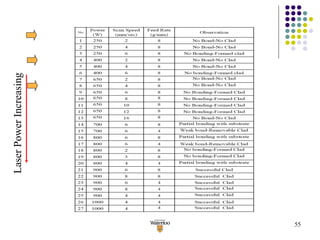
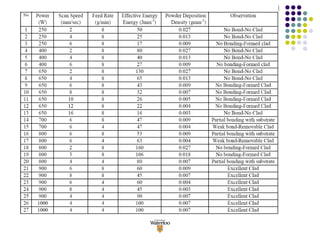
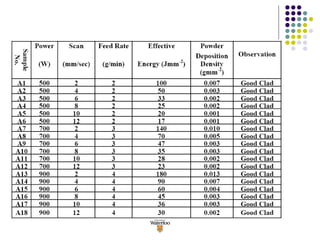
No bond or clad Clad-No bond Clad with partial bond High quality Clad Results and discussion Table of Results No Power W Scan speed mm/s  Feed rate g/min 1 250 2 8 2 250 4 8 3 250 6 8 4 400 2 8 5 400 4 8 6 400 6 8 7 650 2 8 8 650 4 8 9 650 6 8 10 650 8 8 11 650 10 8 12 650 12 8 13 650 16 8 No Power W Scan speed  mm/s Feed rate g/min 14 700 6 8 15 700 6 4 16 800 6 8 17 800 6 4 18 800 2 8 19 800 3 8 20 800 4 4 21 900 6 8 22 900 8 8 23 900 6 4 24 900 8 4 25 900 4 4 26 1000 4 4
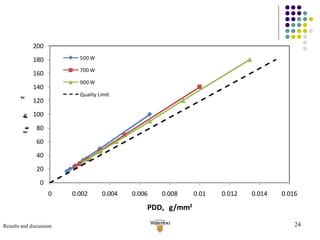
Results and discussion
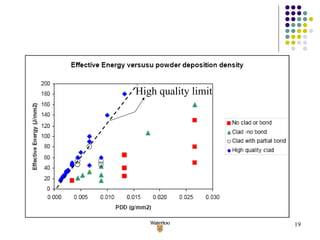
High quality limit
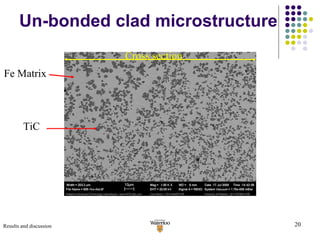
Un-bonded clad microstructure Fe Matrix TiC Cross section Results and discussion
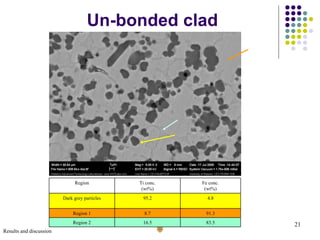
Un-bonded clad Results and discussion Region Ti conc. (wt%) Fe conc. (wt%) Dark grey particles 95.2 4.8 Region 1 8.7 91.3 Region 2 16.5 83.5
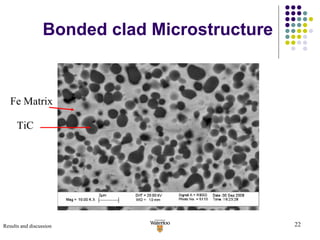
Bonded clad Microstructure Fe Matrix TiC Results and discussion
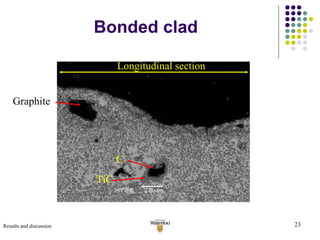
Bonded clad Graphite C TiC Longitudinal section Results and discussion
Results and discussion
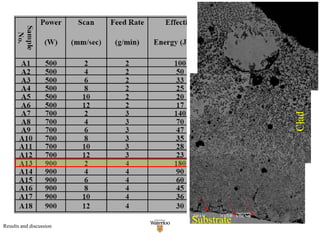
Clad   Substrate   Results and discussion
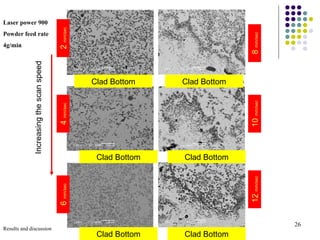
Increasing the scan speed 2  mm/sec 12  mm/sec 10  mm/sec 8  mm/sec 6  mm/sec 4  mm/sec Clad Bottom Clad Bottom Clad Bottom Clad Bottom Clad Bottom Clad Bottom Laser power 900 Powder feed rate  4g/min Results and discussion
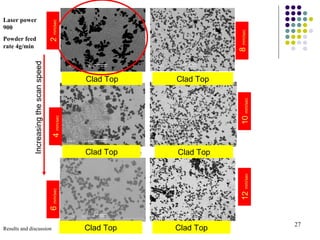
2  mm/sec Increasing the scan speed Clad Top 4  mm/sec 6  mm/sec 8  mm/sec 12  mm/sec 10  mm/sec Clad Top Clad Top Clad Top Clad Top Clad Top Results and discussion Laser power 900 Powder feed rate 4g/min
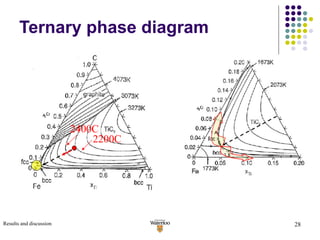
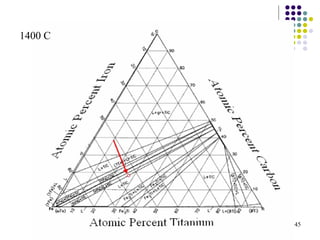
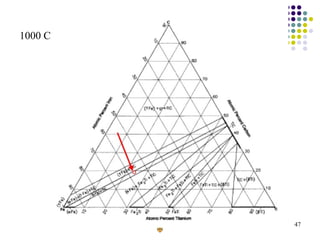
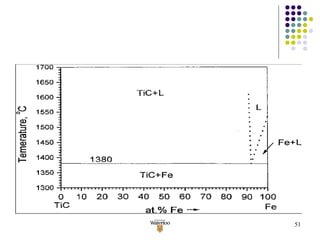
Ternary phase diagram 2200C 2400C Results and discussion
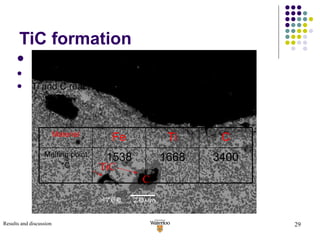
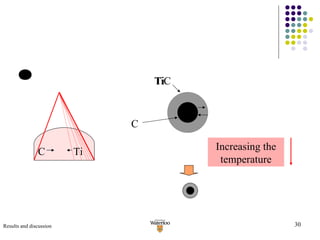
TiC formation Fe powders melt Ti and C dissolve in Fe  Ti and C react to form TiC layer Results and discussion TiC C Material Fe Ti C Melting point °C 1538 1668 3400
Fe Ti C C Ti Increasing the temperature TiC Results and discussion
Summary In-Situ TiC has been formed during the laser cladding process  It was shown that TiC morphology can be controlled by effective energy and powder deposition density A map to predict the clad quality based on process parameters has been developed
Future work Complete understanding of in-situ Fe-TiC coating , laser process parameters, microstructure and surface properties relationship Process Control Optimization the powder composition Investigation of wear resistance behaviour Future work
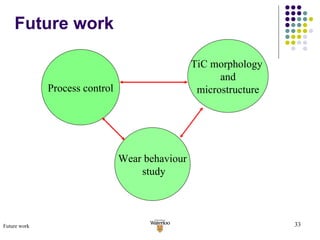
Future work Process control TiC morphology  and  microstructure Wear behaviour study Future work
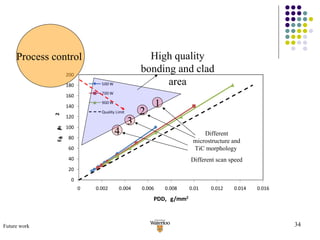
Process control  High quality bonding and clad area Different microstructure and TiC morphology  Different scan speed 1 2 3 4 Future work
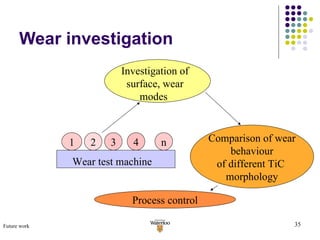
Wear investigation 1 2 3 4 n Wear test machine Investigation of surface, wear modes  Future work Comparison of wear behaviour  of different TiC  morphology Process control
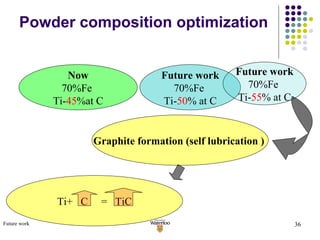
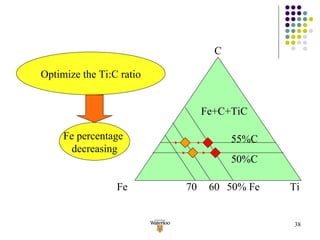
Powder composition optimization Now 70%Fe  Ti- 45 %at C Future work 70%Fe  Ti- 50 % at C Future work 70%Fe  Ti- 55 % at C Graphite formation (self lubrication )  Ti+  C  =  TiC Future work
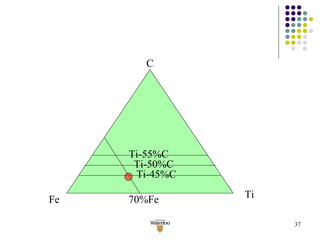
Fe Ti C 70%Fe Ti-55%C Ti-50%C Ti-45%C
Fe percentage  decreasing Ti Fe C 70 60 50% Fe 50%C 55%C Optimize the Ti:C ratio Fe+C+TiC
Future work Process optimization Microstructure characterization Wear behaviour investigation Future work
Time table Future work Activity Winter 2010 Spring 2010 Fall 2010 Winter 2011 Spring 2011 Fall 2011 Winter 2012 Investigation on optimum process parameters  Investigation on optimum compositions TiC phase formation and morphology analyses  Wear resistance investigation and analysis-Process modification Thesis writing Defence
Thanks
Y=ax+b
1400 C
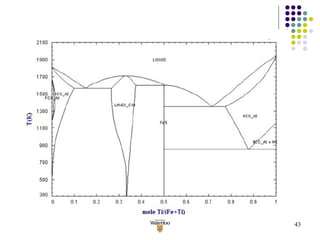
Y=ax+b
1000 C
Laser Power Increasing
In situ formation by laser beam Methods: Pre place  Dynamic  blowing
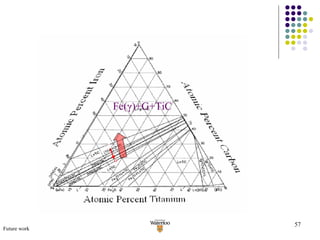
Future work Fe( γ )+ G+TiC


In situ TiC formation Using Laser cladding

  • 1.
    In-Situ TiC-Fe Depositionon Mild Steel Using Laser Cladding Process Ali Emamian Department of Mechanical and Mechatronics Engineering November 18, 2009
  • 2.
    Contents Introduction Motivation Objectives Experimental Approach and Procedure Results and Discussion Summary Future Work
  • 3.
    Matrix Hard particlesIntroduction Hard facing Methods Coating Heat Treatment Carburizing Composite coating Metal matrix Bronizing Ceramic coating
  • 4.
    Laser cladding isa method that can be used to form metal matrix composite Creates a small heat affected zone Melts the powder and substrate Mixture of powder can be pre-place (pre-place method) or fed by nozzle into the melt pool (dynamic blow method) Introduction
  • 5.
    Laser cladding (dynamicblow) D P D L Introduction
  • 6.
    Introduction Laser Cladding to produce composite coating In-Situ Process Direct Adding carbide (ex-situ)
  • 7.
    What is “in-situ”laser cladding ? Heating combined pure powders under a laser heat source generates chemical reaction which produces the desired metal matrix of ceramic reinforcement; Fe+Ti+C Fe + TiC c Fe Ti Matrix (Fe) TiC Introduction
  • 8.
    In-situ process advantagesParticles are thermodynamically stable in the metal matrix Reinforcing’ size can be controlled Rapid solidification can produce finely dispersed ceramic particles High metal/ceramic bond strength (i.e. matrix can transfer the applied stress, easily) Introduction
  • 9.
    Why TiC? TiChas : High melting point (3067 º C) High Young Modules High specific strength High hardness (3000 HVN) 30% greater than WC Low density (WC is almost 3 times heavier) Introduction
  • 10.
    Literature review (ex-situ)Ariely, Laser surface alloying of steel with TiC (1991). Tassin, Carbide-reinforced coatings on AISI 316 L stainless steel by laser surface alloying (1995). Axén, Abrasive wear of TiC-steel composite clad layers on tool steel (1992). Jiang, Laser deposited TiC/H13 tool steel composite coatings and their erosion resistance (2007). Li, Micro structural characterization of laser-clad TiCp-reinforced Ni-Cr-B-Si-C composite coatings on steel (1999). Wanliang, Microstructure of TiC dendrites reinforced titanium matrix composite layer by laser cladding (2003). Hidouci, Microstructural and mechanical characteristics of laser coatings (2000). Wu, Microstructure and mechanical properties at TiCp/Ni-alloy interfaces in laser-synthesized coatings (2001). Literature review
  • 11.
    Literature review (In-situ)Cui, In situ TiC particles reinforced grey cast iron composite fabricated by laser cladding of Ni–Ti–C system (2007). Wang, Microstructure and wear properties of TiC/FeCrBSi surface composite coating prepared by laser cladding (2008). Yang, In-situ TiC reinforced composite coating produced by powder feeding laser cladding (2006). Yan, In situ laser surface coating of TiC metal-matrix composite layer (1996). Yang, S. Fabrication of in-situ synthesized TiC particles reinforced composite coating by powder feeding laser cladding (2005). Wu, X. In situ formation by laser cladding of a TiC composite coating with a gradient distribution (1999). Yang1, In-situ TiC reinforced composite coating produced by powder feeding laser cladding (2006). Wang, In situ synthesized TiC particles reinforced Fe based composite coating produced by laser cladding (2009). Literature review
  • 12.
    Have mostly focusedon pre-place method Mainly used Ni or Co alloys as a binder Did not explain TiC formation mechanism Did not investigate the relationship between clad microstructure and laser processing condition Produced carbides which are combination of Ni, Fe, Co, Cr, B or Si. Variety of carbides other than TiC are produced in a complex solidification process Motivation Motivation
  • 13.
    Objective To formin-situ TiC in Fe matrix To form high quality clad (complete metallurgical bonding between clad and substrate without porosity and crack) Substrate Clad
  • 14.
    Milestones To fullyunderstand the effects of processing parameters on clad characteristics To determine the Fe-TiC clad microstructure from laser processing parameters To determine an optimum cladding condition to produce a high performance Fe-TiC To evaluate hardness and wear resistance in relation to the clad processing condition Objectives
  • 15.
    Experimental set upChemical composition of powder: 24.9 wt% Ti, 5.1 wt% C, 70 wt% Fe Powders’ size: maximum 0.04 mm Laser: Fiber Laser (1.1kW) iPG Diameter of laser beam: fixed at 2.5 mm Deposition method: Dynamic Blow Substrate: AISI 1030 (Carbon Steel) Experimental approach
  • 16.
  • 17.
    No bond orclad Clad-No bond Clad with partial bond High quality Clad Results and discussion Table of Results No Power W Scan speed mm/s Feed rate g/min 1 250 2 8 2 250 4 8 3 250 6 8 4 400 2 8 5 400 4 8 6 400 6 8 7 650 2 8 8 650 4 8 9 650 6 8 10 650 8 8 11 650 10 8 12 650 12 8 13 650 16 8 No Power W Scan speed mm/s Feed rate g/min 14 700 6 8 15 700 6 4 16 800 6 8 17 800 6 4 18 800 2 8 19 800 3 8 20 800 4 4 21 900 6 8 22 900 8 8 23 900 6 4 24 900 8 4 25 900 4 4 26 1000 4 4
  • 18.
  • 19.
  • 20.
    Un-bonded clad microstructureFe Matrix TiC Cross section Results and discussion
  • 21.
    Un-bonded clad Resultsand discussion Region Ti conc. (wt%) Fe conc. (wt%) Dark grey particles 95.2 4.8 Region 1 8.7 91.3 Region 2 16.5 83.5
  • 22.
    Bonded clad MicrostructureFe Matrix TiC Results and discussion
  • 23.
    Bonded clad GraphiteC TiC Longitudinal section Results and discussion
  • 24.
  • 25.
    Clad Substrate Results and discussion
  • 26.
    Increasing the scanspeed 2 mm/sec 12 mm/sec 10 mm/sec 8 mm/sec 6 mm/sec 4 mm/sec Clad Bottom Clad Bottom Clad Bottom Clad Bottom Clad Bottom Clad Bottom Laser power 900 Powder feed rate 4g/min Results and discussion
  • 27.
    2 mm/secIncreasing the scan speed Clad Top 4 mm/sec 6 mm/sec 8 mm/sec 12 mm/sec 10 mm/sec Clad Top Clad Top Clad Top Clad Top Clad Top Results and discussion Laser power 900 Powder feed rate 4g/min
  • 28.
    Ternary phase diagram2200C 2400C Results and discussion
  • 29.
    TiC formation Fepowders melt Ti and C dissolve in Fe Ti and C react to form TiC layer Results and discussion TiC C Material Fe Ti C Melting point °C 1538 1668 3400
  • 30.
    Fe Ti CC Ti Increasing the temperature TiC Results and discussion
  • 31.
    Summary In-Situ TiChas been formed during the laser cladding process It was shown that TiC morphology can be controlled by effective energy and powder deposition density A map to predict the clad quality based on process parameters has been developed
  • 32.
    Future work Completeunderstanding of in-situ Fe-TiC coating , laser process parameters, microstructure and surface properties relationship Process Control Optimization the powder composition Investigation of wear resistance behaviour Future work
  • 33.
    Future work Processcontrol TiC morphology and microstructure Wear behaviour study Future work
  • 34.
    Process control High quality bonding and clad area Different microstructure and TiC morphology Different scan speed 1 2 3 4 Future work
  • 35.
    Wear investigation 12 3 4 n Wear test machine Investigation of surface, wear modes Future work Comparison of wear behaviour of different TiC morphology Process control
  • 36.
    Powder composition optimizationNow 70%Fe Ti- 45 %at C Future work 70%Fe Ti- 50 % at C Future work 70%Fe Ti- 55 % at C Graphite formation (self lubrication ) Ti+ C = TiC Future work
  • 37.
    Fe Ti C70%Fe Ti-55%C Ti-50%C Ti-45%C
  • 38.
    Fe percentage decreasing Ti Fe C 70 60 50% Fe 50%C 55%C Optimize the Ti:C ratio Fe+C+TiC
  • 39.
    Future work Processoptimization Microstructure characterization Wear behaviour investigation Future work
  • 40.
    Time table Futurework Activity Winter 2010 Spring 2010 Fall 2010 Winter 2011 Spring 2011 Fall 2011 Winter 2012 Investigation on optimum process parameters Investigation on optimum compositions TiC phase formation and morphology analyses Wear resistance investigation and analysis-Process modification Thesis writing Defence
  • 41.
  • 44.
  • 45.
  • 46.
  • 47.
  • 55.
  • 56.
    In situ formationby laser beam Methods: Pre place Dynamic blowing
  • 57.
    Future work Fe(γ )+ G+TiC
  • 58.
  • 59.