History of (LBM)
4 In 1965, the first production laser cutting machine was used to
drill holes in diamond dies.
4 This machine was made by the Western Electric Engineering
Research Center.
4 In 1967, the British pioneered laser-assisted oxygen jet cutting
for metals.
4 In the early 1970s, this technology was put into production to
cut titanium for aerospace applications. At the same time CO2
lasers were adapted to cut non-metals, such as textiles,
What is laser beam machining(LBM) ?
LBM schematic
 is an unconventional
machining process in which
a beam of highly
[[coherent]] [[light]] called a
[[Laser]] is directed towards
the work piece for
machining.
 Since the rays of a laser
beam are monochromatic
and parallel it can be
focused to a very small
diameter and can produce
energy as high as 100 MW
of energy for a square
millimeter of area.
Cont…..(LBM)
 It is especially suited to making accurately placed holes.
 It can be used to perform precision micro-machining on
all microelectronic substrates such as ceramic, silicon,
diamond, and graphite.
 Examples of microelectronic micro-machining include
cutting, scribing & drilling all substrates, trimming any
hybrid resistors, patterning displays of glass or plastic and
trace cutting on semiconductor wafers and chips.
 A pulsed ruby laser is normally used for developing a
high power.
 Heat Affected In Laser Zone (HAZ) in laser machining
is relatively narrow and the re-solidified layer is of micron
dimensions. For this reason, the distortion in laser
machining is negligible. In traditional machining, large
areas of work hardening is almost unavoidable.
 Small blind holes, grooves, surface texturing and marking
can be achieved with high quality using LMP. .
 Lasers can be used to cut, drill, weld and mark
Types of (LBM)
There are three main types of lasers used in laser cutting.
 The CO2 Laser is suited for cutting, boring, and engraving.
 The neodymium(Nd) and neodymium yttrium- aluminum-
garnet (NA-YAG) lasers are identical in style and differ only in
application
 Nd is used for boring and where high energy but low repetition
are required.
 The Nd-YAG laser is used where very high power is needed
and for boring and engraving.
 Both CO2 and Nd/ Nd-YAG lasers can be used for welding.
 CO2 lasers are commonly "pumped" by passing a current
through the gas mix (DC-excited) or using radio frequency
energy (RF-excited). The RF method is newer and has become
more popular.
 Since DC designs require electrodes inside the cavity, they can
encounter electrode erosion and plating of electrode material
on glass wear and optics .
 Since RF resonators have external electrodes they are not prone
to those problems.
 CO2 lasers are used for industrial cutting of many materials
including mild steel, aluminium, stainless steel, titanium, paper,
wax, plastics, wood, and fabrics.
 YAG lasers are primarily used for cutting and scribing metals
and ceramics.
ApplicationsLasing material
Boring
Cutting/Scribing
Engraving
CO2
High-energy pulses
Low repetition speed (1 kHz)
Boring
Nd
Very high energy pulses
Boring
Engraving
Trimming
Nd- YAG
Table (1):shows applications of
lasing material
A laser microjet
 A laser microjet is a water-jet guided
laser in which a pulsed laser beam is
coupled into a low-pressure water jet.
This is used to perform laser cutting
functions while using the water jet to
guide the laser beam, much like an optical
fiber, through total internal reflection.
 The advantages of this are that the water
also removes debris and cools the
material.
 Additional advantages over traditional
"dry" laser cutting are high dicing speeds,
parallel Kerf and
unidirectional cutting.
Process of (LBM)
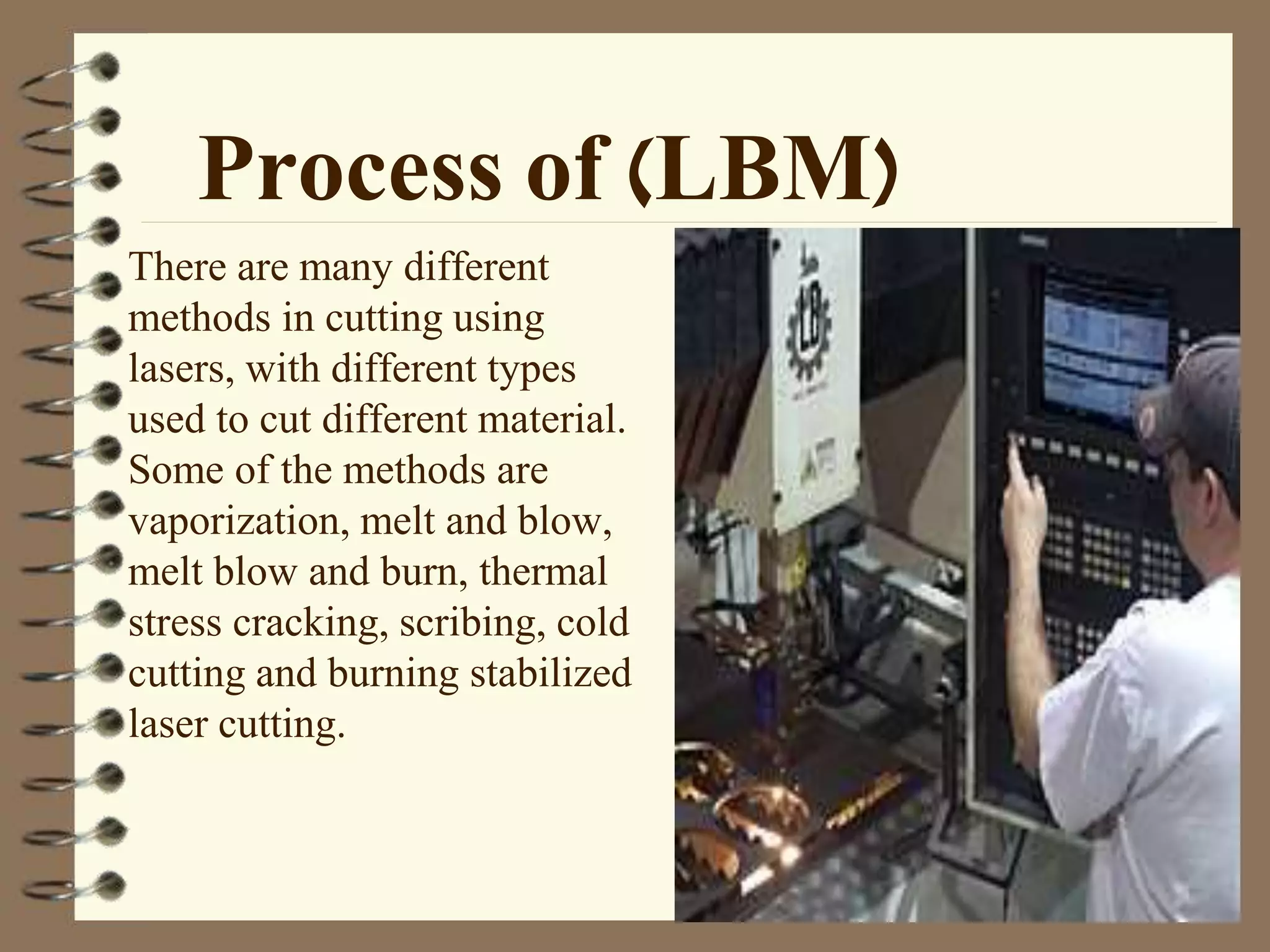
There are many different
methods in cutting using
lasers, with different types
used to cut different material.
Some of the methods are
vaporization, melt and blow,
melt blow and burn, thermal
stress cracking, scribing, cold
cutting and burning stabilized
laser cutting.
Laser beam cutting
(drilling)
4 In drilling, energy transferred (e.g., via a Nd:YAG
laser) into the workpiece melts the material at the
point of contact, which subsequently changes into
a plasma and leaves the region.
4 A gas jet (typically, oxygen) can further facilitate
this phase transformation and departure of
material removed.
4 Laser drilling should be targeted for hard materials
and hole geometries that are difficult to achieve
with other methods.
4 SEM micrograph hole drilled in 250 micro meter
thick Silicon Nitride with 3rd harmonic Nd: YAG
laser
Vaporization cutting
1
• In vaporization cutting the focused beam heats the surface of the material
to boiling point and generates a keyhole.
• The leads to a sudden increase in absorptivity quickly deepening the hole.
2
• As the hole deepens and the material boils, vapor generated erodes the
molten walls blowing ejecta out and further enlarging the hole.
3
• Non melting material such as wood, carbon and thermoset plastics are
usually cut by this method.
Laser beam cutting (milling)
A laser spot reflected onto the surface of a
workpiece travels along a prescribed trajectory
and cuts into the material.
Continuous-wave mode (CO2) gas lasers are
very suitable for laser cutting providing high-
average power, yielding ? high material-
removal rates, and smooth cutting surfaces.
Applications
4 Manufacturers of turbine engines for aircraft propulsion
and for power generation have benefited from the
productivity of lasers for drilling small (0.3–1 mm
diameter typical) cylindrical holes at 15–90° to the surface
in cast, sheet metal and machined components.
4 Their ability to drill holes at shallow angles to the surface at
rates of between 0.3 to 3 holes per second has enabled new
designs incorporating film-cooling holes for improved fuel
efficiency, reduced noise, and lower NOx and CO
emissions.

Laser beam machining (lbm)2013

  • 1.
    History of (LBM) 4In 1965, the first production laser cutting machine was used to drill holes in diamond dies. 4 This machine was made by the Western Electric Engineering Research Center. 4 In 1967, the British pioneered laser-assisted oxygen jet cutting for metals. 4 In the early 1970s, this technology was put into production to cut titanium for aerospace applications. At the same time CO2 lasers were adapted to cut non-metals, such as textiles,
  • 2.
    What is laserbeam machining(LBM) ? LBM schematic  is an unconventional machining process in which a beam of highly [[coherent]] [[light]] called a [[Laser]] is directed towards the work piece for machining.  Since the rays of a laser beam are monochromatic and parallel it can be focused to a very small diameter and can produce energy as high as 100 MW of energy for a square millimeter of area.
  • 3.
    Cont…..(LBM)  It isespecially suited to making accurately placed holes.  It can be used to perform precision micro-machining on all microelectronic substrates such as ceramic, silicon, diamond, and graphite.  Examples of microelectronic micro-machining include cutting, scribing & drilling all substrates, trimming any hybrid resistors, patterning displays of glass or plastic and trace cutting on semiconductor wafers and chips.  A pulsed ruby laser is normally used for developing a high power.  Heat Affected In Laser Zone (HAZ) in laser machining is relatively narrow and the re-solidified layer is of micron dimensions. For this reason, the distortion in laser machining is negligible. In traditional machining, large areas of work hardening is almost unavoidable.  Small blind holes, grooves, surface texturing and marking can be achieved with high quality using LMP. .  Lasers can be used to cut, drill, weld and mark
  • 4.
    Types of (LBM) Thereare three main types of lasers used in laser cutting.  The CO2 Laser is suited for cutting, boring, and engraving.  The neodymium(Nd) and neodymium yttrium- aluminum- garnet (NA-YAG) lasers are identical in style and differ only in application  Nd is used for boring and where high energy but low repetition are required.  The Nd-YAG laser is used where very high power is needed and for boring and engraving.  Both CO2 and Nd/ Nd-YAG lasers can be used for welding.
  • 5.
     CO2 lasersare commonly "pumped" by passing a current through the gas mix (DC-excited) or using radio frequency energy (RF-excited). The RF method is newer and has become more popular.  Since DC designs require electrodes inside the cavity, they can encounter electrode erosion and plating of electrode material on glass wear and optics .  Since RF resonators have external electrodes they are not prone to those problems.  CO2 lasers are used for industrial cutting of many materials including mild steel, aluminium, stainless steel, titanium, paper, wax, plastics, wood, and fabrics.  YAG lasers are primarily used for cutting and scribing metals and ceramics.
  • 6.
    ApplicationsLasing material Boring Cutting/Scribing Engraving CO2 High-energy pulses Lowrepetition speed (1 kHz) Boring Nd Very high energy pulses Boring Engraving Trimming Nd- YAG Table (1):shows applications of lasing material
  • 7.
    A laser microjet A laser microjet is a water-jet guided laser in which a pulsed laser beam is coupled into a low-pressure water jet. This is used to perform laser cutting functions while using the water jet to guide the laser beam, much like an optical fiber, through total internal reflection.  The advantages of this are that the water also removes debris and cools the material.  Additional advantages over traditional "dry" laser cutting are high dicing speeds, parallel Kerf and unidirectional cutting.
  • 8.
    Process of (LBM) Thereare many different methods in cutting using lasers, with different types used to cut different material. Some of the methods are vaporization, melt and blow, melt blow and burn, thermal stress cracking, scribing, cold cutting and burning stabilized laser cutting.
  • 9.
    Laser beam cutting (drilling) 4In drilling, energy transferred (e.g., via a Nd:YAG laser) into the workpiece melts the material at the point of contact, which subsequently changes into a plasma and leaves the region. 4 A gas jet (typically, oxygen) can further facilitate this phase transformation and departure of material removed. 4 Laser drilling should be targeted for hard materials and hole geometries that are difficult to achieve with other methods. 4 SEM micrograph hole drilled in 250 micro meter thick Silicon Nitride with 3rd harmonic Nd: YAG laser
  • 10.
    Vaporization cutting 1 • Invaporization cutting the focused beam heats the surface of the material to boiling point and generates a keyhole. • The leads to a sudden increase in absorptivity quickly deepening the hole. 2 • As the hole deepens and the material boils, vapor generated erodes the molten walls blowing ejecta out and further enlarging the hole. 3 • Non melting material such as wood, carbon and thermoset plastics are usually cut by this method.
  • 11.
    Laser beam cutting(milling) A laser spot reflected onto the surface of a workpiece travels along a prescribed trajectory and cuts into the material. Continuous-wave mode (CO2) gas lasers are very suitable for laser cutting providing high- average power, yielding ? high material- removal rates, and smooth cutting surfaces.
  • 12.
    Applications 4 Manufacturers ofturbine engines for aircraft propulsion and for power generation have benefited from the productivity of lasers for drilling small (0.3–1 mm diameter typical) cylindrical holes at 15–90° to the surface in cast, sheet metal and machined components. 4 Their ability to drill holes at shallow angles to the surface at rates of between 0.3 to 3 holes per second has enabled new designs incorporating film-cooling holes for improved fuel efficiency, reduced noise, and lower NOx and CO emissions.