LASER BEAM MACHINING
DEBABRATA DOBAI
REGD. NO. :- 1501298261
BRANCH :- MECHANICAL
ENGINEERING
KEY POINTS :-
• LASER
• LASER BEAM MACHINING
• TYPES OF LBM
• APPLICATION
• ADVANTAGES
• DISADVANTAGES
• EXAMPLE
• REFERENCE
2
WHAT IS LASER ?
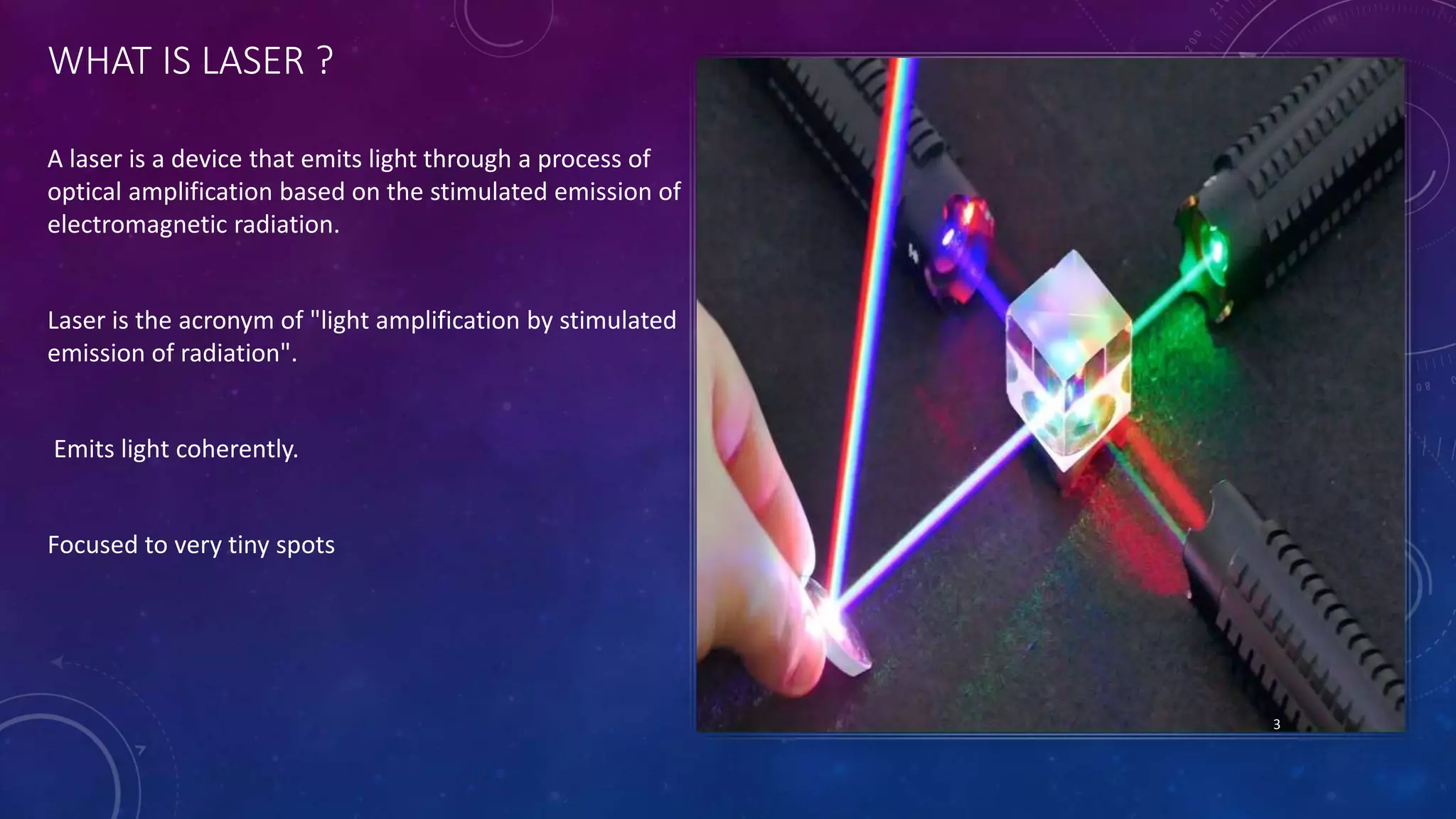
A laser is a device that emits light through a process of
optical amplification based on the stimulated emission of
electromagnetic radiation.
Laser is the acronym of "light amplification by stimulated
emission of radiation".
Emits light coherently.
Focused to very tiny spots
3
WHAT IS LBM ?
• Laser Beam Machining (LBM) is a non-traditional manufacturing process, in which a laser is directed
towards the work piece for machining.
• Uses thermal energy to remove material from metallic or nonmetallic surfaces.
• Suitable for brittle materials having low conductivity.
• LASER :- Light Amplification by Stimulated Emission of Radiation
• Stimulated emission of electromagnetic radiation
• Used light energy from the laser to remove material
by vapourization.
• Energy is concentrated at a point.
• Laser emits continuous light beam.
4
TYPES OF LBM :
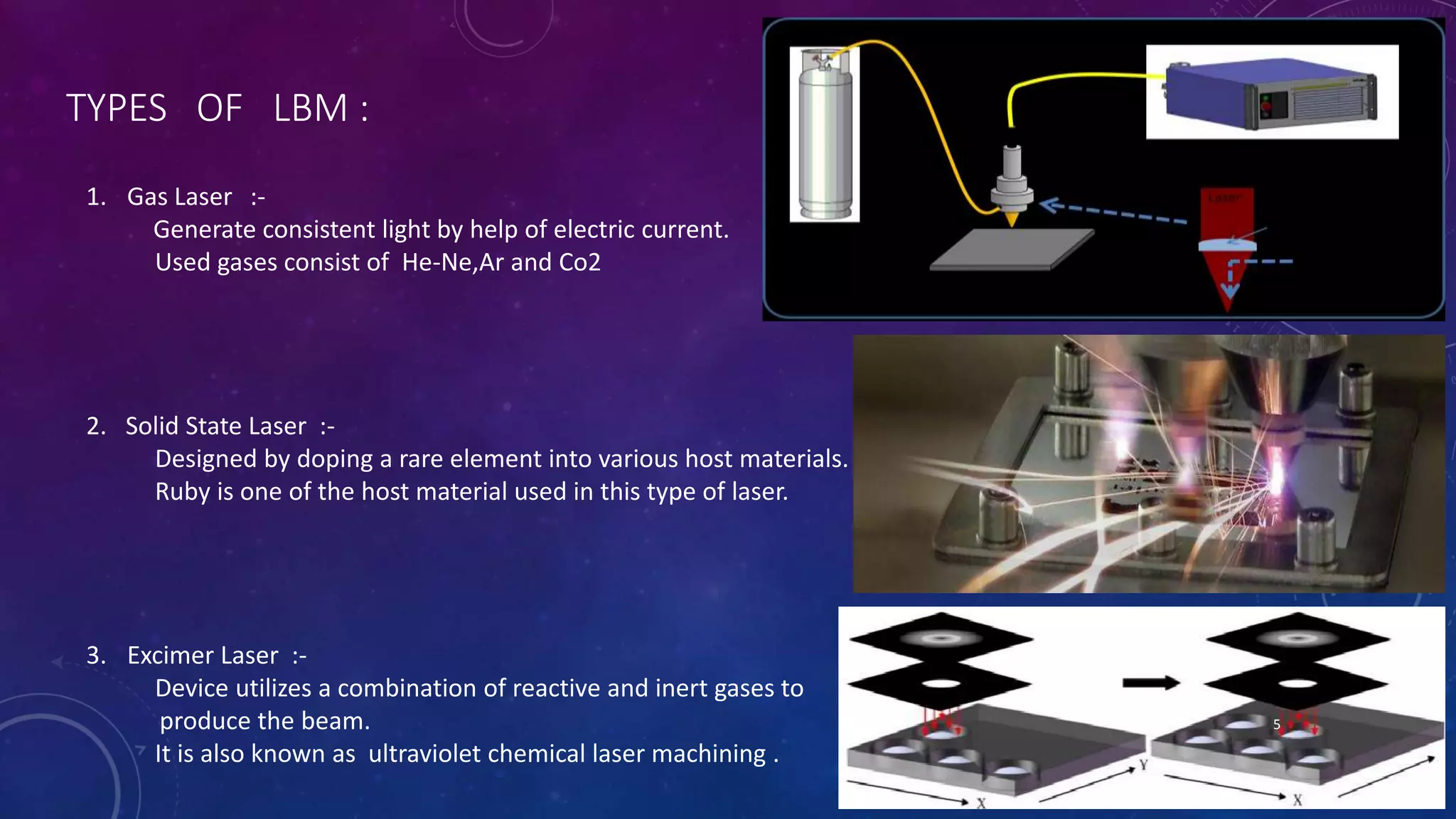
1. Gas Laser :-
Generate consistent light by help of electric current.
Used gases consist of He-Ne,Ar and Co2
2. Solid State Laser :-
Designed by doping a rare element into various host materials.
Ruby is one of the host material used in this type of laser.
3. Excimer Laser :-
Device utilizes a combination of reactive and inert gases to
produce the beam.
It is also known as ultraviolet chemical laser machining .
5
APPLICATION :
• Welding of non-conductive and refractory material.
• Cutting complex profiles for both thin and hard materials.
• Used to make tiny holes.
• Mass-micro machining
• For producing fine and minute holes.
• Used for trimming of sheet metal, carbon resistors and plastic parts.
• LBM is also suitable for dynamic balancing of precise rotating components lie watches.
6
ADVANTAGE :-
• There is no direct contact between the tool and
the workpiece, hence there is no issue of tool
wear.
• Machining can be done in any environment.
• Refractory materials can be easily worked.
• Easy machining of brittle, non-metallic and hard
materials.
• Used for welding of dissimilar metals.
• Micro sized holes can created in all types of
materials.
• Energy obtained is of high density as a result
high heat is obtained.
• Beam configuration and size of exposed area is
easily controllable.
• Precise location of the spot is ensured.
• By applying unidirectional multiple pulses deep
holes of very short diameter can be drilled.
• Extremely small holes can be drilled easily.
DISADVANTAGE:-
• LBM is applicable only for thin sections and
where a small quantity of material is removed.
• Control of hole size is difficult.
• Holes drilled may have a slight taper formation,
hence not suitable for large holes.
• Durability and reliability of the system is limited.
• Due to low production rate, efficiency of system
is low.
• Initial cost and operating cost of the system is
high.
• Highly Skilled operator required.
• Too deep holes are not possible to drill.
• Machined holes are not round shaped or
straight .
• Overall efficiency is very low . (0.3 ~0.5 %)
7
EXAMPLE :
8
REFERENCE :
https://en.wikipedia.org/wiki/Laser_beam_machining
https://basicmechanicalengineering.com/laser-
beam-machining-lbm-principles-and-applications
http://www.mechanicalbooster.com/2017/05/laser
-beam-machining.html
Handbook of the Eurolaser Academy. Springer. ISBN
0-412-81910-4.
"The Carbon Dioxide Laser". Davidson Physics.
Retrieved 17 August 2014.
http://www.mechgrid.com/laser-beam-
machining.html
https://www.sciencedirect.com
9
10
11

Laser Beam Machining Process

  • 1.
    LASER BEAM MACHINING DEBABRATADOBAI REGD. NO. :- 1501298261 BRANCH :- MECHANICAL ENGINEERING
  • 2.
    KEY POINTS :- •LASER • LASER BEAM MACHINING • TYPES OF LBM • APPLICATION • ADVANTAGES • DISADVANTAGES • EXAMPLE • REFERENCE 2
  • 3.
    WHAT IS LASER? A laser is a device that emits light through a process of optical amplification based on the stimulated emission of electromagnetic radiation. Laser is the acronym of "light amplification by stimulated emission of radiation". Emits light coherently. Focused to very tiny spots 3
  • 4.
    WHAT IS LBM? • Laser Beam Machining (LBM) is a non-traditional manufacturing process, in which a laser is directed towards the work piece for machining. • Uses thermal energy to remove material from metallic or nonmetallic surfaces. • Suitable for brittle materials having low conductivity. • LASER :- Light Amplification by Stimulated Emission of Radiation • Stimulated emission of electromagnetic radiation • Used light energy from the laser to remove material by vapourization. • Energy is concentrated at a point. • Laser emits continuous light beam. 4
  • 5.
    TYPES OF LBM: 1. Gas Laser :- Generate consistent light by help of electric current. Used gases consist of He-Ne,Ar and Co2 2. Solid State Laser :- Designed by doping a rare element into various host materials. Ruby is one of the host material used in this type of laser. 3. Excimer Laser :- Device utilizes a combination of reactive and inert gases to produce the beam. It is also known as ultraviolet chemical laser machining . 5
  • 6.
    APPLICATION : • Weldingof non-conductive and refractory material. • Cutting complex profiles for both thin and hard materials. • Used to make tiny holes. • Mass-micro machining • For producing fine and minute holes. • Used for trimming of sheet metal, carbon resistors and plastic parts. • LBM is also suitable for dynamic balancing of precise rotating components lie watches. 6
  • 7.
    ADVANTAGE :- • Thereis no direct contact between the tool and the workpiece, hence there is no issue of tool wear. • Machining can be done in any environment. • Refractory materials can be easily worked. • Easy machining of brittle, non-metallic and hard materials. • Used for welding of dissimilar metals. • Micro sized holes can created in all types of materials. • Energy obtained is of high density as a result high heat is obtained. • Beam configuration and size of exposed area is easily controllable. • Precise location of the spot is ensured. • By applying unidirectional multiple pulses deep holes of very short diameter can be drilled. • Extremely small holes can be drilled easily. DISADVANTAGE:- • LBM is applicable only for thin sections and where a small quantity of material is removed. • Control of hole size is difficult. • Holes drilled may have a slight taper formation, hence not suitable for large holes. • Durability and reliability of the system is limited. • Due to low production rate, efficiency of system is low. • Initial cost and operating cost of the system is high. • Highly Skilled operator required. • Too deep holes are not possible to drill. • Machined holes are not round shaped or straight . • Overall efficiency is very low . (0.3 ~0.5 %) 7
  • 8.
  • 9.
    REFERENCE : https://en.wikipedia.org/wiki/Laser_beam_machining https://basicmechanicalengineering.com/laser- beam-machining-lbm-principles-and-applications http://www.mechanicalbooster.com/2017/05/laser -beam-machining.html Handbook ofthe Eurolaser Academy. Springer. ISBN 0-412-81910-4. "The Carbon Dioxide Laser". Davidson Physics. Retrieved 17 August 2014. http://www.mechgrid.com/laser-beam- machining.html https://www.sciencedirect.com 9
  • 10.
  • 11.