Intoduction
 A light of dual wave-particle is emitted when electronschange
the atom energy levels.
 Light travels across medium as electromagnetic wave, but when
it encounters matter it behaves as energy quantum, photon.
 This phenomenon is an underneath concept of photons used as
an effective engineering tool.
 The light generated by laser is able to break chemical bonds
because it is amplified, hence intense, of monochromatic
wavelength, direct, polarised and coherent.
 Laser beams can be focused over a spot size of 10 – 100 μm
with a power density as high as 1MW/mm2.
 It is estimated that energy required to break chemical bonds of
plastic varies between 3-7 eV; for metals its around 20 eV.
Cont…
 Laser Beam Machining deals with machining and material
processing like heat treatment, alloying , cladding, sheet metal
bending, etc.
 Such processing is carried out utilizing the energy of coherent
photons or laser beam, which is mostly converted into thermal
energy upon interaction with most of the materials.
 Nowadays, laser is also finding application in regenerative
machining or rapid prototyping as in processes like stereo-
lithography, selective laser sintering etc.
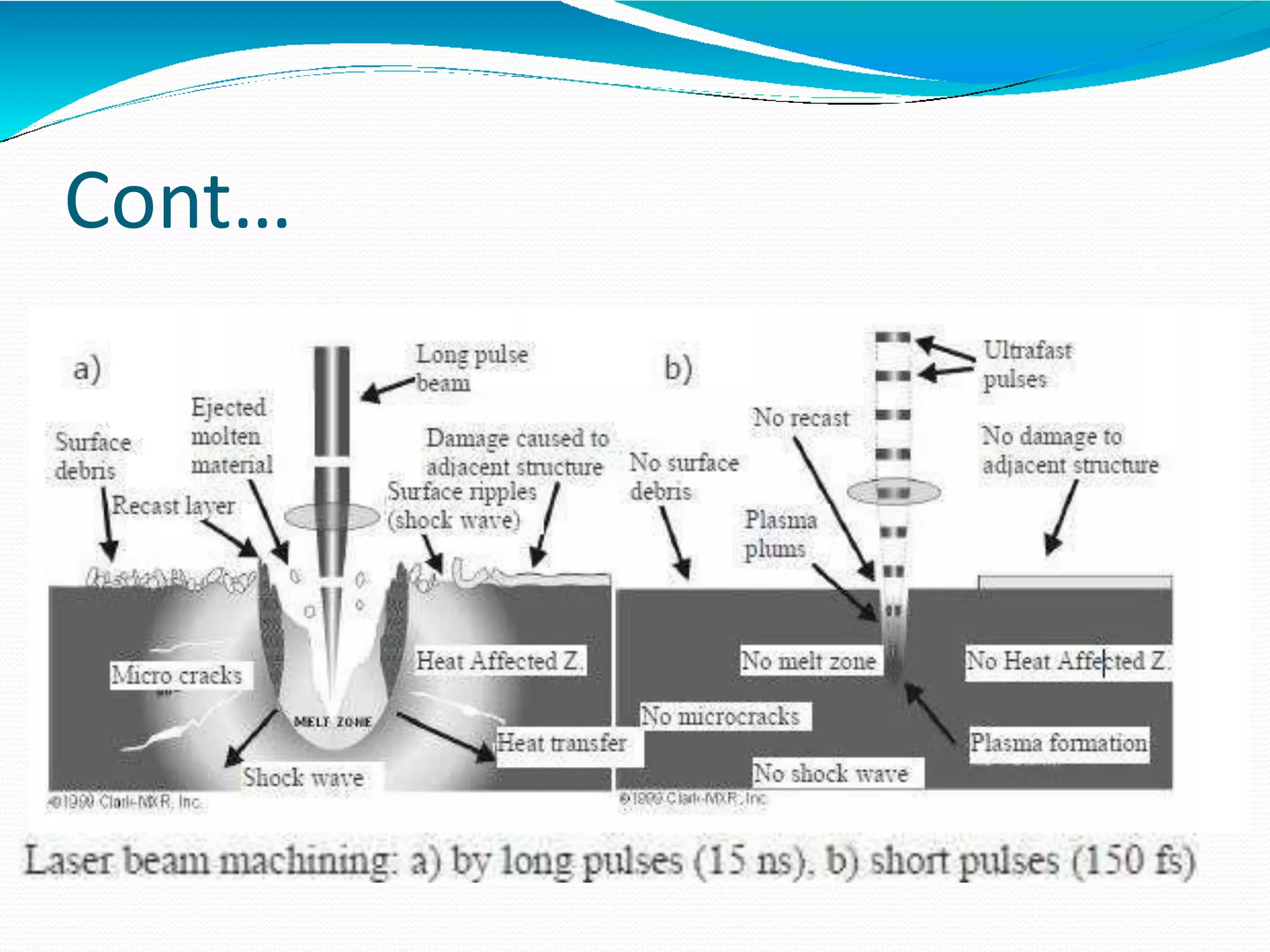
 As laser interacts with the material, the energy of the photon is
absorbed by the work material leading to rapid substantial rise
in local temperature. This in turn results in melting and
vaporisation of the work material and finally material removal.
Cont…
Process Parameters
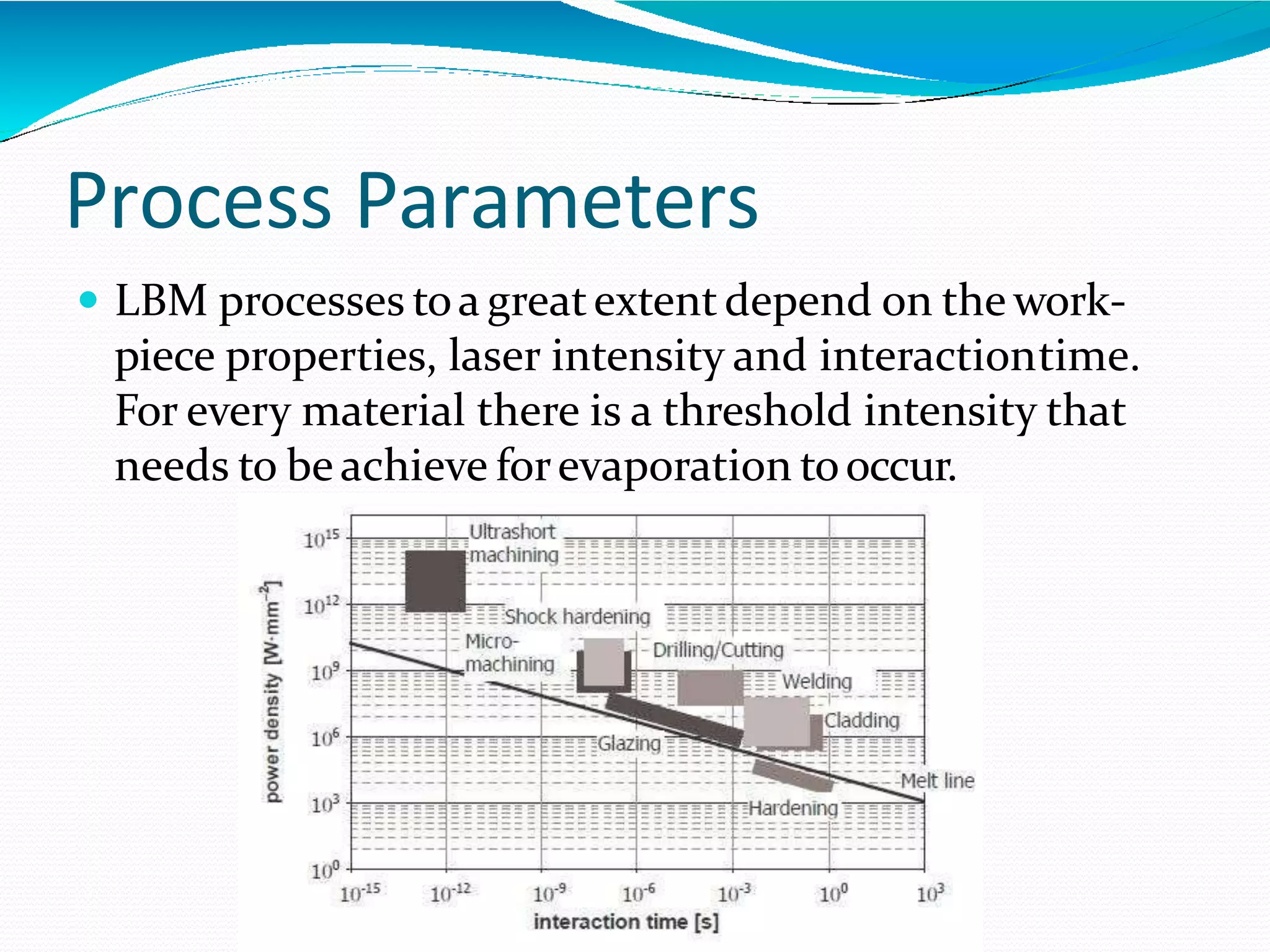
 LBM processes toa greatextent depend on the work-
piece properties, laser intensity and interactiontime.
For every material there is a threshold intensity that
needs to be achieve forevaporation tooccur.
Cont…
 All conventional LBM processes are locatedslightly
above melting line that enables melting and then
evaporation.
 Process employing ultrashort pulsed lasers aresituated
well above situated well above melting line, therefore
it is more likely to evaporate material minimising the
stage of melting.
Material Removal Rate
 The basic assumptions toanalyze the material removal
process are:
1. The intensity of LASER beam does notvary with time.
2. LASER beam is uniform over theentireareaof
hotspot.
3. The material being removed is both meltingand
evaporating.
4. The steady state ablation is characterized by constant
rate of material removal and by the establishmentof a
steady statedistribution.
Cont…
According to theabove assumptions, the steady
temperature distribution is givenby,
Where,
T = temperatureatdistancex below theablating surface,
To= initial uniform temperature of the workpiece,
Tm = melting point of the workpiece
V = steady ablationvelocity,
a = thermal diffusivity of work piece, i.e., (K/ρ) *Cp
K, , Cp= thermal conductivity, density, and specificheat,
respectively, of the workpiece.
Cont…
 After steady ablation is realized, the relationship
between the intensity, exposure time, thicknessof
material which has been removed, and thermal
properties of the material is:
Where, t is theexposuretime.
LBM – Applications
 Laser can be used in wide range of manufacturing
applications
 Material removal – drilling, cutting and tre-panning
 Welding
 Cladding
 Alloying
 Drilling micro-sized holes using laser in difficult – to –
machine materials is the most dominant application in
industry. In laser drilling the laser beam is focused over
the desired spot size. For thin sheets pulse laser can be
used. For thicker ones continuous laser may be used.
LBM – Advantages
 In laser machining there is no physical tool. Thus no machining
force or wear of the tool takes place
 Large aspect ratio in laser drilling can be achieved along with
acceptable accuracy or dimension, form or location
 Micro-holes can be drilled in difficult – to – machine materials
 Though laser processing is a thermal processing but heat
affected zone specially in pulse laser processing is not very
significant due to shorter pulse duration
Thanks to D.PALANI KUMAR
LBM – Limitations
 High initial capital cost
 High maintenance cost
 Not very efficient process
 Presence of Heat Affected Zone – specially in gas assist CO2
laser cutting
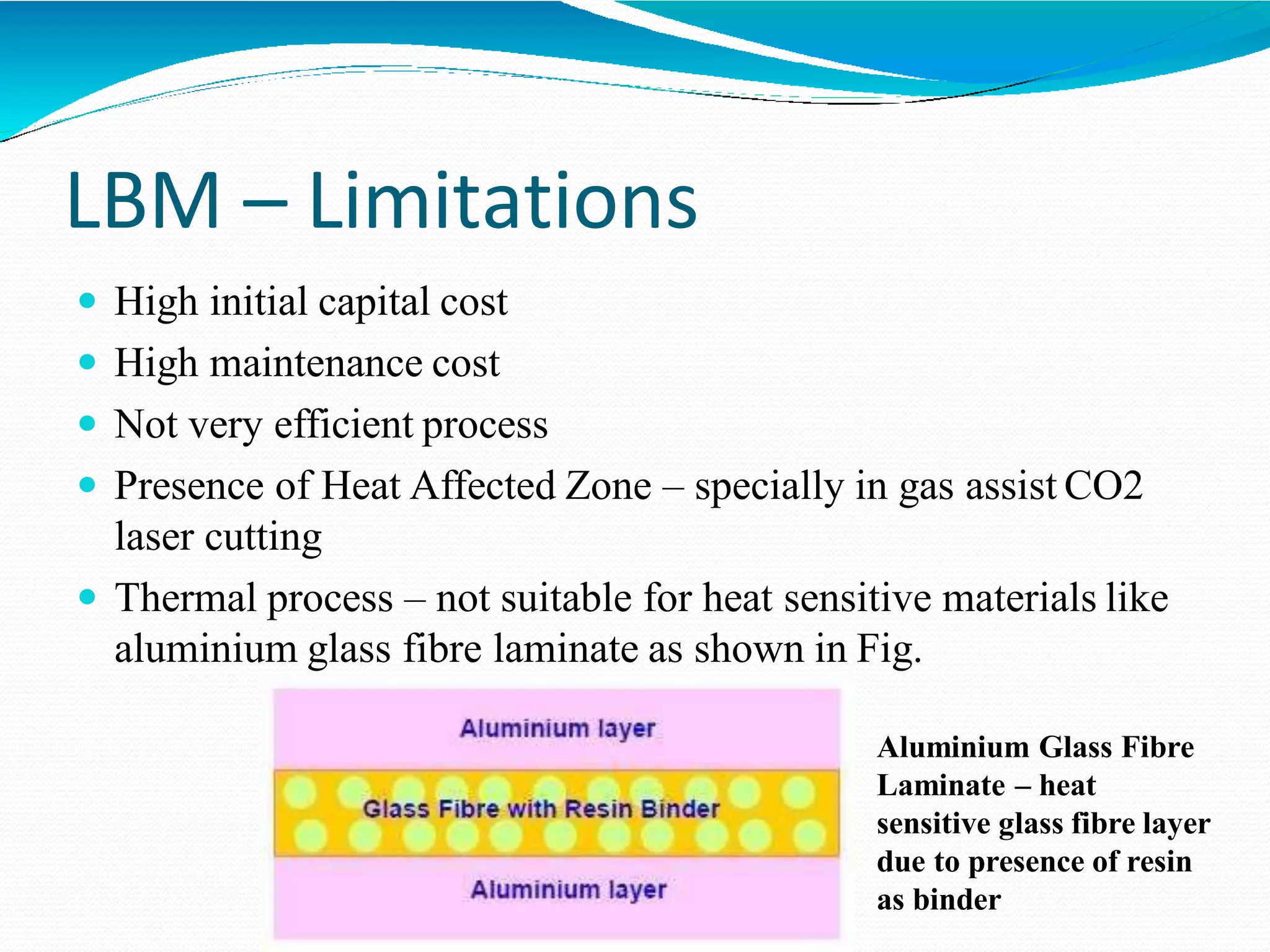
 Thermal process – not suitable for heat sensitive materials like
aluminium glass fibre laminate as shown in Fig.
Aluminium Glass Fibre
Laminate – heat
sensitive glass fibre layer
due to presence of resin
as binder

Lbm 5 unit

  • 2.
    Intoduction  A lightof dual wave-particle is emitted when electronschange the atom energy levels.  Light travels across medium as electromagnetic wave, but when it encounters matter it behaves as energy quantum, photon.  This phenomenon is an underneath concept of photons used as an effective engineering tool.  The light generated by laser is able to break chemical bonds because it is amplified, hence intense, of monochromatic wavelength, direct, polarised and coherent.  Laser beams can be focused over a spot size of 10 – 100 μm with a power density as high as 1MW/mm2.  It is estimated that energy required to break chemical bonds of plastic varies between 3-7 eV; for metals its around 20 eV.
  • 3.
    Cont…  Laser BeamMachining deals with machining and material processing like heat treatment, alloying , cladding, sheet metal bending, etc.  Such processing is carried out utilizing the energy of coherent photons or laser beam, which is mostly converted into thermal energy upon interaction with most of the materials.  Nowadays, laser is also finding application in regenerative machining or rapid prototyping as in processes like stereo- lithography, selective laser sintering etc.  As laser interacts with the material, the energy of the photon is absorbed by the work material leading to rapid substantial rise in local temperature. This in turn results in melting and vaporisation of the work material and finally material removal.
  • 4.
  • 5.
    Process Parameters  LBMprocesses toa greatextent depend on the work- piece properties, laser intensity and interactiontime. For every material there is a threshold intensity that needs to be achieve forevaporation tooccur.
  • 6.
    Cont…  All conventionalLBM processes are locatedslightly above melting line that enables melting and then evaporation.  Process employing ultrashort pulsed lasers aresituated well above situated well above melting line, therefore it is more likely to evaporate material minimising the stage of melting.
  • 7.
    Material Removal Rate The basic assumptions toanalyze the material removal process are: 1. The intensity of LASER beam does notvary with time. 2. LASER beam is uniform over theentireareaof hotspot. 3. The material being removed is both meltingand evaporating. 4. The steady state ablation is characterized by constant rate of material removal and by the establishmentof a steady statedistribution.
  • 8.
    Cont… According to theaboveassumptions, the steady temperature distribution is givenby, Where, T = temperatureatdistancex below theablating surface, To= initial uniform temperature of the workpiece, Tm = melting point of the workpiece V = steady ablationvelocity, a = thermal diffusivity of work piece, i.e., (K/ρ) *Cp K, , Cp= thermal conductivity, density, and specificheat, respectively, of the workpiece.
  • 9.
    Cont…  After steadyablation is realized, the relationship between the intensity, exposure time, thicknessof material which has been removed, and thermal properties of the material is: Where, t is theexposuretime.
  • 10.
    LBM – Applications Laser can be used in wide range of manufacturing applications  Material removal – drilling, cutting and tre-panning  Welding  Cladding  Alloying  Drilling micro-sized holes using laser in difficult – to – machine materials is the most dominant application in industry. In laser drilling the laser beam is focused over the desired spot size. For thin sheets pulse laser can be used. For thicker ones continuous laser may be used.
  • 11.
    LBM – Advantages In laser machining there is no physical tool. Thus no machining force or wear of the tool takes place  Large aspect ratio in laser drilling can be achieved along with acceptable accuracy or dimension, form or location  Micro-holes can be drilled in difficult – to – machine materials  Though laser processing is a thermal processing but heat affected zone specially in pulse laser processing is not very significant due to shorter pulse duration Thanks to D.PALANI KUMAR
  • 12.
    LBM – Limitations High initial capital cost  High maintenance cost  Not very efficient process  Presence of Heat Affected Zone – specially in gas assist CO2 laser cutting  Thermal process – not suitable for heat sensitive materials like aluminium glass fibre laminate as shown in Fig. Aluminium Glass Fibre Laminate – heat sensitive glass fibre layer due to presence of resin as binder