
LASER PHOTOABLATION
University College Of Engineering(UCE),OU
DEPARTMENT OF BIOMEDICAL ENGINEERING
BY. TADESSE WAKTOLA
ZERIHUN KETEMA
25 JAN, 2017
1
Outlines
• Introduction
• Process of photoablation
• Models
• Applications
• Effects
 Conclusion
2
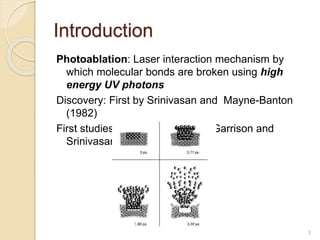
Introduction
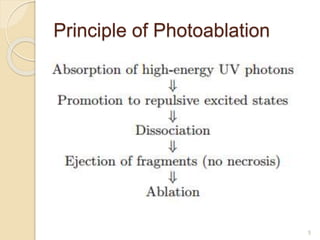
Photoablation: Laser interaction mechanism by
which molecular bonds are broken using high
energy UV photons
Discovery: First by Srinivasan and Mayne-Banton
(1982)
First studies: PMMA modeled by Garrison and
Srinivasan (1985)
3
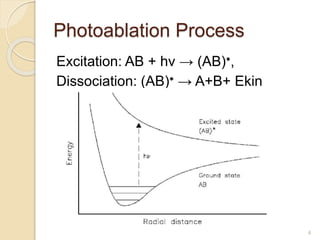
Photoablation Process
Excitation: AB + hν → (AB)∗,
Dissociation: (AB)∗ → A+B+ Ekin
4
Principle of Photoablation
5
Models of Photoablation
 Dependence of ablated depth on incident laser
intensity
 Modeled: By Researchers
Srinivasan and Mayne-Banton (1982)
Andrew et al. (1983)
Deutsch and Geis (1983)
Garrison and Srinivasan (1985)
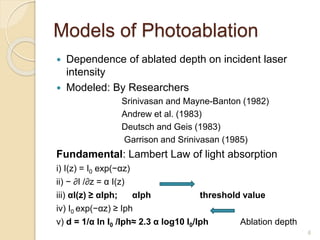
Fundamental: Lambert Law of light absorption
i) I(z) = I0 exp(−αz)
ii) − ∂I /∂z = α I(z)
iii) αI(z) ≥ αIph; αIph threshold value
iv) I0 exp(−αz) ≥ Iph
v) d = 1/α ln I0 /Iph≈ 2.3 α log10 I0/Iph Ablation depth
6
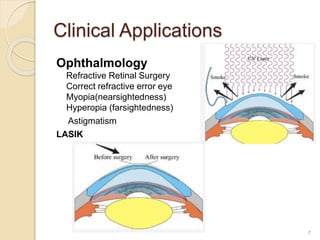
Clinical Applications
Ophthalmology
Refractive Retinal Surgery
Correct refractive error eye
Myopia(nearsightedness)
Hyperopia (farsightedness)
Astigmatism
LASIK
7
Effects of Photoablation
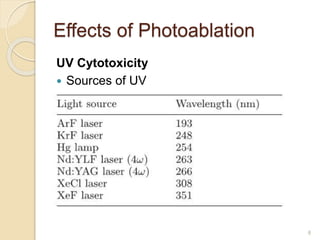
UV Cytotoxicity
 Sources of UV
lasers
8
Effects of Photoablation
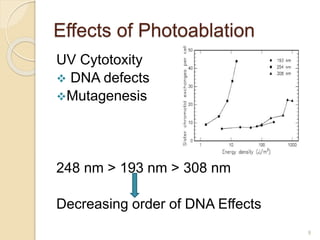
UV Cytotoxity
 DNA defects
Mutagenesis
248 nm > 193 nm > 308 nm
Decreasing order of DNA Effects
9
Conclusion
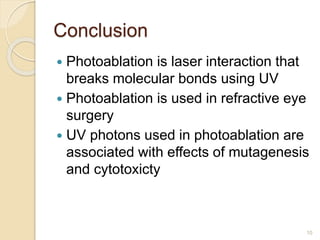
 Photoablation is laser interaction that
breaks molecular bonds using UV
 Photoablation is used in refractive eye
surgery
 UV photons used in photoablation are
associated with effects of mutagenesis
and cytotoxicty
10
References
1.Markolf H. Niemz Laser,Tissue Interactions Fundamentals and
Applications,3rd edition
2.E E Manche,J Carr ,WW Haw, and P S Hersh Excimer Laser
refractive surgery
3. http://www.phakosopht.com/Lasik
4. Ophthalmology : Expert Consult: Online and Print by Myron
Yanoff and Jay S. Duker,2013
11
Thank You
12

Laser Photoablation

  • 1.
    LASER PHOTOABLATION University CollegeOf Engineering(UCE),OU DEPARTMENT OF BIOMEDICAL ENGINEERING BY. TADESSE WAKTOLA ZERIHUN KETEMA 25 JAN, 2017 1
  • 2.
    Outlines • Introduction • Processof photoablation • Models • Applications • Effects  Conclusion 2
  • 3.
    Introduction Photoablation: Laser interactionmechanism by which molecular bonds are broken using high energy UV photons Discovery: First by Srinivasan and Mayne-Banton (1982) First studies: PMMA modeled by Garrison and Srinivasan (1985) 3
  • 4.
    Photoablation Process Excitation: AB+ hν → (AB)∗, Dissociation: (AB)∗ → A+B+ Ekin 4
  • 5.
  • 6.
    Models of Photoablation Dependence of ablated depth on incident laser intensity  Modeled: By Researchers Srinivasan and Mayne-Banton (1982) Andrew et al. (1983) Deutsch and Geis (1983) Garrison and Srinivasan (1985) Fundamental: Lambert Law of light absorption i) I(z) = I0 exp(−αz) ii) − ∂I /∂z = α I(z) iii) αI(z) ≥ αIph; αIph threshold value iv) I0 exp(−αz) ≥ Iph v) d = 1/α ln I0 /Iph≈ 2.3 α log10 I0/Iph Ablation depth 6
  • 7.
    Clinical Applications Ophthalmology Refractive RetinalSurgery Correct refractive error eye Myopia(nearsightedness) Hyperopia (farsightedness) Astigmatism LASIK 7
  • 8.
    Effects of Photoablation UVCytotoxicity  Sources of UV lasers 8
  • 9.
    Effects of Photoablation UVCytotoxity  DNA defects Mutagenesis 248 nm > 193 nm > 308 nm Decreasing order of DNA Effects 9
  • 10.
    Conclusion  Photoablation islaser interaction that breaks molecular bonds using UV  Photoablation is used in refractive eye surgery  UV photons used in photoablation are associated with effects of mutagenesis and cytotoxicty 10
  • 11.
    References 1.Markolf H. NiemzLaser,Tissue Interactions Fundamentals and Applications,3rd edition 2.E E Manche,J Carr ,WW Haw, and P S Hersh Excimer Laser refractive surgery 3. http://www.phakosopht.com/Lasik 4. Ophthalmology : Expert Consult: Online and Print by Myron Yanoff and Jay S. Duker,2013 11
  • 12.