3.3 Graphing Using the First
  and Second Derivatives
     •     What does concave up or concave down look
                              like?
              •    What is an inflection point?
 •       What does the second derivative tell us about the
                       original function f?
         •   What’s “The Second Derivative Test”?
A. What does concave up or
       concave down look like?
• If I gave you a riddle that sounded like,
  “The rate of increase is increasing,” or
  “The slope of the tangent is increasing,”
  could you draw a picture of that?


• That is CONCAVE UP!
• If I gave you a riddle that sounded like,
  “The rate of increase is decreasing,” or
  “The slope of the tangent is decreasing,”
  could you draw a picture of that?


• That is CONCAVE DOWN!
B. What is an inflection point?
• An inflection point is where the concavity
  changes (from up to down, or down to up).
C. What does the second derivative
tell us about the original function f?
• Recall that the first derivative gave us the
  increase/decrease for f, essentially the
  rate of change for f.
• Well, the second derivative will give us the
  rate of change for the rate of change for f.
  In other words, the rate of increase of the
  rate of increase of f.
• Hey! That is concavity!
• So, remember when you found values for
  which the first derivative equals zero or is
  undefined, and you found critical points?

• When you take the second derivative and
  find values for which it is zero or
  undefined, you will be finding inflection
  points!

• (That sounds like the beginning of a “sign
  diagram”? Right, you are!)
A second derivative sign diagram….
• Find the second derivative.
• Set its numerator and denominator equal to zero,
  factor, and solve to find inflection points.
• Chop up the number line into pieces at the
  inflection points, and choose a test value for each
  interval.
• Plug in each test value into the second derivative,
  only caring if it will be positive, negative, or zero.
• Positive second derivative means f is concave up.
• Negative second derivative means f is concave
  down.
• A second derivative that is ZERO means that f is
  STRAIGHT (no concavity).
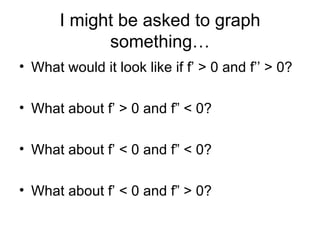
I might be asked to graph
             something…
• What would it look like if f’ > 0 and f’’ > 0?

• What about f’ > 0 and f” < 0?

• What about f’ < 0 and f” < 0?

• What about f’ < 0 and f” > 0?
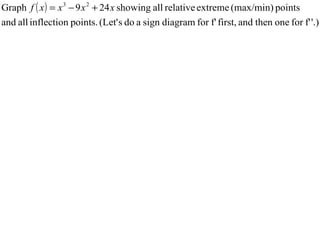
Graph f ( x ) = x 3 − 9 x 2 + 24 x showing all relative extreme (max/min) points
and all inflection points. (Let' s do a sign diagram for f' first, and then one for f' '.)
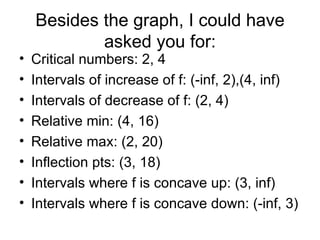
Besides the graph, I could have
            asked you for:
•   Critical numbers: 2, 4
•   Intervals of increase of f: (-inf, 2),(4, inf)
•   Intervals of decrease of f: (2, 4)
•   Relative min: (4, 16)
•   Relative max: (2, 20)
•   Inflection pts: (3, 18)
•   Intervals where f is concave up: (3, inf)
•   Intervals where f is concave down: (-inf, 3)
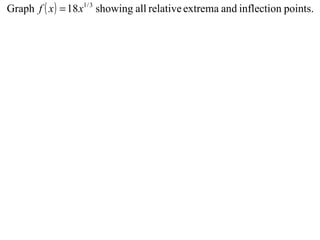
Graph f ( x ) = 18 x1/ 3 showing all relative extrema and inflection points.
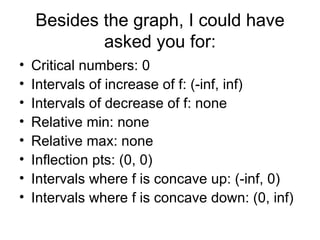
Besides the graph, I could have
            asked you for:
•   Critical numbers: 0
•   Intervals of increase of f: (-inf, inf)
•   Intervals of decrease of f: none
•   Relative min: none
•   Relative max: none
•   Inflection pts: (0, 0)
•   Intervals where f is concave up: (-inf, 0)
•   Intervals where f is concave down: (0, inf)
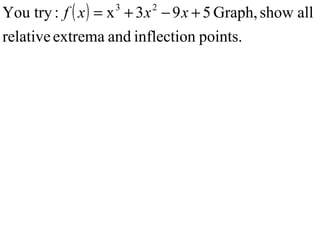
You try : f ( x ) = x + 3 x − 9 x + 5 Graph, show all
                   3     2


relative extrema and inflection points.
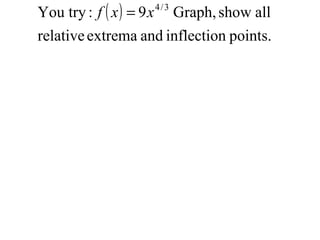
You try : f ( x ) = 9 x Graph, show all
                   4/3


relative extrema and inflection points.
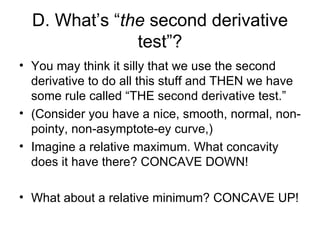
D. What’s “the second derivative
               test”?
• You may think it silly that we use the second
  derivative to do all this stuff and THEN we have
  some rule called “THE second derivative test.”
• (Consider you have a nice, smooth, normal, non-
  pointy, non-asymptote-ey curve,)
• Imagine a relative maximum. What concavity
  does it have there? CONCAVE DOWN!

• What about a relative minimum? CONCAVE UP!
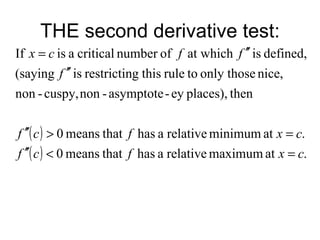
THE second derivative test:
If x = c is a critical number of f at which f ′′ is defined,
(saying f ′′ is restricting this rule to only those nice,
non - cuspy, non - asymptote - ey places), then


f ′′( c ) > 0 means that f has a relative minimum at x = c.
f ′′( c ) < 0 means that f has a relative maximum at x = c.
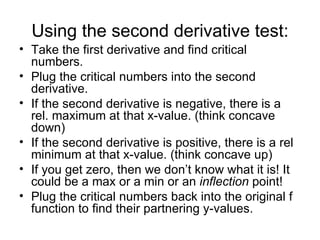
Using the second derivative test:
• Take the first derivative and find critical
  numbers.
• Plug the critical numbers into the second
  derivative.
• If the second derivative is negative, there is a
  rel. maximum at that x-value. (think concave
  down)
• If the second derivative is positive, there is a rel
  minimum at that x-value. (think concave up)
• If you get zero, then we don’t know what it is! It
  could be a max or a min or an inflection point!
• Plug the critical numbers back into the original f
  function to find their partnering y-values.
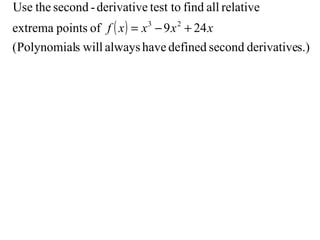
Use the second - derivative test to find all relative
extrema points of f ( x ) = x 3 − 9 x 2 + 24 x
(Polynomials will always have defined second derivatives.)
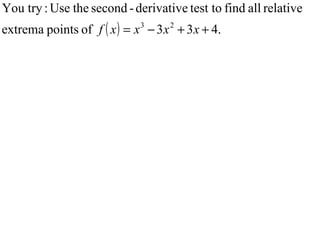
You try : Use the second - derivative test to find all relative
extrema points of f ( x ) = x 3 − 3 x 2 + 3 x + 4.

125 3.3

  • 1.
    3.3 Graphing Usingthe First and Second Derivatives • What does concave up or concave down look like? • What is an inflection point? • What does the second derivative tell us about the original function f? • What’s “The Second Derivative Test”?
  • 2.
    A. What doesconcave up or concave down look like? • If I gave you a riddle that sounded like, “The rate of increase is increasing,” or “The slope of the tangent is increasing,” could you draw a picture of that? • That is CONCAVE UP!
  • 3.
    • If Igave you a riddle that sounded like, “The rate of increase is decreasing,” or “The slope of the tangent is decreasing,” could you draw a picture of that? • That is CONCAVE DOWN!
  • 4.
    B. What isan inflection point? • An inflection point is where the concavity changes (from up to down, or down to up).
  • 5.
    C. What doesthe second derivative tell us about the original function f? • Recall that the first derivative gave us the increase/decrease for f, essentially the rate of change for f. • Well, the second derivative will give us the rate of change for the rate of change for f. In other words, the rate of increase of the rate of increase of f. • Hey! That is concavity!
  • 6.
    • So, rememberwhen you found values for which the first derivative equals zero or is undefined, and you found critical points? • When you take the second derivative and find values for which it is zero or undefined, you will be finding inflection points! • (That sounds like the beginning of a “sign diagram”? Right, you are!)
  • 7.
    A second derivativesign diagram…. • Find the second derivative. • Set its numerator and denominator equal to zero, factor, and solve to find inflection points. • Chop up the number line into pieces at the inflection points, and choose a test value for each interval. • Plug in each test value into the second derivative, only caring if it will be positive, negative, or zero. • Positive second derivative means f is concave up. • Negative second derivative means f is concave down. • A second derivative that is ZERO means that f is STRAIGHT (no concavity).
  • 8.
    I might beasked to graph something… • What would it look like if f’ > 0 and f’’ > 0? • What about f’ > 0 and f” < 0? • What about f’ < 0 and f” < 0? • What about f’ < 0 and f” > 0?
  • 9.
    Graph f (x ) = x 3 − 9 x 2 + 24 x showing all relative extreme (max/min) points and all inflection points. (Let' s do a sign diagram for f' first, and then one for f' '.)
  • 10.
    Besides the graph,I could have asked you for: • Critical numbers: 2, 4 • Intervals of increase of f: (-inf, 2),(4, inf) • Intervals of decrease of f: (2, 4) • Relative min: (4, 16) • Relative max: (2, 20) • Inflection pts: (3, 18) • Intervals where f is concave up: (3, inf) • Intervals where f is concave down: (-inf, 3)
  • 11.
    Graph f (x ) = 18 x1/ 3 showing all relative extrema and inflection points.
  • 12.
    Besides the graph,I could have asked you for: • Critical numbers: 0 • Intervals of increase of f: (-inf, inf) • Intervals of decrease of f: none • Relative min: none • Relative max: none • Inflection pts: (0, 0) • Intervals where f is concave up: (-inf, 0) • Intervals where f is concave down: (0, inf)
  • 13.
    You try :f ( x ) = x + 3 x − 9 x + 5 Graph, show all 3 2 relative extrema and inflection points.
  • 14.
    You try :f ( x ) = 9 x Graph, show all 4/3 relative extrema and inflection points.
  • 15.
    D. What’s “thesecond derivative test”? • You may think it silly that we use the second derivative to do all this stuff and THEN we have some rule called “THE second derivative test.” • (Consider you have a nice, smooth, normal, non- pointy, non-asymptote-ey curve,) • Imagine a relative maximum. What concavity does it have there? CONCAVE DOWN! • What about a relative minimum? CONCAVE UP!
  • 16.
    THE second derivativetest: If x = c is a critical number of f at which f ′′ is defined, (saying f ′′ is restricting this rule to only those nice, non - cuspy, non - asymptote - ey places), then f ′′( c ) > 0 means that f has a relative minimum at x = c. f ′′( c ) < 0 means that f has a relative maximum at x = c.
  • 17.
    Using the secondderivative test: • Take the first derivative and find critical numbers. • Plug the critical numbers into the second derivative. • If the second derivative is negative, there is a rel. maximum at that x-value. (think concave down) • If the second derivative is positive, there is a rel minimum at that x-value. (think concave up) • If you get zero, then we don’t know what it is! It could be a max or a min or an inflection point! • Plug the critical numbers back into the original f function to find their partnering y-values.
  • 18.
    Use the second- derivative test to find all relative extrema points of f ( x ) = x 3 − 9 x 2 + 24 x (Polynomials will always have defined second derivatives.)
  • 19.
    You try :Use the second - derivative test to find all relative extrema points of f ( x ) = x 3 − 3 x 2 + 3 x + 4.