LANGUAGE PLANNING &
POLICY
Hiyam Raad Adwan (GS65920)
Nur Suhana bt Zabri ( GS 64659 )
Mabroka Salem ( GS 65072)
1/8/2023 SAMPLE FOOTER TEXT 1
WHAT IS LANGUAGE
POLICY?
McCarty (2011) defines language policy as "a
complex sociocultural process [and as] modes of
human interaction, negotiation, and production
mediated by relations of power
Simply said
An act that government does either officially
through legislation, court decisions or policy to
determine how languages are used, cultivate
language skills needed to meet national priorities,
establish the rights of individuals or groups to use
and maintain languages.
1/8/2023 SAMPLE FOOTER TEXT 2
DIFFERENCES LANGUAGE PLANNING & POLICY
Language planning is a macro
sociological activity at a
governmental and national level
only
language policy can be "either a
macro- or micro sociological
activity at a governmental and
national level or at an
institutional level” (cited in Poon,
2004)
1/8/2023 SAMPLE FOOTER TEXT 3
IMPLEMENTATION
1/8/2023 SAMPLE FOOTER TEXT 4
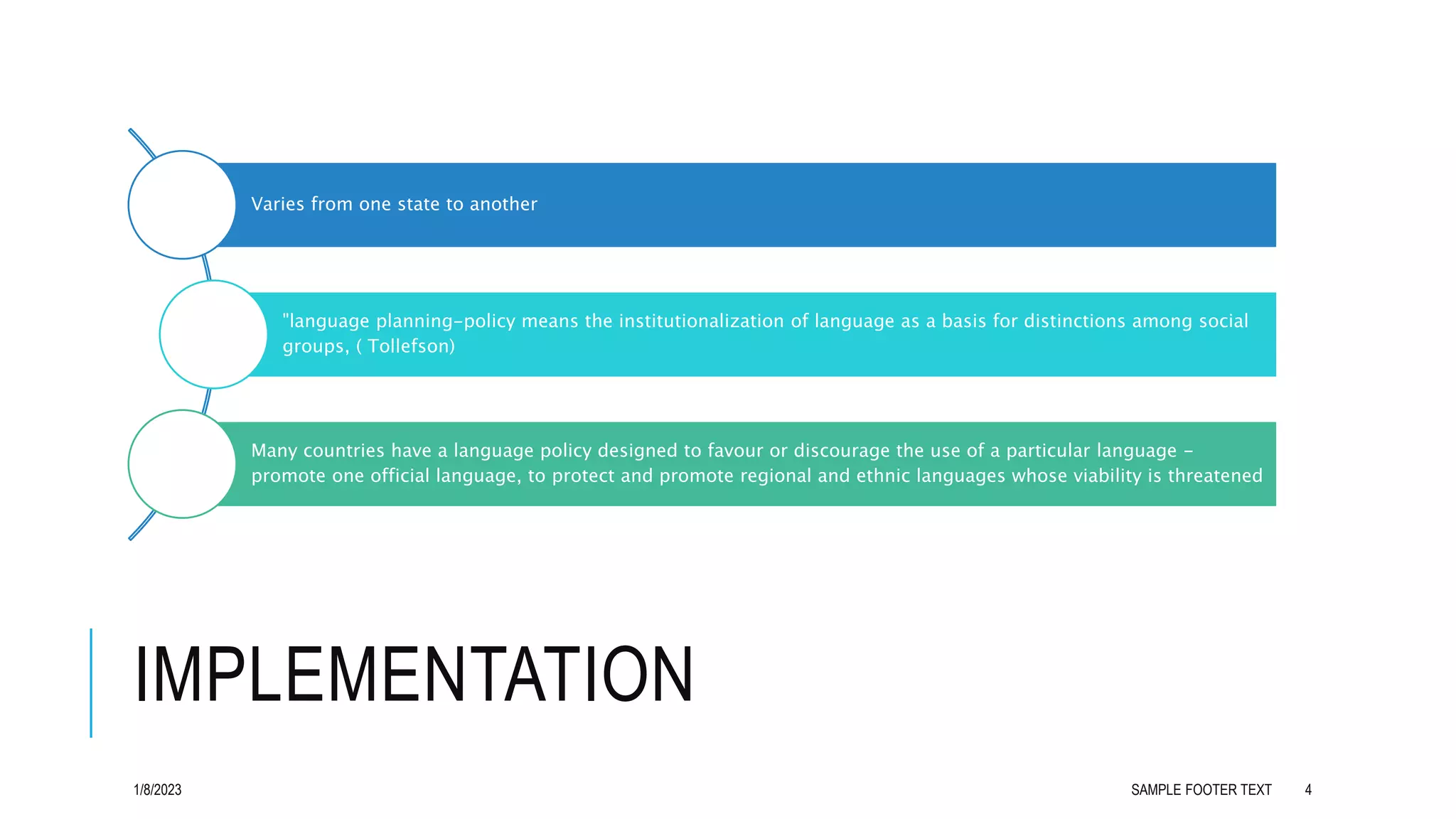
Varies from one state to another
"language planning-policy means the institutionalization of language as a basis for distinctions among social
groups, ( Tollefson)
Many countries have a language policy designed to favour or discourage the use of a particular language -
promote one official language, to protect and promote regional and ethnic languages whose viability is threatened
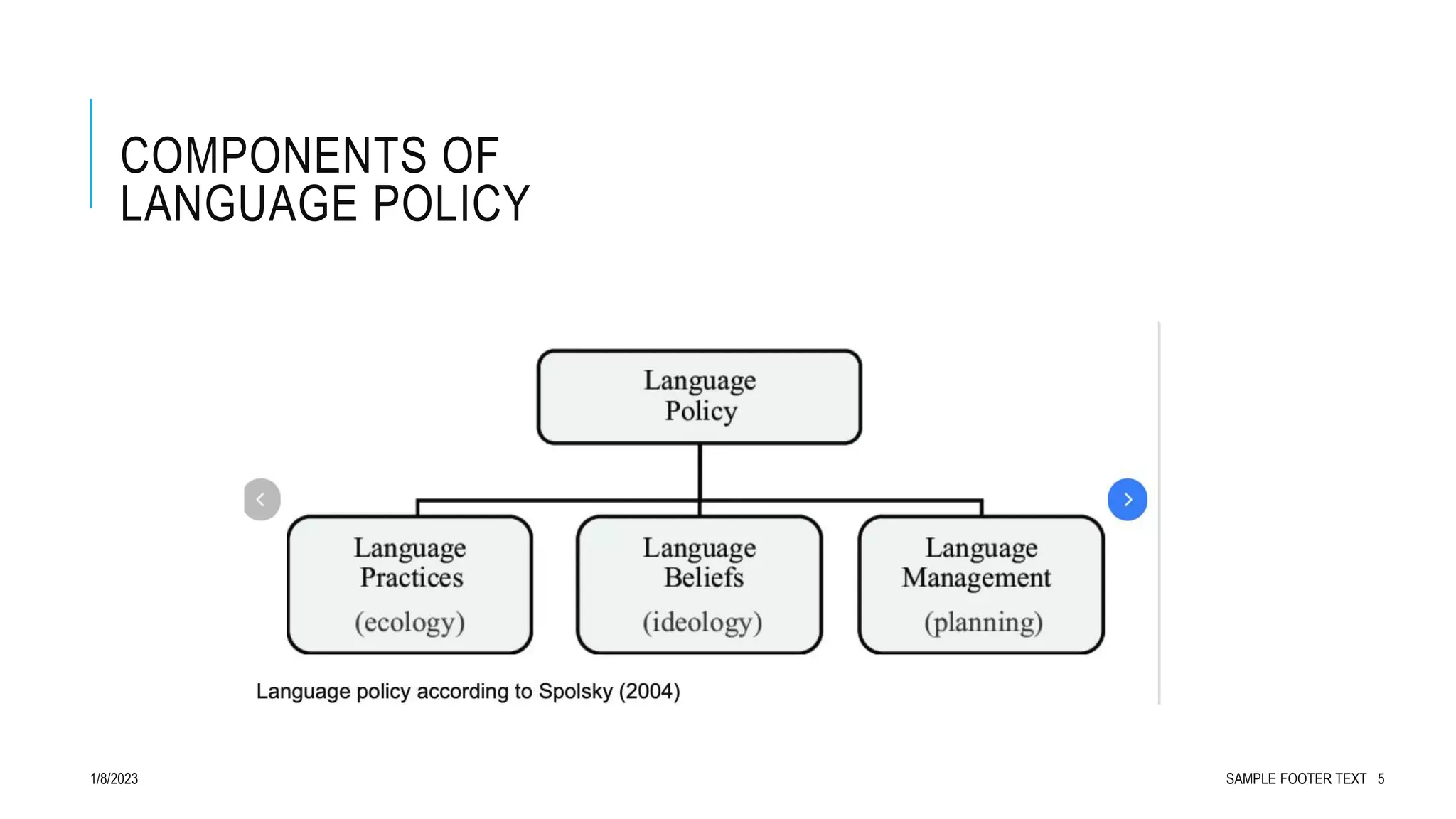
COMPONENTS OF
LANGUAGE POLICY
1/8/2023 SAMPLE FOOTER TEXT 5
LANGUAGE BELIEFS (
IDEOLOGY)
The language beliefs of parents influence the language
spoken at home. Kim (2011) recounts a Korean parent
living in the United States who insists on English being
the only language used at home in order to facilitate
their daughter's acculturation into mainstream culture
in an empirical study.
In a case study on Chinese immigrant living in the
United Kingdom, a Chinese family changed the
language they speak at home from Korean (as one of
the minority languages in Mainland China) into
Mandarin due to the fact that Mandarin has higher
status than Korean in the United Kingdom (Hua & Wei,
2016).
LANGUAGE PRACTICES
(ECOLOGY)
represent the real language used inside the families in
home settings.
In the interviews she did for her study on Chinese
immigrants in New Zealand, Chan (2018) finds that
Chinese parents frequently use Chinese with their
children, whereas siblings prefer to interact in English.
Despite the fact that these parents are worried,
alternative solutions are not obvious. According to
Chan (2018), most Chinese families are flexible with
their children's language choices when they are unable
to find the Chinese terms. Because of the parents'
flexible approach, the actual language habits in their
homes are more diverse.
LANGUAGE
MANAGEMENT
(PLANNING)
arises when there are unexpected or undesirable language practises
in the family, or when family members' actions are required.
Schwartz (2010) provides an example of a Canadian family's efforts to
raise their children in a French-dominant home by spending their
school years in English-speaking Louisiana and their summer
vacations in French-speaking Québec. French is preferred at all times
at home, regardless of where they reside, and children in Louisiana
were enrolled in French immersion programmes. In this scenario, the
parents are attempting to control their home language settings
despite the language they experienced in social settings.
Irrespective of the dominant language environment, they were
determined to regulate and intervene in language practices in the
family.
STAGES OF
LANGUAGE
POLICY
1. Selection ( Decision Procedures)
The choice of a language variety to fulfil
certain functions in a given society
STAGES OF
LANGUAGE POLICY
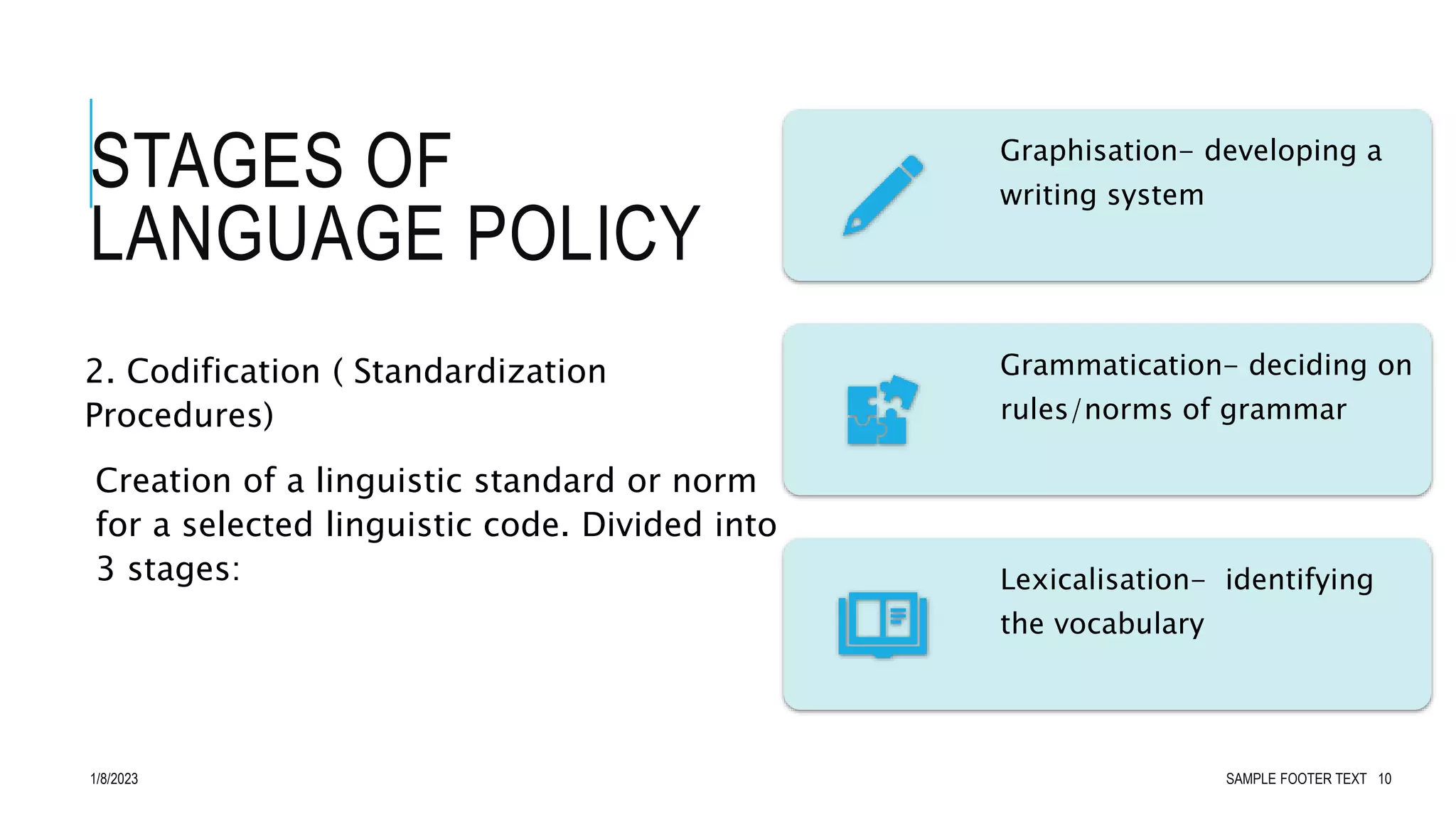
2. Codification ( Standardization
Procedures)
Creation of a linguistic standard or norm
for a selected linguistic code. Divided into
3 stages:
1/8/2023 SAMPLE FOOTER TEXT 10
Graphisation- developing a
writing system
Grammatication- deciding on
rules/norms of grammar
Lexicalisation- identifying
the vocabulary
STAGES OF LANGUAGE
POLICY
3. Implementation ( Educational Spread)
Promoting of the decisions made in the stages of selection and
codification which can include marketing strategy, production
of book, pamphlets, newspapers and textbooks using the new
codifies standard.
Implementation can be :
1. vigorous legal enforcement. Eg : Native Americans in
Bureau of Indian Education Boarding Schools
2. Encouragement. Eg : Spanish province of Catalonia, where
the use of Catalan is encouraged, but not enforced
1/8/2023 SAMPLE FOOTER TEXT 11
STAGES OF LANGUAGE POLICY
4. Elaboration/ Modernization (
Functional Development)
Refers to the terminology and
stylistic development of a codified
language to meet the
communicative demands of
modern life and technology. Its
main area is the production and
dissemination of new terms.
Lexical Modernization
Strategies:
1. Borrowing – Portable
Document File (PDF), Samurai
2. Extension of meaning of a
word- Influence = Influencer, Blog
= Blogger
3. Creation of new terms (
neologisms)-Hangry, chillax,
brunch
IMPORTANCE OF
LANGUAGE POLICY
Language policy have a major
impact on language vitability
and, ultimately, on the rights of
the individual.
Language policy influence the
right to use and maintain
languages, affect language
status, and determine which
languages are nurtured.
1/8/2023 SAMPLE FOOTER TEXT 13
LANGUAGE PLANNING
WHAT IS LANGUAGE
PLANNING?
language planning is a deliberate
effort to influence the function,
structure, or acquisition of a language
or language variety within a speech
community. it is often associated with
government planning but is also used
by a variety of non-governmental
organizations and individuals.
economic benefits and political
domination can be among its goals
(kaplan & baldauf,1997: 3).
LANGUAGE POLICY
A language policy is a body of ideas, laws,
regulations, rules and practices intended to
achieve the planned language change in the
society, group or system. Only when such
policy exists can any sort of serious
evaluation of planning occur (Rubin, 1971);i.e.,
in the absence of a policy there cannot be a
plan to be adjusted. For example, which
language will be national? Which language will
be used as a regional language, and what will
their status be?
DIVISION OF LANGUAGE
PLANNING
THE PRACTICE OF LANGUAGE
PLANNING MAY BE ONE OF THESE
TYPES:
1.CORPUS PLANNING
2.STATUS PLANNING
4.ACQUISITION PLANNING
5.USAGE PLANNING
6.PRESTIGE PLANNING
The activities of language planning:
1.Corpus planning
Corpus planning, which deals with what is internal to a language, is
as widespread as status planning but is often in the hands of
professional linguists in collaboration with 'ordinary' speakers.
Corpus planning refers to norm selection and codification
(characteristics or criteria of a ‘good’ language are established). It is
usually undertaken by language experts, resulting in dictionaries,
grammar, literacy manuals, and pronunciation and writing style
guides.
2.Status Planning
Status planning is concerned with official decisions about the
appropriate use of a language.
The results of status planning are laws, clauses in constitutions
prescribing the official standing of languages, and regulations for their
use in public administration.
1.THE STATUS OF TAMAZIGHT IN
LIBYA BEFORE THE 17TH OF FEB.
REVOLUTION:
The former Libyan leader, Gadhafi, never fully recognized the Amazigh
and their language. For him, Amazigh and their language are also
regarded as threatening Arab Muslim identity. He denies the existence
of Amazigh in the whole of North Africa.
2. The status of Tamazight After the 17th of Feb. Revolution:
After the 17th of February revolution, the Tamazight language, which
has been marginalized in Libya for centuries by Libyan politicians,
gained significant status with the Arabic language in Libyan media
(Hamed, 2014).
3.Acquisition planning
Acquisition planning (language-in-education) typically
describes the language teaching policies of states.
Foreign or second language instruction can be
motivated by humanistic rationales, economic interest
calculations, assessments about national security or
geo-political interest, or responses to the needs,
opportunities, and rights of linguistic minorities.
During the 1970s and until the mid-1980s
learning english was an obligatory component
within the libyan national curriculum, but in 1986
teaching and learning english were completely
banned. this was due to the cultural, political and
economical factors which have deeply influenced
the educational system at that time.
after a while the libyan educationalists realized
the fault and determined to incorporate english in
the curriculum again. they decided that not only
english must be taught, but other languages must
also be learned even at the very early stages of
the learning process (sawani, 2009).
4.Usage planning
Usage planning refers to efforts to extend the communicative domains
of a given language.
This usually occurs in opposition to a replacing language after political
reconstitution (administrative devolution, federalism, or national
independence) but in more extreme cases usage planning forms part
of regeneration efforts on behalf of dying languages.
For example, in libya, colloquial libyan
arabic is the first language acquired
by most libyans at home and in other
informal domains such as the street,
and it is the language of everyday
conversation. it is not a codified
language though it is used, as a
written language, by many libyans in
electronic media and social
communication networks such as
facebook and whatsapp. (adam&
yunus, 2021)
5.Prestige planning
Prestige planning involves elevating the esteem of a linguistic code.
Esteem is conferred on a language in proportion to the quality and
extent of its important works of literature. Many of today's major
languages have benefited from prestige planning by poets,
philosophers, and religious figures.
HIGH VARIETY
AND LOW
VARIETY:
Arabic is a national and official
language, and that support is
offered in educational institutions,
governmental and public offices,
and media.
Arabic is one of the major
languages with two writing systems:
the formal "al-lugah al-Fusha" (H-
variety) and the informal "al-lugah
al-aammiyya" (slang) (L-type).
Written Arabic has the highest (H),
and regional dialects or vernaculars
have the lowest (L).
6.Discourse planning
Discourse planning has a range of meanings. The most
straightforward refers to education to develop persuasive or assertive
ways of expression, such as to help young people participate in society
and accomplish personal goals through effective communication.
Participation in public life relies on language abilities to express an
opinion, progress economically, prevent exploitation or abuse, explore
identity, and make connections..
Through his speech during the
revolution in libya, al ghaddafi
wanted to gain the people’s gratitude
for all his good deeds, which would
eventually lead to his support.
important messages were sent to
libyans whether they are
revolutionaries or supporters which
encourage those who still believe in
him to act quickly against the
revolutionaries(alwash et al., 2022).
ROLES OF LANGUAGE POLICY AND
PLANNING IN A COUNTRY:
Many countries have a language policy
designed to favor or discourage the use of
a language(s). although many nations
historically have used language policies to
promote one official language at the
expense of others, many countries have
policies to promote regional and ethnic
languages that are in danger.
Although nations historically have used
language policies most often to
promote one official language at the
expense of others, just as happened in
the era of the italian empire.
libya has been heavily influenced and
shaped by ottoman and italian
languages due to the extended periods
of colonization. the italian language is
well understood, especially by older
generations, because libya was subject
to italian colonialism between 1911-
1943, and of course, there are linguistic
remains from that period.
LANGUAGE PLANNING AND
POLICY (LPP)
Language and Society
LANGUAGE PLANNING
AND POLICY (LPP)
In LPP notion, analytical focus is fourfold:
•Relationship among languages.
•Relationships among social contexts of Language.
•Relationship among individual speakers and their
languages.
•Interrelationships among these three dimensions.
•Although some have fault it for overly associating
language phenomena with natural processes.
LANGUAGE
PLANNING
In sociolinguistics, language planning (also known
as language engineering) is a deliberate effort to
influence the function, structure
or acquisition of languages or language varieties within
a speech community. Robert L. Cooper (1989) defines
language planning as "the activity of preparing a
normative orthography, grammar, and dictionary for
the guidance of writers and speakers in a non-
homogeneous speech community" .Along
with language ideology and language practices,
language planning is part of language policy – a
typology drawn from Bernard Spolsky's theory of
language policy.
LANGUAGE
MANAGEME
NT
According to Spolsky, language management is a more
precise term than language planning. Language
management is defined as "the explicit and observable
effort by someone or some group that has or claims
authority over the participants in the domain to modify
their practices or beliefs“. Language planning is often
associated with government planning, but is also used
by a variety of non-governmental organizations such
as grass-roots organizations as well as individuals.
Goals of such planning vary. Better communication
through assimilation of a single dominant language can
bring economic benefits to minorities but is also
perceived to facilitate their political domination. It
involves the establishment of language regulators, such
as formal or informal agencies, committees, societies
or academies to design or develop new structures to
meet contemporary needs.
LANGUAGE
PLANNING AS
A TERM
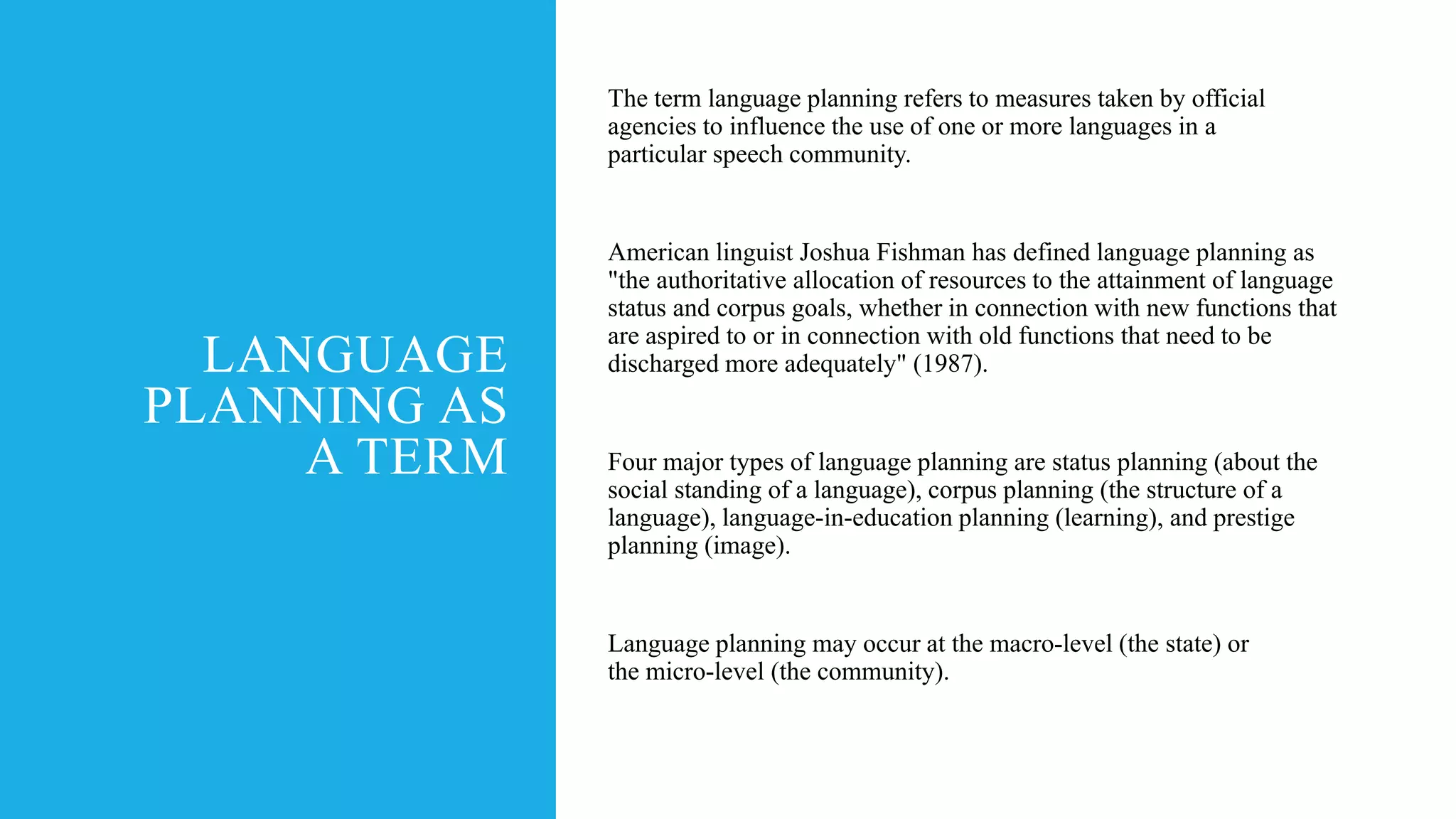
The term language planning refers to measures taken by official
agencies to influence the use of one or more languages in a
particular speech community.
American linguist Joshua Fishman has defined language planning as
"the authoritative allocation of resources to the attainment of language
status and corpus goals, whether in connection with new functions that
are aspired to or in connection with old functions that need to be
discharged more adequately" (1987).
Four major types of language planning are status planning (about the
social standing of a language), corpus planning (the structure of a
language), language-in-education planning (learning), and prestige
planning (image).
Language planning may occur at the macro-level (the state) or
the micro-level (the community).
LANGUAGE
PLANNING
HAS THREE
MAIN
SORTS
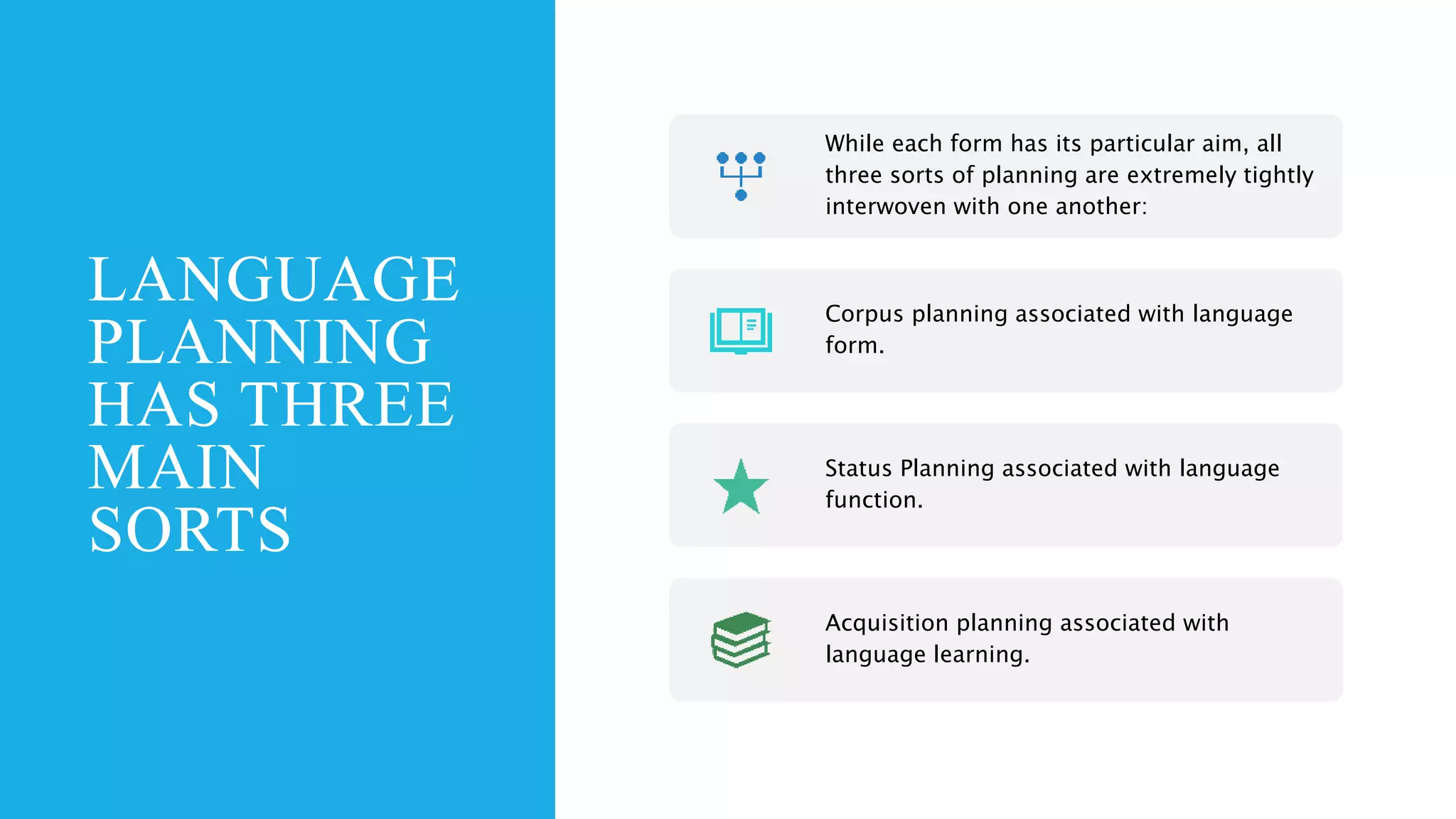
While each form has its particular aim, all
three sorts of planning are extremely tightly
interwoven with one another:
Corpus planning associated with language
form.
Status Planning associated with language
function.
Acquisition planning associated with
language learning.
Ecological language planning should be vital because, it ensures
and develop linguistic contexts by encouraging linguistic diversity.
In terms of educational LPP, policy and practice are mutually
dependent. As a result, monolingualism and literacy are typically
preferred by those in positions of power over oracy and
bilingualism, and national educational systems frequently place a lot
of emphasis on the development of the dominant language.
LANGUAGE
POLICY
Language policy has been defined in a number of ways. According to Kaplan
and Baldauf (1997), "A language policy is a body of ideas, laws, regulations,
rules and practices intended to achieve the planned language change in the
societies, group or system" .
Lo Bianco defines the field as “a situated activity, whose specific history and
local circumstances influence what is regarded as a language problem, and
whose political dynamics determine which language problems are given policy
treatment” .
McCarty (2011) defines language policy as "a complex sociocultural process
[and as] modes of human interaction, negotiation, and production mediated by
relations of power. The ‘policy’ in these processes resides in their language-
regulating power; that is, the ways in which they express normative claims
about legitimate and illegitimate language forms and uses, thereby governing
language statuses and uses" .
LANGUAGE PLANNING AND LANGUAGE POLICY
ARE TWO SEPARATE CONCEPTS THAT ARE
REFERRED TO BY THE ACRONYM "LPP.“
Language Planning: is a practice meant to impact on language use
within a particular speech group. Its is employed by government in
large scale , they decide the formal language; and agencies in small
scale, such as: educational institutes and local groups and even
individuals.
Language Policy: includes principles and beliefs, norms and
restrictions, within language practices and management decisions of
community or policy, for example, the required hours of teaching a
language in schools, methodology of teaching and designing curricula.
In this situation policy language planning combine policy.
LANGUAGE PLANNING
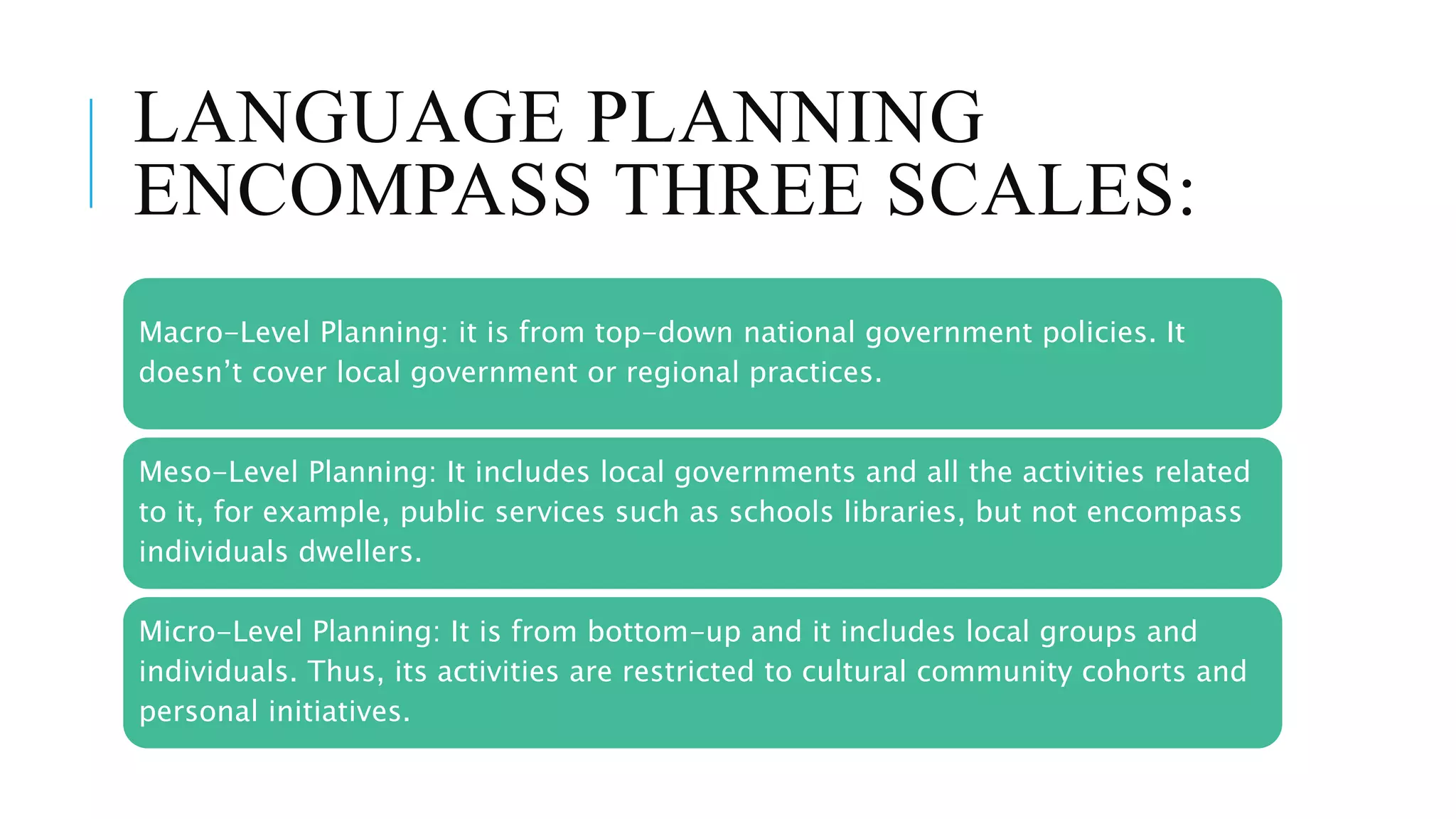
ENCOMPASS THREE SCALES:
Macro-Level Planning: it is from top-down national government policies. It
doesn’t cover local government or regional practices.
Meso-Level Planning: It includes local governments and all the activities related
to it, for example, public services such as schools libraries, but not encompass
individuals dwellers.
Micro-Level Planning: It is from bottom-up and it includes local groups and
individuals. Thus, its activities are restricted to cultural community cohorts and
personal initiatives.
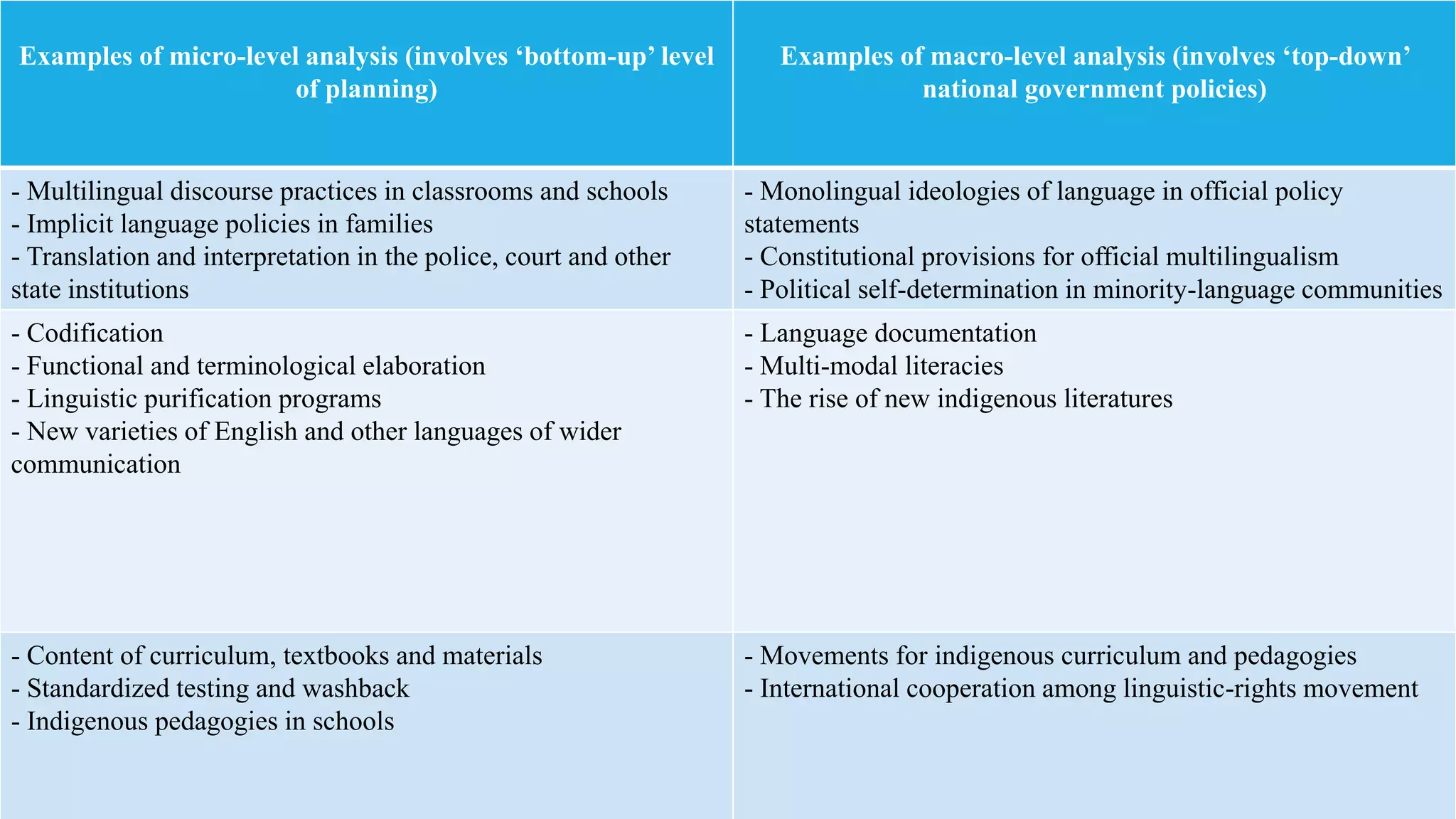
Examples of micro-level analysis (involves ‘bottom-up’ level
of planning)
Examples of macro-level analysis (involves ‘top-down’
national government policies)
- Multilingual discourse practices in classrooms and schools
- Implicit language policies in families
- Translation and interpretation in the police, court and other
state institutions
- Monolingual ideologies of language in official policy
statements
- Constitutional provisions for official multilingualism
- Political self-determination in minority-language communities
- Codification
- Functional and terminological elaboration
- Linguistic purification programs
- New varieties of English and other languages of wider
communication
- Language documentation
- Multi-modal literacies
- The rise of new indigenous literatures
- Content of curriculum, textbooks and materials
- Standardized testing and washback
- Indigenous pedagogies in schools
- Movements for indigenous curriculum and pedagogies
- International cooperation among linguistic-rights movement
FOUR CATEGORIES ARE HIGHLIGHTED AS
A RESULT OF ENGLISH CONTINUING TO
REPLACE OTHER LANGUAGES IN VARIOUS
PARTS OF THE WORLD:
Category A includes a country most people speak English as the
mother tongue.
Category B includes a country where a minority speaks English as
the mother tongue.
Category C includes a country where none of the people have
English as a mother tongue.
Category D includes bilingual countries that have two official
languages.
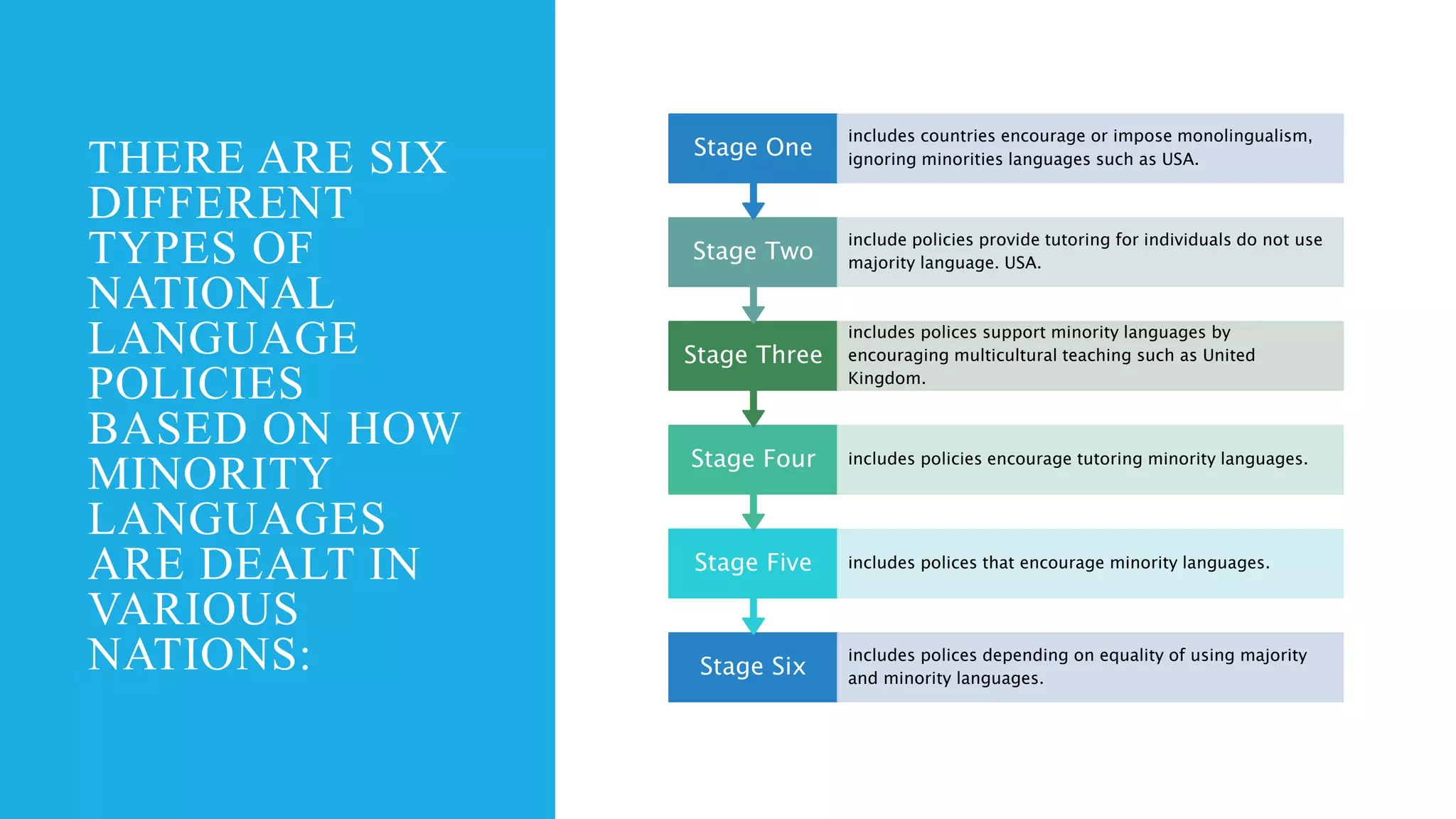
THERE ARE SIX
DIFFERENT
TYPES OF
NATIONAL
LANGUAGE
POLICIES
BASED ON HOW
MINORITY
LANGUAGES
ARE DEALT IN
VARIOUS
NATIONS: Stage Six
includes polices depending on equality of using majority
and minority languages.
Stage Five includes polices that encourage minority languages.
Stage Four includes policies encourage tutoring minority languages.
Stage Three
includes polices support minority languages by
encouraging multicultural teaching such as United
Kingdom.
Stage Two
include policies provide tutoring for individuals do not use
majority language. USA.
Stage One
includes countries encourage or impose monolingualism,
ignoring minorities languages such as USA.
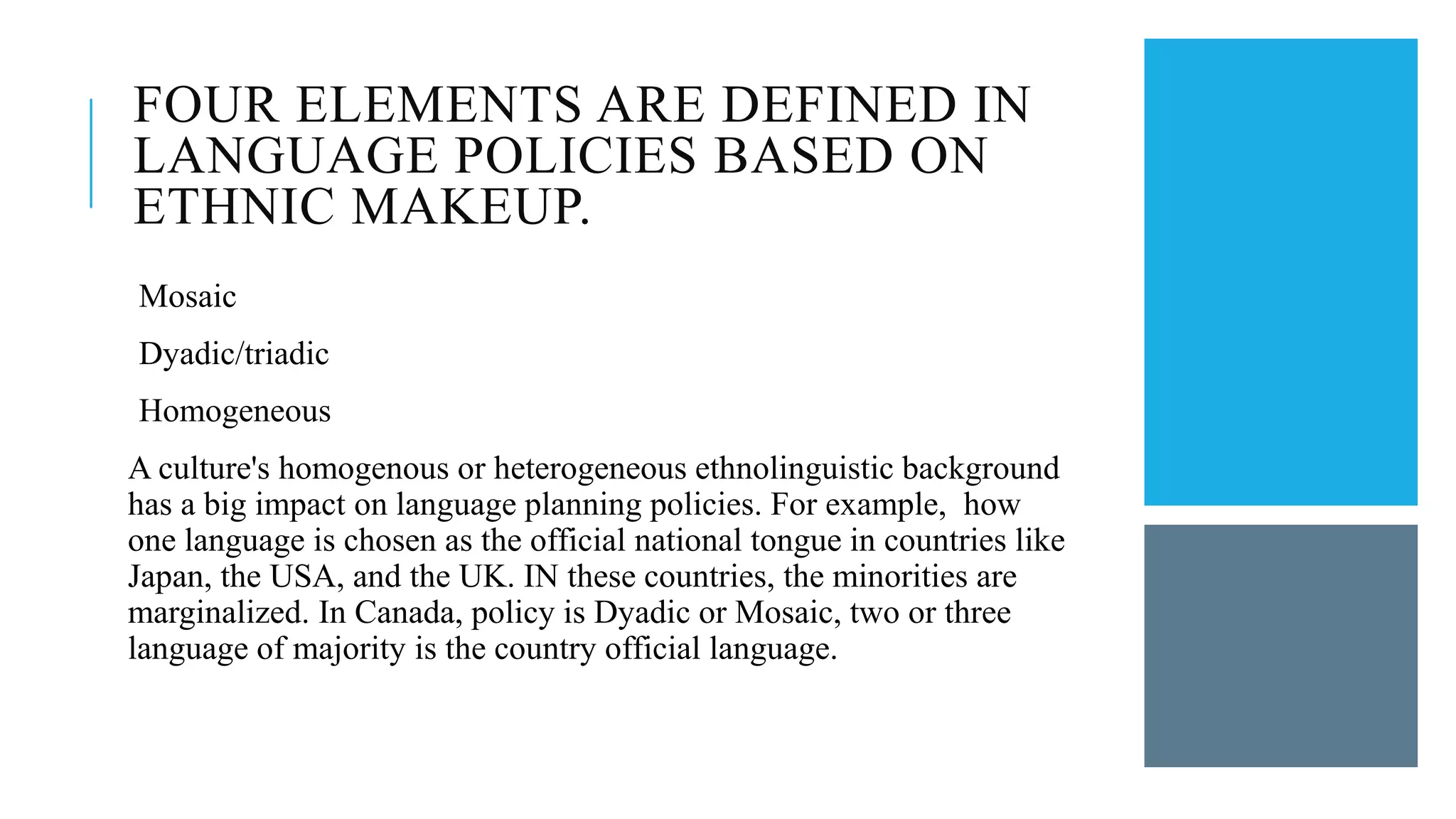
FOUR ELEMENTS ARE DEFINED IN
LANGUAGE POLICIES BASED ON
ETHNIC MAKEUP.
Mosaic
Dyadic/triadic
Homogeneous
A culture's homogenous or heterogeneous ethnolinguistic background
has a big impact on language planning policies. For example, how
one language is chosen as the official national tongue in countries like
Japan, the USA, and the UK. IN these countries, the minorities are
marginalized. In Canada, policy is Dyadic or Mosaic, two or three
language of majority is the country official language.
THE PLANNING POLICY OF
BILINGUALISM IN IRAQ
Iraq as a multicultural and multilingual country has different
languages as Arabic, which is the dominant language, and it also
has some other minority languages, such as Kurdish, Turkish,
Syriac, Assyrian.
BEFORE 2003
Iraq as a multicultural and multilingual country has different
languages as Arabic, which is the dominant language, and it also has
some other minority languages, such as Kurdish, Turkish,
Syriac....etc. Over the last 80 years, Iraq which was involved in some
political struggles, had faced many internal problems regarding the
Arabic domination that occurred, and this was owing to the absence
of clear language policy used.
AFTER 2003
After the invasion by the Americans and the coalition forces of Iraq in
2003, a new era had begun, in which many international companies, NGOs.
(Non-Governmental Organizations), and the emergence of oil and gas
investors were established in the country to urge the government of Iraq to
think seriously about many matters that had curbed the development of the
new era. Thus, due to the lack of clear policy, there were some internal and
external needs to use the multilingual system such as adding English and
Kurdish languages in the economic, commercial, education system,
universities, communication, to name a few. In relation to these needs and
others from the Iraqi society to look after the minority languages in the new
Iraqi educational system, the government had no other choice but to
respond to the demands of the various parties.
IMPROVEMENTS ARE NEEDED TO
DEVELOP THE LANGUAGE POLICY
IN IRAQ
In the case where the Arabic and Kurdish are the only two official languages named in
the Iraqi constitution, their status is raised, while the statuses of other minority languages
in the country are becoming marginalized. Therefore, language shift from minority
languages to the dominant languages is more likely to take place as minority groups have
the tendency to adopt the language with higher status.
A number of minority languages like Aramaic, and Turkmen had been excluded from
government institutions, workplace speech and documents, while Arabic and Kurdish
have their place in these domains. Additionally, the likelihood of the shift from minority
languages to the dominant ones and the endangerment of minority languages is
undeniably high.

Language Planning and Policy (LPP).pptx

  • 1.
    LANGUAGE PLANNING & POLICY HiyamRaad Adwan (GS65920) Nur Suhana bt Zabri ( GS 64659 ) Mabroka Salem ( GS 65072) 1/8/2023 SAMPLE FOOTER TEXT 1
  • 2.
    WHAT IS LANGUAGE POLICY? McCarty(2011) defines language policy as "a complex sociocultural process [and as] modes of human interaction, negotiation, and production mediated by relations of power Simply said An act that government does either officially through legislation, court decisions or policy to determine how languages are used, cultivate language skills needed to meet national priorities, establish the rights of individuals or groups to use and maintain languages. 1/8/2023 SAMPLE FOOTER TEXT 2
  • 3.
    DIFFERENCES LANGUAGE PLANNING& POLICY Language planning is a macro sociological activity at a governmental and national level only language policy can be "either a macro- or micro sociological activity at a governmental and national level or at an institutional level” (cited in Poon, 2004) 1/8/2023 SAMPLE FOOTER TEXT 3
  • 4.
    IMPLEMENTATION 1/8/2023 SAMPLE FOOTERTEXT 4 Varies from one state to another "language planning-policy means the institutionalization of language as a basis for distinctions among social groups, ( Tollefson) Many countries have a language policy designed to favour or discourage the use of a particular language - promote one official language, to protect and promote regional and ethnic languages whose viability is threatened
  • 5.
  • 6.
    LANGUAGE BELIEFS ( IDEOLOGY) Thelanguage beliefs of parents influence the language spoken at home. Kim (2011) recounts a Korean parent living in the United States who insists on English being the only language used at home in order to facilitate their daughter's acculturation into mainstream culture in an empirical study. In a case study on Chinese immigrant living in the United Kingdom, a Chinese family changed the language they speak at home from Korean (as one of the minority languages in Mainland China) into Mandarin due to the fact that Mandarin has higher status than Korean in the United Kingdom (Hua & Wei, 2016).
  • 7.
    LANGUAGE PRACTICES (ECOLOGY) represent thereal language used inside the families in home settings. In the interviews she did for her study on Chinese immigrants in New Zealand, Chan (2018) finds that Chinese parents frequently use Chinese with their children, whereas siblings prefer to interact in English. Despite the fact that these parents are worried, alternative solutions are not obvious. According to Chan (2018), most Chinese families are flexible with their children's language choices when they are unable to find the Chinese terms. Because of the parents' flexible approach, the actual language habits in their homes are more diverse.
  • 8.
    LANGUAGE MANAGEMENT (PLANNING) arises when thereare unexpected or undesirable language practises in the family, or when family members' actions are required. Schwartz (2010) provides an example of a Canadian family's efforts to raise their children in a French-dominant home by spending their school years in English-speaking Louisiana and their summer vacations in French-speaking Québec. French is preferred at all times at home, regardless of where they reside, and children in Louisiana were enrolled in French immersion programmes. In this scenario, the parents are attempting to control their home language settings despite the language they experienced in social settings. Irrespective of the dominant language environment, they were determined to regulate and intervene in language practices in the family.
  • 9.
    STAGES OF LANGUAGE POLICY 1. Selection( Decision Procedures) The choice of a language variety to fulfil certain functions in a given society
  • 10.
    STAGES OF LANGUAGE POLICY 2.Codification ( Standardization Procedures) Creation of a linguistic standard or norm for a selected linguistic code. Divided into 3 stages: 1/8/2023 SAMPLE FOOTER TEXT 10 Graphisation- developing a writing system Grammatication- deciding on rules/norms of grammar Lexicalisation- identifying the vocabulary
  • 11.
    STAGES OF LANGUAGE POLICY 3.Implementation ( Educational Spread) Promoting of the decisions made in the stages of selection and codification which can include marketing strategy, production of book, pamphlets, newspapers and textbooks using the new codifies standard. Implementation can be : 1. vigorous legal enforcement. Eg : Native Americans in Bureau of Indian Education Boarding Schools 2. Encouragement. Eg : Spanish province of Catalonia, where the use of Catalan is encouraged, but not enforced 1/8/2023 SAMPLE FOOTER TEXT 11
  • 12.
    STAGES OF LANGUAGEPOLICY 4. Elaboration/ Modernization ( Functional Development) Refers to the terminology and stylistic development of a codified language to meet the communicative demands of modern life and technology. Its main area is the production and dissemination of new terms. Lexical Modernization Strategies: 1. Borrowing – Portable Document File (PDF), Samurai 2. Extension of meaning of a word- Influence = Influencer, Blog = Blogger 3. Creation of new terms ( neologisms)-Hangry, chillax, brunch
  • 13.
    IMPORTANCE OF LANGUAGE POLICY Languagepolicy have a major impact on language vitability and, ultimately, on the rights of the individual. Language policy influence the right to use and maintain languages, affect language status, and determine which languages are nurtured. 1/8/2023 SAMPLE FOOTER TEXT 13
  • 14.
  • 15.
    WHAT IS LANGUAGE PLANNING? languageplanning is a deliberate effort to influence the function, structure, or acquisition of a language or language variety within a speech community. it is often associated with government planning but is also used by a variety of non-governmental organizations and individuals. economic benefits and political domination can be among its goals (kaplan & baldauf,1997: 3).
  • 16.
    LANGUAGE POLICY A languagepolicy is a body of ideas, laws, regulations, rules and practices intended to achieve the planned language change in the society, group or system. Only when such policy exists can any sort of serious evaluation of planning occur (Rubin, 1971);i.e., in the absence of a policy there cannot be a plan to be adjusted. For example, which language will be national? Which language will be used as a regional language, and what will their status be?
  • 17.
    DIVISION OF LANGUAGE PLANNING THEPRACTICE OF LANGUAGE PLANNING MAY BE ONE OF THESE TYPES: 1.CORPUS PLANNING 2.STATUS PLANNING 4.ACQUISITION PLANNING 5.USAGE PLANNING 6.PRESTIGE PLANNING
  • 18.
    The activities oflanguage planning: 1.Corpus planning Corpus planning, which deals with what is internal to a language, is as widespread as status planning but is often in the hands of professional linguists in collaboration with 'ordinary' speakers. Corpus planning refers to norm selection and codification (characteristics or criteria of a ‘good’ language are established). It is usually undertaken by language experts, resulting in dictionaries, grammar, literacy manuals, and pronunciation and writing style guides.
  • 20.
    2.Status Planning Status planningis concerned with official decisions about the appropriate use of a language. The results of status planning are laws, clauses in constitutions prescribing the official standing of languages, and regulations for their use in public administration.
  • 21.
    1.THE STATUS OFTAMAZIGHT IN LIBYA BEFORE THE 17TH OF FEB. REVOLUTION: The former Libyan leader, Gadhafi, never fully recognized the Amazigh and their language. For him, Amazigh and their language are also regarded as threatening Arab Muslim identity. He denies the existence of Amazigh in the whole of North Africa. 2. The status of Tamazight After the 17th of Feb. Revolution: After the 17th of February revolution, the Tamazight language, which has been marginalized in Libya for centuries by Libyan politicians, gained significant status with the Arabic language in Libyan media (Hamed, 2014).
  • 22.
    3.Acquisition planning Acquisition planning(language-in-education) typically describes the language teaching policies of states. Foreign or second language instruction can be motivated by humanistic rationales, economic interest calculations, assessments about national security or geo-political interest, or responses to the needs, opportunities, and rights of linguistic minorities.
  • 23.
    During the 1970sand until the mid-1980s learning english was an obligatory component within the libyan national curriculum, but in 1986 teaching and learning english were completely banned. this was due to the cultural, political and economical factors which have deeply influenced the educational system at that time. after a while the libyan educationalists realized the fault and determined to incorporate english in the curriculum again. they decided that not only english must be taught, but other languages must also be learned even at the very early stages of the learning process (sawani, 2009).
  • 24.
    4.Usage planning Usage planningrefers to efforts to extend the communicative domains of a given language. This usually occurs in opposition to a replacing language after political reconstitution (administrative devolution, federalism, or national independence) but in more extreme cases usage planning forms part of regeneration efforts on behalf of dying languages.
  • 25.
    For example, inlibya, colloquial libyan arabic is the first language acquired by most libyans at home and in other informal domains such as the street, and it is the language of everyday conversation. it is not a codified language though it is used, as a written language, by many libyans in electronic media and social communication networks such as facebook and whatsapp. (adam& yunus, 2021)
  • 26.
    5.Prestige planning Prestige planninginvolves elevating the esteem of a linguistic code. Esteem is conferred on a language in proportion to the quality and extent of its important works of literature. Many of today's major languages have benefited from prestige planning by poets, philosophers, and religious figures.
  • 27.
    HIGH VARIETY AND LOW VARIETY: Arabicis a national and official language, and that support is offered in educational institutions, governmental and public offices, and media. Arabic is one of the major languages with two writing systems: the formal "al-lugah al-Fusha" (H- variety) and the informal "al-lugah al-aammiyya" (slang) (L-type). Written Arabic has the highest (H), and regional dialects or vernaculars have the lowest (L).
  • 28.
    6.Discourse planning Discourse planninghas a range of meanings. The most straightforward refers to education to develop persuasive or assertive ways of expression, such as to help young people participate in society and accomplish personal goals through effective communication. Participation in public life relies on language abilities to express an opinion, progress economically, prevent exploitation or abuse, explore identity, and make connections..
  • 29.
    Through his speechduring the revolution in libya, al ghaddafi wanted to gain the people’s gratitude for all his good deeds, which would eventually lead to his support. important messages were sent to libyans whether they are revolutionaries or supporters which encourage those who still believe in him to act quickly against the revolutionaries(alwash et al., 2022).
  • 30.
    ROLES OF LANGUAGEPOLICY AND PLANNING IN A COUNTRY: Many countries have a language policy designed to favor or discourage the use of a language(s). although many nations historically have used language policies to promote one official language at the expense of others, many countries have policies to promote regional and ethnic languages that are in danger.
  • 31.
    Although nations historicallyhave used language policies most often to promote one official language at the expense of others, just as happened in the era of the italian empire. libya has been heavily influenced and shaped by ottoman and italian languages due to the extended periods of colonization. the italian language is well understood, especially by older generations, because libya was subject to italian colonialism between 1911- 1943, and of course, there are linguistic remains from that period.
  • 32.
    LANGUAGE PLANNING AND POLICY(LPP) Language and Society
  • 33.
    LANGUAGE PLANNING AND POLICY(LPP) In LPP notion, analytical focus is fourfold: •Relationship among languages. •Relationships among social contexts of Language. •Relationship among individual speakers and their languages. •Interrelationships among these three dimensions. •Although some have fault it for overly associating language phenomena with natural processes.
  • 34.
    LANGUAGE PLANNING In sociolinguistics, languageplanning (also known as language engineering) is a deliberate effort to influence the function, structure or acquisition of languages or language varieties within a speech community. Robert L. Cooper (1989) defines language planning as "the activity of preparing a normative orthography, grammar, and dictionary for the guidance of writers and speakers in a non- homogeneous speech community" .Along with language ideology and language practices, language planning is part of language policy – a typology drawn from Bernard Spolsky's theory of language policy.
  • 35.
    LANGUAGE MANAGEME NT According to Spolsky,language management is a more precise term than language planning. Language management is defined as "the explicit and observable effort by someone or some group that has or claims authority over the participants in the domain to modify their practices or beliefs“. Language planning is often associated with government planning, but is also used by a variety of non-governmental organizations such as grass-roots organizations as well as individuals. Goals of such planning vary. Better communication through assimilation of a single dominant language can bring economic benefits to minorities but is also perceived to facilitate their political domination. It involves the establishment of language regulators, such as formal or informal agencies, committees, societies or academies to design or develop new structures to meet contemporary needs.
  • 36.
    LANGUAGE PLANNING AS A TERM Theterm language planning refers to measures taken by official agencies to influence the use of one or more languages in a particular speech community. American linguist Joshua Fishman has defined language planning as "the authoritative allocation of resources to the attainment of language status and corpus goals, whether in connection with new functions that are aspired to or in connection with old functions that need to be discharged more adequately" (1987). Four major types of language planning are status planning (about the social standing of a language), corpus planning (the structure of a language), language-in-education planning (learning), and prestige planning (image). Language planning may occur at the macro-level (the state) or the micro-level (the community).
  • 37.
    LANGUAGE PLANNING HAS THREE MAIN SORTS While eachform has its particular aim, all three sorts of planning are extremely tightly interwoven with one another: Corpus planning associated with language form. Status Planning associated with language function. Acquisition planning associated with language learning.
  • 38.
    Ecological language planningshould be vital because, it ensures and develop linguistic contexts by encouraging linguistic diversity. In terms of educational LPP, policy and practice are mutually dependent. As a result, monolingualism and literacy are typically preferred by those in positions of power over oracy and bilingualism, and national educational systems frequently place a lot of emphasis on the development of the dominant language.
  • 39.
    LANGUAGE POLICY Language policy hasbeen defined in a number of ways. According to Kaplan and Baldauf (1997), "A language policy is a body of ideas, laws, regulations, rules and practices intended to achieve the planned language change in the societies, group or system" . Lo Bianco defines the field as “a situated activity, whose specific history and local circumstances influence what is regarded as a language problem, and whose political dynamics determine which language problems are given policy treatment” . McCarty (2011) defines language policy as "a complex sociocultural process [and as] modes of human interaction, negotiation, and production mediated by relations of power. The ‘policy’ in these processes resides in their language- regulating power; that is, the ways in which they express normative claims about legitimate and illegitimate language forms and uses, thereby governing language statuses and uses" .
  • 40.
    LANGUAGE PLANNING ANDLANGUAGE POLICY ARE TWO SEPARATE CONCEPTS THAT ARE REFERRED TO BY THE ACRONYM "LPP.“ Language Planning: is a practice meant to impact on language use within a particular speech group. Its is employed by government in large scale , they decide the formal language; and agencies in small scale, such as: educational institutes and local groups and even individuals. Language Policy: includes principles and beliefs, norms and restrictions, within language practices and management decisions of community or policy, for example, the required hours of teaching a language in schools, methodology of teaching and designing curricula. In this situation policy language planning combine policy.
  • 41.
    LANGUAGE PLANNING ENCOMPASS THREESCALES: Macro-Level Planning: it is from top-down national government policies. It doesn’t cover local government or regional practices. Meso-Level Planning: It includes local governments and all the activities related to it, for example, public services such as schools libraries, but not encompass individuals dwellers. Micro-Level Planning: It is from bottom-up and it includes local groups and individuals. Thus, its activities are restricted to cultural community cohorts and personal initiatives.
  • 42.
    Examples of micro-levelanalysis (involves ‘bottom-up’ level of planning) Examples of macro-level analysis (involves ‘top-down’ national government policies) - Multilingual discourse practices in classrooms and schools - Implicit language policies in families - Translation and interpretation in the police, court and other state institutions - Monolingual ideologies of language in official policy statements - Constitutional provisions for official multilingualism - Political self-determination in minority-language communities - Codification - Functional and terminological elaboration - Linguistic purification programs - New varieties of English and other languages of wider communication - Language documentation - Multi-modal literacies - The rise of new indigenous literatures - Content of curriculum, textbooks and materials - Standardized testing and washback - Indigenous pedagogies in schools - Movements for indigenous curriculum and pedagogies - International cooperation among linguistic-rights movement
  • 43.
    FOUR CATEGORIES AREHIGHLIGHTED AS A RESULT OF ENGLISH CONTINUING TO REPLACE OTHER LANGUAGES IN VARIOUS PARTS OF THE WORLD: Category A includes a country most people speak English as the mother tongue. Category B includes a country where a minority speaks English as the mother tongue. Category C includes a country where none of the people have English as a mother tongue. Category D includes bilingual countries that have two official languages.
  • 44.
    THERE ARE SIX DIFFERENT TYPESOF NATIONAL LANGUAGE POLICIES BASED ON HOW MINORITY LANGUAGES ARE DEALT IN VARIOUS NATIONS: Stage Six includes polices depending on equality of using majority and minority languages. Stage Five includes polices that encourage minority languages. Stage Four includes policies encourage tutoring minority languages. Stage Three includes polices support minority languages by encouraging multicultural teaching such as United Kingdom. Stage Two include policies provide tutoring for individuals do not use majority language. USA. Stage One includes countries encourage or impose monolingualism, ignoring minorities languages such as USA.
  • 45.
    FOUR ELEMENTS AREDEFINED IN LANGUAGE POLICIES BASED ON ETHNIC MAKEUP. Mosaic Dyadic/triadic Homogeneous A culture's homogenous or heterogeneous ethnolinguistic background has a big impact on language planning policies. For example, how one language is chosen as the official national tongue in countries like Japan, the USA, and the UK. IN these countries, the minorities are marginalized. In Canada, policy is Dyadic or Mosaic, two or three language of majority is the country official language.
  • 46.
    THE PLANNING POLICYOF BILINGUALISM IN IRAQ Iraq as a multicultural and multilingual country has different languages as Arabic, which is the dominant language, and it also has some other minority languages, such as Kurdish, Turkish, Syriac, Assyrian.
  • 47.
    BEFORE 2003 Iraq asa multicultural and multilingual country has different languages as Arabic, which is the dominant language, and it also has some other minority languages, such as Kurdish, Turkish, Syriac....etc. Over the last 80 years, Iraq which was involved in some political struggles, had faced many internal problems regarding the Arabic domination that occurred, and this was owing to the absence of clear language policy used.
  • 48.
    AFTER 2003 After theinvasion by the Americans and the coalition forces of Iraq in 2003, a new era had begun, in which many international companies, NGOs. (Non-Governmental Organizations), and the emergence of oil and gas investors were established in the country to urge the government of Iraq to think seriously about many matters that had curbed the development of the new era. Thus, due to the lack of clear policy, there were some internal and external needs to use the multilingual system such as adding English and Kurdish languages in the economic, commercial, education system, universities, communication, to name a few. In relation to these needs and others from the Iraqi society to look after the minority languages in the new Iraqi educational system, the government had no other choice but to respond to the demands of the various parties.
  • 49.
    IMPROVEMENTS ARE NEEDEDTO DEVELOP THE LANGUAGE POLICY IN IRAQ In the case where the Arabic and Kurdish are the only two official languages named in the Iraqi constitution, their status is raised, while the statuses of other minority languages in the country are becoming marginalized. Therefore, language shift from minority languages to the dominant languages is more likely to take place as minority groups have the tendency to adopt the language with higher status. A number of minority languages like Aramaic, and Turkmen had been excluded from government institutions, workplace speech and documents, while Arabic and Kurdish have their place in these domains. Additionally, the likelihood of the shift from minority languages to the dominant ones and the endangerment of minority languages is undeniably high.