Turkish
Language
Turkish is a language, spoken by nearly 220 million people in the world.
Speakers are located predominantly in Turkey, with smaller groups in
Azerbaijan, Turkmenistan, Tajikistan, Kazakhstan, Uzbekistan,
Kyrgyzstan, Uigur, Germany, Bulgaria, Macedonia, Northern Cyprus,
Greece, the Caucasus, other parts of Europe and Central Asia.
Turkish is also spoken by large emigrant
communities and by the Turkish population
remaining in Eastern European countries after
the extinction of the Ottoman Empire, including
Bulgaria, Romania and Serbia. Some of its
major linguistic particularities are vowel
harmony and extensive suffixes.
Official
Language
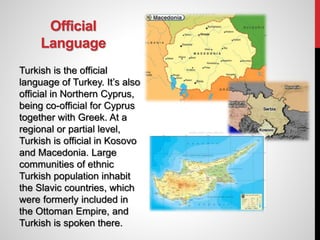
Turkish is the official
language of Turkey. It’s also
official in Northern Cyprus,
being co-official for Cyprus
together with Greek. At a
regional or partial level,
Turkish is official in Kosovo
and Macedonia. Large
communities of ethnic
Turkish population inhabit
the Slavic countries, which
were formerly included in
the Ottoman Empire, and
Turkish is spoken there.
Varieties
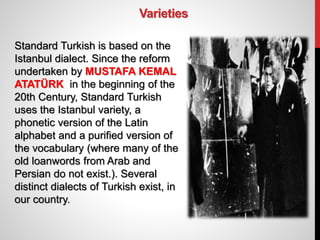
Standard Turkish is based on the
Istanbul dialect. Since the reform
undertaken by MUSTAFA KEMAL
ATATÜRK in the beginning of the
20th Century, Standard Turkish
uses the Istanbul variety, a
phonetic version of the Latin
alphabet and a purified version of
the vocabulary (where many of the
old loanwords from Arab and
Persian do not exist.). Several
distinct dialects of Turkish exist, in
our country.
Brief History
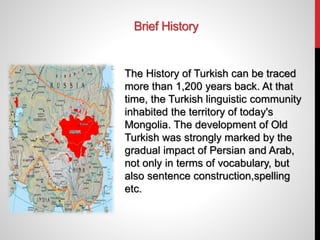
The History of Turkish can be traced
more than 1,200 years back. At that
time, the Turkish linguistic community
inhabited the territory of today's
Mongolia. The development of Old
Turkish was strongly marked by the
gradual impact of Persian and Arab,
not only in terms of vocabulary, but
also sentence construction,spelling
etc.
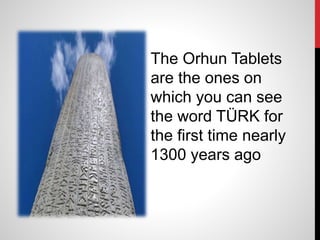
The Orhun Tablets
are the ones on
which you can see
the word TÜRK for
the first time nearly
1300 years ago
The expansion of Turks and the Turkish Language
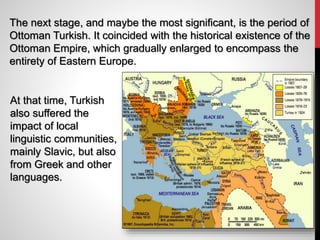
The next stage, and maybe the most significant, is the period of
Ottoman Turkish. It coincided with the historical existence of the
Ottoman Empire, which gradually enlarged to encompass the
entirety of Eastern Europe.
At that time, Turkish
also suffered the
impact of local
linguistic communities,
mainly Slavic, but also
from Greek and other
languages.
In the beginning of the 20th Century, the greatest Turkish
leader, MUSTAFA KEMAL ATATURK, undertook critical
reforms of the state of Turkey, aiming to establish both a
strong and independent national identity and a less religious-
dominated perception of the world. He adopted many of the
achievements of Western Civilization. As for the language, the
reform eliminated the old Arabic-based alphabet for the sake
of a new phonetic version of the Latin alphabet.
It also aimed to re-
establish Turkish
equivalents for old
loanwords from Arab and
Persian. Since then, the
official version of
Standard Turkish is
based on the dialect of
Istanbul.
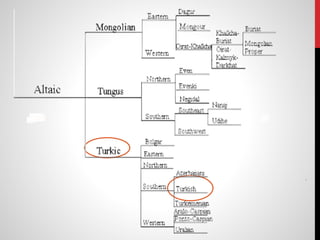
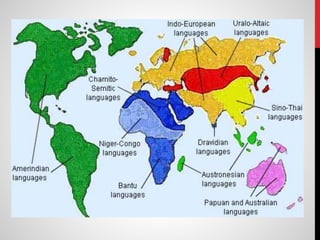
A very ancient language, Turkish belongs to the Altaic group of
the Ural-Altaic family of languages. The first known written
records date back nearly 1,300 years.
With a few exceptions, the main features which distinguish the
Altaic languages from Indo-European are as follows:
Vowel harmony is a feature of all Ural-Altaic tongues.
No gender.
Suffixes.
Adjectives precede nouns.
Verbs come at the end of the sentence.
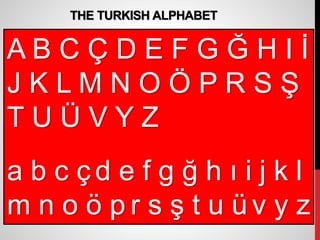
THE TURKISH ALPHABET
A B C Ç D E F G Ğ H I İ
J K L M N O Ö P R S Ş
T U Ü V Y Z
a b c ç d e f g ğ h ı i j k l
m n o ö p r s ş t u ü v y z
Turkish is a phonetic language. This
basically means that it is spoken the way it
is written, and vica versa. To accomplish
that, in 1928 MUSTAFA KEMAL ATATÜRK
introduced a phonetic variant of the Latin
alphabet. The letters Q, W and X were
removed and 7 new, rather exotic looking
characters were introduced: ç, ğ, ş, ö, ü and
ı (undotted i). As a result, the Turkish
alphabet consists of 29 letters — eight
vowels and twenty-one consonants.
Some Examples of Turkish words
These are our names and their meanings:
Please repeat after me;
Deniz (Sea), Bilgehan (Wiseman), Göktuğ (Sky
Blue feather), Cansu (water that gives life), Barış
(Peace)
And our teachers;
İpek (Silk), Alev (Flame), Savaş (War)
Loanwords Of
Italian Origin
Makine
Baston
Bilanço
Kanto
Kasko
Kundura
Lokanta
Makarna
Olta
Peçete
Pusula
Üniforma
İnternet
Çizburger
Hamburger
Fast food
Muffin
Futbol
Platform
Kovboy
Amigo
Cunta
Kanarya
Mandalina
Patates
Puro
Loanwords Of
English Origin
Loanwords Of
Spanish Origin
These are some of the Turkish words that you can
see ın most of the places in the world

Turkish language

  • 1.
  • 2.
    Turkish is alanguage, spoken by nearly 220 million people in the world. Speakers are located predominantly in Turkey, with smaller groups in Azerbaijan, Turkmenistan, Tajikistan, Kazakhstan, Uzbekistan, Kyrgyzstan, Uigur, Germany, Bulgaria, Macedonia, Northern Cyprus, Greece, the Caucasus, other parts of Europe and Central Asia.
  • 3.
    Turkish is alsospoken by large emigrant communities and by the Turkish population remaining in Eastern European countries after the extinction of the Ottoman Empire, including Bulgaria, Romania and Serbia. Some of its major linguistic particularities are vowel harmony and extensive suffixes.
  • 4.
    Official Language Turkish is theofficial language of Turkey. It’s also official in Northern Cyprus, being co-official for Cyprus together with Greek. At a regional or partial level, Turkish is official in Kosovo and Macedonia. Large communities of ethnic Turkish population inhabit the Slavic countries, which were formerly included in the Ottoman Empire, and Turkish is spoken there.
  • 5.
    Varieties Standard Turkish isbased on the Istanbul dialect. Since the reform undertaken by MUSTAFA KEMAL ATATÜRK in the beginning of the 20th Century, Standard Turkish uses the Istanbul variety, a phonetic version of the Latin alphabet and a purified version of the vocabulary (where many of the old loanwords from Arab and Persian do not exist.). Several distinct dialects of Turkish exist, in our country.
  • 6.
    Brief History The Historyof Turkish can be traced more than 1,200 years back. At that time, the Turkish linguistic community inhabited the territory of today's Mongolia. The development of Old Turkish was strongly marked by the gradual impact of Persian and Arab, not only in terms of vocabulary, but also sentence construction,spelling etc.
  • 7.
    The Orhun Tablets arethe ones on which you can see the word TÜRK for the first time nearly 1300 years ago
  • 8.
    The expansion ofTurks and the Turkish Language
  • 9.
    The next stage,and maybe the most significant, is the period of Ottoman Turkish. It coincided with the historical existence of the Ottoman Empire, which gradually enlarged to encompass the entirety of Eastern Europe. At that time, Turkish also suffered the impact of local linguistic communities, mainly Slavic, but also from Greek and other languages.
  • 10.
    In the beginningof the 20th Century, the greatest Turkish leader, MUSTAFA KEMAL ATATURK, undertook critical reforms of the state of Turkey, aiming to establish both a strong and independent national identity and a less religious- dominated perception of the world. He adopted many of the achievements of Western Civilization. As for the language, the reform eliminated the old Arabic-based alphabet for the sake of a new phonetic version of the Latin alphabet. It also aimed to re- establish Turkish equivalents for old loanwords from Arab and Persian. Since then, the official version of Standard Turkish is based on the dialect of Istanbul.
  • 11.
    A very ancientlanguage, Turkish belongs to the Altaic group of the Ural-Altaic family of languages. The first known written records date back nearly 1,300 years. With a few exceptions, the main features which distinguish the Altaic languages from Indo-European are as follows: Vowel harmony is a feature of all Ural-Altaic tongues. No gender. Suffixes. Adjectives precede nouns. Verbs come at the end of the sentence.
  • 15.
    THE TURKISH ALPHABET AB C Ç D E F G Ğ H I İ J K L M N O Ö P R S Ş T U Ü V Y Z a b c ç d e f g ğ h ı i j k l m n o ö p r s ş t u ü v y z
  • 16.
    Turkish is aphonetic language. This basically means that it is spoken the way it is written, and vica versa. To accomplish that, in 1928 MUSTAFA KEMAL ATATÜRK introduced a phonetic variant of the Latin alphabet. The letters Q, W and X were removed and 7 new, rather exotic looking characters were introduced: ç, ğ, ş, ö, ü and ı (undotted i). As a result, the Turkish alphabet consists of 29 letters — eight vowels and twenty-one consonants.
  • 17.
    Some Examples ofTurkish words These are our names and their meanings: Please repeat after me; Deniz (Sea), Bilgehan (Wiseman), Göktuğ (Sky Blue feather), Cansu (water that gives life), Barış (Peace) And our teachers; İpek (Silk), Alev (Flame), Savaş (War)
  • 18.
    Loanwords Of Italian Origin Makine Baston Bilanço Kanto Kasko Kundura Lokanta Makarna Olta Peçete Pusula Üniforma İnternet Çizburger Hamburger Fastfood Muffin Futbol Platform Kovboy Amigo Cunta Kanarya Mandalina Patates Puro Loanwords Of English Origin Loanwords Of Spanish Origin
  • 19.
    These are someof the Turkish words that you can see ın most of the places in the world