
Language planning and language shift
Lanuage
Language is an asset and
primary instrument of
human communication. It
gives a sense of identity to
an individual as well as a
social group. However,
language can also become
a problem and a barrier to
communication, which
necessitates language
policy and planning.
Language policy
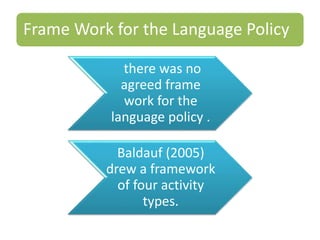
Frame Work for the Language Policy
there was no
agreed frame
work for the
language policy .
Baldauf (2005)
drew a framework
of four activity
types.
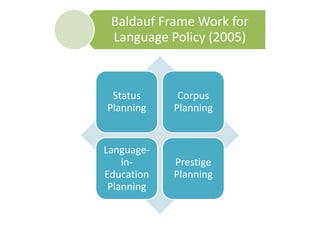
Baldauf Frame Work for
Language Policy (2005)
Status
Planning
Corpus
Planning
Language-
in-
Education
Planning
Prestige
Planning
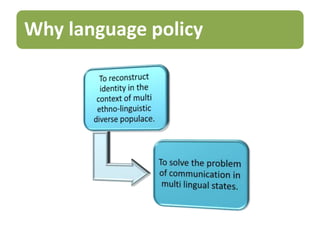
Why language policy
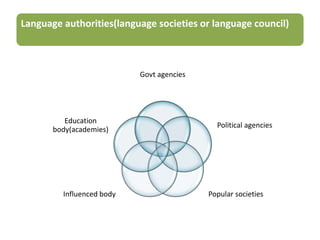
Language authorities(language societies or language council)
Govt agencies
Political agencies
Popular societiesInfluenced body
Education
body(academies)
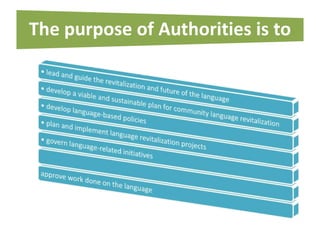
The purpose of Authorities is to
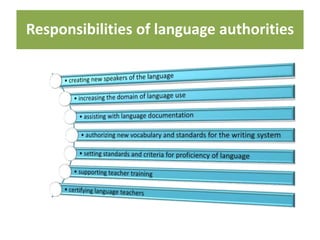
Responsibilities of language authorities
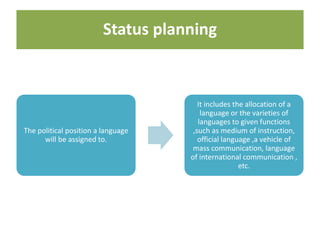
Status planning
The political position a language
will be assigned to.
It includes the allocation of a
language or the varieties of
languages to given functions
,such as medium of instruction,
official language ,a vehicle of
mass communication, language
of international communication ,
etc.
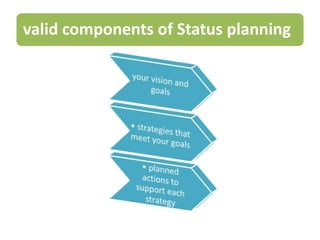
valid components of Status planning
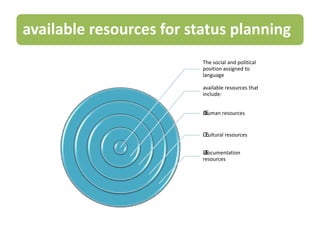
available resources for status planning
The social and political
position assigned to
language
available resources that
include:
Œ.human resources
Œ. cultural resources
Œ.documentation
resources
What is language shift
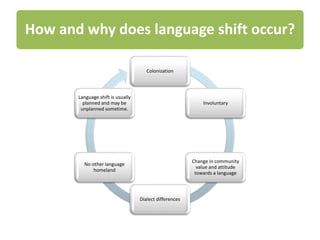
How and why does language shift occur?
Colonization
Involuntary
Change in community
value and attitude
towards a language
Dialect differences
No other language
homeland
Language shift is usually
planned and may be
unplanned sometime.
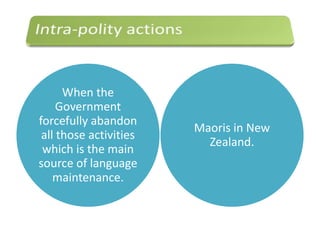
When the
Government
forcefully abandon
all those activities
which is the main
source of language
maintenance.
Maoris in New
Zealand.
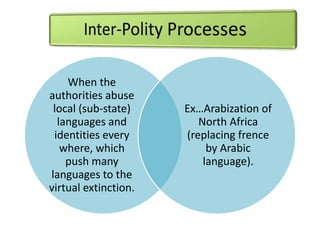
When the
authorities abuse
local (sub-state)
languages and
identities every
where, which
push many
languages to the
virtual extinction.
Ex…Arabization of
North Africa
(replacing frence
by Arabic
language).
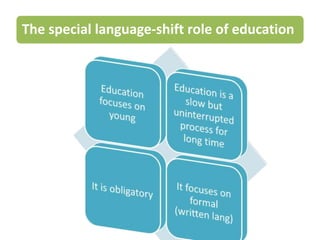
The special language-shift role of education
The Pro-English “Conspiracy”
Planned vs unplanned shift
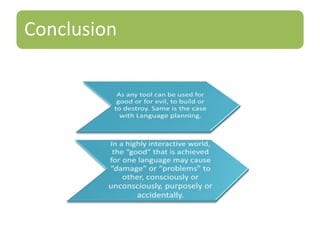
Conclusion

Language planning and language shift